

Article-At-A-Glance
- Bifacial panels produce 20–30% more energy annually than standard monofacial panels by capturing reflected light from both sides — making them the stronger long-term investment for most farm operations.
- Thin-film panels are lighter, more flexible, and perform better in extreme heat, making them the right fit for curved barn roofs, greenhouses, and hot-climate farms where rigid panels simply won’t work.
- The USDA REAP grant can cover up to 50% of your solar installation costs — and both bifacial and thin-film systems qualify, dramatically shortening your payback period.
- Bifacial panels thrive in agrivoltaic setups, where crops grow beneath elevated panels and reflective soil or snow boosts rear-side energy generation — a dual-income land strategy gaining traction fast.
- There’s one specific farm condition where thin-film actually outperforms bifacial on ROI — and most solar salespeople won’t tell you about it. Keep reading to find out.
Choosing the wrong solar panel technology for your farm can cost you tens of thousands of dollars in lost production over a 25-year lifespan — so this comparison matters more than most farmers realize.
Growing Solar Mist helps farmers cut through the noise on exactly these kinds of decisions, offering practical, agriculture-focused solar guidance built around real farm economics — not generic residential advice. The bifacial vs thin-film debate is one of the most common questions in agricultural solar, and the answer genuinely depends on your farm’s layout, roof condition, climate, and energy goals.
Bifacial Beats Thin-Film for Most Farmers — But Not All
Bifacial solar panels are the dominant choice for large-scale agricultural solar installations right now, and for good reason. Their ability to generate electricity from both the front and rear surfaces gives them a fundamental output advantage that compounds significantly over a 25+ year system lifespan. But “most farms” isn’t “every farm,” and thin-film technology has carved out real, legitimate niches where it genuinely wins.
- Bifacial panels work best in open fields, flat ground-mount systems, and agrivoltaic setups with reflective ground surfaces
- Thin-film panels are the better call for curved roofs, aging structures with low load capacity, and greenhouse applications
- Both technologies qualify for federal tax credits and USDA REAP grants
- Bifacial systems typically carry a higher upfront cost but deliver stronger long-term ROI in the right conditions
- Thin-film’s lower temperature coefficient gives it a real edge in consistently hot climates
The sections below break down exactly how each technology works, where each one wins head-to-head, and how to match the right panel type to your specific farm situation.
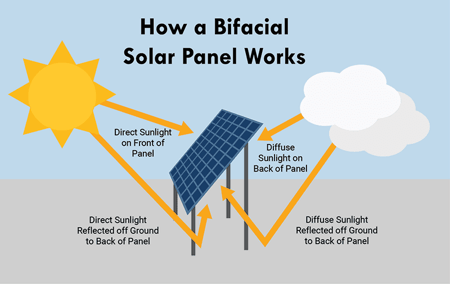
“Bifacial Solar Panels: What Are They …” from www.paradisesolarenergy.com and used with no modifications.
What Are Bifacial Solar Panels?
Bifacial solar panels are photovoltaic modules that generate electricity from both their front and rear surfaces. Unlike standard panels that only use direct sunlight hitting the top face, bifacial panels capture light that bounces off the ground, surrounding surfaces, and even the sky — turning previously wasted reflected energy into usable electricity. For a deeper understanding of the differences and benefits of bifacial solar panels, explore more in our detailed guide.
How Bifacial Panels Capture Light From Both Sides
The rear surface of a bifacial panel is made of transparent backsheet or glass, allowing reflected and diffuse light to reach the solar cells from underneath. When installed with adequate clearance above the ground — typically elevated at least 1 to 2 feet — the rear side receives meaningful irradiance that standard panels completely ignore. This rear-side contribution is called the bifacial gain, and in agricultural settings it regularly adds 10–30% additional energy generation on top of front-side production. To understand how bifacial panels can maximize energy and cut electric bills on farms, exploring their benefits can be insightful.
The physics are straightforward: more light reaching active solar cells means more electrons moving, which means more power output. Bifacial panels don’t require any special inverters or controllers to take advantage of this — the gain is built directly into the panel’s physical design.
Why Reflective Surfaces Matter for Bifacial Output
The amount of bifacial gain your panels produce is directly tied to the albedo — or reflectivity — of the surface beneath them. Farm environments are exceptionally well-suited to maximizing this gain. Snow-covered fields reflect up to 90% of incoming sunlight, light-colored or sandy soil reflects 20–30%, and certain light-colored crop covers or gravel can push that figure even higher. This is precisely why bifacial installations on farms often outperform the same panels installed in suburban or commercial rooftop settings where dark asphalt shingles absorb rather than reflect light.
Typical Efficiency Range for Bifacial Panels
Modern bifacial panels built on monocrystalline PERC or TOPCon cell technology achieve front-side efficiencies of 20–23%. Factor in the rear-side bifacial gain under typical agricultural conditions and effective system output efficiency can reach the equivalent of 24–26% or more. These aren’t theoretical numbers — they reflect real-world performance data from ground-mount agricultural installations with moderate albedo surfaces.
What Are Thin-Film Solar Panels?
Thin-film solar panels are a completely different manufacturing approach from the crystalline silicon panels that dominate the residential and commercial markets. Instead of slicing wafers from a silicon ingot, thin-film panels deposit ultra-thin layers of photovoltaic material — sometimes just a few micrometers thick — directly onto a substrate like glass, metal, or flexible plastic. The result is a panel that is significantly lighter, sometimes flexible, and built with fundamentally different performance characteristics.
How Thin-Film Technology Differs From Crystalline Silicon
Crystalline silicon panels — both monocrystalline and polycrystalline — rely on rigid silicon wafers to generate electricity. Thin-film panels replace that silicon wafer with a deposited semiconductor layer that can be applied to a wide range of surfaces. This manufacturing difference has cascading effects: thin-film panels weigh less per square foot, can be made semi-transparent, conform to curved surfaces, and generally tolerate heat better than their crystalline counterparts. The tradeoff is lower raw efficiency, meaning you need more surface area to produce the same power output.
For farms with ample roof space or specific structural constraints, this tradeoff is often entirely acceptable — and sometimes the right call.
The 3 Main Types of Thin-Film Panels
Not all thin-film panels are the same. The three primary types each use different semiconductor materials and carry distinct performance profiles worth understanding before making a purchasing decision.
- Cadmium Telluride (CdTe): The most commercially widespread thin-film technology, manufactured at scale by First Solar. CdTe panels deliver efficiencies in the 18–22% range in modern utility-scale modules and perform exceptionally well in high-temperature, high-irradiance environments. They carry some environmental considerations around cadmium content but are fully recyclable through First Solar’s collection program.
- Copper Indium Gallium Selenide (CIGS): CIGS panels offer the highest efficiency among thin-film types, with some commercial modules reaching 23%. They perform well in low-light and diffuse-light conditions and can be manufactured on flexible substrates — making them a viable option for curved or irregular mounting surfaces common on older farm structures.
- Amorphous Silicon (a-Si): The original thin-film technology, now largely used in small-scale or specialty applications. Efficiency tops out around 7–10%, making it poorly suited for most farm energy generation needs where output per square foot matters.

Bifacial vs Thin-Film: Head-to-Head Comparison
With both technologies defined, it’s time to put them side by side across the metrics that actually matter for farm solar decisions — because efficiency percentages alone don’t tell the full story. For more insights, explore flexible and lightweight thin-film solar panels that might suit your farm’s needs.
Energy Efficiency
Bifacial panels hold a clear overall efficiency advantage. Monocrystalline bifacial panels using TOPCon or HJT cell technology routinely achieve 21–23% front-side efficiency, with real-world bifacial gains pushing total system output meaningfully higher in agricultural ground-mount applications. CdTe thin-film has closed the gap significantly — modern First Solar Series 7 modules achieve efficiency ratings competitive with many standard monofacial silicon panels — but bifacial’s dual-surface advantage is difficult to overcome on a watt-per-square-foot basis in open-field conditions. For more insights on solar panel types for agriculture, check out best solar panels for farmers.
Weight and Installation Flexibility
Thin-film panels win this category decisively. A standard bifacial glass-glass panel weighs between 50–70 lbs, while thin-film modules — particularly flexible CIGS panels — can weigh as little as 5–15 lbs per panel. For aging barn roofs, pole barns, or any structure where a structural engineer has flagged load capacity concerns, this weight difference isn’t a minor convenience — it’s the deciding factor. Many older farm buildings simply cannot safely support the dead load of a full bifacial glass-glass array without costly structural reinforcement.
Installation flexibility extends beyond weight. Flexible thin-film panels can conform to curved metal roofing profiles — the kind found on classic gambrel barns and Quonset hut storage buildings — where rigid bifacial panels would require custom racking, air gaps, and significant additional labor costs. For farms with irregular or non-standard roof geometries, thin-film eliminates a layer of installation complexity that can otherwise blow up a project budget.
Performance in Heat and Partial Shade
This is where thin-film earns its most technically significant advantage. All solar panels lose efficiency as temperature rises — but they don’t all lose it at the same rate. This rate is measured by the temperature coefficient, expressed as % power loss per degree Celsius above 25°C. Bifacial monocrystalline panels typically carry a temperature coefficient of -0.26% to -0.35% per °C. CdTe thin-film panels from First Solar come in at approximately -0.27% per °C, and some CIGS modules perform even better. In climates where rooftop temperatures regularly exceed 60–70°C during summer months — common across the Southern U.S., Southwest, and parts of the Central Valley — thin-film’s lower thermal sensitivity translates into measurably higher summer output.
Lifespan and Degradation Rates
Bifacial panels built with dual-glass construction have a meaningful longevity advantage over single-glass or polymer-backsheet alternatives. Premium bifacial glass-glass modules from manufacturers like LONGi, Jinko, and Canadian Solar carry 30-year linear power warranties with degradation rates as low as 0.4% per year — meaning after 25 years, they’re still producing at roughly 90% of their original rated output. This slow degradation curve is a significant factor in long-term farm energy cost calculations.
Thin-film panels — particularly CdTe — have demonstrated solid long-term field performance, with First Solar reporting degradation rates around 0.5% per year in large-scale deployments. That’s competitive with many standard silicon panels, though it trails the best-in-class bifacial glass-glass modules. For a 25-year farm solar system, even a 0.1–0.2% annual degradation difference compounds into thousands of kilowatt-hours of lost production over the system’s life. To explore more about how solar panels can benefit farms, check out why farms are ideal locations for solar panels.
Upfront Cost vs Long-Term ROI
Bifacial panels carry a higher per-watt cost at installation — typically $0.10–$0.20 more per watt than comparable monofacial or thin-film options. For a 100 kW farm system, that premium translates to roughly $10,000–$20,000 in additional upfront capital. However, when you factor in the bifacial gain — the extra 10–30% energy production from rear-side capture — the cost-per-kilowatt-hour produced over the system’s lifetime frequently favors bifacial in open-field agricultural installations.
Thin-film’s ROI story is strongest in specific scenarios: structures where installation complexity inflates bifacial project costs, hot climates where thermal performance erodes crystalline silicon output, and applications where the lower system weight eliminates the need for structural upgrades. In those situations, thin-film’s lower upfront cost combined with its performance advantages in context can produce a payback period that matches or beats a bifacial installation.
Where Bifacial Panels Win on the Farm
Bifacial panels aren’t just marginally better in the right conditions — they can be transformatively more productive. The agricultural environment is almost uniquely well-suited to unlocking bifacial technology’s full potential, in ways that urban or suburban solar installations simply can’t replicate.
Open Fields and Agrivoltaic Crop Systems
Ground-mounted bifacial arrays in open agricultural fields are where this technology performs at its absolute best. Elevated on single-axis tracking racking systems at heights of 4–8 feet, bifacial panels in field installations can achieve bifacial gains of 15–25% above their front-side rated output — simply from light reflecting off the soil, cover crops, or gravel beneath them. Single-axis trackers amplify this further by optimizing the panel angle throughout the day, consistently maximizing both front and rear-side irradiance.
Agrivoltaic systems — where crops are grown beneath elevated solar arrays — are an emerging and rapidly growing practice that suits bifacial panels particularly well. Shade-tolerant crops like lettuce, spinach, herbs, and certain berry varieties have shown equal or improved yields when grown under bifacial arrays compared to full-sun exposure, while the panels simultaneously generate electricity. University research programs across the U.S. and Europe have documented cases where agrivoltaic installations increase total land productivity by 60–70% compared to either solar or agriculture used independently on the same acreage.
Snow and High-Albedo Ground Conditions
Winter performance is one of bifacial technology’s most compelling advantages for farms in northern climates. Snow-covered fields reflect up to 90% of incident sunlight — creating a natural rear-side irradiance boost that dramatically increases bifacial gain during the exact months when energy production from standard panels drops most sharply. Farms that run high winter energy loads for barn heating, livestock operations, or cold storage can capture 35–40% more production from bifacial systems compared to monofacial alternatives during snowy periods.
Beyond snow, other high-albedo ground conditions common to farms — light sandy soils, white gravel access roads, light-colored mulch, and reflective greenhouse poly covers — all contribute to sustained rear-side generation throughout the year. Farms in the Midwest, Northeast, and Mountain West regions are particularly well-positioned to benefit from this seasonal bifacial advantage.
Long-Term Energy Production for Large Operations
For farm operations with significant and growing energy demands — grain drying systems, large-scale irrigation pumping, refrigerated storage, milking parlors — bifacial panels’ superior long-term output makes them the economically dominant choice. The combination of higher base efficiency, lower annual degradation rates, and consistent bifacial gain means a bifacial system produces substantially more cumulative kilowatt-hours over a 25-year lifespan than an equivalent thin-film installation of the same nameplate capacity.
System Size
Bifacial 25-Year Output (est.)
Thin-Film 25-Year Output (est.)
Bifacial Advantage
50 kW
1,625,000 kWh
1,375,000 kWh
+250,000 kWh
100 kW
3,250,000 kWh
2,750,000 kWh
+500,000 kWh
250 kW
8,125,000 kWh
6,875,000 kWh
+1,250,000 kWh
Estimates based on average agricultural ground-mount conditions with moderate albedo. Actual output varies by location, climate, and installation design.
At average U.S. commercial electricity rates, a 250 kW bifacial system’s output advantage over thin-film over 25 years represents a substantial additional value — capital that stays on the farm rather than flowing to the utility company.

“Thin-Film Solar Panels for Farmers …” from growingsolarmist.com and used with no modifications.
Where Thin-Film Panels Win on the Farm
Thin-film technology isn’t a compromise or a second-best option — in the right farm contexts, it’s the smarter, more practical, and more cost-effective choice. Understanding exactly where those contexts apply is what separates a well-designed farm solar system from an oversold one.
Curved or Aging Barn Roofs That Can’t Handle Heavy Panels
The single most common scenario where thin-film outright wins on the farm is the classic aging barn roof situation. Timber-framed barns built before 1980, Quonset storage buildings, and pole barn structures are everywhere across American agricultural land — and most of them were never engineered to carry the dead load of a conventional rigid solar array. A structural reinforcement project to bring an older barn up to the load requirements for bifacial glass-glass panels can easily add $15,000–$40,000 to a project cost, instantly obliterating the ROI case for bifacial on that structure.
Flexible CIGS thin-film panels — products like those from SunPower Maxeon’s thin-film line or specialty agricultural suppliers — can be bonded or mechanically fastened directly to standing seam metal roofing with minimal added weight and no racking system required. This streamlined installation approach dramatically cuts labor costs and eliminates the structural upgrade requirement entirely. For a farm with three or four aging outbuildings that need roofing solar, thin-film’s installation simplicity can make the difference between a viable project and an unaffordable one.
Greenhouse Integration and Partial Transparency
Semi-transparent thin-film panels — particularly amorphous silicon and some CIGS variants — can be integrated directly into greenhouse glazing, replacing standard polycarbonate or glass panels while simultaneously generating electricity. This dual function is something bifacial panels fundamentally cannot replicate. A properly designed thin-film greenhouse integration allows 10–40% light transmission through the panel, providing diffuse light to crops below while offsetting the greenhouse’s electrical load for climate control, lighting, and irrigation systems.
Research from European agrivoltaic greenhouse programs has demonstrated that certain crops — including tomatoes, peppers, and leafy greens — maintain commercially acceptable yields under semi-transparent thin-film canopies, particularly in high-irradiance regions where some shading is actually beneficial. For farms already investing in controlled-environment agriculture, integrating thin-film solar into the greenhouse structure rather than adding a separate ground-mount or rooftop array simplifies the project, reduces total material costs, and makes efficient use of every square foot of farm infrastructure.
Hot Climates with Consistent High Temperatures
In regions where summer ambient temperatures regularly exceed 95°F — think the San Joaquin Valley, the Texas Panhandle, or the lower Mississippi Delta — thin-film panels’ superior thermal performance delivers real, measurable energy gains over bifacial crystalline silicon. When rooftop surface temperatures climb to 65–75°C during peak summer hours, a bifacial monocrystalline panel losing output at -0.30% per °C is bleeding meaningful production compared to a CdTe thin-film module operating at -0.27% or better. Across a full summer season, that difference accumulates into hundreds of additional kilowatt-hours for large farm arrays.
For farms in these high-heat corridors that also have straightforward south-facing metal rooftops — grain storage facilities, equipment sheds, and similar structures — thin-film’s combination of lower thermal losses, simpler installation on standing seam metal roofing, and competitive upfront cost creates a genuinely compelling ROI case. This is the scenario most solar salespeople won’t walk you through honestly, because bifacial panels carry higher margins. The honest answer is: in sustained high-heat applications on suitable rooftops, thin-film frequently wins on total lifetime cost-per-kilowatt-hour.
Farm Solar Incentives That Apply to Both Panel Types
One of the most important facts in agricultural solar — and one that removes a common barrier to entry — is that the major federal and USDA incentive programs available to farmers apply to both bifacial and thin-film solar installations. Your panel technology choice does not determine your grant or tax credit eligibility. Your status as an agricultural producer does.
USDA REAP Grant Coverage Up to 50%
The USDA Rural Energy for America Program — universally known as REAP — is the single most powerful financial tool available to American farmers pursuing solar energy. It provides grants covering up to 40% of eligible project costs for renewable energy systems, and when combined with REAP loan guarantees, the total assistance can reach 50% of project costs. For a $200,000 farm solar installation, that’s up to $100,000 in direct federal support — capital that fundamentally transforms the payback timeline of any system.
REAP grants are available to agricultural producers and rural small businesses across all 50 states. Eligible applicants must derive at least 50% of their gross income from agricultural operations, and the project must be located in a rural area as defined by USDA guidelines. Both ground-mount bifacial arrays and rooftop thin-film installations qualify, provided the system is used to offset the farm’s own energy consumption.
The application process is competitive and requires a detailed energy audit, project cost documentation, and a simple payback analysis. Grant cycles typically open once or twice per year, and applications are scored on factors including energy savings, project feasibility, and environmental benefit. Working with a solar installer experienced in REAP applications — rather than one who treats it as an afterthought — can make a significant difference in your award outcome.
One critical strategic point: REAP grants are awarded on a first-come, first-served basis within each funding cycle, and popular cycles routinely exhaust their funding before all qualified applicants are served. Starting your application process 6–9 months before your target installation date is not excessive — it’s simply prudent farm business planning.
- Maximum grant: Up to 40% of eligible project costs (50% combined with loan guarantees)
- Eligible systems: Both bifacial and thin-film solar installations
- Applicant requirement: At least 50% of gross income from agricultural operations
- Location requirement: Rural area as defined by USDA guidelines
- Application timing: Plan 6–9 months ahead of target installation
- Pro tip: Work with a REAP-experienced installer to maximize award potential
Federal Investment Tax Credit for Farmers
The federal Investment Tax Credit (ITC) — currently set at 30% of total installed system cost under the Inflation Reduction Act — applies directly to farm solar installations of both panel types. For a farm structured as an LLC, S-corp, or sole proprietorship with sufficient tax liability, the ITC directly reduces your federal tax bill dollar-for-dollar. A $150,000 bifacial ground-mount system generates a $45,000 federal tax credit. Combined with a REAP grant, a farmer could realistically reduce their net out-of-pocket project cost to 20–30% of the original installed price — a payback period that makes solar one of the most compelling capital investments available in agriculture today.
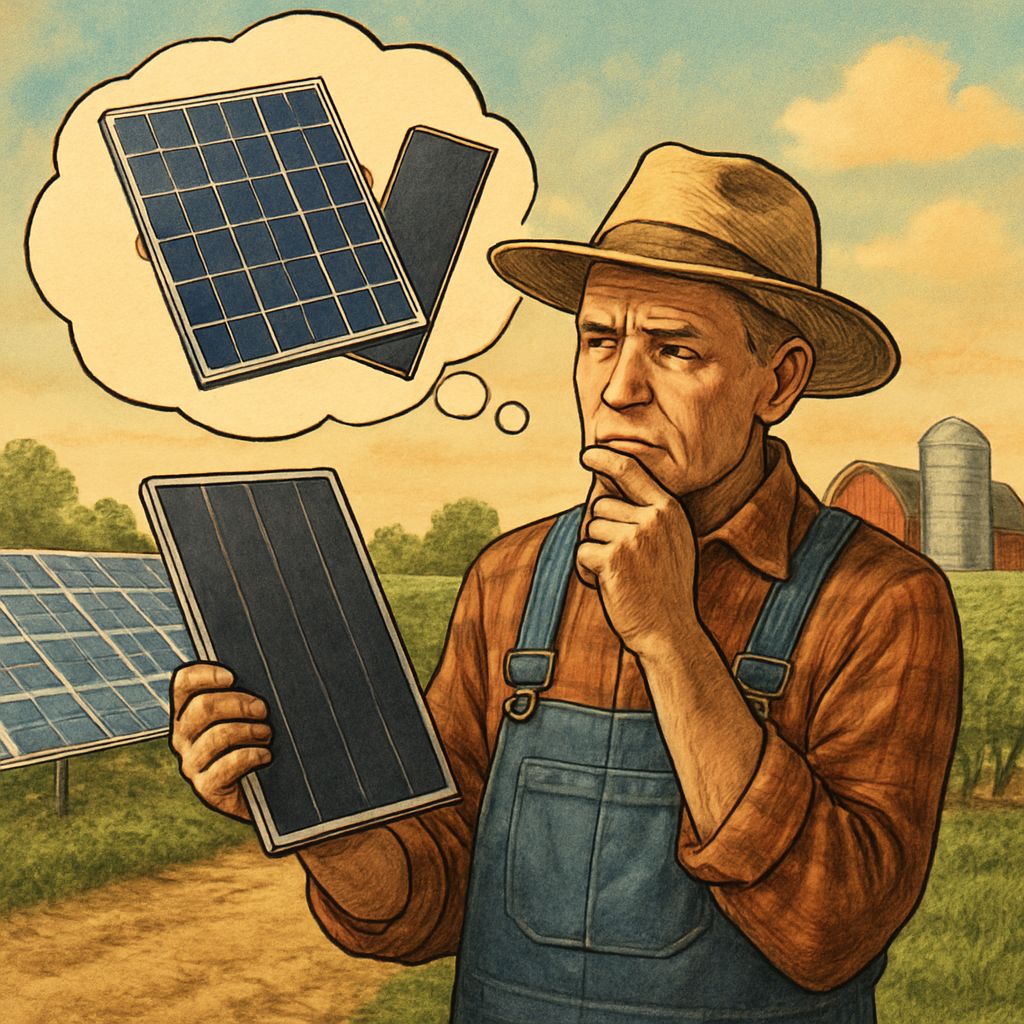
Which Panel Type Should Farmers Choose?
For most farmers with open land, ground-mount capability, and energy loads above 50,000 kWh annually, bifacial panels are the right choice. Their superior output, lower long-term degradation, and exceptional performance in reflective agricultural environments deliver the best lifetime cost-per-kilowatt-hour in typical farm conditions. If you’re building a new agrivoltaic system, powering a large dairy or grain operation, or installing in a northern climate with significant snow cover, bifacial should be your starting point.
If your farm has aging or curved barn roofs with structural load limitations, operates in a consistently high-heat climate, or needs solar integrated into greenhouse glazing, thin-film is not a compromise — it’s the correct technical answer. The smartest farm solar decisions aren’t made by defaulting to the most popular technology. They’re made by honestly matching panel characteristics to specific farm conditions, structural realities, and long-term energy goals. When in doubt, commission a site-specific energy assessment before committing to either technology — the cost of that assessment is trivial compared to the cost of the wrong system over 25 years. For more insights, consider exploring how solar panels work on farms.
Frequently Asked Questions
Farmers evaluating bifacial and thin-film solar consistently run into the same practical questions — questions that deserve direct, no-nonsense answers based on how these technologies actually perform in agricultural settings rather than how they’re marketed. For more insights, explore thin-film vs polycrystalline solar panels to understand which is best for agricultural use.
Below are the most common questions, answered with the specificity your farm investment decision deserves.
Can bifacial solar panels work on a barn roof?
Bifacial panels can be installed on barn roofs, but the key factors are structural load capacity and roof geometry. Most bifacial glass-glass panels weigh 50–70 lbs each, and a full rooftop array can add significant dead load to an aging structure. Before committing to a bifacial barn roof installation, you need a structural assessment — not an estimate, an actual engineering evaluation.
- New or recently reinforced barns with engineered trusses: likely suitable for bifacial
- Pre-1980 timber-framed barns with unknown truss ratings: require structural assessment first
- Metal Quonset or curved-roof structures: thin-film is usually the better fit
- Flat or low-slope metal roofing with known load ratings: bifacial may work with ballasted racking
The roof also needs to be in good condition before any panels go up. Installing a 25-year solar system on a roof that needs replacement in 10 years is an expensive mistake — you’ll pay to remove and reinstall the panels when the roof fails. Address the roof first, then size your solar system.
If the structural numbers don’t support bifacial, flexible CIGS thin-film panels bonded to standing seam metal roofing are a practical alternative that eliminates both the load concern and the racking cost — and still delivers meaningful energy production from the same roof area.
Do thin-film panels last as long as bifacial panels?
Modern CdTe thin-film panels from First Solar carry 25-year linear power warranties with documented degradation rates around 0.5% per year in large-scale deployments — competitive with many standard crystalline silicon panels. CIGS thin-film warranties vary by manufacturer but generally follow a similar 25-year performance guarantee framework. So in terms of warranted lifespan, thin-film and bifacial panels are comparable.
Where bifacial pulls ahead on longevity is in the best-in-class degradation rates. Premium bifacial glass-glass modules from manufacturers like LONGi Solar and Jinko Tiger Neo achieve degradation rates as low as 0.4% per year with 30-year linear power warranties — meaning at year 25, they’re producing roughly 90% of original rated output versus approximately 87–88% for thin-film at 0.5% annual degradation. For a 25-year farm system, that 2–3% cumulative output difference is real and worth factoring into your lifetime energy cost analysis.
Are bifacial panels worth the higher upfront cost for small farms?
For small farms with systems under 25 kW, the bifacial premium is harder to justify purely on output grounds — especially if installation conditions don’t maximize bifacial gain. A smaller rooftop system on a south-facing metal shed, for example, may see minimal rear-side contribution due to roof proximity, making the bifacial premium largely wasted. In these cases, high-efficiency monofacial monocrystalline panels often deliver the best value. However, if a small farm is doing a ground-mount installation with elevated racking over reflective soil or gravel, bifacial’s rear-side gain becomes meaningful even at smaller system sizes, and the premium can be justified over a 20–25 year horizon when combined with REAP grants and the ITC.
Can I grow crops directly under bifacial solar panels?
Yes — and this is one of the most exciting developments in agricultural solar right now. Agrivoltaic systems that combine elevated bifacial arrays with crop production underneath have demonstrated strong results across a growing body of research. The key is proper system design: panels need to be elevated to at least 8–12 feet for farm equipment access, spaced to allow adequate light penetration between rows, and oriented to balance energy production with crop light requirements.
Crops that perform well in agrivoltaic bifacial systems include leafy greens (lettuce, spinach, kale), herbs (basil, cilantro, mint), certain root vegetables, and shade-tolerant small fruits including strawberries and raspberries. Commodity row crops like corn and soybeans are generally not well-suited to traditional agrivoltaic spacing, though research into optimized configurations for these crops is ongoing. The dual income potential — electricity revenue plus crop sales from the same land — makes agrivoltaic bifacial installations one of the highest-ROI land use strategies currently available to American farmers.
Which solar panel type qualifies for the USDA REAP grant?
Both bifacial and thin-film solar panels qualify for USDA REAP grants. The program does not discriminate by panel technology — it evaluates the project as a whole renewable energy system based on energy savings, project feasibility, and applicant eligibility. Whether you’re installing a 100 kW bifacial ground-mount array or a 30 kW flexible thin-film system on an equipment barn, both projects can receive REAP funding provided all other eligibility requirements are met.
The most important eligibility factors are applicant-side, not technology-side: you must be an agricultural producer or rural small business, derive at least 50% of gross income from agriculture, and be located in a USDA-defined rural area. The solar system must be used to offset the farm operation’s own energy consumption — not sold entirely to the grid as a standalone generating business.
For maximum financial impact, stack your REAP grant with the 30% federal Investment Tax Credit. These two programs are designed to work together — the ITC applies to the net project cost after grants, and together they can reduce your effective out-of-pocket investment to 20–30% of the original installed system price. At that net cost level, payback periods for properly designed farm solar systems — bifacial or thin-film — routinely fall in the 4–7 year range, against a 25–30 year panel lifespan.
There has never been a stronger financial case for farm solar than exists right now, and the panel technology decision — bifacial or thin-film — matters far less than simply starting the process. Growing Solar Mist specializes in helping farmers navigate exactly these decisions, from technology selection through grant applications and installation planning, so your farm captures every dollar of value available from the current incentive environment. For more insights, explore the best solar panel options for agricultural use.





Leave a Reply