

Key Takeaways
- Solar irrigation systems use solar panels to convert sunlight into electricity, powering water pumps for irrigation.
- They reduce electricity costs and are environmentally friendly, promoting sustainable agriculture.
- Key components include solar panels, charge controllers, batteries, inverters, and water pumps.
- Proper sizing and installation of components are crucial for optimal system performance.
- Regular maintenance ensures the longevity and efficiency of solar irrigation systems.
Solar Irrigation Systems: An Overview
Solar irrigation systems are transforming how we approach farming. By harnessing the power of the sun, these systems provide a sustainable and cost-effective solution for watering crops. This technology not only cuts down on electricity bills but also reduces reliance on fossil fuels, making it a win-win for both farmers and the environment.
What is a Solar Irrigation System?
At its core, a solar irrigation system is a setup that uses solar panels to convert sunlight into electricity. This electricity then powers a water pump, which draws water from a source like a well or a reservoir and distributes it to crops. The system is designed to work efficiently even in remote areas where traditional power sources might not be available.
Benefits of Solar-Powered Irrigation
Solar-powered irrigation offers numerous benefits. First and foremost, it significantly reduces operational costs. Farmers no longer have to worry about fluctuating electricity prices or fuel costs. Moreover, it’s environmentally friendly. By using renewable energy, farmers can reduce their carbon footprint and contribute to a healthier planet.
Besides financial and environmental benefits, solar irrigation systems are also reliable. They provide a consistent water supply, ensuring that crops receive the necessary hydration, even during power outages or fuel shortages.
The Role of Renewable Energy in Agriculture
Renewable energy, particularly solar power, plays a crucial role in modern agriculture. It empowers farmers to become more self-sufficient and less dependent on external energy sources. With solar irrigation systems, farmers can harness the sun’s energy, a free and abundant resource, to meet their water needs.
This shift towards renewable energy also aligns with global efforts to combat climate change. By reducing greenhouse gas emissions and promoting sustainable farming practices, solar irrigation systems are helping to create a more resilient agricultural sector.
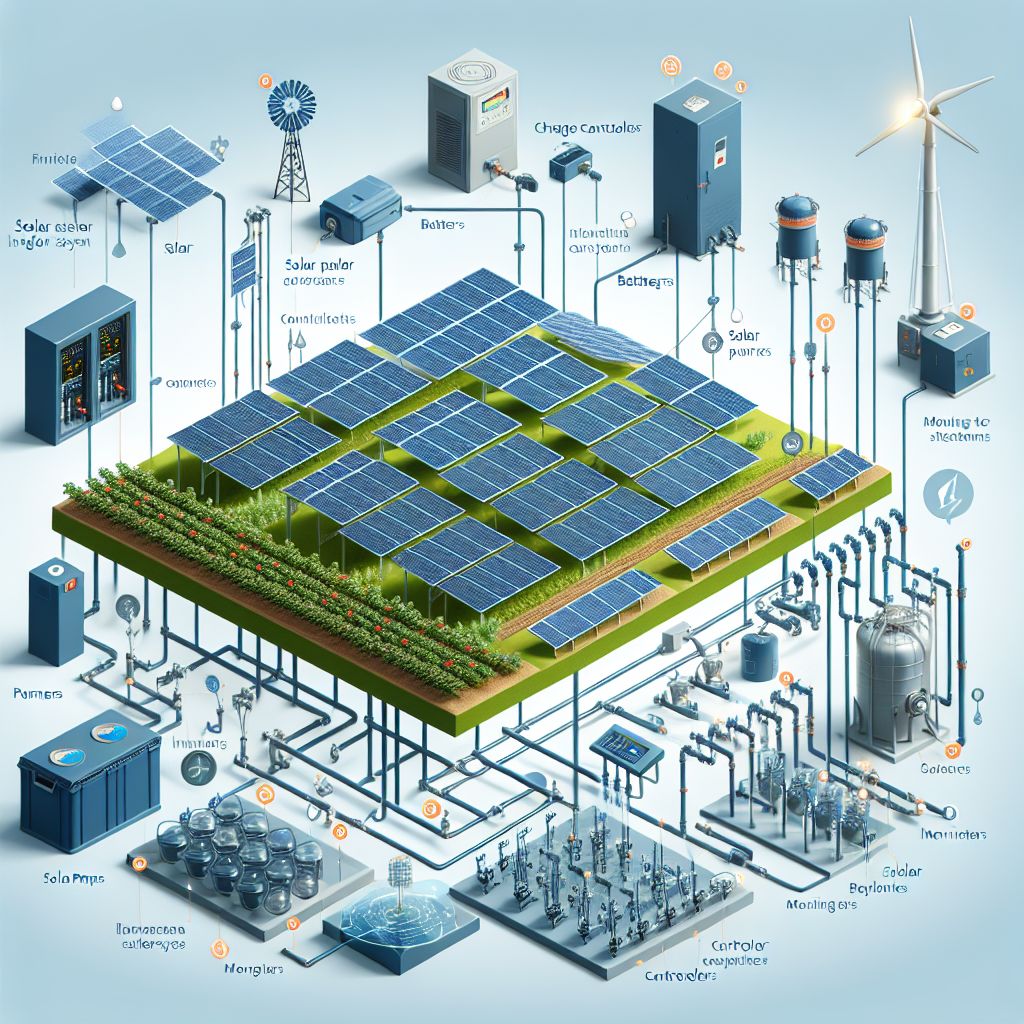
“Solar Irrigation System Components for …” from growingsolarmist.com and used with no modifications.
Core Components of a Solar Irrigation System
Understanding the core components of a solar irrigation system is essential for anyone looking to implement this technology. Each component plays a vital role in ensuring the system operates efficiently and effectively.
Solar Panels: Energy Capture
Solar panels are the heart of any solar irrigation system. They capture sunlight and convert it into electricity. The type and size of solar panels you choose will directly impact the system’s performance. It’s crucial to select panels that can generate enough power to meet your irrigation needs.
There are different types of solar panels available, including monocrystalline, polycrystalline, and thin-film panels. Each has its own advantages and considerations. For instance, monocrystalline panels are highly efficient but can be more expensive. While polycrystalline panels offer a good balance of cost and efficiency. Thin-film panels are more affordable and very flexible but are less efficient than the other 2 types of solar panels.
Here’s a table comparing the different solar panel you can use with an irrigation system on a farm:
|
Solar Panel Type |
Efficiency |
Cost per Watt |
Pros |
Cons |
|---|---|---|---|---|
|
Monocrystalline |
17-22% |
$1.00 – $1.50 |
– Highest efficiency. 1, 3 |
– Most expensive option. 1, 3 |
|
Polycrystalline |
13-17% |
$0.90 – $1.20 |
– Lower cost than monocrystalline. 1, 3 |
– Slightly lower efficiency. 1, 3 |
|
Thin-Film |
10-13% |
$0.70 – $1.00 |
– Lowest cost. 1, 3 |
– Lowest efficiency. 1, 3 |
Monocrystalline panels are highly efficient and durable, making them ideal for high-performance irrigation systems that require consistent power output. Their higher cost is often offset by their superior performance in the long run 3.
Polycrystalline panels offer a good balance between cost and efficiency, making them suitable for medium-scale irrigation projects. They perform well in most conditions and are a popular choice for many agricultural applications 3.
Thin-film panels, while less efficient, are more affordable and flexible. They can be a good option for portable irrigation systems or installations where weight is a concern. Their lower efficiency means you may need more panels to achieve the same power output as crystalline options 3.
Charge Controllers: Power Regulation
Charge controllers play a crucial role in regulating the power flowing from the solar panels to the batteries. They ensure that the batteries are charged optimally, preventing overcharging and deep discharging, which can damage the batteries and reduce their lifespan.
- PWM Controllers: Pulse Width Modulation (PWM) controllers are a cost-effective option that regulates the charging process by reducing the voltage to match the battery’s needs.
- MPPT Controllers: Maximum Power Point Tracking (MPPT) controllers are more efficient as they optimize the power output from the solar panels, especially in varying weather conditions.
Choosing the right charge controller depends on the specific requirements of your solar irrigation system, including the size of your solar array and the type of batteries used.
Batteries: Energy Storage
Batteries store the electricity generated by the solar panels for use when sunlight is not available, such as during cloudy days or at night. This ensures a continuous supply of power to the water pump, regardless of weather conditions.
When selecting batteries, consider factors such as capacity, lifespan, and maintenance requirements. Common types of batteries used in solar irrigation systems include lead-acid, lithium-ion, and nickel-cadmium batteries. Each type has its own pros and cons, so it’s essential to choose one that aligns with your specific needs and budget. For more information on solar-powered systems, you might want to explore solar-powered sprinkler irrigation systems.
Inverters: Converting Energy
Inverters are essential in solar irrigation systems because they convert the direct current (DC) electricity generated by solar panels into alternating current (AC) electricity. This conversion is crucial since most water pumps and other electrical equipment operate on AC power. By using inverters, you ensure that the energy harnessed from the sun is compatible with your irrigation system’s components. For more insights, explore the benefits of solar-powered irrigation systems.
There are different types of inverters available, including pure sine wave and modified sine wave inverters. Pure sine wave inverters provide cleaner and more reliable power, making them ideal for sensitive equipment. While they might be more expensive, their efficiency and reliability often justify the cost, especially for larger or more complex systems.

“How Solar Irrigation Systems are …” from www.smartcommercialsolar.com.au and used with no modifications.
Essential Irrigation Parts
Beyond the solar components, your irrigation system needs essential parts to deliver water efficiently to your crops. These parts work together to ensure that water is distributed evenly and effectively across your fields.
Each part of the irrigation system plays a specific role, from moving water to controlling the flow and directing it precisely where it’s needed. Understanding these components will help you set up and maintain a system that meets your agricultural needs. For more detailed information, you can explore the essential guide to irrigation systems.
Solar Water Pumps: Moving Water
Solar water pumps are the backbone of any solar irrigation system. They use the electricity generated by the solar panels to draw water from a source, such as a well or a river, and push it through the irrigation network to the crops. The choice of pump depends on factors like the water source’s depth, the distance the water needs to travel, and the volume of water required.
There are two main types of solar water pumps: submersible pumps and surface pumps. Submersible pumps are placed underwater and are ideal for deep water sources, such as wells. Surface pumps, on the other hand, are installed above ground and are better suited for shallow water sources, like ponds or streams. For more information on solar-powered irrigation options, explore the various irrigation systems farmers can power with solar.
When selecting a solar water pump, consider its flow rate, head (the height it can lift water), and energy consumption. A well-chosen pump will ensure efficient water delivery without overloading your solar power system.
Pipes and Hoses: Distribution Network
Pipes and hoses form the distribution network of your irrigation system. They carry water from the pump to the fields, ensuring that every part of your farm receives the necessary hydration. The material and diameter of the pipes and hoses affect the system’s efficiency and durability.
Common materials used for irrigation pipes include PVC, polyethylene, and rubber. Each material has its own advantages. For instance, PVC is durable and resistant to corrosion, while polyethylene is flexible and easy to install. Choosing the right material depends on your specific needs and environmental conditions. For more information on how these materials are used in innovative systems, check out this article on solar-powered linear irrigation systems.
Irrigation Controllers: System Control
Irrigation controllers are the brains of your system. They automate the watering process, allowing you to set schedules and control the flow of water based on your crops’ needs. This automation ensures efficient water use and reduces the risk of over- or under-watering.
Advanced irrigation controllers can be integrated with weather sensors and soil moisture sensors to adjust watering schedules based on real-time data. This level of control not only conserves water but also maximizes crop yield by providing the optimal amount of water at the right time.
Emitters: Direct Plant Watering
Emitters are the final components in the irrigation system, responsible for delivering water directly to the plants. They come in various forms, including drippers, sprinklers, and micro-sprayers, each suited for different types of crops and planting arrangements. For more information on irrigation systems, check out this article on solar-powered sprinkler irrigation systems.
Drippers are ideal for precise watering, delivering water slowly and directly to the plant’s root zone. Sprinklers, on the other hand, cover larger areas and are suitable for crops that require more extensive watering. Choosing the right emitters depends on your crops’ water requirements and the layout of your fields.
Here’s a table discussing the different parts of a solar irrigation system:
|
Component |
Function |
Description |
|---|---|---|
|
Solar Panels |
Power generation |
Convert sunlight into electricity to power the system. 1, 2, 3 |
|
Pump Controller/Inverter |
Power management |
Regulates voltage and ensures smooth operation of the pump. 1, 2, 3 |
|
Solar Water Pump |
Water extraction |
Pumps water from the source (e.g., wells, canals) to the irrigation system. 1, 2, 3 |
|
Water Storage Tank |
Water storage | |
|
Piping and Fittings |
Water transport |
Transports water from the pump to the irrigation system. 1 |
|
Irrigation Infrastructure |
Water distribution |
Distributes water to fields through a network of pipes. 1 |
|
Lightning Arrestor |
System protection |
Guards against lightning strikes to protect electrical components. 1 |
|
Earthing |
Safety |
Protects the system from electrical problems. 1 |
|
Mounting Structure |
Panel support |
Provides a sturdy frame for optimal panel placement. 2 |
|
Batteries (optional) |
Energy storage |
Stores excess energy for use during cloudy days or at night. 2, 3 |
|
Control Systems |
Automation |
May include timers, sensors, and remote monitoring for efficiency. 2 |
This table outlines the main components of a solar irrigation system, each playing a crucial role in harnessing solar energy to power efficient and sustainable agricultural irrigation.

Optional Equipment for Optimization
To further enhance the efficiency and effectiveness of your solar irrigation system, you might consider investing in optional equipment. These additions can help you monitor performance, adjust operations, and optimize water usage.
Types of Irrigation Systems
There are several types of irrigation systems you can implement, depending on your specific needs and resources. Drip irrigation, for instance, is highly efficient, delivering water directly to the plant roots with minimal waste. Sprinkler systems, while less precise, are excellent for covering large areas quickly.
Monitoring and Sensors
Integrating monitoring devices and sensors into your system can provide valuable insights into its performance. Soil moisture sensors, for example, can help you determine when and how much to water your crops. Weather sensors can adjust irrigation schedules based on current and forecasted weather conditions, ensuring that your plants receive the right amount of water without wastage.
Installation Tools and Accessories
Having the right tools and accessories on hand can make the installation and maintenance of your solar irrigation system much easier. Items like pipe cutters, wrenches, and sealing tape are essential for assembling and maintaining your system. Additionally, investing in quality mounting systems for your solar panels ensures they are securely positioned to capture maximum sunlight.
By equipping your solar irrigation system with the right components and optional equipment, you can maximize its efficiency and ensure that it meets your farming needs effectively.

System Design and Setup
Designing and setting up a solar irrigation system requires careful planning and consideration of various factors. By understanding your site’s specific requirements and the capabilities of each component, you can create a system that operates efficiently and meets your agricultural goals.
Understanding Site Requirements
Before setting up your solar irrigation system, assess your site’s requirements, including water sources, crop types, and environmental conditions. This assessment will help you determine the size and type of system needed to meet your irrigation needs effectively.
Sizing Your System Appropriately
Proper sizing of your solar irrigation system is crucial for optimal performance. Consider factors such as the daily water requirement of your crops, the available sunlight, and the capacity of each component. By accurately sizing your system, you ensure that it operates efficiently and reliably, providing your crops with the necessary hydration.
Tips for Installing and Positioning Components
Installing a solar irrigation system can seem daunting, but with the right approach, it becomes manageable. Start by identifying the best location for your solar panels. Ideally, they should be placed where they can receive maximum sunlight throughout the day. Avoid areas with shade from trees or buildings.
When positioning your water pump, ensure it’s close to the water source to minimize the distance water needs to travel. This reduces energy consumption and increases efficiency. Secure the pump and other components to prevent damage from weather or wildlife. For more information on sustainable energy solutions, explore irrigation systems farmers can power with solar.
Example: In a small farm in Arizona, the owner installed solar panels on a south-facing slope to maximize sun exposure, resulting in a 20% increase in energy efficiency.
Finally, when laying out your pipes and hoses, plan the most direct routes to your crops to reduce friction and pressure loss. This careful planning will ensure your system operates smoothly and effectively.

Maintenance and Troubleshooting
Regular maintenance is key to keeping your solar irrigation system running efficiently. By performing routine checks and addressing issues promptly, you can extend the lifespan of your system and prevent costly repairs.
Start by inspecting the solar panels for dirt or debris that might block sunlight. Cleaning them regularly ensures maximum energy capture. Check the charge controller and batteries for any signs of wear or corrosion. These components are crucial for energy storage and distribution.
Example: A farmer in Texas noticed a drop in water pressure and discovered a blockage in the pipes. Regular flushing of the system now prevents similar issues. For more information on maintaining your irrigation system, check out this essential guide to irrigation systems.
If you encounter issues, such as reduced water flow or inconsistent power, consult the system’s manual for troubleshooting tips or contact a professional for assistance. Addressing problems early can prevent more significant issues down the line.
Regular Maintenance Tips
Here are some tips to keep your system in top shape:
- Clean solar panels monthly to remove dust and debris.
- Inspect all electrical connections for corrosion.
- Check battery charge levels and replace batteries as needed.
- Flush pipes and hoses to prevent blockages.
- Test the pump’s operation and listen for unusual noises.
Common Issues and Solutions
Common issues with solar irrigation systems include improper maintenance of solar-powered irrigation systems.
- Reduced Water Flow: Check for blockages or leaks in pipes and hoses.
- Power Loss: Inspect solar panels for shading or damage.
- Battery Issues: Ensure batteries are properly charged and replace if necessary.

Environmental and Economic Impact of Solar Irrigation
Solar irrigation systems offer significant environmental and economic benefits. By reducing reliance on fossil fuels, they contribute to a cleaner, more sustainable agricultural practice. Learn more about different irrigation systems powered by solar for farmers.
Sustainability Advantages
- Reduces carbon footprint by using renewable energy.
- Decreases water waste through efficient irrigation methods.
- Promotes biodiversity by maintaining natural habitats.
By using solar energy, farmers can minimize their environmental impact while promoting sustainable farming practices. This not only benefits the planet but also enhances the farm’s reputation as an eco-friendly operation.
Moreover, solar irrigation systems align with global efforts to combat climate change, making them a forward-thinking choice for modern farmers.
Cost-Benefit Analysis for Farmers
- Initial investment costs can be offset by savings on electricity bills.
- Government incentives and rebates may be available for renewable energy projects.
- Increased crop yields due to consistent and efficient watering.
While the initial setup costs for a solar irrigation system can be significant, the long-term savings and benefits often outweigh the investment. Farmers can expect reduced operational costs, increased crop productivity, and a positive environmental impact.
Additionally, many regions offer incentives for adopting renewable energy technologies, further enhancing the financial appeal of solar irrigation systems.
Frequently Asked Questions (FAQ)
To help you better understand solar irrigation systems, here are answers to some common questions:
How do solar irrigation systems save money?
Solar irrigation systems save money by eliminating the need for grid electricity or fuel to power water pumps. Over time, the savings on energy costs can offset the initial investment in the system.
What size solar panel do I need for my farm?
The size of the solar panel you need depends on your farm’s water requirements, the pump’s power consumption, and the average sunlight in your area. It’s essential to calculate these factors to determine the appropriate panel size.
Can solar irrigation systems function on cloudy days?
Yes, solar irrigation systems can function on cloudy days, although their efficiency may be reduced. Batteries can store excess energy generated on sunny days to ensure continuous operation during less sunny periods.
How long do the components of a solar irrigation system last?
With proper maintenance, solar panels can last 25-30 years, while batteries typically last 5-10 years. Regular maintenance and timely replacement of components can extend the system’s overall lifespan.
What kind of maintenance does a solar irrigation system need?
Maintenance includes regular cleaning of solar panels, checking electrical connections, inspecting batteries, and ensuring the water pump and irrigation components are functioning correctly. Addressing issues promptly can prevent major problems.
Solar irrigation systems are becoming increasingly popular among farmers due to their efficiency and sustainability. These systems utilize solar panels to power irrigation equipment, reducing reliance on traditional energy sources. For those interested in exploring the benefits of solar irrigation, it might be worthwhile to look into solar-powered sprinkler irrigation systems, which offer numerous advantages for modern agriculture.

Leave a Reply