
Key Takeaways
- Solar lateral move irrigation systems are best suited for large, rectangular fields growing uniform crops like wheat, corn, soybeans, cotton, and forage crops.
- Solar power eliminates grid dependency, making these systems ideal for remote or off-grid farmland where running electrical lines is costly or impractical.
- Lateral move systems achieve water application efficiency above 80%, significantly outperforming flood and furrow irrigation methods that lose water to runoff and evaporation.
- The biggest limitation is field shape — solar lateral move systems underperform on irregular, hilly, or circular-layout properties, where center pivot systems have a clear advantage.
- Keep reading to find out whether the upfront cost is actually worth it for your specific farm type, and how it stacks up against center pivot systems in real-world energy and coverage comparisons.
Solar lateral move irrigation is quietly changing how large-scale farms manage water — especially in areas where grid power is expensive or simply unavailable.
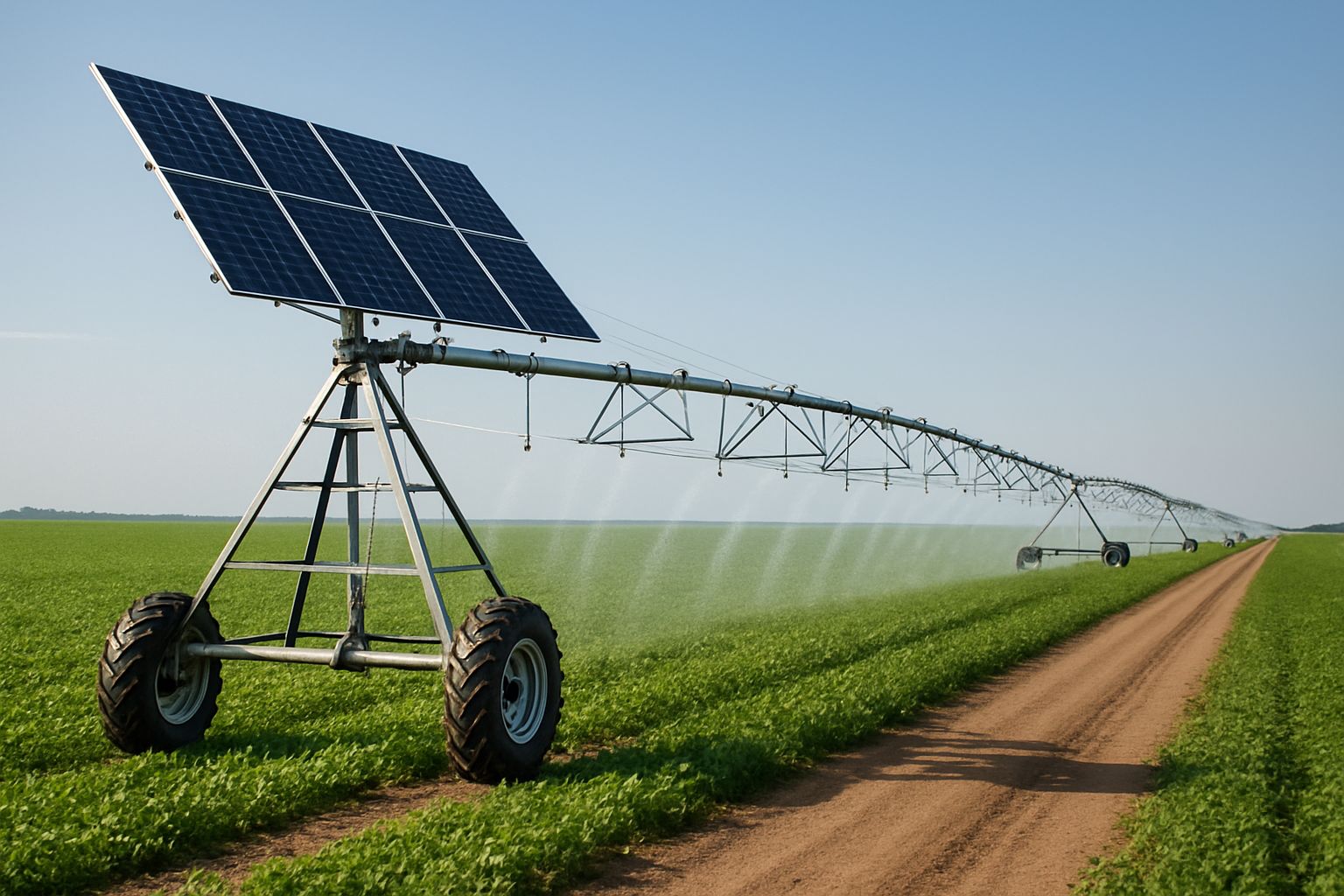
Lateral move irrigation (also called linear move irrigation) uses a series of wheeled towers supporting a long boom of sprinklers that travels in a straight line across a field. Unlike center pivot systems that rotate in a circle, a lateral move system moves back and forth across rectangular fields, delivering uniform water coverage from one end to the other. When you add solar power into the equation, you’re removing one of the biggest operational costs — electricity — and making the system viable on farmland that’s miles from the nearest power line.
Resources like Irrigation Montroyal have been helping farming communities understand and implement systems like these, offering guidance on matching the right irrigation technology to the right land conditions.

“Solar-Powered Linear Move Irrigation …” from growingsolarmist.com and used with no modifications.
What Is a Solar Lateral Move Irrigation System?
A solar lateral move irrigation system is a mechanized, mobile sprinkler system powered entirely or primarily by photovoltaic (PV) solar panels. The system moves in a straight lateral line across a rectangular field, distributing water through overhead sprinklers or drop nozzles mounted along a boom that can stretch hundreds of meters. Water is supplied either from an open canal running alongside the field or from a flexible hose that feeds the system as it moves.
The solar component powers the electric drive motors on each wheeled tower, the control systems, and in some configurations, the water pump itself. This is a significant operational shift from grid-tied or diesel-powered systems. Farmers in remote regions, particularly in sub-Saharan Africa, Central Asia, and parts of Australia and North America, are adopting solar lateral move systems precisely because they cut fuel and electricity costs while maintaining the performance of a fully automated irrigation system.
How the System Moves Across a Field
Each wheeled tower in a lateral move system is driven by its own electric motor. These motors work in coordination, guided by alignment sensors that keep the entire boom straight as it travels across the field. The lead tower sets the pace, and the following towers correct their position continuously to prevent the boom from bending or misaligning — a problem that can cause uneven water distribution or mechanical stress on the structure.
Most systems travel at an adjustable speed. Slower movement means more water applied per pass, while faster movement reduces application depth. This variable speed control is one of the features that makes lateral move systems so adaptable to different crops and soil water requirements. Here’s what makes up a standard lateral move system:
- Wheeled drive towers — typically spaced 30 to 60 meters apart along the boom
- A central boom structure — supporting the water supply pipe and sprinkler drops
- Alignment sensors and control panels — maintaining straight-line travel
- Sprinkler heads or low-pressure drop nozzles — delivering water at or near crop canopy level
- Solar panels — mounted on the towers or on a dedicated panel array near the field
- End-of-field sensors or GPS controls — stopping or reversing the system automatically
When the system reaches the end of the field, it stops and can either reverse or be repositioned manually, depending on the setup. More advanced systems use GPS-based guidance to handle this automatically.
How Solar Power Drives the System
Solar panels on a lateral move system typically power the tower drive motors directly through a DC or AC electrical system. In well-designed setups, battery storage buffers power supply during cloud cover or early morning starts. The power demand for the drive motors is relatively low compared to the pump, which is why solar is well-suited to this application — keeping the system moving doesn’t require enormous energy, but doing it consistently over a full growing season adds up to significant savings compared to diesel or grid power.
Canal-Fed vs. Hose-Fed Water Supply
There are two primary ways a lateral move system receives its water. In canal-fed systems, the field has an open water channel running along one edge, and the system draws water directly as it passes. Hose-fed systems use a large-diameter flexible hose connected to a pressurized supply line, which is dragged or repositioned as the machine moves. Canal-fed systems are more common on large irrigated farms in flat regions, while hose-fed systems offer more flexibility on farms without established canal infrastructure.
Best Farm Types for Solar Lateral Move Irrigation
Not every farm is the right match for a solar lateral move system, but for the farms that do fit the profile, this technology delivers exceptional results. The common thread across all ideal candidates is simple: large, open, rectangular fields growing uniform crops that benefit from consistent, overhead water delivery.
Large-Scale Grain and Cereal Farms
Wheat, corn, barley, and sorghum are among the most common crops irrigated by lateral move systems worldwide. These crops grow across wide, flat fields and require consistent moisture during specific growth stages — particularly germination, tillering in wheat, and tasseling in corn. A solar lateral move system can be programmed to apply precise water depths at each growth stage without any manual intervention.
For grain farms operating across hundreds or thousands of hectares in remote locations, the elimination of grid electricity costs alone can justify the system investment within a few growing seasons. The combination of automated scheduling, solar energy, and uniform water distribution makes this setup one of the most cost-effective irrigation choices available for large cereal operations.
Legume and Oilseed Crop Farms
Soybeans, canola, sunflowers, and field peas thrive under lateral move irrigation because these crops are sensitive to both water stress and waterlogging. A lateral move system’s ability to apply small, frequent water doses at low pressure minimizes soil compaction and surface crusting — both of which damage legume root systems. Solar power makes it economically viable to run more frequent, shorter irrigation cycles that keep soil moisture in the ideal range without over-applying.
Canola and sunflower farms in particular benefit from the even water distribution because uneven moisture causes uneven maturity — a serious issue at harvest. Lateral move systems eliminate the dry corners and wet centers that are common problems with center pivot irrigation on square fields.
Cotton Farms in Remote or Off-Grid Areas
Cotton is a high-value crop with significant water demands, and many of the world’s cotton-growing regions are located in hot, arid areas far from reliable electrical infrastructure. Solar lateral move irrigation is an exceptionally strong match for these operations. The system can apply water during early morning or evening hours when evaporation losses are lowest, and the solar array can be sized to match the energy requirements of both the drive system and the pump, reducing operational costs dramatically compared to diesel-powered alternatives.
Silage and Forage Crop Operations
Alfalfa, ryegrass, and silage corn are harvested multiple times per season and require consistent irrigation throughout the growing period. The challenge with forage crops is that irrigation needs to resume quickly after each cutting — sometimes within days. Solar lateral move systems can be reprogrammed between harvest cycles and put back into operation without waiting for fuel deliveries or dealing with grid outages, which is a genuine advantage for livestock operations that depend on consistent forage supply.
The durability of modern lateral move structures also holds up well to the repeated passes and repositioning required across a forage farm’s multiple annual cutting cycles. These systems are built for high-frequency use, and when solar eliminates the energy cost per cycle, the economics of intensive forage irrigation become very favorable.
Field Conditions That Make This System Perform at Its Best
The right field conditions can mean the difference between a solar lateral move system that pays for itself in three seasons and one that causes constant mechanical headaches. Before committing to this technology, understanding the physical requirements of the land is essential.
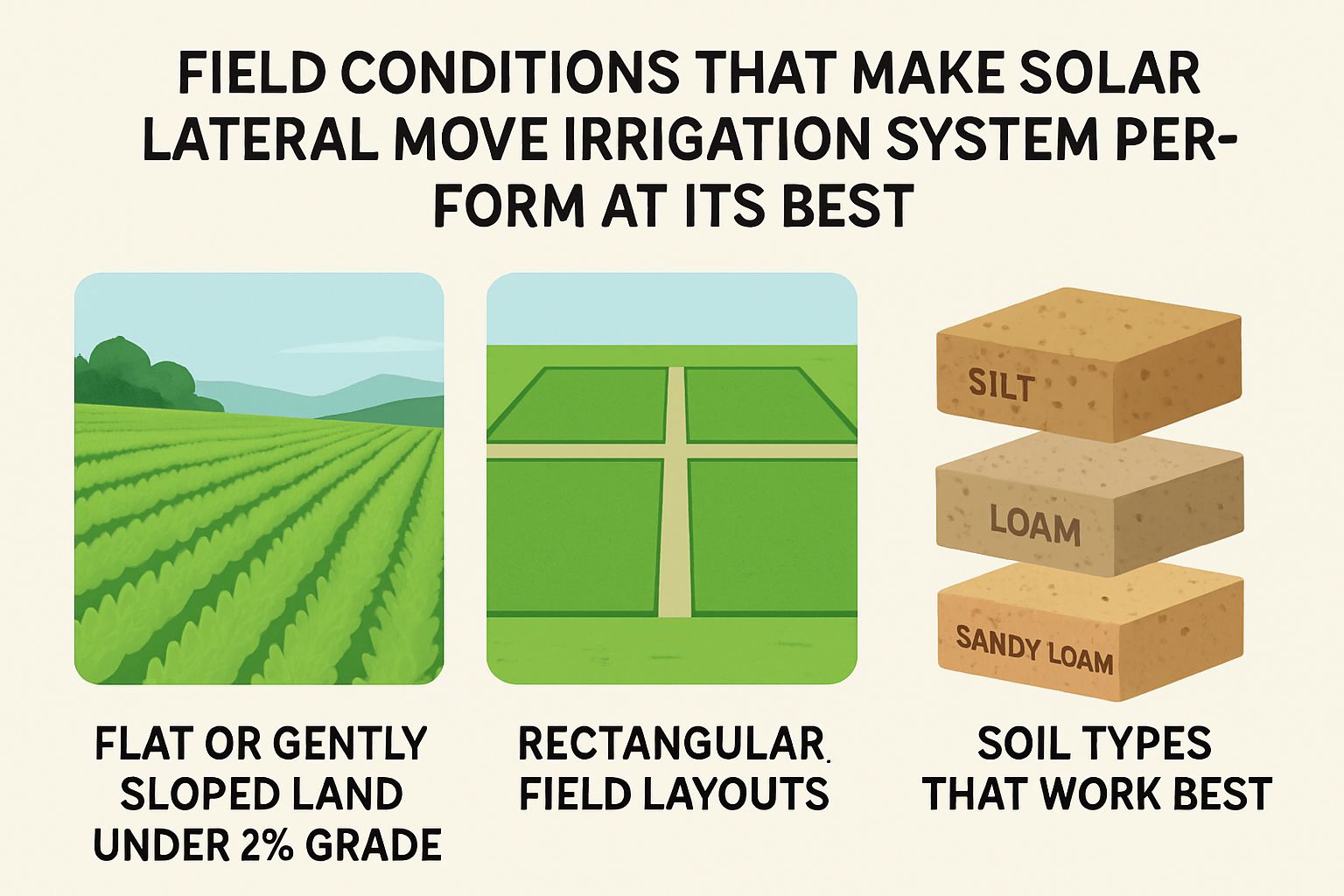
Flat or Gently Sloped Land Under 2% Grade
Solar lateral move systems are engineered for flat terrain. A slope of 2% or less is the generally accepted maximum for reliable, consistent operation. Beyond that threshold, the wheeled towers begin to experience uneven traction, the boom can drift out of alignment, and water distribution becomes uneven as pressure changes across elevation differences. Some manufacturers engineer their drive systems to handle slopes up to 5% with additional motor torque and alignment controls, but flat is always better. Farms in river valleys, alluvial plains, and irrigated flat-land regions are naturally well-suited to this requirement. For more information on how solar panels can enhance farm irrigation systems, check out the benefits of solar panels for farm irrigation.
Rectangular Field Layouts
This is non-negotiable. A solar lateral move system travels in a straight line, which means the field must be rectangular — or very close to it — to achieve full coverage without leaving unirrigated sections at the edges or corners.
Fields with irregular boundaries, angled edges, or L-shaped layouts create coverage gaps that defeat the purpose of an automated irrigation system. In practice, many large grain and cotton farms already operate rectangular fields specifically because they were designed for mechanized farming, which is why these farm types align so naturally with lateral move systems.
Some operations manage L-shaped or irregular properties by dividing them into separate rectangular irrigation zones, each served by its own lateral move system or a shared system that is repositioned between zones. This approach works, but it adds complexity and cost to the setup. When evaluating whether your farm layout suits a lateral move system, look for these field characteristics:
- Clearly defined rectangular boundaries with minimal angular deviation
- Field length ideally between 400 and 1,600 meters for efficient boom travel
- Field width matched to the boom length of the system being installed
- Consistent soil surface without large ridges, drainage cuts, or embedded obstacles
- End-of-field access for system repositioning or hose management
Soil Types That Work Best
Medium-textured soils — loams, sandy loams, and clay loams — perform best under lateral move irrigation because they absorb water at a moderate rate that matches the application rate of most sprinkler configurations. Heavy clay soils can pond and run off if the system moves too slowly or applies water faster than the infiltration rate allows. Sandy soils require more frequent passes at lower application volumes to prevent deep percolation losses. Both extremes can be managed with the right nozzle selection and system speed settings, but medium-textured soils give the widest operational window with the least adjustment needed. For more on irrigation efficiency, explore the benefits of solar panels in farm irrigation systems.
Farm Types Where Solar Lateral Move Irrigation Falls Short
As capable as solar lateral move systems are, they are the wrong tool for certain farm types — and choosing the wrong system is an expensive mistake.
Orchards and vineyards are an immediate disqualifier. Tree and vine crops require drip or micro-sprinkler irrigation delivered at root level, and the physical structure of a lateral move boom cannot navigate between established tree rows without causing significant crop damage. The overhead application method also creates humidity conditions in dense orchard canopies that promote fungal diseases.
Vegetable farms with diverse crop mixes and small plot sizes face a different problem. Lateral move systems are designed for uniform crop types across large continuous areas. A mixed vegetable operation that grows tomatoes, peppers, and leafy greens in adjacent blocks needs different water volumes, frequencies, and delivery methods for each crop — something a single lateral move system cannot accommodate efficiently.
Hilly or terraced farmland presents a straightforward mechanical problem. Slopes exceeding 5% prevent the wheeled towers from maintaining traction and alignment, making operation unsafe and unreliable. Terraced farms, which are by definition not flat continuous surfaces, physically cannot accommodate the straight-line travel path the system requires. For those seeking alternative solutions, exploring solar-powered tractors could be beneficial in managing such challenging terrains.
- Orchards and vineyards — incompatible with overhead boom delivery and tree row spacing
- Mixed vegetable farms — require variable water management that one lateral system cannot provide
- Hilly or terraced land — slopes above 5% prevent safe, consistent tower movement
- Irregularly shaped properties — non-rectangular boundaries leave significant unirrigated areas
- Very small farms under 20 hectares — the capital cost of a lateral move system rarely justifies the investment at small scale
- High-tunnel or greenhouse operations — enclosed structures cannot physically accommodate a mobile boom system
“Southern Irrigation” from southernirrigation.com and used with no modifications.
Solar Lateral Move vs. Center Pivot Irrigation
The comparison between solar lateral move and center pivot irrigation comes up on almost every large farm where a new system is being evaluated. Both are mechanized, both can be solar-powered, and both deliver water through overhead sprinklers on a moving boom. But the differences between them matter significantly depending on your field shape, water source, and land use goals.
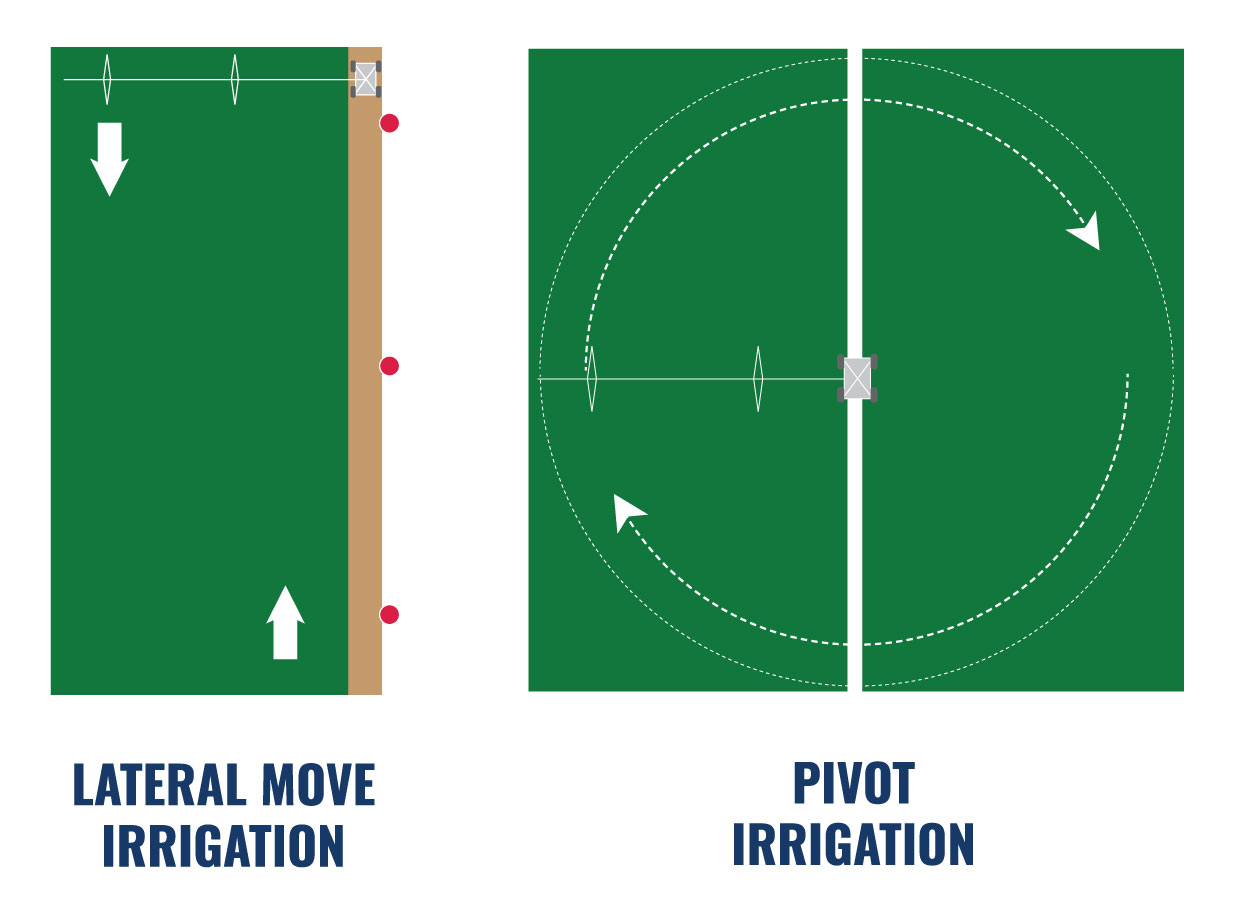
Center pivot systems rotate in a circle around a fixed central point, which means they inherently irrigate a circular area. Lateral move systems travel in a straight line and irrigate a rectangle. That single difference drives most of the practical distinctions between the two technologies. For those interested in sustainable energy solutions, solar panels for farm irrigation systems can be a beneficial addition to both types of systems.
Field Shape and Coverage Differences
On a square field, a center pivot system leaves the four corners unirrigated — an area that can represent 21% or more of the total field. A lateral move system covers the full rectangle, leaving no dry corners. For high-value crops where every square meter of productive land matters, that difference is significant. Conversely, center pivot systems work on circular or irregularly shaped fields that would be impractical for lateral move equipment.
Energy Cost Comparison
Both systems can be solar-powered, but lateral move systems typically have lower total energy demands for the drive mechanism because the towers only need to travel in one plane of movement rather than maintaining the rotational arc tension of a pivot system. When the pump energy is excluded, drive system power consumption for a lateral move is generally lower per hectare irrigated on rectangular fields. Over a full growing season across a 200-hectare grain farm, this difference in drive energy consumption adds up to meaningful savings on battery storage requirements and solar array sizing.
Which System Covers More Usable Field Area
On rectangular fields, lateral move systems win outright on usable coverage percentage. On circular or irregularly shaped properties, center pivot systems are more practical. The decision ultimately comes down to your field geometry — if your farm was designed or is suitable for rectangular mechanized cropping, a solar lateral move system will almost always deliver better land utilization than a center pivot alternative.
Key Benefits of Going Solar on a Lateral Move System
Adding solar power to a lateral move irrigation system is not just an environmental decision — it is a financial and operational one that changes the economics of large-scale irrigation in measurable, farm-specific ways.
Reduced Operating Costs on Remote Farmland
Grid electricity on remote farmland is either unavailable or priced at a premium when it does reach the property. Diesel fuel adds another layer of cost and logistical complexity — fuel needs to be transported, stored, and managed across a full growing season. Solar eliminates both problems. A properly sized solar array on a lateral move system can power the drive motors and control electronics with zero ongoing fuel cost, and in many configurations, excess solar capacity can power additional farm infrastructure like water pumps, shed lighting, or grain handling equipment.
Water Efficiency Above 80%
Flood and furrow irrigation — still the dominant method on many large grain farms worldwide — typically achieves water application efficiency of 40% to 60%, meaning a large portion of every irrigation event is lost to runoff, evaporation, or deep percolation. Solar lateral move systems, equipped with low-pressure drop nozzles positioned close to the crop canopy, consistently achieve application efficiencies above 80%. On water-limited farms, or farms operating under water allocation restrictions, that efficiency difference is the margin between a profitable season and a water-stressed one.
Labor Savings Compared to Hand-Move and Furrow Systems
A single operator can manage a solar lateral move system across hundreds of hectares, programming irrigation schedules, monitoring system position through remote telemetry, and making adjustments from a smartphone or desktop without walking the field. Compare that to hand-move sprinkler systems, which require physical relocation of pipes and sprinklers multiple times per week, or furrow irrigation, which demands constant monitoring of flow rates and furrow conditions across the entire field width.
The labor hours eliminated by a fully automated solar lateral move system, over the course of a full irrigation season, can be substantial enough to offset a significant portion of the system’s capital cost when labor is priced at market rates. For farms operating in areas with rising labor costs or seasonal worker shortages, this automation advantage becomes one of the most compelling reasons to make the switch. Additionally, solar-powered tractors and tools can further enhance efficiency and savings for farmers.
Is Solar Lateral Move Irrigation Worth the Upfront Cost?
The honest answer is: it depends on your farm’s scale, remoteness, crop value, and current irrigation method. The capital cost of a solar lateral move system is significant. A fully equipped system including the boom structure, drive towers, solar array, control electronics, and installation can range from tens of thousands to several hundred thousand dollars depending on field length, boom span, and solar array size. For farms already using center pivot or other mechanized irrigation, the incremental cost of switching may be lower than starting from scratch.
The payback calculation becomes clearest when you factor in what you’re replacing. A farm currently spending heavily on diesel fuel for irrigation pumps and drive systems, or paying premium rates for remote grid electricity, can realistically expect a solar lateral move system to pay back its capital cost within five to eight years through energy savings alone — before accounting for water savings, labor reduction, and potential yield improvements from more consistent irrigation. For high-value crops like cotton or seed crops, the payback window can be considerably shorter. The farms that struggle to justify the investment are typically small operations under 50 hectares, farms with cheap and reliable grid access, or properties that grow diverse crops requiring variable irrigation management that a single lateral move system cannot efficiently serve.
Frequently Asked Questions
What crops are best suited for solar lateral move irrigation?
Solar lateral move irrigation performs best on uniform, large-area field crops. Wheat, corn, soybeans, canola, cotton, sorghum, barley, sunflowers, alfalfa, and silage crops are the strongest matches. These crops share key characteristics: they grow across large continuous areas, tolerate overhead water delivery, and benefit from the consistent, programmable moisture application that lateral move systems provide. Row crops with defined plant spacing also work well because low-pressure drop nozzles can be configured to deliver water precisely between rows, reducing foliar wetness and disease pressure.
How much water can a lateral move irrigation system save compared to flood irrigation?
Lateral move irrigation systems typically achieve application efficiencies of 80% to 90%, compared to flood irrigation efficiency rates of 40% to 60%. In practical terms, this means a farm that currently applies 1,000 millimeters of water per season through flood irrigation could achieve the same crop water demand with 500 to 600 millimeters using a well-managed lateral move system — a water saving of 40% to 50% per season. On farms operating under water allocation caps or in water-scarce regions, this saving can directly translate into expanded irrigated area within the same allocation, or improved water security across dry seasons.
Can solar lateral move systems work on hilly or uneven land?
Solar lateral move systems are designed for flat to gently sloping terrain and work reliably on slopes up to approximately 2%, with some manufacturer configurations handling up to 5% with enhanced drive motor torque and alignment systems. Beyond these thresholds, the wheeled towers lose consistent traction, the boom structure risks misalignment, and water pressure variability across elevation changes causes uneven distribution. Terraced or steeply sloping land is not suitable for lateral move equipment of any power source.
Farmers with moderately uneven land sometimes invest in laser grading to bring their fields within the slope tolerance of a lateral move system before installation. On high-value cropping land, this earthworks investment can be cost-effective when combined with the long-term irrigation efficiency gains. For land that cannot be practically graded, center pivot systems with their rotational flexibility, or drip irrigation on contoured rows, are more appropriate alternatives.
How does a solar lateral move system get its water supply?
There are two main water supply methods used with lateral move systems. Canal-fed systems draw water from an open channel or concrete-lined canal running along the length of the field. As the machine travels, it continuously draws from the canal through an intake pump and filter system. This approach works best on farms with established irrigation canal infrastructure and a consistent water source such as a river diversion, reservoir, or groundwater pumping station.
Hose-fed systems use a large-diameter flexible supply hose connected to a pressurized mainline buried along the field’s edge. As the machine travels, the hose feeds out behind or ahead of the system. When the hose reaches its maximum extension, it is repositioned — either manually or with a hose reel system — to allow the machine to continue its travel path. Hose-fed systems are more common on farms without canal infrastructure and offer flexibility in water source location, including groundwater bores and storage tanks that feed a pressurized distribution line.
How does solar lateral move irrigation compare to drip irrigation for large farms?
Drip irrigation delivers water directly to the root zone through buried or surface-laid emitter lines, achieving application efficiencies of 90% to 95% — the highest of any irrigation method. Solar lateral move irrigation delivers water overhead through sprinklers at 80% to 90% efficiency. On pure water efficiency metrics, drip irrigation has a measurable advantage. However, the comparison changes significantly when you factor in scale, crop type, and total system cost.
On large-scale grain and broadacre farms, drip irrigation is rarely practical. Installing, maintaining, and eventually replacing drip tape or emitter lines across hundreds or thousands of hectares is enormously expensive, and the systems are vulnerable to rodent damage, root intrusion, emitter clogging, and equipment damage during tillage operations. A lateral move system operates above the crop, requires no in-field buried infrastructure, and can be relocated between fields or seasons with relative ease.
Drip irrigation holds a strong advantage for high-value horticultural crops — vegetables, berries, tree fruits — where precise root-zone delivery justifies the installation cost and the crops themselves are managed with minimal tillage disturbance. For those same crops, a solar lateral move system is not an appropriate tool. The two technologies serve largely different farm types, and on the broadacre and grain farms where lateral move systems excel, drip irrigation is rarely a realistic competitive alternative.
For sustainable farming communities evaluating long-term irrigation infrastructure, the most important question is not which system is technically superior in isolation — it is which system best fits the specific combination of crops, field geometry, water availability, and financial resources of the individual farm operation. Solar lateral move irrigation represents one of the most compelling convergences of energy efficiency, water conservation, and agricultural automation available to large-scale grain and broadacre farmers today. Irrigation Montroyal helps farming communities navigate these decisions with expert guidance tailored to real field conditions.


Leave a Reply