
Key Takeaways:
- Solar-powered farm equipment can reduce operational costs by up to 70% compared to traditional diesel-powered machinery over the lifetime of the equipment.
- Modern solar irrigation systems can water up to 5 acres on a single sunny day without any grid electricity, making them ideal for remote operations.
- Solar tractors like the FarmDroid FD20 can run 8+ hours on a single charge, delivering performance comparable to diesel models while eliminating fuel costs entirely.
- Most solar-powered hand tools and irrigation systems pay for themselves in 2-3 years, while larger equipment like solar tractors typically reach break-even in 5-7 years.
- Government incentives and rising fuel costs are shrinking the payback window fast — keep reading to see exactly how much you could save based on your farm size and setup.
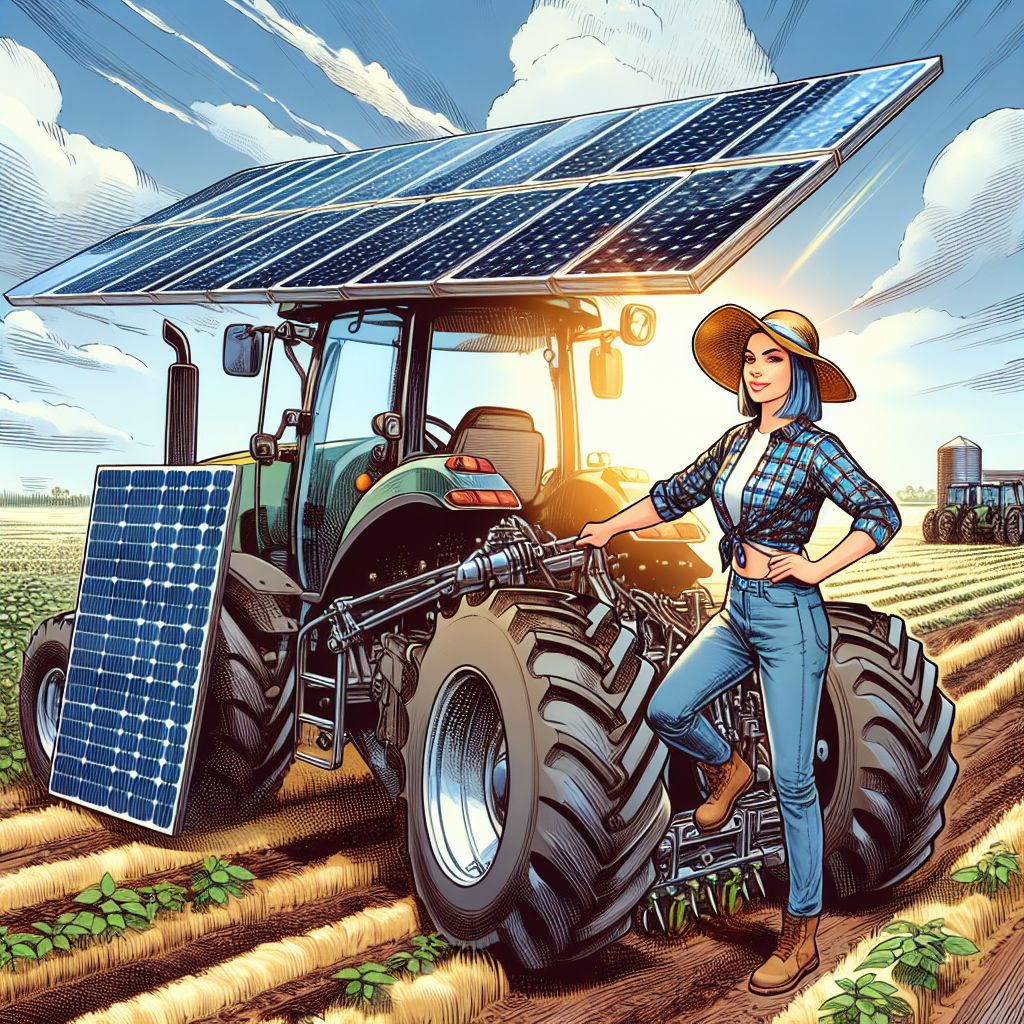
Fuel bills are quietly draining farm budgets every single season, and solar powered farming tools are one of the most practical ways to stop that leak for good.
Growing Solarmist has been tracking how solar technology is reshaping agricultural operations, and the numbers are hard to ignore. Farmers who make the switch are not just cutting emissions — they are cutting costs in ways that show up on the bottom line within just a few growing seasons.
Solar Farm Equipment Is Already Paying Off for Real Farmers
The shift toward solar is not a future trend. It is happening right now on working farms across the country. Remote operations that once spent heavily on fuel delivery are finding that solar-powered alternatives change the entire financial equation. When you eliminate the need for diesel on a daily basis, those savings compound fast.
Electric motors in solar-powered farm equipment deliver instant torque and precise control that diesel engines simply cannot match. Beyond performance, they bring something even more valuable to the farm: predictability. No surprise fuel price spikes, no engine rebuilds, no oil changes. Just consistent, low-cost power from the sun.
How Solar Tractors Actually Work on a Farm
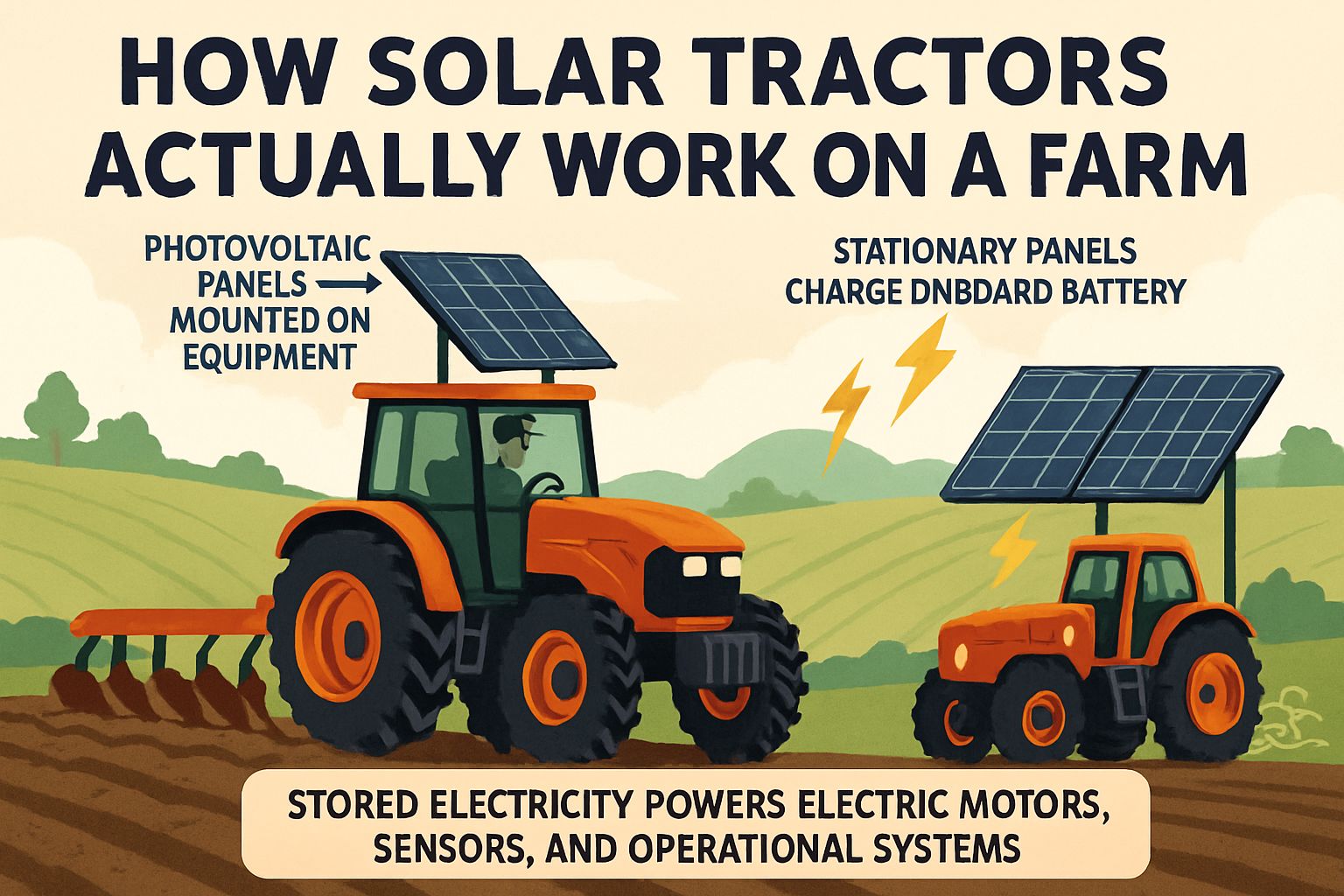
Solar farm vehicles work by mounting photovoltaic panels directly onto the equipment or using stationary panels to charge onboard battery systems. That stored electricity then powers electric motors, onboard sensors, and operational systems throughout the workday. It is a fundamentally different machine than what most farmers grew up using, but the transition is more straightforward than it sounds.
Photovoltaic Panels Convert Sunlight Into Usable Power
Photovoltaic (PV) panels capture sunlight and convert it directly into DC electricity through a process called the photovoltaic effect. That electricity either flows directly to motors during operation or gets stored in lithium-ion battery packs for later use. The efficiency of modern PV panels has improved dramatically in recent years, making them reliable even in partially cloudy conditions.
Most solar farm vehicles use monocrystalline silicon panels, which offer the highest efficiency rates in compact form factors — important when you are mounting them on equipment rather than a rooftop. The panels feed into a charge controller that regulates voltage and protects the battery system from overcharging. It is a clean, self-contained power loop that requires almost no intervention once installed.
Battery Storage Keeps Equipment Running After Dark
How a Solar Tractor Power System Works:
☀ Sunlight hits PV panels → DC electricity generated
↓
⚡ Charge controller regulates voltage → Protects battery system
↓
🔋 Lithium-ion battery bank stores energy → Powers electric motor
↓
🚜 Equipment operates up to 8+ hours → Zero fuel cost per hour
Battery technology is the backbone of solar-powered farm equipment. Modern lithium-ion battery packs used in solar tractors and utility vehicles can hold enough charge to power a full 8-hour workday, even when cloud cover reduces solar input during operation. The batteries recharge overnight using any leftover solar energy captured earlier, or through a standard grid connection as a backup option.
Battery degradation is one of the most common concerns farmers raise, and it is a fair one. However, the latest lithium iron phosphate (LiFePO4) battery chemistry used in agricultural equipment is rated for 2,000 to 4,000 charge cycles — meaning the battery pack can last 10 or more years under normal farm use before needing replacement.
This durability changes the long-term cost math significantly. Unlike a diesel engine that demands regular oil changes, filter replacements, and eventual overhauls, the battery system in a solar farm vehicle requires almost no routine maintenance beyond keeping connections clean and monitoring charge levels through the onboard display. For more information on battery systems, consider exploring the benefits of LiFePO4 batteries for solar panels in farming.
The FarmDroid FD20: A Real Solar Tractor Doing Real Farm Work
The FarmDroid FD20 is one of the clearest examples of solar-powered agricultural equipment moving from concept to commercial reality. This solar-powered, GPS-guided robot operates entirely on solar energy and handles seeding and mechanical weeding without any fuel input. It runs autonomously between rows, which means labor costs drop alongside fuel costs.
The FD20 is purpose-built for row crops and has been deployed on organic farms across Europe and North America where chemical herbicide restrictions make mechanical weeding essential. Its solar panels provide enough continuous power to operate through a full work cycle, and its onboard GPS system delivers centimeter-level precision that outperforms manual weeding in both speed and accuracy.
For farmers who have been skeptical that solar equipment can handle real agricultural demands, the FD20 is the proof point. It is not a prototype. It is a production machine doing commercial work on real farms right now, demonstrating the benefits of solar technology for agriculture.
Solar Irrigation Systems Cut Water Costs Dramatically
Solar Irrigation vs. Grid-Powered Irrigation — Cost Snapshot:
Cost Factor
Grid-Powered Pump
Solar-Powered Pump
Monthly electricity cost
$150 – $400
$0 (after install)
Fuel/grid dependency
High
None
Installation cost
$1,000 – $3,000
$2,500 – $8,000
Average payback period
N/A
3 – 5 years
Maintenance cost (annual)
Moderate – High
Very Low
Irrigation is one of the largest energy expenses on any crop farm, and it is also one of the fastest areas where solar delivers measurable savings. A solar-powered pump system eliminates monthly electricity bills for water delivery entirely, replacing them with a one-time capital investment that pays for itself within a few growing seasons.
Solar irrigation systems are particularly effective for farms that irrigate during daylight hours, which aligns perfectly with peak solar generation. The sun is doing the most work at the exact moment the crops need water — making it one of the most naturally efficient applications of solar power in agriculture. For those looking to enhance efficiency further, consider integrating smart controllers and sensors into your irrigation systems.
For remote farms where grid connectivity is expensive or unreliable, solar irrigation is not just a cost-saving tool — it is often the only practical option. Running power lines to a remote field can cost tens of thousands of dollars. A solar pump system handles the same job for a fraction of that price with no ongoing utility bills attached.
How Solar Pumps Replace Grid-Powered Irrigation
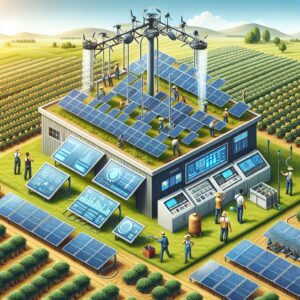
A solar irrigation system typically consists of a PV panel array, a charge controller, a submersible or surface pump, and a storage tank or direct-to-drip line connection. The panels power the pump directly during daylight, with any excess energy either stored in a small battery buffer or used to fill a gravity-fed tank for nighttime irrigation if needed.
The system scales easily. A single 400-watt panel setup can power a small submersible pump capable of moving 1,500 to 2,000 gallons per day. Larger operations simply add more panels and a higher-capacity pump to match their acreage and crop water requirements.
- DC solar pumps are the most efficient option for smaller systems under 5 acres
- AC pump systems with an inverter work better for larger operations with higher flow demands
- Variable speed pumps adjust output automatically based on available solar power, maximizing efficiency on partly cloudy days
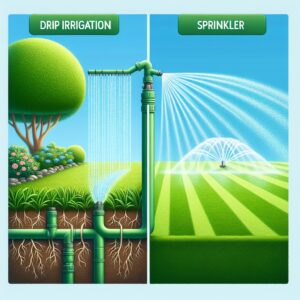
- Drip irrigation paired with solar pumps reduces water usage by 30–50% compared to flood or sprinkler methods
Choosing the right pump type depends on well depth, flow rate requirements, and whether the system will run on battery backup or direct solar power. Most agricultural solar pump suppliers provide sizing calculators that take the guesswork out of the selection process.
One System Can Water Up to 5 Acres Per Sunny Day
A properly sized solar irrigation system can effectively water up to 5 acres on a single sunny day without any grid electricity. This is not a theoretical number — it is a benchmark that working solar irrigation systems are hitting consistently in field conditions. For small to mid-size farms, this coverage range handles the majority of irrigation needs without a single dollar spent on electricity.
Scaling up is straightforward. Farms with larger acreage simply expand the panel array and pump capacity proportionally. The modular nature of solar irrigation systems means you can start small, prove the system on one field, and expand as your confidence and budget allow.
Solar-Powered Hand Tools That Replace Gas Equipment
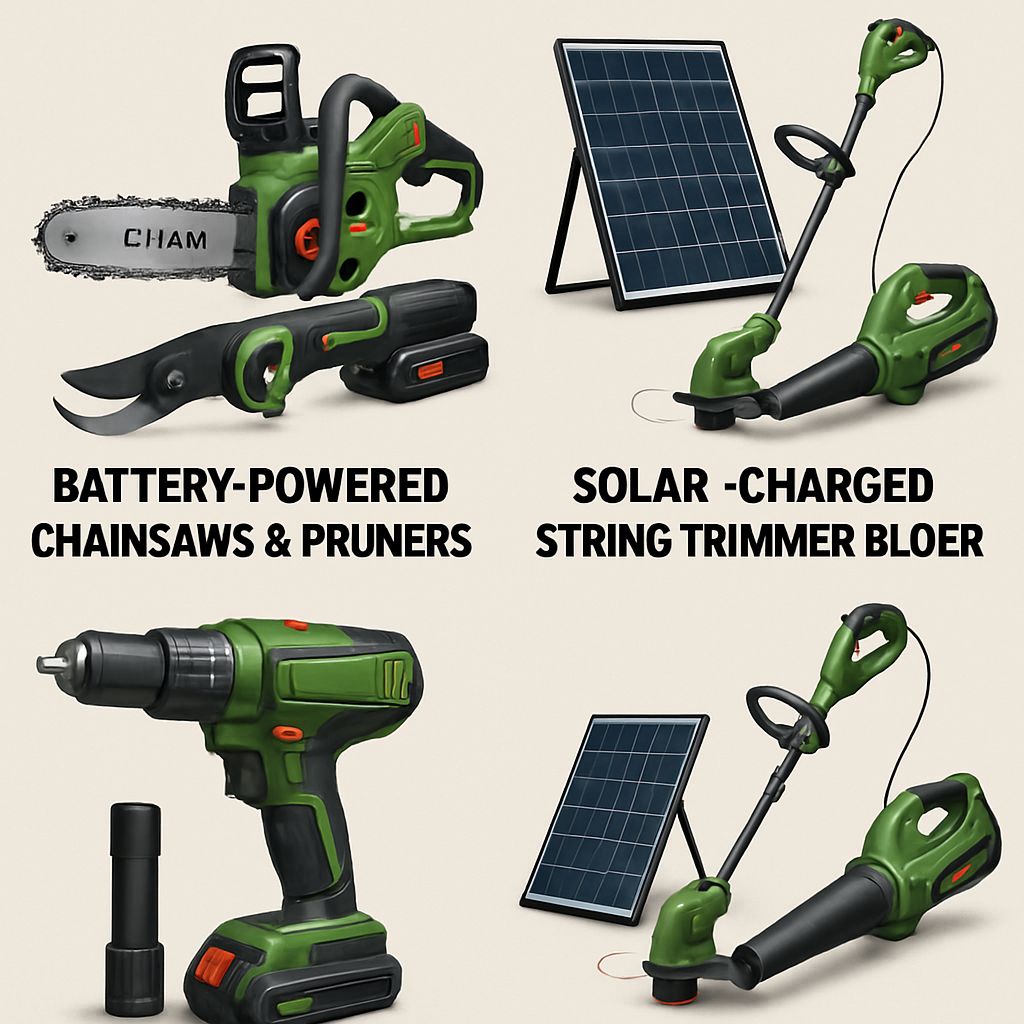
Gas-powered hand tools are a significant hidden cost on most farms — fuel, oil, spark plugs, carburetors, pull-start repairs. Solar-charged battery tools eliminate almost all of that. Modern lithium-ion powered tools have reached a performance level where they match or outperform their gas counterparts in most farm applications, and the cost per hour of operation is dramatically lower.
1. Battery-Powered Chainsaws and Pruners
Battery-powered chainsaws from brands like Husqvarna and STIHL have closed the performance gap with gas models considerably. The STIHL MSA 220 C-B, for example, delivers bar and chain speeds comparable to a mid-range gas chainsaw while running on a lithium-ion battery pack that recharges fully in under an hour using a solar-charged station. For orchard work, fence line clearing, and windbreak maintenance, it handles the workload without the fumes or pull-start frustration.
Cordless pruners from brands like Felco and Pellenc have become standard equipment on vineyards and orchards where repetitive cutting creates serious hand fatigue. The Pellenc Vinion cordless pruner runs on a backpack battery system that can complete a full day of pruning on a single charge — a charge that can be topped up at a solar station between rows.
2. Solar-Charged String Trimmers and Blowers
Battery-powered string trimmers and blowers have come a long way from the underpowered early models that frustrated farmers. The EGO Power+ ST1521S string trimmer, for instance, runs on a 56-volt arc lithium battery that delivers enough torque to handle thick grass and weeds along fence lines, irrigation ditches, and barn perimeters. A single charge lasts 45 to 60 minutes of continuous use, and the battery recharges fully from a solar-charged station in under two hours.
The real advantage on a working farm is not just the fuel savings — it is the elimination of carburetor problems that plague gas trimmers after sitting unused for weeks between seasons. Battery tools are ready to work the moment you pick them up, which matters when you have a narrow weather window and cannot afford equipment downtime.
3. Electric Drills and Post Drivers
Electric post drivers powered by solar-charged battery packs are transforming fencing operations on livestock farms. Traditional gas-powered post drivers require fuel, warm-up time, and regular mechanical service. The Drivall DF500E electric post driver runs on a 48-volt lithium battery system and drives fence posts at the same rate as gas models — roughly one post every 30 to 60 seconds depending on soil conditions — while producing zero exhaust in the work environment. For farms that spend weeks each year on fencing maintenance and expansion, the operational savings add up to thousands of dollars over a single season.
Solar Electric Fencing Eliminates Monthly Utility Bills
Electric fencing is one of the most universally adopted solar applications on farms today, and for good reason. A solar-powered fence energizer requires nothing more than a small PV panel, a sealed lead-acid or lithium battery, and the energizer unit itself. Systems like the Gallagher S200 Solar Fence Energizer are designed specifically for agricultural use, powering up to 25 miles of single-wire fence on a full charge with no grid connection required. For rotational grazing operations where fencing moves frequently and grid power is never nearby, solar energizers are not just convenient — they are the only practical solution. The ongoing cost after installation is essentially zero, replacing what would otherwise be a continuous utility draw month after month.
The Real Cost Comparison: Diesel vs. Solar Farm Equipment
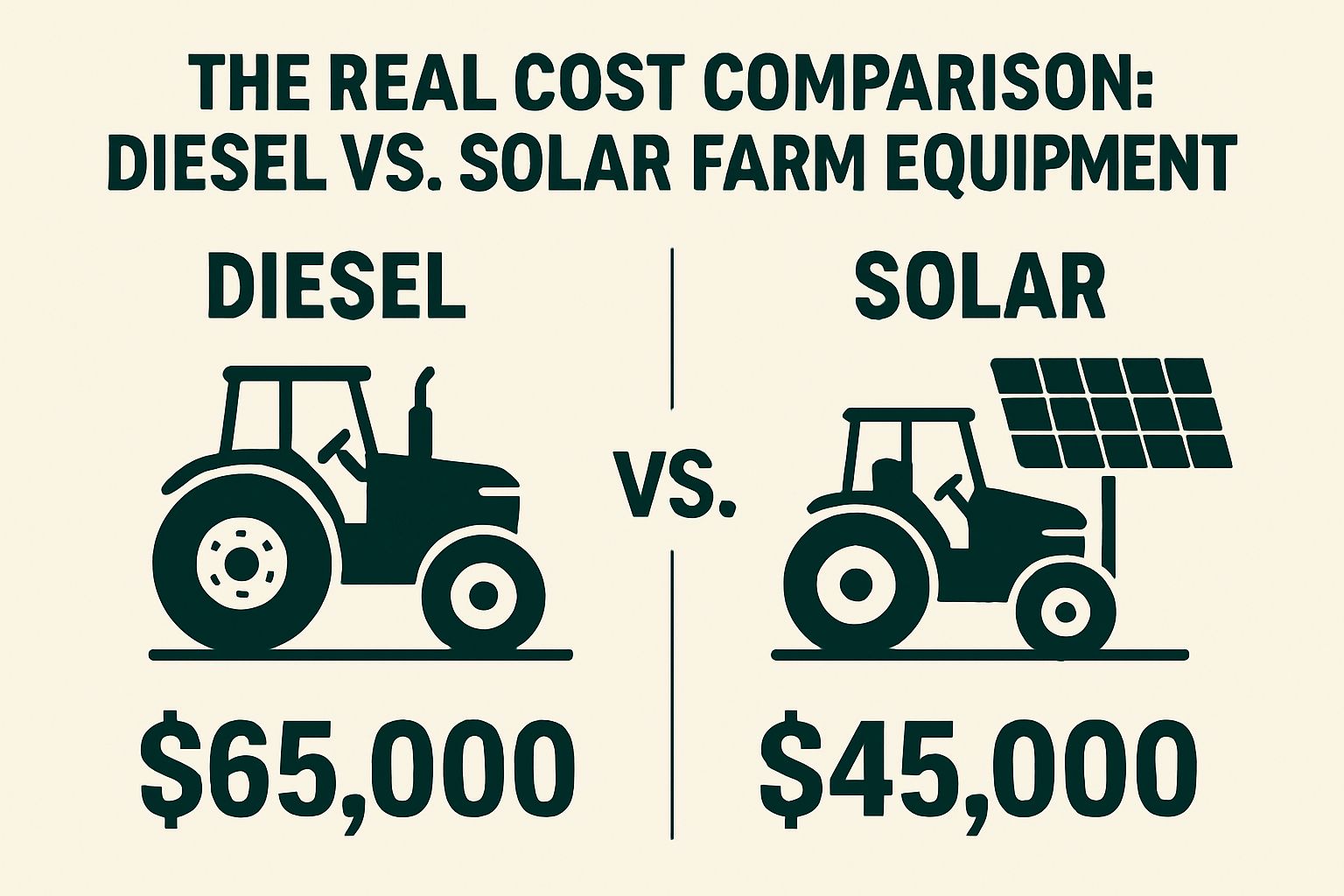
The upfront price difference between diesel and solar farm equipment is real, but focusing only on the purchase price is like judging a truck by its sticker without looking at what it costs to fill the tank for the next decade. The true financial comparison has to account for fuel, maintenance, repairs, and the compounding effect of rising diesel prices over time.
Upfront Costs vs. Long-Term Fuel Savings
A standard diesel tractor in the $75,000 to $100,000 range will consume roughly 5 gallons of fuel per hour during active field work. At $3.50 per gallon, an 8-hour workday costs approximately $140 in fuel alone. Over a 200-day operating season, that adds up to $28,000 in annual fuel costs — and that number climbs every time diesel prices spike. Comparable solar-electric tractor models range from $100,000 to $150,000 at purchase, meaning the premium over a diesel unit is $25,000 to $50,000. At $28,000 in annual fuel savings, that gap closes within two years of heavy operation, and every season after that is pure savings. For those interested in maximizing efficiency, consider the benefits of dual-axis solar trackers for agricultural use.
Maintenance costs tell an equally compelling story. Solar-powered equipment costs 60 to 70% less to maintain than conventional alternatives over a 10-year period. Electric motors have far fewer moving parts than internal combustion engines, which means no oil changes, no fuel filters, no injector cleaning, and no timing belt replacements. The mechanical simplicity of electric drive systems translates directly into fewer breakdown days and lower repair bills throughout the equipment’s working life.
How Quickly Solar Equipment Pays for Itself
The payback period for solar farm equipment varies based on how hard the equipment works, local fuel prices, and what incentives are available in your area. For farmers interested in maximizing efficiency, understanding the difference between dual-axis and single solar trackers can be crucial. Here is a realistic breakdown of what farmers can expect:
|
Equipment Type |
Typical Payback Period |
Primary Savings Driver |
|---|---|---|
|
Solar hand tools (trimmers, pruners) |
1 – 2 years |
Fuel and maintenance elimination |
|
Solar fence energizers |
1 – 3 years |
Utility bill elimination |
|
Solar irrigation systems |
3 – 5 years |
Electricity and labor savings |
|
Solar utility vehicles |
4 – 6 years |
Fuel and maintenance savings |
|
Solar tractors (full-size) |
5 – 7 years |
Fuel savings + incentives |
High-utilization equipment reaches break-even fastest. A solar irrigation pump running daily during a long growing season will hit payback far sooner than a solar tractor used only for seasonal tillage. Matching the right solar investment to your highest-use equipment category is the smartest way to accelerate your return.
Government Incentives and Tax Credits That Reduce Your Initial Investment
Federal and state incentive programs can dramatically shorten the payback timeline for solar farm equipment. The U.S. Investment Tax Credit (ITC) currently allows farmers to deduct a significant percentage of solar energy system costs directly from their federal tax liability. The USDA Rural Energy for America Program (REAP) offers grants covering up to 25% of project costs and loan guarantees for renewable energy investments on agricultural operations — including solar-powered irrigation, equipment charging stations, and solar panel installations for farm machinery.
- USDA REAP Grants: Cover up to 25% of total solar project costs for agricultural producers
- Federal Investment Tax Credit (ITC): Provides a substantial direct tax credit on qualifying solar energy system installations
- USDA EQIP Program: Offers financial assistance for conservation practices, which can include solar-powered irrigation and energy-efficient equipment upgrades
- State-Level Rebate Programs: Many states offer additional rebates, property tax exemptions, or sales tax exemptions on solar agricultural equipment — check your state’s department of agriculture for current offerings
- Accelerated Depreciation (MACRS): Solar farm equipment may qualify for 5-year accelerated depreciation under the Modified Accelerated Cost Recovery System, reducing taxable income significantly in the first years of ownership
Stacking multiple incentives is where farmers see the most dramatic reduction in effective purchase price. A solar irrigation system with a gross cost of $8,000 could see its net cost drop to $4,000 or less after applying a REAP grant, a federal tax credit, and a state rebate — cutting the payback period nearly in half before the system pumps a single gallon of water.
Working with an accountant who understands agricultural tax law is worth the investment when navigating these programs. The paperwork can be detailed, but the financial payoff for getting it right is substantial. Many solar equipment suppliers also offer assistance with REAP grant applications as part of their installation service, so it is worth asking before you sign any purchase agreement. Additionally, consider the benefits of solar panel dual-axis trackers for maximizing energy efficiency on your farm.
Solar Farm Equipment Works Best for These Types of Farms
Solar-powered tools and equipment are not a one-size-fits-all solution, but they fit a remarkably wide range of farm types and sizes. The key is matching the right solar investment to the right operational need rather than trying to replace every piece of conventional equipment at once.
The farms that see the fastest and most significant returns share a few common characteristics: high daily equipment utilization, significant fuel or electricity expenses, and either remote location or frequent equipment movement away from grid power. If your operation checks any of those boxes, solar equipment deserves a serious look at your next budget planning session.
Small to Mid-Size Operations Benefit Most
Small to mid-size farms operating between 10 and 500 acres are often the strongest candidates for solar equipment adoption. These operations typically run equipment hard during growing season, carry meaningful fuel costs relative to their overall margin, and are nimble enough to integrate new technology without the organizational complexity of large corporate farming operations. Solar hand tools, irrigation pumps, and fence energizers deliver fast, visible returns at this scale without requiring massive capital outlays to get started.
Remote Farms Save the Most on Fuel Delivery Costs
Remote farming operations carry a cost burden that grid-connected farms never face: fuel delivery charges. When diesel has to be trucked to a remote location, the per-gallon cost rises significantly above pump prices, and the logistical challenge of keeping equipment fueled adds both time and administrative overhead to daily operations. Solar-powered equipment eliminates this problem entirely at the point of installation. A solar irrigation pump or solar tractor charging station powered by rooftop or ground-mount panels turns a remote location from a cost liability into a self-sufficient energy hub — with no delivery truck required and no price spike vulnerability built into every hour of operation.
Solar Power Cuts More Than Just Fuel Costs
Fuel is the most obvious expense that solar eliminates, but it is far from the only one. When you replace diesel-powered equipment with solar-electric alternatives, you trigger a cascade of secondary savings that compound quietly over every season of operation. Farmers who have made the switch consistently report that the benefits they did not anticipate — lower maintenance bills, reduced noise, less equipment downtime — end up being just as meaningful as the fuel savings they planned for. To learn more about the options available, consider exploring solar panel backup battery types for farmers.
Lower Maintenance Bills Without Engine Upkeep
Internal combustion engines are mechanically complex, and that complexity costs money every year. Oil changes, fuel filters, air filters, spark plugs, injector cleaning, timing belt replacements, and coolant flushes are all recurring expenses that solar-electric equipment simply does not have. Electric motors contain a fraction of the moving parts found in a diesel engine, which means there is dramatically less that can wear out, break down, or require scheduled service.
Over a 10-year period, solar-powered farm equipment costs 60 to 70% less to maintain than conventional diesel alternatives. For a fleet of farm equipment, that gap represents tens of thousands of dollars staying in the operation rather than going to the repair shop. Beyond the direct cost savings, fewer maintenance requirements also mean less equipment downtime during critical planting and harvest windows — which has its own significant value on a working farm.
Reduced Noise Improves Working Conditions and Livestock Stress
Electric motors operate at a fraction of the noise level produced by diesel engines. This matters more than most farmers initially expect. Extended exposure to high-decibel engine noise creates real occupational health risks for farm operators, and persistent machinery noise near livestock has been linked to elevated stress levels in animals, which can negatively affect growth rates, milk production, and reproductive performance. Switching to solar-electric equipment reduces ambient farm noise significantly, creating a better working environment for people and a calmer one for animals — a benefit that does not show up in a fuel cost spreadsheet but absolutely shows up in overall farm productivity.
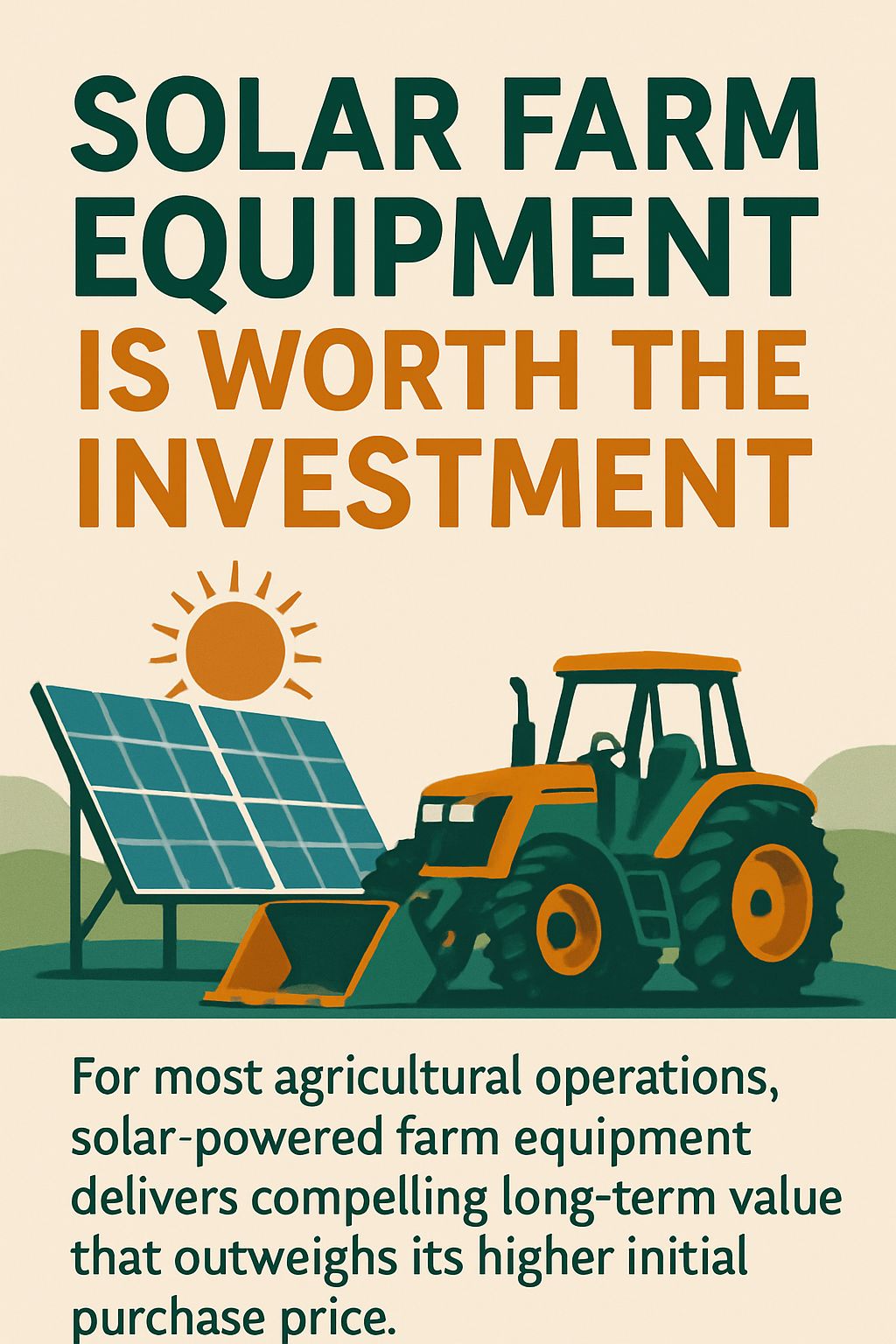
Solar Farm Equipment Is Worth the Investment
For most agricultural operations, solar-powered farm equipment delivers compelling long-term value that outweighs its higher initial purchase price. When you factor in annual fuel savings, reduced maintenance costs, available government incentives through programs like USDA REAP, and the compounding advantage of insulating your operation from diesel price volatility, the financial case becomes straightforward. Small tools and irrigation systems pay for themselves in two to three years. Larger equipment like solar tractors reaches break-even in five to seven years, and that timeline shortens considerably when incentives are stacked properly. Every season after payback is pure margin improvement — and in agriculture, margin is everything.
Frequently Asked Questions
These are the questions farmers ask most often when evaluating solar-powered equipment for their operations. The answers are based on real-world performance data and current market conditions.
How Long Does It Take for Solar Farm Equipment to Pay for Itself?
The payback period depends on the type of equipment and how intensively it is used. Solar-powered hand tools and fence energizers typically pay for themselves within one to three years. Solar irrigation systems reach break-even in three to five years. Full-size solar tractors generally require five to seven years to reach parity with their diesel counterparts, though available tax credits and USDA REAP grants can cut that timeline significantly by reducing the effective purchase price from day one.
Can Solar Tractors Handle Heavy-Duty Farm Work?
Yes — and in some respects, they outperform diesel tractors in field conditions. Electric motors deliver instant, consistent torque across their entire operating range, which means no waiting for an engine to reach peak power output. The FarmDroid FD20 is one example of a commercial solar tractor handling real agricultural workloads — seeding and mechanical weeding — autonomously and continuously on solar power alone. That said, solar tractors are best suited for operations where daily run time aligns with battery capacity, and charging infrastructure is available between shifts. For farms running equipment around the clock, a hybrid solar-diesel approach may make more practical sense as battery technology continues to improve.
Do Solar-Powered Farm Tools Work on Cloudy Days?
Solar-powered farm tools and equipment continue to operate on cloudy days, though at reduced solar input. This is where battery storage becomes essential. Equipment with properly sized lithium-ion battery packs draws on stored energy during low-light conditions, maintaining full operational capability regardless of cloud cover. Modern solar panels, particularly monocrystalline silicon designs, continue generating meaningful electricity even under overcast skies — typically at 10 to 25% of their rated output. For extended periods of heavy cloud cover, most solar farm equipment systems include a grid connection backup option that keeps batteries topped up without interrupting farm operations.
What Size Solar Setup Do I Need to Power Farm Equipment?
System sizing depends on your equipment’s power consumption, your daily operating hours, and your local solar resource (measured in peak sun hours per day). A solar irrigation pump for a 5-acre field might require a 1 to 2 kilowatt panel array, while a full equipment charging station for a solar tractor could require 10 to 20 kilowatts of panel capacity with a substantial battery bank to support overnight charging.
The most reliable way to size a solar system correctly is to start with your equipment’s rated power consumption in kilowatts, multiply by your daily operating hours to get kilowatt-hours needed, then divide by your location’s average peak sun hours to determine minimum panel capacity. Add 20 to 30% buffer capacity to account for efficiency losses and cloudy day performance reduction.
Most solar equipment suppliers and agricultural solar installers offer free system sizing consultations and provide detailed energy modeling based on your specific location and equipment list. Taking advantage of that service before purchasing is strongly recommended — an undersized system is a frustrating and expensive mistake to correct after installation.
Are There Government Grants or Tax Credits for Solar Farm Equipment?
- USDA REAP Grants: Cover up to 25% of total project costs for agricultural solar installations, with loan guarantees available for the remaining investment
- Federal Investment Tax Credit (ITC): Provides a direct federal tax credit on qualifying solar energy system costs — consult a tax professional for current rates applicable to agricultural equipment
- USDA EQIP Program: Offers financial assistance for conservation practices including solar-powered irrigation systems and energy-efficient equipment upgrades on working farms
- MACRS Accelerated Depreciation: Solar farm equipment qualifies for 5-year accelerated depreciation, significantly reducing taxable income in the early years of ownership
- State Rebate and Exemption Programs: Many states offer additional rebates, property tax exemptions on solar installations, or sales tax exemptions on solar agricultural equipment purchases
The most powerful financial strategy for solar farm equipment is stacking multiple incentives simultaneously. A farmer purchasing a $10,000 solar irrigation system could potentially receive a $2,500 REAP grant, a meaningful federal tax credit, and a state rebate — reducing the effective out-of-pocket cost to well under half of the original purchase price before a single dollar of fuel savings is counted.
Filing for these programs requires documentation and attention to deadlines, but the financial return on that administrative effort is substantial. REAP applications in particular can be competitive, so submitting early in the application window improves your chances of securing grant funding for your project.
Working with an accountant experienced in agricultural tax law is highly recommended when navigating federal and state incentive programs. The rules governing depreciation schedules, tax credit eligibility, and grant compliance requirements are specific, and getting them right maximizes the financial benefit your operation receives from the investment.
Many solar equipment installers and suppliers who specialize in agricultural projects will assist with REAP grant applications as part of their service offering. Before signing a purchase or installation agreement, ask explicitly whether grant application support is included — it frequently is, and it saves significant time and effort on your end.
The bottom line is straightforward: between federal grants, tax credits, state incentives, and accelerated depreciation, the true cost of solar farm equipment is considerably lower than the sticker price suggests. Farmers who take the time to pursue available programs consistently find that their effective investment — and their payback timeline — looks far more attractive than initial estimates indicated.

Leave a Reply