
Article-At-A-Glance
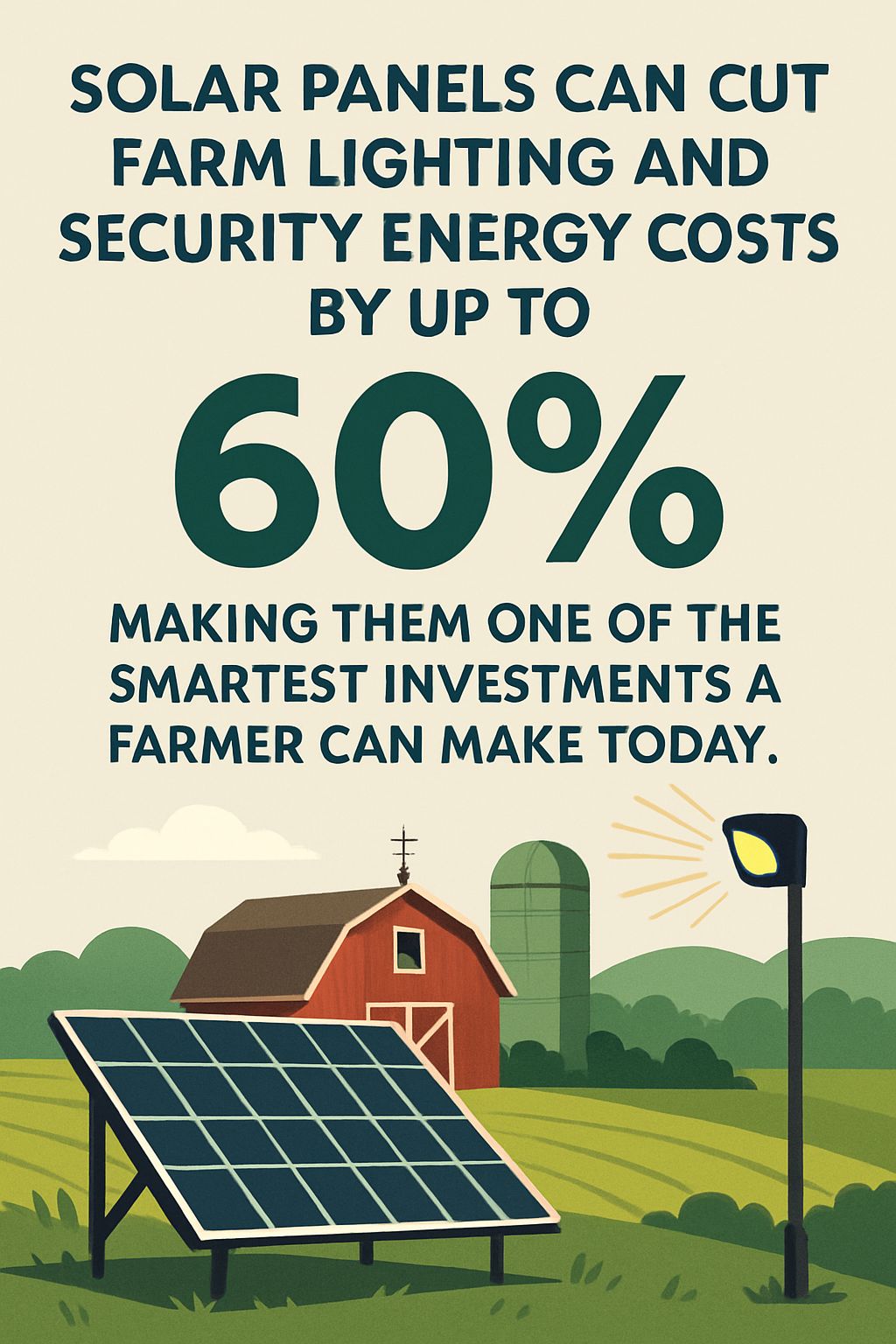
- Solar panels can cut farm lighting and security energy costs by up to 60%, making them one of the smartest investments a farmer can make today.
- Grid-dependent security systems leave farms vulnerable during outages — solar-powered alternatives keep cameras, lights, and alarms running 24/7.
- The average mid-sized farm saves between $1,200–$2,500 annually just by switching security lighting to solar power.
- Solar security systems can cover remote areas of a property that traditional wired systems simply can’t reach cost-effectively.
- There are federal and state tax incentives available for farms that install solar-powered systems — keep reading to find out what you qualify for.
Farm theft, rising electricity bills, and unreliable grid connections are draining farmers — and solar panels are quietly solving all three problems at once.
For farmers managing large properties, energy costs for lighting and security aren’t small line items. Floodlights running through the night, cameras drawing continuous power, and alarm systems tied to an unpredictable grid all add up fast. GrowingSolarMist has been at the forefront of helping agricultural communities understand how solar energy isn’t just about powering crops — it’s about protecting everything you’ve built. The shift toward solar-powered farm security is accelerating, and for good reason.
Solar Panels Cut Farm Lighting & Security Costs by Up to 60%
Traditional security lighting systems burn through electricity constantly, especially when you’re trying to illuminate large open areas like equipment yards, barn perimeters, and livestock paddocks. The costs compound quickly. A single high-wattage floodlight running eight hours a night can add hundreds of dollars to your annual electricity bill — and most farms run dozens of them.
Switching to solar-powered security lighting eliminates that recurring cost at the source. Rather than pulling from the grid, solar panels charge battery banks during daylight hours, which then power lighting and security equipment through the night. The average mid-sized farm operating this way saves $1,200–$2,500 per year on energy costs related to security lighting alone. Over a 10-year panel lifespan, that’s a substantial return that compounds alongside any energy price increases from your utility provider.
Farm Security Problems That Solar-Powered Solutions Can Fix
Farm security isn’t a simple problem. It involves protecting expensive machinery, livestock, stored crops, and remote infrastructure spread across potentially hundreds of acres. The vulnerabilities are real, and the traditional tools for addressing them have serious limitations.
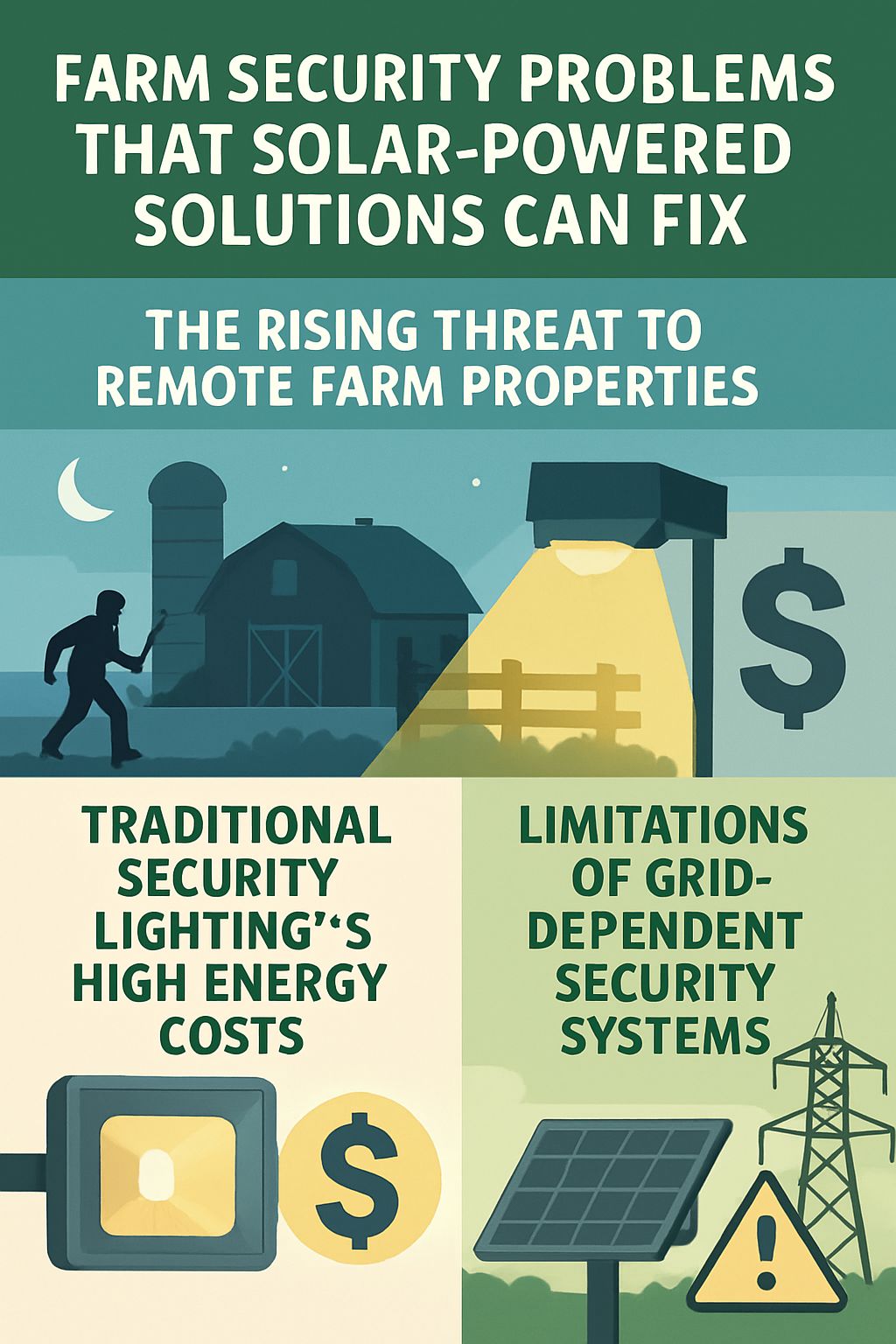
The Rising Threat to Remote Farm Properties
Agricultural theft is a growing concern across the United States. Thieves target farms specifically because of the remote locations, low foot traffic, and high-value equipment that’s often left in the open. Tractors, ATVs, irrigation equipment, copper wiring, and livestock are all common targets.
Remote areas of a farm are the most exposed. A barn located half a mile from the main house might as well be invisible to a traditional wired security system — running electrical lines out to it is expensive and disruptive. Solar-powered security stations, however, can be deployed anywhere with sun exposure, turning your most isolated outbuildings into monitored, well-lit deterrents.
Traditional Security Lighting’s High Energy Costs
Grid-powered floodlights and camera systems are expensive to run continuously. Many farms rely on metal halide or high-pressure sodium floodlights, which consume between 150–1,000 watts per fixture. Running even a modest setup of 10 fixtures at 400 watts each for 10 hours nightly generates roughly 14,600 kWh of energy consumption per year — a significant electricity bill before you’ve even considered the cameras, DVR systems, and alarm hardware drawing power alongside them.
Limitations of Grid-Dependent Security Systems
Farms in rural areas are statistically more likely to experience power outages than urban properties, and those outages tend to last longer. A severe storm that knocks out grid power for 12–48 hours leaves a grid-dependent security system completely blind. No lights. No cameras. No alarms. That window of vulnerability is exactly when opportunistic theft occurs. To mitigate such risks, farmers can explore backup batteries for solar panels to ensure continuous security system operation during power outages.
Solar-powered systems with battery storage don’t have this weakness. A properly sized battery bank — like those paired with the Renogy 200W Solar Panel Kit and a lithium iron phosphate (LiFePO4) battery — can maintain full security system operation for 48–72 hours without any sunlight input, covering the vast majority of weather-related outages.
How Solar Panels Transform Farm Security
Solar power doesn’t just replace the grid as an energy source — it fundamentally changes what’s possible for farm security. Systems that were previously impractical due to wiring costs or location constraints become straightforward to deploy when you remove the dependency on grid infrastructure.
24/7 Power for Security Systems Even During Outages
The backbone of any solar security setup is continuous, uninterrupted power. A solar panel array paired with quality battery storage ensures that your cameras, lights, and monitoring systems stay operational regardless of what the grid is doing. Systems using AGM or LiFePO4 batteries can hold charge efficiently for multiple days, with LiFePO4 options offering a lifespan of 2,000–5,000 charge cycles compared to 300–500 cycles for standard lead-acid batteries. For more information on solar panels for farms, visit MC Power’s farm solar panel page.
This reliability shifts the security dynamic entirely. Rather than hoping the grid stays up, farmers using solar-backed systems operate from a position of energy independence — their security infrastructure is simply not exposed to grid-related vulnerabilities.
Motion-Activated Lighting That Deters Intruders
Motion-activated solar floodlights are one of the most cost-effective deterrents available to farmers. Units like the LITOM 120 LED Solar Motion Sensor Light deliver up to 1,000 lumens of output triggered by movement within a 26-foot detection radius, using zero power when inactive. The sudden activation of bright lighting is highly effective at startling and deterring intruders, and the solar-charged battery ensures it’s always ready — even after several overcast days.
Smart Camera Integration with Solar Power
Modern solar security setups go well beyond simple lighting. Pairing solar power with IP camera systems gives farmers a fully independent surveillance network that doesn’t rely on grid connectivity at all. The Reolink Go PT Ultra is a strong example — it’s a 4K pan-tilt camera that operates on solar power with a built-in rechargeable battery, supports 4G LTE connectivity, and requires zero wiring. Mount it on a fence post near a gate or equipment yard, point the small solar panel toward the sky, and you have live video coverage in a location that would have cost thousands to wire traditionally.
For farms with multiple outbuildings, a networked system of solar-powered cameras creates overlapping coverage zones that eliminate blind spots. Each unit operates independently, meaning a single point of failure doesn’t compromise the entire system. Learn more about the benefits of solar panel dual-axis trackers for agriculture to enhance your farm’s efficiency.
Remote Monitoring Capabilities for Peace of Mind
One of the most underappreciated advantages of modern solar security systems is the ability to monitor your entire farm from a smartphone, anywhere in the world. Solar-powered cameras with 4G LTE or Wi-Fi connectivity push live footage and motion alerts directly to your phone. You don’t need to be on the property to know what’s happening at 2 a.m. near your equipment barn.
Systems like the Eufy SoloCam S340 offer dual-lens solar cameras with 360-degree coverage, built-in AI human detection, and continuous solar charging — all managed through a single mobile app. The AI detection filters out false alerts from animals or blowing debris, so the notifications you receive are genuinely actionable.
For larger operations, platforms like Milestone XProtect or Genetec Security Center allow centralized management of dozens of camera feeds, with event-based recording triggered by motion, schedule, or alarm input. When these platforms are fed by solar-powered camera nodes distributed across a property, the result is enterprise-grade surveillance at a fraction of traditional installation costs.
Remote monitoring also has practical benefits beyond theft prevention. Farmers regularly use their camera networks to check on livestock, monitor weather conditions across different parts of the property, and verify that equipment has been properly secured after a workday.
Solar Security System Comparison: Grid-Powered vs. Solar-Powered
Feature
Grid-Powered System
Solar-Powered System
Works During Power Outages
No
Yes (battery backup)
Remote Area Installation
Expensive (wiring costs)
Cost-effective (no wiring)
Annual Energy Cost
$1,200–$2,500+
Near $0 after install
Installation Complexity
High (licensed electrician)
Low (DIY-friendly)
Scalability
Limited by wiring infrastructure
Highly scalable
Environmental Impact
High carbon footprint
Zero operational emissions
The Dual Benefits of Solar Security Lighting
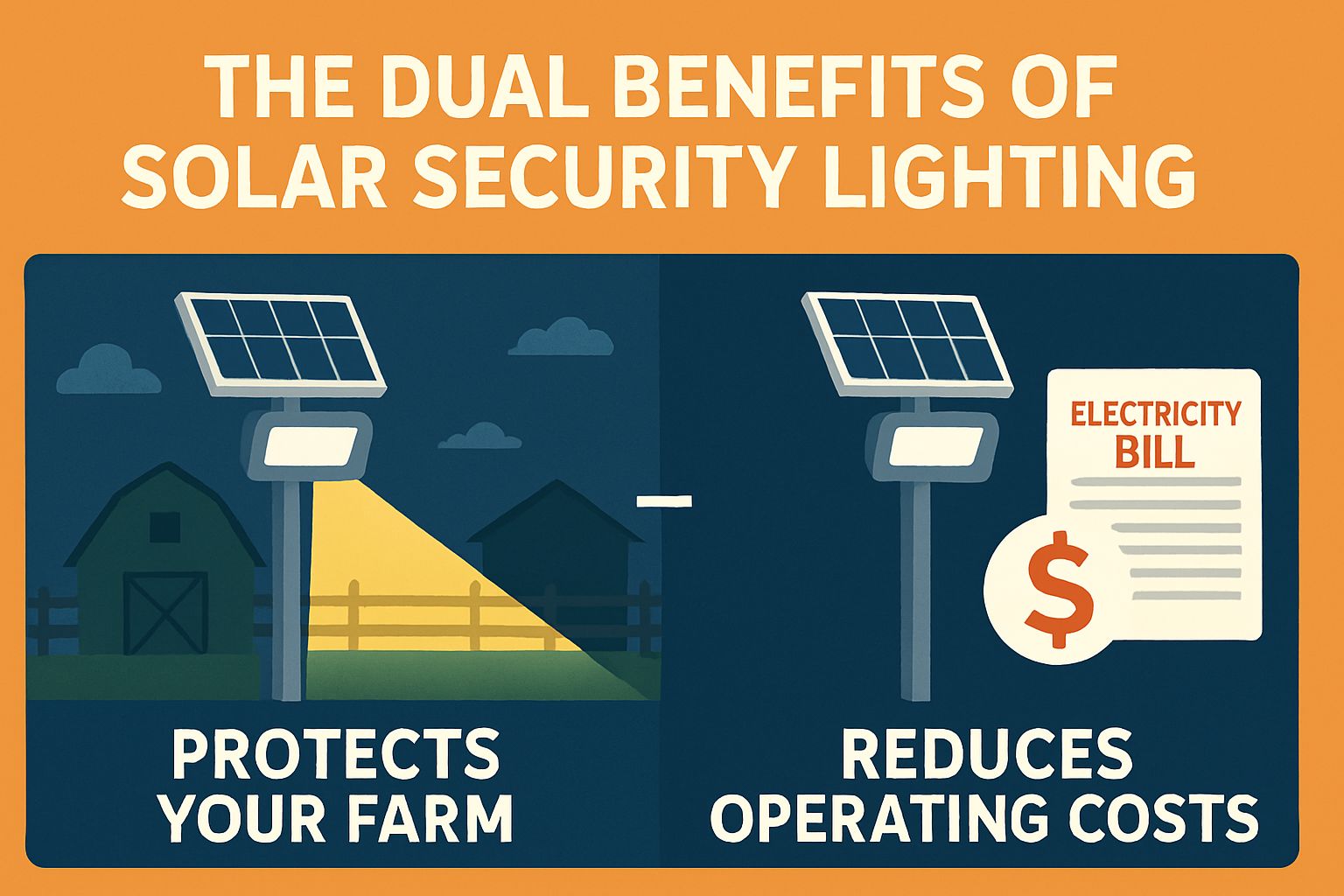
Solar security lighting delivers value on two fronts simultaneously — it protects your property while actively reducing your operating costs. These aren’t competing priorities. The same system that keeps your farm safe is the one eliminating a chunk of your monthly electricity bill.
What makes this dual benefit particularly compelling for farmers is the compounding effect. As utility energy prices continue rising, the value of your solar investment increases alongside them. A system that saves you $1,800 annually today saves you more in year five when electricity rates have climbed further.
Significant Energy Cost Reduction
The math on solar security lighting is straightforward. Traditional grid-powered security lighting for a mid-sized farm typically costs between $1,200–$2,500 per year in electricity alone. Solar-powered alternatives bring that recurring cost to near zero after the initial installation investment.
Most quality solar security lighting systems — like the Ring Solar Floodlight Cam Wired Plus or the Maxsa Innovations 44643 Solar Security Light — pay for themselves within 18–36 months through energy savings. After that, every month of operation represents pure savings returned to your farm budget. For further insights on enhancing solar power efficiency, consider exploring the benefits of smart controllers and sensors in your farming operations.
Factor in reduced wear on grid-tied electrical infrastructure, lower maintenance costs on simpler solar components, and potential reductions in farm insurance premiums when documented security systems are in place, and the financial case becomes even stronger.
Extended Coverage to Remote Areas Without Grid Access
Grid extension costs for rural properties are prohibitive — running electrical lines to a remote barn or paddock can cost $15,000–$50,000 or more depending on distance and terrain. Solar-powered security systems bypass this entirely. A self-contained solar security station can be installed in a single afternoon for a few hundred dollars, providing lighting and camera coverage in locations that would otherwise remain permanently unprotected.
Increased Property Value with Security Upgrades
Farms with documented, professionally installed security infrastructure command higher valuations. Solar-powered security systems contribute to this in two ways: they represent tangible installed assets with measurable energy savings, and they signal to buyers that the property is well-managed and protected.
Insurance companies are increasingly recognizing solar-powered security upgrades as risk-reduction measures. Several agricultural insurers offer premium discounts of 5–15% for farms with verified camera systems, motion-activated lighting, and alarm infrastructure in place — adding another layer of financial return to your solar security investment.
Real-World Success: Farmers Who Enhanced Security with Solar
The benefits of solar-powered farm security aren’t theoretical. Farmers across the country have deployed these systems and documented measurable improvements in both security outcomes and energy costs. Two cases illustrate what’s possible when solar technology is applied strategically to real agricultural security challenges.
Case Study: Livestock Farm Reduces Theft with Strategic Lighting
A cattle operation in central Texas had experienced repeated incidents of equipment theft and unauthorized vehicle access through a back gate nearly a mile from the main farmhouse. Running electrical lines to that location was quoted at over $22,000. Instead, the farm installed a solar security station combining two LITOM 120 LED Solar Motion Sensor Lights and a Reolink Go PT Ultra solar camera with 4G LTE connectivity. Total hardware cost came in under $800. Within the first month of installation, the motion-activated lighting triggered twice on approaching vehicles — both times resulting in the vehicles turning around before reaching the gate. The remote camera footage was accessible in real time from the farmer’s phone, and the entire system operated without any grid connection or monthly service fees beyond the cellular data plan.
Case Study: Orchard Protects Equipment with Solar Security
A stone fruit orchard in California’s Central Valley was losing tens of thousands of dollars annually to equipment theft and vandalism during harvest season. The orchard’s equipment storage area sat at the far end of the property, well beyond practical grid extension range. The owner installed a network of four Eufy SoloCam S340 solar cameras positioned at key access points around the storage yard, supplemented by Maxsa Innovations 44643 Solar Security Lights mounted on the equipment shed corners. The AI-powered human detection on the Eufy cameras filtered out the constant movement of orchard workers during the day while flagging after-hours activity precisely. In the first full harvest season after installation, the orchard reported zero equipment theft incidents — a dramatic contrast to prior years. The owner noted the system paid for itself in the first season alone when compared to the value of equipment previously lost.
Is it a Good Investment for a Farmer to Use Solar Panels to Power the Farm Security System & Night Lighting Efficiency
Yes — and the numbers make the case clearly. A properly designed solar security system for a mid-sized farm typically requires an upfront investment of $2,000–$8,000 depending on coverage area, camera count, and battery storage capacity. Against annual energy savings of $1,200–$2,500, most systems achieve full payback within 2–4 years. After that breakeven point, the system continues generating savings for another 20+ years, since quality solar panels carry performance warranties lasting 25 years and LiFePO4 battery banks routinely last 10–15 years with minimal maintenance.
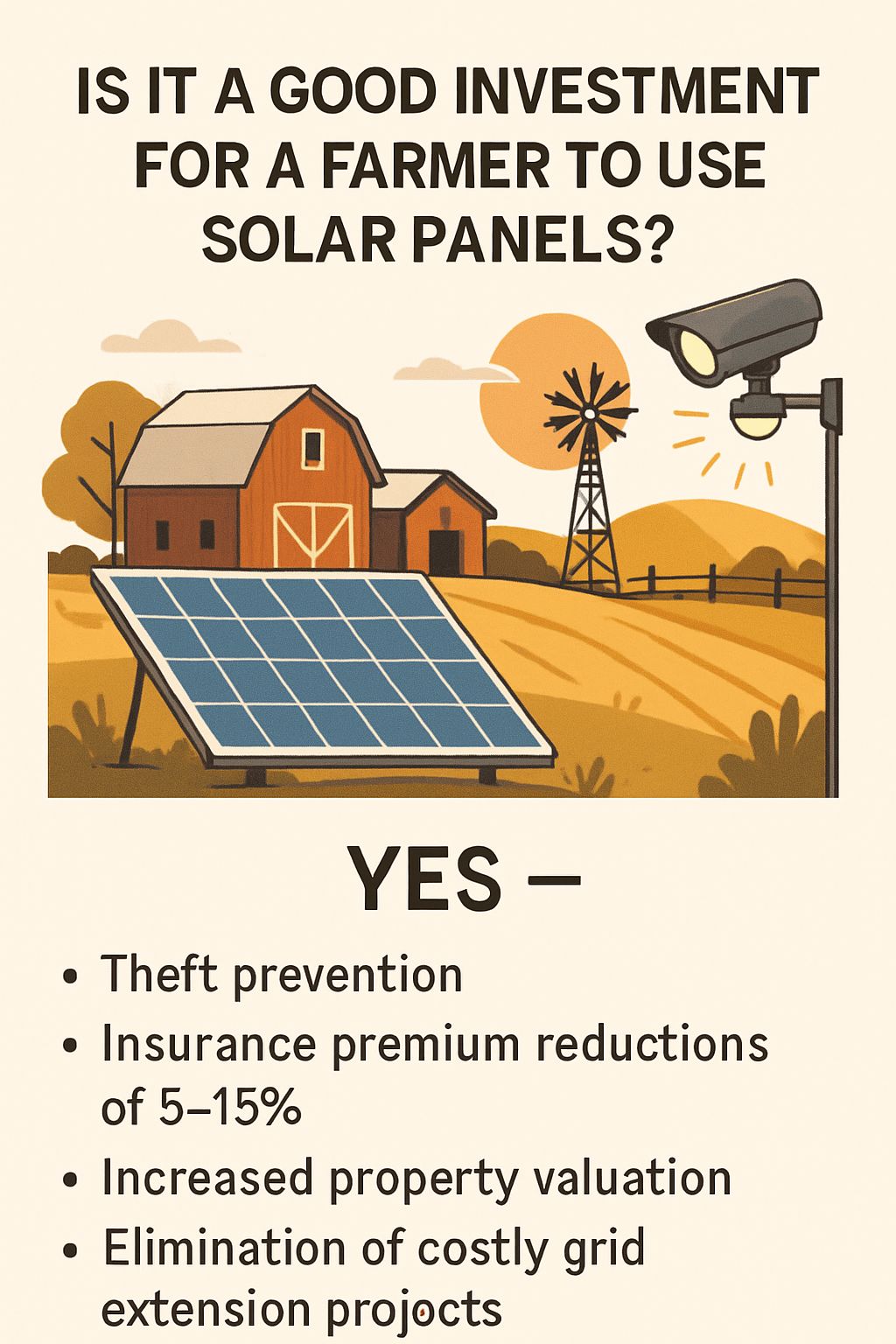
Beyond the direct energy savings, the investment case strengthens when you account for theft prevention, insurance premium reductions of 5–15%, increased property valuation, and the elimination of costly grid extension projects. For farms in remote areas where grid power to outbuildings would cost $15,000–$50,000 to install, solar security systems don’t just pay for themselves — they replace an expense that would have been far larger. The question for most farmers isn’t whether solar security makes financial sense. It’s how quickly they can get the system deployed and generating returns.
Frequently Asked Questions
Solar-powered farm security is a practical, financially sound upgrade for operations of almost any size. As more farmers make the transition, a consistent set of questions comes up around costs, compatibility, durability, and incentives.
The answers below cut through the noise and give you the specific information you need to make a confident decision about deploying solar security on your property.
Whether you’re starting from scratch or looking to upgrade an existing system, understanding these fundamentals will help you invest wisely and avoid common pitfalls.
How Much Do Solar Security Lights for Farms Typically Cost?
Entry-level solar security lights — like the LITOM 120 LED Solar Motion Sensor Light — start at around $30–$80 per unit. Mid-range floodlights with larger solar panels and higher lumen output, such as the Maxsa Innovations 44643, run $80–$200 per unit. Premium solar camera-light combos like the Ring Solar Floodlight Cam Wired Plus or Eufy SoloCam S340 range from $150–$400 per unit.
For a complete farm security lighting system covering multiple outbuildings, entry points, and perimeter zones, expect a total hardware investment of $1,500–$6,000 depending on scale. Installation is largely DIY-friendly for solar systems, which eliminates the $500–$2,000+ electrician costs associated with grid-tied alternatives. Annual operating costs after installation are minimal — typically just occasional battery replacement every 5–10 years and basic panel cleaning.
Can Solar-Powered Security Systems Integrate with Existing Farm Cameras?
Yes, in most cases. If your existing cameras are already IP-based and connected to a network video recorder (NVR) or cloud platform, adding solar power is primarily a matter of replacing or supplementing the camera’s power source rather than replacing the camera itself. Solar-to-USB and solar-to-12V DC adapters make it straightforward to connect solar panels and battery banks to many existing camera models.
For fully wired PoE (Power over Ethernet) camera systems, a solar-charged battery system feeding a PoE switch can power the entire camera network independently from the grid — keeping your existing infrastructure intact while removing the grid dependency. Compatibility considerations to check before purchasing include the type of battery used, such as LiFePO4 batteries, which are beneficial for solar panel backups in farming.
- Camera operating voltage requirements (typically 12V DC or PoE 48V)
- Power consumption in watts per camera (critical for sizing the solar panel and battery bank)
- Whether the NVR or DVR system can also be solar-powered or has a UPS backup option
- Connectivity type — Wi-Fi, 4G LTE, or wired Ethernet — which affects where cameras can be physically located
- Cloud platform compatibility if you’re adding new solar cameras alongside existing ones
When in doubt, consult the camera manufacturer’s specifications for minimum and maximum input voltage before connecting any solar power system to existing hardware.
How Long Do Solar Panels for Security Lighting Systems Last?
Quality solar panels used in security lighting systems carry performance warranties of 25 years, with most maintaining over 80% of their original output capacity at that mark. The panels themselves rarely fail outright — degradation is gradual, averaging about 0.5% output reduction per year for premium monocrystalline panels. In practical terms, a solar panel installed today will still be performing effectively well into the 2040s with minimal maintenance beyond occasional cleaning.
Do Solar Security Systems Work in Cloudy or Rainy Weather?
Solar panels continue generating power on cloudy days — typically at 10–25% of their peak output depending on cloud density. While this reduced input means the battery bank isn’t charging as aggressively, a properly sized system accounts for multiple consecutive low-sun days without any degradation in security system performance.
The key is right-sizing your battery storage capacity relative to your system’s power consumption. A system drawing 50 watts continuously needs at minimum a 100Ah 12V battery bank to cover 24 hours without solar input. Most well-designed farm security setups use batteries sized for 48–72 hours of autonomy, providing a substantial buffer through extended cloudy periods or heavy rain events. To explore more about the benefits of backup batteries for solar panels, check out this guide on backup batteries.
In practice, most regions of the United States — even the Pacific Northwest, which sees significant cloud cover — receive enough annual solar irradiance to keep well-designed solar security systems running reliably year-round. The Renogy 200W Solar Panel Kit paired with a 200Ah LiFePO4 battery is a commonly recommended starting point for farms in lower-sunlight regions, providing enough generation and storage margin to handle multi-day overcast stretches without issue.
Are There Tax Incentives for Installing Solar-Powered Farm Security?
Yes — and they’re substantial. The federal Investment Tax Credit (ITC), currently set at 30% through 2032 under the Inflation Reduction Act, applies to solar energy systems installed on farms, including those used for security and lighting applications. This means a $5,000 solar security system installation generates a $1,500 direct reduction in your federal tax liability — not a deduction, but a dollar-for-dollar credit.
Beyond the federal ITC, many states offer additional incentives. The USDA Rural Energy for America Program (REAP) provides grants covering up to 50% of eligible project costs for agricultural producers installing renewable energy systems, including solar. REAP grants are specifically designed for farm operations and have funded thousands of solar installations across the country. Applications are accepted on a rolling basis, making it accessible for farms planning installations at any point during the year.
State-level incentives vary significantly but can include additional tax credits, sales tax exemptions on solar equipment purchases, and property tax exemptions that prevent your solar installation from increasing your farm’s assessed property tax value. Checking the Database of State Incentives for Renewables & Efficiency (DSIRE) at dsireusa.org gives you a complete picture of what’s available in your specific state — it’s the most comprehensive and regularly updated resource for agricultural solar incentives currently available.







Leave a Reply