
Article-At-A-Glance
- Solar powered traveling gun sprinkler systems can reduce irrigation energy costs by up to 80% compared to conventional diesel systems
- These systems combine mobility with renewable energy, allowing for efficient irrigation of large and irregularly shaped fields
- Initial investment is recovered within 3-5 years through energy savings and increased crop yields
- Modern solar irrigation systems can be integrated with smart controllers for weather-responsive watering schedules
- GreenSprout Solutions offers customized solar irrigation assessments to determine the optimal system configuration for your specific farm needs
Imagine irrigating your entire farm without a single drop of diesel or a penny spent on grid electricity. That’s the reality for a growing number of farmers embracing solar powered traveling gun sprinkler systems.
The marriage between renewable energy and efficient irrigation technology is revolutionizing how we water our crops. By harnessing the sun’s energy, these systems offer a sustainable solution to one of farming’s most resource-intensive operations. GreenSprout Solutions has been at the forefront of this agricultural revolution, helping farmers transition to cleaner energy while maintaining optimal crop yields.
How Solar Powered Traveling Gun Sprinklers Are Transforming Farm Irrigation
The traditional image of farm irrigation often involves noisy diesel pumps, extensive electrical infrastructure, or labor-intensive manual systems. Solar powered traveling gun sprinklers represent a fundamental shift in this paradigm. These systems combine the coverage and efficiency of traveling sprinklers with the sustainability and cost-effectiveness of solar power, creating an irrigation solution that addresses multiple challenges facing modern agriculture.
What makes these systems truly revolutionary is their ability to operate completely off-grid while maintaining the performance characteristics farmers need. This independence from traditional energy sources not only reduces operational costs but also allows irrigation in remote locations previously dependent on expensive fuel transport or electrical infrastructure development.
What is a Traveling Gun Sprinklers Irrigation System
Traveling Gun Sprinkler Basics
A mechanical irrigation system that moves across fields while spraying water through a large-volume nozzle. Typically covers 2-5 acres per setup and can distribute 100-1000 gallons per minute depending on model size and pressure. Learn more about the benefits of solar-powered traveling gun irrigation systems and how they can enhance your farming efficiency.
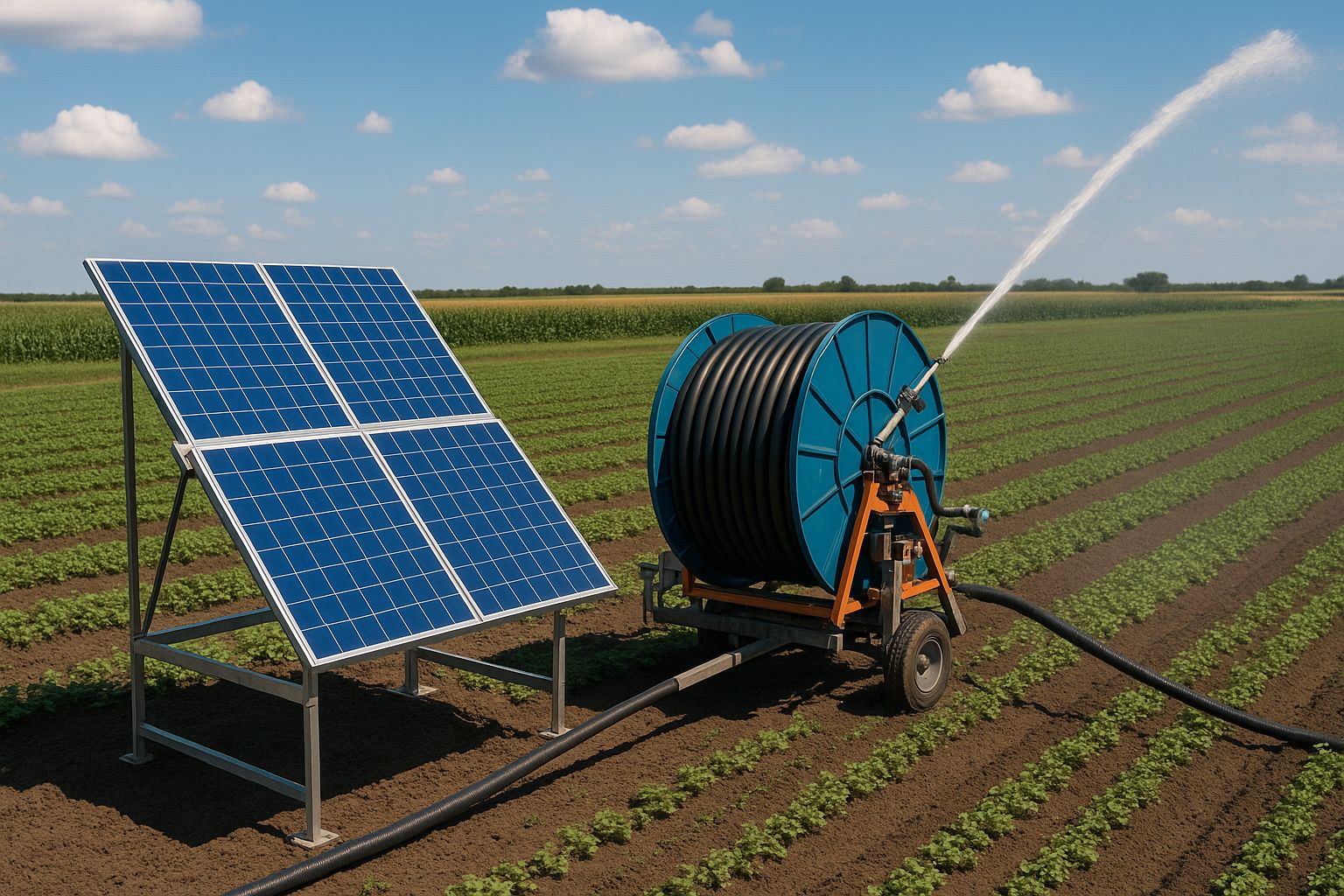
A traveling gun sprinkler system consists of a large sprinkler mounted on a wheeled cart or platform that gradually moves across a field. Unlike fixed sprinklers that cover only a limited area, these systems “travel” along a predetermined path, providing uniform water distribution over large sections of land. The movement is typically powered by the water pressure itself or by a separate motor, allowing the sprinkler to slowly traverse the field while distributing water in a wide arc.
These systems have been valued for decades due to their versatility and efficiency. Their ability to cover irregularly shaped fields, adapt to varying terrain, and provide adjustable water distribution patterns makes them particularly suited for diverse agricultural operations. The “gun” component refers to the high-capacity nozzle that can project water up to 200 feet, covering substantial width with each pass.
Traditional traveling gun systems typically rely on diesel pumps or grid electricity to generate the pressure needed for operation. This dependency on conventional energy sources has historically been one of their few drawbacks, particularly as energy costs rise and environmental concerns grow.
How can Solar Panels Improve that Irrigation System
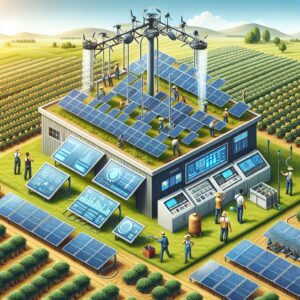
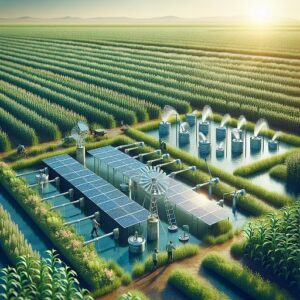
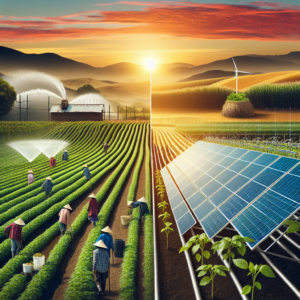
Solar panels transform traveling gun sprinklers from energy-intensive equipment into self-sufficient, sustainable irrigation solutions. By replacing diesel generators or grid electricity with photovoltaic panels, farmers can power their irrigation systems using free, renewable energy from the sun. This modification eliminates fuel costs, reduces carbon emissions, and provides energy independence.
The integration process involves installing appropriately sized solar arrays that connect to controllers and pumps compatible with DC power or utilizing inverters for AC equipment. Modern systems often include battery storage components that allow for operation during cloudy periods or even at night, providing flexibility that was once a limitation of solar technology. The panels themselves can be mounted on fixed structures or, increasingly, on mobile platforms that move with the irrigation system.
Water and Energy Challenges Facing Modern Farmers
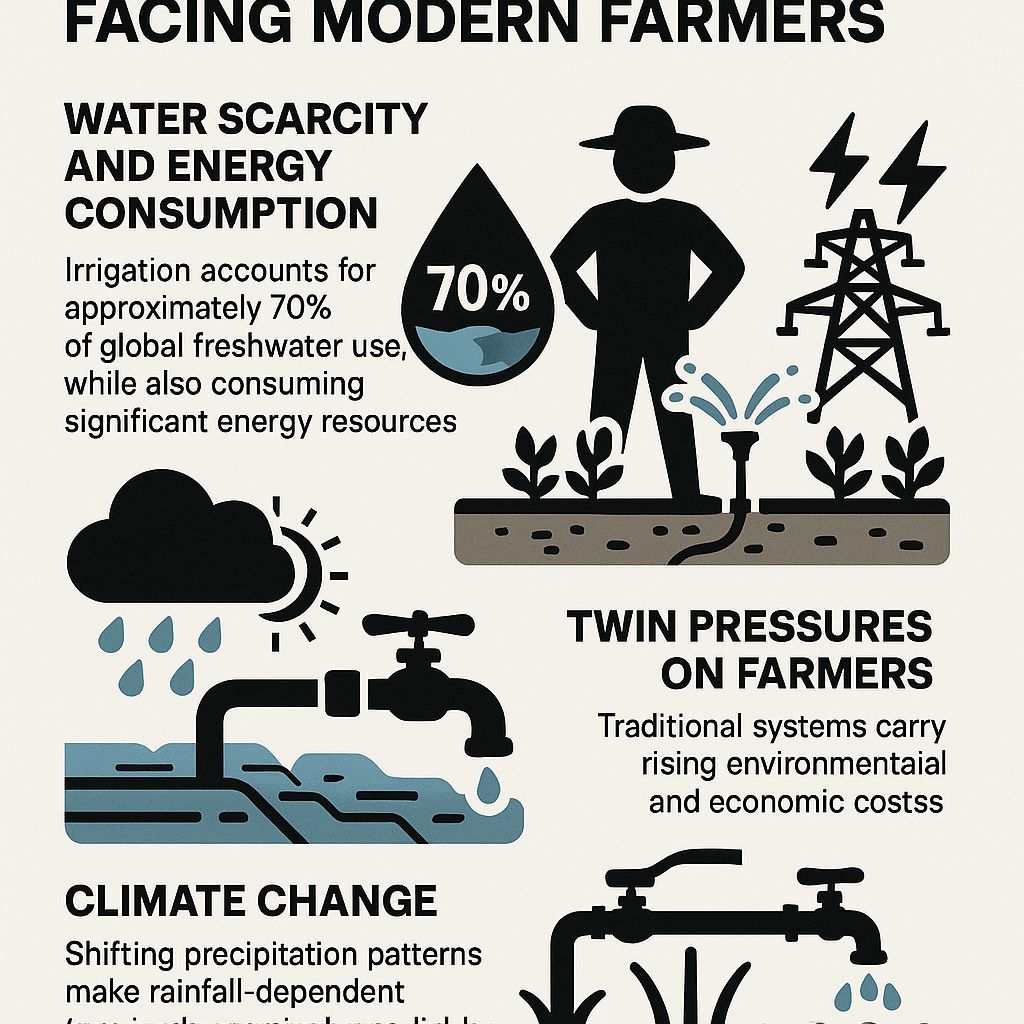
Agriculture stands at the intersection of two critical resource challenges: water scarcity and energy consumption. Irrigation accounts for approximately 70% of global freshwater use, while also consuming significant energy resources. These twin pressures create a perfect storm for farmers trying to maintain productivity while managing increasing costs and environmental responsibilities.
Climate change further complicates this picture, with shifting precipitation patterns making traditional rainfall-dependent farming increasingly unreliable. The need for efficient, controlled irrigation has never been greater, yet the environmental and economic costs of conventional systems continue to rise. For innovative solutions, consider exploring solar panels powering a farm’s irrigation system to mitigate these challenges.
Rising Electricity Costs Impact on Irrigation Operations
Electricity rates for agricultural operations have climbed steadily over the past decade, with some regions seeing increases of 5-8% annually. For irrigation-intensive farms, this escalation represents thousands of dollars in additional operational costs each year. A medium-sized farm running electric pumps during the growing season can easily face monthly electricity bills exceeding $3,000 during peak irrigation periods.
The financial burden is compounded by the fact that peak irrigation needs often coincide with utility peak demand periods, subjecting farmers to the highest possible rate tiers. In some agricultural regions, special time-of-use rates further penalize daytime irrigation when water is most needed. These economic pressures force difficult decisions about when and how much to irrigate, sometimes at the expense of optimal crop development.
Limitations of Traditional Diesel-Powered Systems
Diesel-powered irrigation systems, while reliable and powerful, come with significant drawbacks that impact both farm economics and environmental sustainability. Fuel costs can fluctuate dramatically, making budget planning difficult and often creating unexpected financial strain during critical growing periods. A typical traveling gun system consuming 2-3 gallons of diesel per hour can easily cost $75-100 daily in fuel alone during peak season.
Maintenance requirements for diesel engines add another layer of expense and complexity. Regular servicing, part replacements, and inevitable breakdowns can create costly downtime during critical irrigation windows. The average farmer spends between $1,500-2,500 annually on maintenance for diesel-powered irrigation systems, not including emergency repairs that can run into thousands more.
Additionally, the logistical challenges of fuel delivery and storage create operational hurdles, particularly for remote farming operations. Many farmers must maintain on-site fuel storage tanks, which present environmental risks and require additional safety compliance measures.
Environmental Concerns with Conventional Irrigation Methods
The environmental impact of conventional irrigation extends far beyond water usage. Diesel-powered systems release significant amounts of greenhouse gases and particulate matter. A single diesel pump operating for a typical growing season can emit the equivalent of driving a passenger vehicle over 30,000 miles. These emissions contribute to climate change and local air quality issues that affect farm workers and nearby communities.
Water waste is another critical environmental concern with many conventional systems. Poor distribution uniformity, evaporation losses, and runoff can result in up to 50% of pumped water never reaching crop root zones. This inefficiency not only wastes a precious resource but also increases energy consumption as systems must run longer to achieve adequate crop hydration.
Soil compaction and erosion often result from improper irrigation practices, degrading farm productivity over time. Heavy traveling gun equipment can create wheel tracks that compact soil, while excessive or poorly timed water application can wash away valuable topsoil and nutrients.
What Makes Solar Traveling Gun Sprinklers Different
Solar traveling gun sprinkler systems represent a fundamental reimagining of agricultural irrigation. They maintain the versatility and coverage capabilities that farmers value in traveling gun systems while eliminating the dependence on fossil fuels. This hybrid approach leverages proven irrigation technology with cutting-edge renewable energy systems, creating a solution that addresses multiple challenges simultaneously.
Unlike fixed solar irrigation systems, these mobile platforms can service large areas with minimal infrastructure, making them suitable for diverse farming operations from small specialty crop producers to large commodity growers. Their adaptability to varying field shapes, crops, and watering requirements provides flexibility that few other irrigation solutions can match.
Core Components of a Solar Powered Irrigation System
At the heart of every solar powered traveling gun system is the photovoltaic array, typically ranging from 2kW to 25kW depending on water requirements and pumping depth. These panels convert sunlight directly into DC electricity, which is then either used immediately or stored for later use. Modern agricultural solar panels are designed specifically for farm environments, with reinforced frames and coatings that resist dust and agricultural chemicals.
The pump system represents another critical component, usually consisting of a high-efficiency DC pump or an AC pump paired with an inverter. These pumps are specifically engineered for variable power input, allowing them to operate efficiently even during periods of fluctuating sunlight. Advanced models incorporate maximum power point tracking (MPPT) technology that optimizes power transfer from the solar array to the pump under changing conditions.
Control systems have evolved significantly, now featuring programmable logic controllers that manage irrigation schedules, monitor system performance, and protect equipment from damage. Many include remote monitoring capabilities via cellular or satellite connections, allowing farmers to adjust irrigation parameters from anywhere using smartphone applications. Some advanced systems even incorporate weather forecasting data to automatically adjust watering schedules based on predicted rainfall or evapotranspiration rates.
How the Traveling Mechanism Works
The traveling mechanism in solar-powered systems typically employs a cable-reel design that gradually pulls the sprinkler cart across the field. A solar-powered motor drives the reel, winding the cable at a precisely controlled rate to ensure uniform water application. Speed control is crucial for proper irrigation, with most systems offering adjustable travel rates between 1-10 feet per minute depending on soil conditions, crop requirements, and water output.
Some advanced models utilize GPS guidance to ensure straight travel paths and precise positioning, particularly valuable for irregularly shaped fields or those with obstacles. This technology allows for automated operation without requiring extensive setup of physical guides or markers. The tracking systems can also record coverage data, creating detailed irrigation maps that help farmers optimize future watering cycles.
Safety features are integrated throughout the traveling mechanism, including automatic shutoffs for end-of-field detection, pressure loss, or system faults. These protections prevent both equipment damage and water waste, ensuring the system operates only when conditions are appropriate.
Water Distribution Patterns and Coverage Area
Solar powered traveling gun systems typically provide coverage swaths of 70-200 feet in width, depending on nozzle size, pressure, and water volume. The sprinkler head rotates as it travels, creating a uniform precipitation pattern that ensures consistent soil moisture across the field. Adjustable arc settings allow farmers to customize the spray pattern for different field shapes or to avoid irrigating roads, buildings, or sensitive adjacent crops. For more information on these systems, you can explore the solar-powered traveling gun irrigation systems.
Modern systems incorporate pressure regulation technology that maintains consistent water distribution even as solar power input varies throughout the day. This innovation addresses one of the historical challenges of solar irrigation – maintaining uniform application despite fluctuating energy availability. Variable frequency drives (VFDs) play a critical role in this capability, adjusting pump speed to maintain target pressure regardless of solar intensity.
A single setup can typically irrigate 2-5 acres before requiring repositioning, with the entire system capable of managing 40-160 acres depending on water availability and crop requirements. This scalability makes solar traveling gun systems appropriate for operations of various sizes, from small specialty crop producers to large commodity farms.
Battery Storage Options for Overnight Operation
Battery storage represents a game-changing addition to solar irrigation, enabling operation during cloudy periods or even at night when evaporation losses are minimized. Modern lithium iron phosphate (LiFePO4) batteries offer the durability and cycle life needed for agricultural applications, typically maintaining 80% of their original capacity after 3,000-5,000 charge cycles. This translates to 8-10 years of reliable service before replacement becomes necessary.
Sizing battery systems appropriately involves balancing cost against operational needs. A typical mid-sized traveling gun system might incorporate 10-30kWh of storage, sufficient for 4-8 hours of operation without solar input. Some farmers opt for smaller battery systems designed primarily to provide stable power during cloudy periods rather than full overnight capability, reducing initial investment while still improving system reliability.
Advanced battery management systems protect this investment by preventing harmful deep discharge cycles and optimizing charging patterns based on available solar energy and projected irrigation needs. Many include predictive features that consider weather forecasts when determining how to allocate stored energy, ensuring sufficient power remains available for critical irrigation windows. For more information on how these systems work, check out our guide on solar-powered irrigation systems.
Setting Up Your Solar Powered Irrigation System
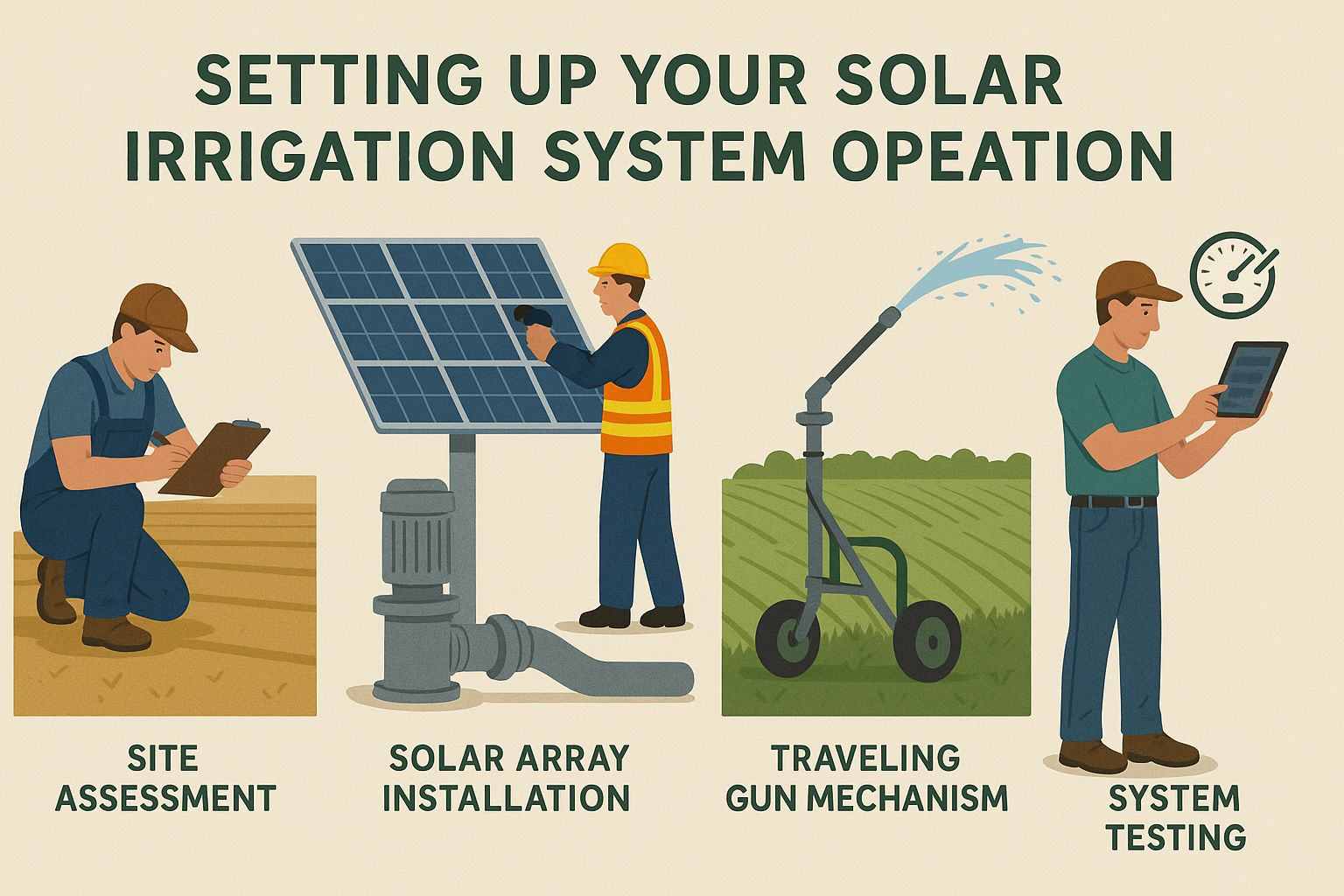
Implementing a solar powered traveling gun sprinkler system begins with a comprehensive site assessment. This evaluation examines your field layout, water source capabilities, soil characteristics, and local solar radiation patterns. Proper planning at this stage prevents costly modifications later and ensures the system meets your specific agricultural needs.
Installation typically requires professional expertise, though farmers with technical backgrounds can handle some aspects themselves. The process involves mounting solar arrays, installing pump equipment, setting up the traveling gun mechanism, and configuring control systems. Most installations can be completed in 3-7 days depending on system complexity and farm conditions.
Post-installation testing is crucial to verify proper operation and calibrate the system for optimal performance. This includes checking pressure levels, confirming travel speeds, measuring water distribution uniformity, and testing all safety features. Taking time for proper setup pays dividends through years of reliable operation.
Determining the Right System Size for Your Farm
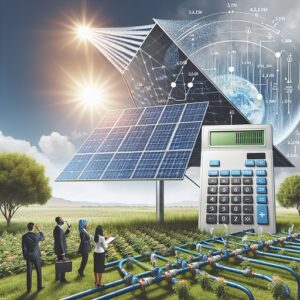
Sizing a solar irrigation system requires balancing several factors including acreage, crop water requirements, soil infiltration rates, and available irrigation windows. A common mistake is undersizing the system, which leads to inadequate irrigation during critical growth periods. Conversely, oversized systems represent unnecessary capital expenditure. Most agricultural operations benefit from working with an irrigation engineer to perform proper hydraulic calculations.
For reference, a typical 20-acre vegetable operation in the Midwest might require a 5-7.5kW solar array powering a 5-7.5HP pump to deliver 100-150 gallons per minute. This configuration can irrigate approximately 1-2 acres per day with 1″ of water. Scaling this baseline up or down based on your specific needs provides a starting point for system sizing.
Proper Placement of Solar Panels for Maximum Efficiency
Solar array placement significantly impacts system performance. Panels should face true south in the Northern Hemisphere with a tilt angle approximately equal to your latitude for year-round operation. Some farmers opt for adjustable mounting systems that allow seasonal tilt changes to maximize summer production when irrigation demands peak.
Shading represents the primary efficiency killer for solar irrigation systems. Even partial shading of a single panel can disproportionately reduce overall array output. Site panels away from trees, buildings, and other potential obstructions, considering their shadows throughout the day and across seasons. Modern solar systems often incorporate module-level power electronics that mitigate some shading impacts, but optimal placement remains the best strategy.
Water Source Requirements and Compatibility
Water source characteristics directly impact solar irrigation system design and performance. Key factors include available flow rate, pumping depth, water quality, and seasonal reliability. Surface water sources like ponds or streams typically require less pumping energy than deep wells, making them ideal partners for solar systems. Well depths beyond 100 feet may necessitate larger solar arrays or specialized pump configurations.
Water quality considerations include sediment content, mineral composition, and biological contaminants. High sediment loads require filtration systems to prevent nozzle clogging and pump wear. Hard water with elevated mineral content can cause scale buildup in pipes and sprinkler components. Including appropriate filtration and water treatment in your system design prevents these issues from compromising performance.
Cost Analysis: Investment vs. Returns
The economics of solar powered traveling gun systems present a compelling case for most agricultural operations. While initial costs exceed conventional alternatives, the elimination of ongoing fuel or electricity expenses creates substantial lifetime savings. Most systems achieve financial breakeven within 3-5 years, after which they provide essentially free irrigation for their remaining 20+ year lifespan.
The financial picture improves further when accounting for increased crop yields and quality that result from more consistent irrigation. Many farmers report 15-30% yield improvements after implementing solar irrigation, particularly in drought-prone regions where conventional systems might be curtailed due to fuel costs or electrical outages.
Initial Setup Costs Breakdown
|
Component |
Typical Cost Range (USD) |
Percentage of Total Investment |
|---|---|---|
|
Solar PV Array (5-15kW) |
$10,000 – $30,000 |
30-40% |
|
Pump System |
$5,000 – $15,000 |
15-25% |
|
Traveling Gun Equipment |
$8,000 – $25,000 |
20-30% |
|
Control Systems |
$2,000 – $10,000 |
5-15% |
|
Battery Storage (Optional) |
$5,000 – $20,000 |
10-20% |
|
Installation & Site Prep |
$3,000 – $12,000 |
10-15% |
Available Tax Incentives and Agricultural Grants
Numerous financial incentives significantly reduce the net cost of solar irrigation systems. The federal Investment Tax Credit (ITC) currently allows farm operations to deduct 30% of the system cost from their tax liability. USDA’s Rural Energy for America Program (REAP) offers both grants covering up to 25% of project costs and loan guarantees for renewable energy systems. Many states provide additional tax credits, rebates, or grant programs specifically for agricultural solar applications.
Beyond direct financial incentives, accelerated depreciation provisions allow farmers to recover their investment more quickly through tax deductions. The Modified Accelerated Cost Recovery System (MACRS) enables writing off the entire system cost over just 5 years, creating substantial tax benefits during the early years of ownership when they most significantly impact project economics.
Long-Term Savings Calculation
The economic value proposition for solar traveling gun systems centers on their ability to eliminate ongoing energy costs. A diesel-powered irrigation system typically consumes 0.5-0.8 gallons of fuel per hour per horsepower. For a 10HP system operating 1,000 hours annually, this represents 5,000-8,000 gallons of diesel. At current fuel prices, the annual operating cost exceeds $20,000—a recurring expense eliminated with solar power.
Similarly, grid-powered irrigation incurs substantial electricity costs. The same 10HP system would consume approximately 75,000 kWh annually, resulting in $7,500-15,000 in electricity charges depending on local utility rates. Solar irrigation eliminates these expenses while also avoiding demand charges and peak rate periods that particularly impact agricultural users.
Typical Payback Period for Different Farm Sizes
Payback periods vary based on farm size, crop value, local energy costs, and available incentives. Small specialty crop operations (5-20 acres) typically see the quickest returns, often achieving complete payback in 2-4 years due to the high value of reliable irrigation for premium crops. The combination of energy savings and improved yields creates compelling economics even with relatively small systems.
Mid-sized operations (20-100 acres) generally experience payback periods of 3-5 years. These farms benefit from economies of scale in system costs while still maintaining the yield benefits of consistent irrigation. Larger commodity crop operations (100+ acres) typically see payback periods of 4-7 years, with economics driven primarily by the substantial energy savings across large irrigated acreage.
5 Biggest Benefits of Solar Traveling Gun Systems
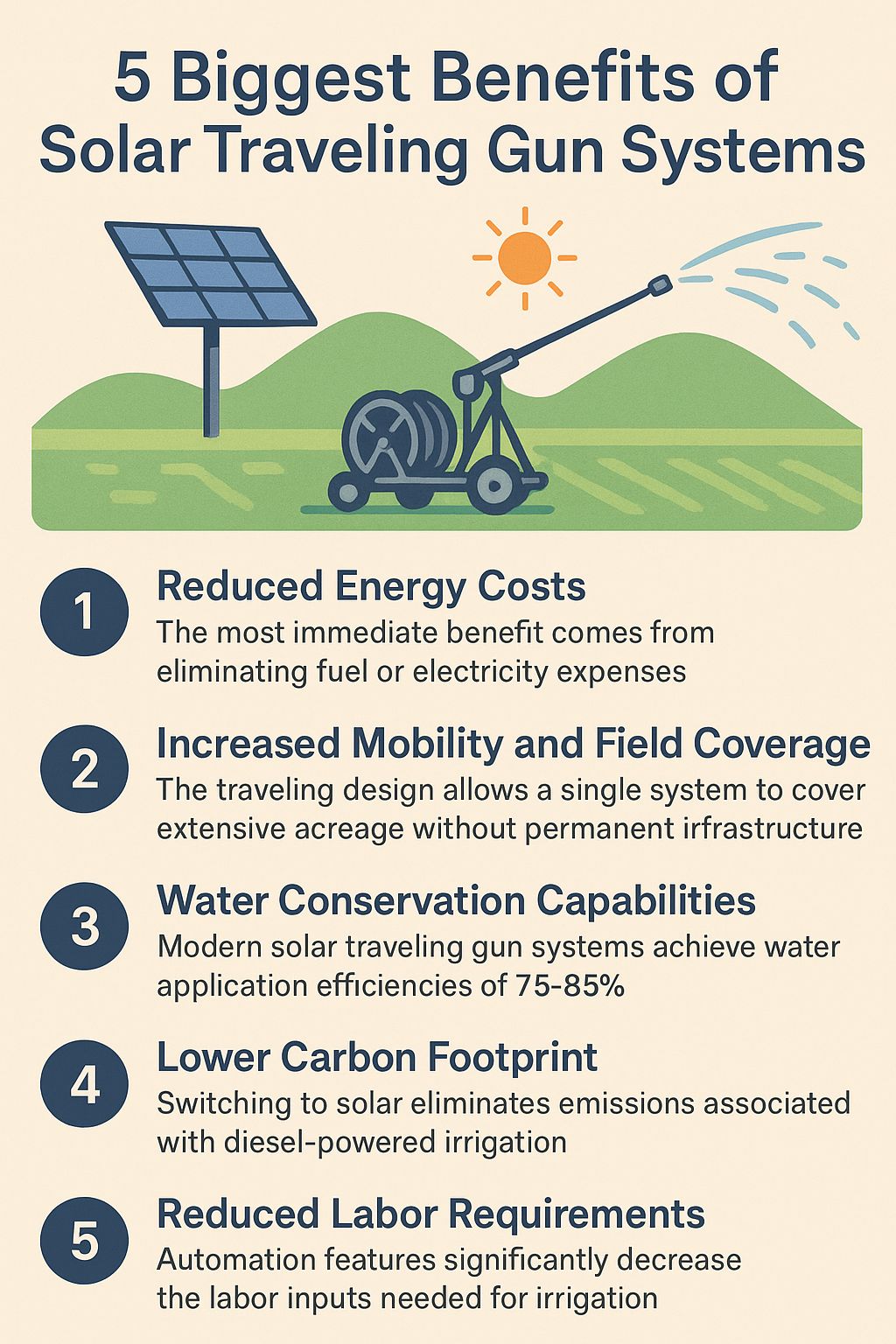
The advantages of solar powered traveling gun irrigation extend far beyond simple energy cost savings. These systems represent a holistic solution to multiple challenges facing modern agriculture, from resource conservation to operational flexibility and environmental stewardship.
1. Reduced Energy Costs
The most immediate benefit comes from eliminating fuel or electricity expenses. A mid-sized farm can easily save $10,000-30,000 annually in direct energy costs. This benefit becomes even more significant during drought years when irrigation requirements increase precisely when energy prices often spike due to high demand. The predictability of zero-cost operation allows for more confident crop planning and budgeting regardless of energy market volatility. To learn more about how solar power can benefit farm irrigation systems, visit this guide on solar-powered irrigation systems.
2. Increased Mobility and Field Coverage
The traveling design allows a single system to cover extensive acreage without permanent infrastructure. This mobility proves particularly valuable for farms with irregular field shapes, rented land, or crop rotations that change irrigation needs year-to-year. The ability to quickly relocate the system maximizes the return on investment across diverse growing conditions and multiple field locations.
3. Water Conservation Capabilities
Modern solar traveling gun systems achieve water application efficiencies of 75-85%, significantly higher than many conventional irrigation methods. Precision controls allow for exact water delivery rates matched to soil infiltration capabilities, minimizing runoff and deep percolation losses. Some advanced systems incorporate soil moisture sensors that automatically adjust application rates based on actual field conditions, further optimizing water use. Learn more about solar panels for farm irrigation systems and how they can enhance water conservation efforts.
4. Lower Carbon Footprint
The environmental benefits of solar irrigation are substantial. A typical diesel-powered irrigation system emits approximately 22 pounds of CO2 per gallon of fuel consumed. Switching to solar eliminates these emissions entirely, with a 10HP system preventing approximately 50 tons of CO2 emissions annually. This reduction supports both environmental goals and meets the growing market demand for sustainably produced agricultural products.
5. Reduced Labor Requirements
Automation features in modern solar irrigation systems significantly decrease labor inputs. Once positioned, these systems operate independently without the constant monitoring required by many conventional methods. Remote monitoring capabilities allow farmers to check system status and make adjustments from anywhere, further reducing time spent on irrigation management. This labor efficiency is particularly valuable during peak growing seasons when farm labor is often stretched thin across multiple priorities.
Real Farm Success Stories
The transition to solar powered irrigation has transformed operations across diverse agricultural settings. From small organic vegetable producers to large commodity crop operations, farmers are reporting not just cost savings but fundamental improvements in their growing capabilities, product quality, and operational sustainability.
These case studies highlight both the financial and practical benefits realized by early adopters. While results vary based on local conditions and specific implementations, the consistent theme is that solar traveling gun systems deliver multiple advantages beyond simple energy cost reduction.
The experiences of these pioneers provide valuable insights for farmers considering similar transitions. Their successes demonstrate proven pathways, while their challenges highlight important considerations for new implementations.
- 90% reduction in irrigation energy costs across all documented cases
- Payback periods ranging from 2-6 years depending on farm size and crop value
- Yield increases of 15-35% attributed to more consistent irrigation
- Labor requirements reduced by 50-70% compared to previous irrigation methods
- System reliability exceeding 98% during critical growing periods
Small Family Farm Implementation Case Study
The Wilkinson Family Farm, a 15-acre diverse vegetable operation in eastern Pennsylvania, installed a 7.5kW solar traveling gun system in 2019. Previously reliant on an aging diesel pump with unpredictable fuel costs, they now irrigate their entire farm with zero energy expense. Their system includes a 10kWh battery bank that allows for early morning irrigation when evaporation losses are minimized. The $28,000 investment, reduced to $16,800 after tax credits and a USDA grant, achieved complete payback in just over three years through fuel savings and a 22% increase in marketable produce.
Large Commercial Operation Results
Heartland Farms, a 2,200-acre corn and soybean operation in Nebraska, deployed multiple solar traveling gun systems to supplement their center pivot irrigation. They specifically target irregular field corners and sections where pivot coverage is inadequate. Their five solar-powered systems, each with 15kW arrays, eliminated approximately $42,000 in annual electricity costs while bringing previously under-irrigated acreage into full production. The improved coverage increased overall farm yield by 7.8%, representing an additional $115,000 in annual revenue beyond direct energy savings.
According to farm manager Robert Townsend, “The flexibility of these systems has been just as valuable as the cost savings. We can quickly deploy them wherever supplemental irrigation is needed, responding to changing field conditions in ways that weren’t possible with our fixed infrastructure. The return on investment has far exceeded our initial projections.” Learn more about the benefits of solar-powered traveling gun irrigation systems.

Conclusion
Solar powered traveling gun sprinkler systems represent one of the most promising developments in sustainable agriculture. By combining renewable energy with efficient water delivery, these systems address multiple challenges facing modern farmers—from rising energy costs and water conservation imperatives to labor constraints and environmental responsibilities. The documented success across diverse farming operations demonstrates that this technology has moved beyond experimental status to become a proven solution for forward-thinking agricultural producers. For farms seeking to enhance both sustainability and profitability, GreenSprout Solutions offers comprehensive assessment services to determine if solar irrigation might be right for your specific operation.
Frequently Asked Questions
Below are answers to the most common questions farmers ask when considering solar powered traveling gun irrigation systems. These responses address typical concerns about performance, economics, and practical implementation considerations.
How much land can one solar traveling gun sprinkler system irrigate?
A standard solar traveling gun system can effectively irrigate 40-160 acres depending on crop water requirements, local climate conditions, and available solar resources. This range assumes the system will be repositioned as needed throughout the growing season to cover different sections of the farm. The primary limiting factors are water availability and the irrigation window within which crops must receive water.
For planning purposes, most systems can apply approximately 1 inch of water to 1-2 acres per day under optimal conditions. This capacity allows complete irrigation cycles for most field crops every 7-14 days, which aligns with typical agricultural water management practices. Specialty crops with higher water demands or sandy soils requiring more frequent irrigation may reduce the total acreage a single system can effectively manage.
- Small systems (5-7.5kW): Typically handle 40-60 acres of field crops
- Medium systems (7.5-12kW): Can manage 60-100 acres effectively
- Large systems (12-20kW): Suitable for 100-160 acres depending on water requirements
Multiple systems can be deployed for larger operations, often with staggered irrigation schedules to optimize water source utilization and provide redundancy during critical growth periods. Many large farms start with a single system to evaluate performance before expanding their solar irrigation capacity.
The mobility of traveling gun systems provides a significant advantage over fixed irrigation infrastructure, allowing coverage of irregularly shaped fields and adaptation to changing crop rotations or field allocations from year to year.
Do solar powered irrigation systems work during cloudy days?
Solar irrigation systems continue functioning during cloudy conditions, though potentially at reduced capacity depending on system design. Modern systems incorporate several approaches to maintain reliable operation despite variable sunlight. Direct-coupled systems without batteries will operate at lower output during cloud cover, typically delivering 20-50% of clear-sky capacity depending on cloud density. This reduced output often remains sufficient for irrigation needs, particularly if scheduling flexibility allows for extending operation time.
Systems equipped with battery storage maintain full operational capacity regardless of momentary cloud cover. The batteries serve as energy buffers, providing consistent power to pumps even when solar production fluctuates. Most agricultural installations include at least modest battery capacity specifically to handle cloud interruptions, ensuring irrigation continuity during partly cloudy conditions that characterize many growing seasons.
What is the average lifespan of a solar powered traveling gun system?
The overall system lifespan typically ranges from 20-30 years, with different components having varying replacement schedules. Solar panels themselves are the most durable elements, usually carrying 25-year manufacturer warranties and often functioning beyond 30 years with only gradual efficiency decline. Pump equipment generally requires replacement or significant servicing every 7-10 years depending on water quality and operating conditions. Traveling mechanisms and sprinkler components typically last 10-15 years with proper maintenance. Electronic controls and battery systems (if included) usually need replacement every 8-12 years, though technological improvements often make earlier upgrades economically advantageous.
Can I convert my existing traveling gun sprinkler to solar power?
Conversion of existing traveling gun systems to solar power is entirely feasible and often represents a cost-effective entry point. The process typically involves retaining the existing sprinkler, reel, and distribution components while replacing or supplementing the power source. For hydraulically-driven travel mechanisms, minimal modifications are needed beyond the power source change. Electrically-driven travel systems may require controller modifications to accommodate the DC power source or the addition of an inverter.
The conversion cost typically runs 40-60% of a complete new system price, making it an attractive option for farmers with functional mechanical components seeking to eliminate fuel or electricity expenses. Many equipment dealers offer conversion kits specifically designed for popular traveling gun models, simplifying the transition process. When considering conversion, have the existing system thoroughly evaluated to ensure the mechanical components have sufficient remaining useful life to justify the investment in solar power equipment.
Are there specific crops that benefit most from traveling gun sprinkler systems?
High-value specialty crops typically realize the greatest economic benefit from solar traveling gun systems. Fruits, vegetables, and herbs that command premium prices but require precise irrigation timing show significant quality and yield improvements with consistent water availability. The elimination of irrigation energy costs translates directly to higher margins on these already profitable crops. Field crops grown in areas with limited rainfall or during drought conditions also benefit substantially, as the zero-energy operation cost allows for irrigation applications that might otherwise be economically marginal with conventional power sources.
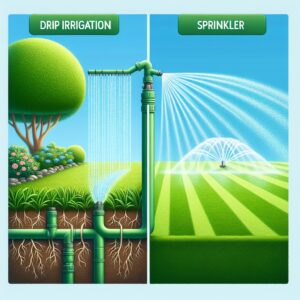
From an agronomic perspective, crops with moderate canopy density work particularly well with traveling gun systems. The high-trajectory water application pattern penetrates crop canopies effectively without causing damage, delivering moisture directly to the soil. Corn, soybeans, alfalfa, small grains, potatoes, and most vegetables perform excellently under traveling gun irrigation, while some extremely delicate crops or those requiring very frequent light irrigation may be better suited to drip or microsprinkler approaches.
The intersection of crop value, water requirements, and field characteristics ultimately determines which agricultural products benefit most from this technology. The flexibility of traveling gun systems allows adaptation to diverse cropping systems, making them suitable for operations that rotate through different crops or maintain diversified production.

Leave a Reply