

Key Takeaways: Solar Battery Backup Solutions for Farms
- Lithium-ion batteries offer longer lifespans (10-15 years) and deeper discharge capabilities than lead-acid options, making them better for high-demand farm operations despite higher upfront costs.
- Lead-acid batteries remain a cost-effective solution for farmers on tight budgets, with excellent cold-weather performance making them suitable for northern agricultural regions.
- Power outages cost American farms an estimated $1-3 billion annually in lost productivity, spoiled products, and compromised livestock welfare.
- Properly sizing your battery system based on critical farm loads rather than total energy consumption can reduce costs while ensuring essential operations continue during outages.
- Growing Solar Mist provides specialized solar battery backup solutions that integrate seamlessly with existing farm infrastructure, helping farmers achieve energy independence.
Farm Power Failures: Why You Need Solar Battery Backup If You Are Using Solar Panels to Power Your Farm
Your farm’s solar panels go dark the moment the grid fails—a harsh reality many farmers discover too late. Without battery backup, grid-tied solar systems shut down during outages due to anti-islanding safety protocols, leaving your operation vulnerable precisely when you need power most. This technical limitation means your investment in solar panels provides zero protection against increasingly common rural power disruptions.
As climate change intensifies weather extremes, the aging rural electrical infrastructure faces mounting challenges. According to Department of Energy statistics, rural areas experience 2-3 times more power outages than urban centers, with significantly longer restoration times averaging 6.5 hours versus 2.1 hours in cities. For farmers, these aren’t mere inconveniences—they’re existential threats to livestock welfare, irrigation cycles, and cold storage integrity.
The Real Cost of Power Outages on Agricultural Operations
When the power goes out on a farm, the financial impact extends far beyond temporary inconvenience. Climate-controlled barns housing thousands of animals suddenly lose ventilation, heating, or cooling systems. Automated feeding and watering systems shut down. Milk spoils in bulk tanks as cooling fails. Even a single six-hour outage during extreme weather can result in catastrophic livestock losses worth tens of thousands of dollars.
Crop production faces equally serious threats. Irrigation pumps and timers stop functioning at potentially critical growing stages. Post-harvest processing and refrigeration systems shut down, reducing market-ready crop quality and shelf life. According to a 2022 agricultural resilience study by Growing Solar Mist, power disruptions cost American farms an estimated $1-3 billion annually in lost productivity, compromised production cycles, and spoiled products.
Beyond immediate losses, outages disrupt the precise timing essential to modern agriculture. Breeding cycles, germination schedules, and feeding routines require consistency that power failures directly undermine. The true cost extends beyond direct losses to include long-term production impacts that may affect farm profitability for seasons to come.
Weather-Related Vulnerabilities in Rural Power Grids
Rural power infrastructure faces unique challenges that make farms particularly susceptible to outages. Transmission lines often run through remote, heavily vegetated areas where maintenance is more difficult and expensive for utility companies. Ice storms, high winds, and lightning strikes regularly damage these exposed lines, while floods and wildfires threaten substations serving agricultural communities. For farmers looking to mitigate these risks, exploring solar-powered irrigation systems can offer a reliable alternative to traditional power sources.
Climate change has intensified these vulnerabilities. USDA climate data shows a 37% increase in severe weather events affecting agricultural regions over the past decade. When storms hit, rural areas typically wait longer for repairs as utility companies prioritize population centers. This restoration gap leaves farms without power for extended periods precisely when weather conditions may be most threatening to livestock and crops.
Diesel Generators: The Expensive Status Quo
For generations, farmers have relied on diesel generators as their backup power solution—a dependable but increasingly problematic approach. While generators provide immediate power when needed, they come with significant downsides that solar battery systems address. Diesel fuel costs have risen dramatically, with average farm generator operational costs now exceeding $1.50-$2.50 per kilowatt-hour during extended use—over ten times the cost of utility power. This has prompted many farmers to explore alternatives like solar-powered systems to reduce dependency on diesel.
Maintenance requirements add another layer of expense. Generators need regular servicing, fuel filtering, and component replacement regardless of how frequently they’re used. Many farmers report spending $800-1,200 annually maintaining generators they might only use for 20-30 hours. During critical emergencies, fuel availability becomes another vulnerability, as regional disasters often create diesel shortages exactly when generators are most needed.
Environmental factors are increasingly influencing farm decisions too. Diesel generators produce significant emissions including nitrogen oxides and particulates that impact local air quality. For farms pursuing sustainable certification or carbon reduction goals, diesel generation directly contradicts these objectives. Solar battery backup systems eliminate these operational costs and emissions while providing silent, maintenance-free protection against outages.

Solar Battery Backup Fundamentals for Agricultural Use
Solar battery backup systems function as energy reservoirs, storing excess electricity generated by your solar panels for use during outages or high-demand periods. Unlike generators that require ongoing fuel purchases, battery systems capture and store energy your solar array already produces, creating a closed-loop resilience system. The economics become particularly favorable when considering that many farms generate surplus solar power during midday that could be stored rather than exported to the grid at wholesale rates. For more insights on solar technology applications, explore how drones boost solar panel efficiency for farmers.
Modern agricultural battery systems integrate sophisticated charge controllers and inverters that automatically detect grid failures and seamlessly transition your essential farm loads to battery power without disruption. This happens in milliseconds—far faster than generator startup—ensuring critical systems like ventilation, water pumps, and refrigeration experience no damaging power interruption. Advanced systems can also prioritize certain loads, automatically shedding non-essential equipment to extend backup duration for critical farm functions.
How Farm Solar Battery Systems Work During Outages
When the grid fails, your solar battery system springs into action through a carefully orchestrated sequence. First, the automatic transfer switch disconnects your farm from the grid to prevent backfeeding that could endanger utility workers. Next, the inverter begins drawing electricity from your battery bank and converting it to AC power that matches utility specifications. Within milliseconds, your critical farm loads receive consistent, clean power without the voltage fluctuations common with generator startups.
During daylight hours, your solar panels continue generating electricity, simultaneously powering your farm operations and recharging the batteries. This continuous generation capability represents a crucial advantage over generators, which consume increasingly scarce fuel during extended outages. Smart systems can automatically adjust charging patterns based on weather forecasts, prioritizing battery charging when clouds or storms threaten future generation capacity.
Modern battery systems also provide detailed monitoring capabilities via smartphone apps that alert you to system status, remaining backup time, and power consumption patterns. This visibility allows you to make informed decisions about energy usage during extended outages, potentially extending backup duration by adjusting farm operations to match available resources. For instance, understanding the components of a solar irrigation system can help optimize resource allocation during such times.
Key Components of an Agricultural Battery Backup System
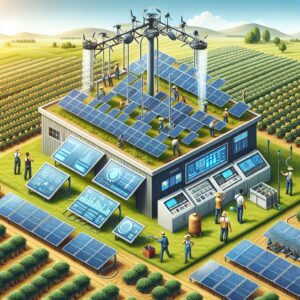
Essential Components of Farm Battery Backup Systems
Battery Bank: The energy storage medium (lead-acid or lithium-ion)
Charge Controller: Regulates charging process to protect batteries
Inverter: Converts DC battery power to AC for farm equipment
Automatic Transfer Switch: Safely disconnects from grid during outages
Monitoring System: Tracks system performance and battery status
Critical Load Panel: Separates essential from non-essential farm circuits
Solar Array: Generates electricity and recharges batteries during daylight, which is crucial for solar-powered irrigation systems.
Sizing Your System: Matching Power Needs to Battery Capacity
Properly sizing your farm’s battery backup system begins with identifying truly critical loads rather than attempting to power your entire operation. Most farms can maintain essential functions with 30-50% of their total power capacity. Begin by documenting power requirements for mission-critical equipment like ventilation systems, water pumps, refrigeration units, and essential lighting.
The backup duration needed should reflect both your region’s typical outage length and the seasonal vulnerabilities specific to your operation. Livestock operations typically require longer backup durations (24-48 hours) compared to crop farms where 8-12 hours might suffice during critical periods. Growing Solar Mist’s agricultural energy assessment tools can help identify your farm’s unique requirements based on operational type, scale, and location-specific outage patterns.
Expansion capability represents another crucial sizing consideration. The modular nature of battery systems allows for starting with essential coverage and expanding as budget permits. Many farmers find success beginning with batteries sized for critical systems only, then adding capacity annually as they recognize the operational benefits and energy cost savings these systems provide.

Lead-Acid Batteries: The Trusted Workhorse
Lead-acid batteries have powered farms through outages for decades, offering proven reliability at accessible price points. These traditional batteries utilize a chemical reaction between lead plates and sulfuric acid to store and release electrical energy. Despite being the oldest battery technology in widespread use, modern advancements have significantly improved their performance for agricultural applications while maintaining their cost advantage. For farmers interested in integrating solar solutions, exploring solar-powered irrigation systems can complement their existing power setup.
Types of Lead-Acid Batteries for Farm Applications
Flooded lead-acid (FLA) batteries represent the most economical option, with initial costs 40-60% lower than other alternatives. These traditional batteries require regular watering and ventilated housing due to hydrogen gas emissions during charging. While their maintenance requirements are higher, many farmers appreciate their repairability—individual cells can often be replaced rather than discarding the entire battery when problems arise.
Sealed lead-acid batteries, including Absorbent Glass Mat (AGM) and Gel varieties, offer maintenance-free operation at a moderate price increase (typically 20-30% more than flooded versions). AGM batteries perform exceptionally well in cold environments, making them particularly suitable for northern farms where winter temperatures regularly drop below freezing. Their spill-proof design allows for flexible mounting options throughout farm buildings without dedicated battery rooms.
For farms with existing equipment maintenance programs, advanced lead-acid options like carbon-enhanced batteries offer extended cycle life and improved partial state of charge operation. These newer formulations incorporate carbon additives that reduce sulfation—the primary cause of lead-acid battery failure—extending usable lifespan by 50-100% compared to traditional models while maintaining similar price points. For a detailed comparison, check out this guide on solar irrigation batteries.
Strengths: Affordability, Cold Weather Performance, and Availability
The primary advantage of lead-acid batteries remains their affordability, with complete systems typically costing $400-600 per kilowatt-hour of storage capacity—roughly half the installed cost of comparable lithium systems. This lower entry point allows farms to implement larger backup capacity within tight capital improvement budgets. Local availability represents another significant advantage, with replacement batteries available through agricultural suppliers, auto parts stores, and battery dealers throughout rural areas.
Cold weather performance stands out as a surprising strength for lead-acid technology. While capacity decreases in cold temperatures, properly sized lead-acid systems continue functioning effectively in unheated farm buildings where temperatures may drop well below freezing. Many northern livestock operations report reliable winter performance from insulated lead-acid battery banks in environments where temperatures regularly reach -20°F, conditions that would severely impact lithium battery performance without expensive heating systems.
Weaknesses: Maintenance Requirements, Weight, and Shorter Lifespan
The maintenance requirements of flooded lead-acid batteries represent their most significant drawback for busy farming operations. Monthly watering, terminal cleaning, and specific gravity testing demand consistent attention throughout the year. This maintenance burden typically requires 1-2 hours monthly for moderate-sized systems, creating an ongoing operational commitment many farms struggle to consistently fulfill amid seasonal workload fluctuations.
Lead-acid batteries’ limited depth of discharge (typically 50%) effectively doubles the physical size and weight requirements compared to lithium alternatives for equivalent usable capacity. This greater spatial footprint often requires dedicated battery rooms or reinforced flooring to accommodate weights reaching 2-4 times that of comparable lithium systems. Their shorter lifespan—typically 500-1,000 cycles depending on depth of discharge patterns—means replacement costs must be factored into long-term operational budgeting, usually every 5-7 years under normal farm usage patterns.
Best Applications for Lead-Acid on Farms
Lead-acid batteries shine in seasonal agricultural operations where backup power is critical during specific production periods but less necessary year-round. Their lower initial investment makes economic sense for farms that experience fewer than 5-10 outages annually, as the cost premium for longer-lived lithium systems may never be recovered through extended lifespan. Cold-climate operations particularly benefit from lead-acid’s superior low-temperature performance in unheated farm buildings where insulated battery enclosures provide adequate environmental protection without expensive heating systems. For more information on solar-powered solutions, explore our guide on solar-powered irrigation systems for farmers.
Farms with established equipment maintenance routines often successfully integrate lead-acid battery care into existing preventative maintenance schedules. Operations with mechanically-inclined staff who already handle routine equipment maintenance can easily absorb the additional tasks required for lead-acid battery upkeep. Additionally, farms with available covered space find the larger footprint of lead-acid systems less problematic than operations with severe space constraints in equipment buildings.

Lithium-Ion Batteries: The Modern Powerhouse
Lithium-ion technology has revolutionized agricultural energy storage with unprecedented energy density, cycle life, and system intelligence. These advanced batteries utilize lithium’s chemical properties to store more energy in significantly less space while offering deeper discharge capabilities and minimal maintenance requirements. For modern farming operations with critical power needs, lithium systems provide reliable performance that aligns with the increasing electrification and automation of agricultural production systems.
Types of Lithium Batteries Suitable for Agricultural Settings
Lithium Iron Phosphate (LiFePO4) has emerged as the preferred chemistry for agricultural applications due to its exceptional safety profile and thermal stability. Unlike consumer electronics batteries, these phosphate-based systems resist thermal runaway even when damaged, making them appropriate for dusty, vibration-prone farm environments. Their flat discharge curve maintains consistent voltage until nearly depleted, ensuring irrigation pumps and ventilation systems receive stable power throughout discharge cycles.
Newer Lithium Nickel Manganese Cobalt (NMC) batteries offer even greater energy density, reducing space requirements by an additional 20-30% compared to LiFePO4 systems. While these higher-density options typically cost 15-25% more, farms with severe space constraints in equipment buildings often find this premium justified by their compact footprint. These systems require more sophisticated battery management systems but provide performance advantages for operations needing maximum capacity in minimal space.
Strengths: Longer Lifespan, Depth of Discharge, and Efficiency
The primary advantage of lithium-ion systems lies in their exceptional longevity, typically delivering 3,000-5,000 complete cycles before capacity degrades to 80% of original specifications. For most farm applications, this translates to 10-15 years of reliable service—often double or triple the usable lifespan of lead-acid alternatives. Growing Solar Mist’s agricultural energy assessments frequently demonstrate lifetime costs approximately 20-30% lower for lithium systems despite higher upfront investment, primarily due to this extended replacement interval.
Lithium batteries’ ability to safely discharge to 80-90% of total capacity (compared to 50% for lead-acid) effectively provides nearly twice the usable energy per rated kilowatt-hour. This deeper discharge capability means your farm can install significantly less overall capacity while maintaining equivalent backup duration. Many agricultural operations report successfully backing up critical barn systems with lithium batteries occupying just 30-40% of the space required for comparable lead-acid installations.
Charging efficiency represents another significant advantage, with lithium systems typically converting 95-98% of incoming solar energy to stored power, compared to 80-85% for lead-acid alternatives. This higher efficiency translates directly to faster recharging during limited daylight hours between winter storms or cloudy periods, ensuring batteries return to full capacity more quickly after outage events. The resulting improvement in system readiness proves particularly valuable during multiple outage scenarios common in severe weather seasons.
Weaknesses: Upfront Cost, Temperature Sensitivity, and BMS Requirements
The substantial initial investment remains the primary barrier for many farm operations considering lithium battery systems. With installed costs typically ranging from $800-1,200 per kilowatt-hour of capacity (compared to $400-600 for lead-acid), the upfront premium can challenge agricultural capital improvement budgets. While lifetime economics strongly favor lithium technology, the higher entry point often requires creative financing solutions or phased implementation approaches for budget-conscious farm operations. For those interested in integrating solar solutions, exploring solar-powered irrigation systems might provide additional benefits.
Temperature sensitivity represents a genuine concern for agricultural applications, particularly in unheated outbuildings common on farms. Most lithium batteries significantly reduce charging current below 32°F through their battery management systems, with many stopping charging completely below 14-20°F to prevent cell damage. Installations in cold climates require either heated enclosures or specialized cold-weather rated models that incorporate internal heating elements, adding 15-25% to system costs in northern regions.
The sophisticated battery management systems (BMS) essential to lithium battery longevity introduce complexity that some farmers find challenging. While these electronic systems protect batteries from damaging operating conditions, they also create potential failure points requiring specialized diagnostics beyond typical farm maintenance capabilities. Remote locations may face delays obtaining qualified service technicians for BMS-related issues, potentially extending downtime during critical periods.
Best Applications for Lithium-Ion on Farms
Lithium-ion batteries excel in high-use agricultural settings where frequent power cycling occurs, such as operations using load shifting to reduce peak demand charges or maximize self-consumption of solar generation. Their superior cycle life provides compelling economic advantages for farms experiencing frequent grid instability, as each outage event represents a smaller percentage of the battery’s total lifetime. Operations requiring compact installation in space-constrained equipment rooms particularly benefit from lithium’s energy density advantages.
Livestock operations with critical ventilation requirements benefit from lithium systems’ ability to deliver consistent power output until nearly depleted. Modern confinement barns often incorporate sophisticated environmental controls that perform optimally with stable power characteristics lithium systems provide. Additionally, farms pursuing agricultural sustainability certifications often prefer lithium technology’s reduced lifetime resource consumption and elimination of hazardous materials compared to lead-acid alternatives. For more information on sustainable farming practices, explore the benefits of solar-powered irrigation systems.

Head-to-Head Comparison: Critical Factors for Farmers
Here’s a comprehensive head-to-head comparison table of Lead-Acid Battery vs. Lithium-Ion Battery, tailored specifically to the critical factors important for farmers:
|
Critical Factor |
Lead-Acid Battery |
Lithium-Ion Battery |
|---|---|---|
|
Upfront Cost |
Lower ($100–$200/kWh) | |
|
Lifespan | ||
|
Maintenance |
Minimal, mostly visual inspection 9 | |
|
Charging Time |
8–10 hours for full charge 6 |
2–4 hours for full charge 6 |
|
Depth of Discharge | ||
|
Energy Density | ||
|
Efficiency | ||
|
Weight/Size | ||
|
Power Output | ||
|
Environmental Impact |
Highly recyclable but uses toxic lead 8 |
Lower emissions, longer life, recycling improving 8 |
|
Suitability for Intermittent Use |
Good for infrequent, low-cost backup 2 |
Key Insights for Farmers
- Cost vs. Value: Lead-acid batteries are cheaper upfront, but lithium-ion batteries last longer and require less maintenance, often making them more cost-effective over time. 2, 5, 6.
- Capacity and Usability: Lithium-ion batteries offer more usable capacity per cycle due to higher depth of discharge and efficiency, allowing farmers to run more equipment or irrigation systems for longer periods without recharging. 1, 2, 7
- Maintenance: Lead-acid batteries need regular maintenance (like checking fluid levels), which can be a hassle in remote or busy farm settings. Lithium-ion batteries are largely maintenance-free. 9, 4
- Charging and Downtime: Lithium-ion batteries charge much faster, reducing downtime during peak farming operations. 6
- Durability: Lithium-ion batteries withstand more charge/discharge cycles, making them better suited for solar-powered or frequently used farm equipment. 8
- Weight and Installation: Lithium-ion batteries are lighter and take up less space, which is important for mobile farm equipment or limited storage areas. 6, 9
- Environmental Considerations: Lead-acid batteries are easier to recycle but contain hazardous materials. Lithium-ion batteries are improving in recyclability and have a lower overall environmental impact due to their longevity. 8
Initial Investment vs. Lifetime Cost Analysis
While lithium systems typically require 2-2.5 times the initial investment of comparable lead-acid installations, detailed lifetime cost analysis reveals a more nuanced economic picture. When analyzing complete 15-year ownership costs including replacements, maintenance labor, and performance factors, lithium systems typically demonstrate 15-30% lower total cost of ownership for most agricultural applications. This advantage becomes particularly pronounced in operations experiencing frequent outages or utilizing daily cycling for load shifting purposes.
The financial equation shifts significantly when considering opportunity costs associated with battery systems. Livestock operations facing catastrophic loss potential during outages often justify lithium’s premium based on superior reliability and reduced maintenance burden during critical periods. Similarly, farms with limited maintenance staff may find the labor savings from lithium’s maintenance-free operation offsets much of the initial cost premium when calculated across the system’s lifespan.
Cycle Life and Replacement Frequency
The dramatic cycle life advantage of lithium technology creates compelling long-term economics despite higher upfront costs. Most agricultural implementations of lead-acid batteries require complete replacement every 5-7 years under typical farm usage patterns. In contrast, quality lithium systems maintain 80% or greater capacity for 10-15 years in identical applications, effectively reducing lifetime battery expenditures by 30-50% when replacement costs are annualized. For farmers considering energy solutions, exploring solar-powered irrigation systems can offer additional benefits in efficiency and sustainability.
This replacement frequency difference becomes particularly significant for remote operations where installation logistics add substantial costs. Farms located hours from service centers often incur additional expenses for battery replacement including travel charges, expedited shipping, and extended downtime costs. By reducing these replacement events by half or more, lithium systems provide logistical and operational advantages beyond simple component cost comparisons.
Maintenance Requirements in Dusty Farm Environments
The agricultural environment presents unique challenges for battery systems, with airborne dust, temperature fluctuations, and vibration from equipment creating maintenance challenges. Flooded lead-acid batteries require particular attention in these conditions, as dust accumulation on cell tops creates conductive paths between terminals while accelerating water loss through increased self-discharge. Most farm implementations require monthly cleaning, watering, and terminal inspections to maintain reliable operation.
Lithium systems’ sealed, maintenance-free design eliminates these vulnerabilities, offering particular advantages in extremely dusty operations like grain handling facilities, poultry barns, or hay processing areas. Their solid-state construction resists the effects of equipment vibration that often loosens connections and accelerates component wear in lead-acid systems. For operations with limited maintenance staff or during peak seasonal workloads, this maintenance difference can prove decisive in technology selection regardless of cost considerations.
Temperature Performance: From Freezing Barns to Hot Equipment Sheds
Agricultural battery systems frequently operate in environments with extreme temperature variations that challenge both technologies in different ways. Lead-acid batteries maintain charging capability at lower temperatures but experience significant capacity reduction—typically losing 50% of rated capacity at 0°F while still accepting charging current. This characteristic makes them suitable for unheated outbuildings in northern regions where installation simplicity outweighs capacity concerns.
Lithium batteries maintain consistent capacity across temperature ranges but require heating systems in cold environments to enable charging functionality. Most agricultural lithium installations in cold climates incorporate insulated enclosures with thermostatically controlled heating elements that activate below 35°F, adding 15-25% to system costs. However, their superior high-temperature performance—maintaining full functionality up to 140°F without accelerated degradation—provides advantages in equipment rooms that frequently exceed 100°F during summer months.
Space and Weight Considerations for Limited Farm Buildings
The physical footprint difference between these technologies creates practical installation challenges in many agricultural settings. A typical 20kWh lead-acid battery bank requires approximately 30-40 square feet of floor space and weighs 2,000-3,000 pounds, often necessitating structural reinforcement for elevated installations. Equivalent lithium systems typically occupy 10-15 square feet and weigh 500-800 pounds, allowing installation in space-constrained equipment rooms or on standard flooring without structural modifications.
This spatial efficiency translates directly to installation flexibility, with lithium systems often mounting on walls or in standard equipment racks rather than requiring dedicated floor space. Many farms successfully incorporate lithium batteries into existing utility rooms, repurposed closets, or even mobile trailer-based systems that can relocate seasonally between different farm operations. This installation flexibility often proves valuable in older farm buildings with limited available space for new systems.

Real-World Performance: Farm Case Studies
Small Livestock Operation: Lead-Acid Success Story
The Davidson family operates a 300-head dairy goat operation in Wisconsin that installed a lead-acid battery backup system sized specifically for barn ventilation, water pumps, and minimal lighting. Their 48V system utilizes sixteen L16 batteries providing 30kWh of total capacity (15kWh usable) at an installed cost of $12,500 including all balance of system components. The system successfully maintained critical functions through three extended winter outages during its first year, preventing catastrophic losses that had occurred during previous weather events.
Key to their success was right-sizing the system for truly essential loads rather than attempting to backup their entire operation. By separating critical circuits to a subpanel powered by their battery system, they maintained ventilation and water while temporarily suspending automated feeding and milk cooling during outages. Their local equipment dealer provides quarterly maintenance service coinciding with regular milking equipment maintenance, ensuring proper battery care without additional farm labor commitment.
- Initial investment: $12,500 ($416/kWh) for 30kWh lead-acid system
- Annual maintenance cost: $600 for quarterly service visits
- Expected lifespan: 6-7 years with proper maintenance
- Outage performance: Successfully powered critical loads through three winter outages (8, 12, and 17 hours)
The Davidsons’ experience demonstrates how thoughtfully implemented lead-acid systems can provide cost-effective protection for small livestock operations with well-defined critical loads. Their success hinged on professional installation, regular maintenance from qualified technicians, and realistic expectations about system capabilities during outages. By focusing exclusively on life-safety systems rather than production equipment, they maximized the effectiveness of their investment while maintaining economic viability.
Large Crop Farm: Lithium-Ion ROI Timeline
Heartland Organics, a 2,000-acre certified organic vegetable operation in California, implemented a comprehensive lithium-ion battery system primarily to reduce substantial peak demand charges while providing outage protection for critical irrigation and cold storage systems. Their 60kWh lithium system cost $78,000 installed but generates approximately $12,000 annually in avoided demand charges by shifting irrigation load from peak afternoon hours to battery power. When grid outages occur—typically during summer heat waves when irrigation is most critical—the system automatically transitions to backup mode, maintaining cooling for harvested crops while powering essential well pumps.
Mixed-Use Farm: Hybrid Battery Approach
Riverside Family Farms in Tennessee implemented an innovative hybrid approach combining both battery technologies to leverage their complementary strengths. Their system utilizes a 10kWh lithium battery for daily cycling and immediate outage response, handling the first 2-4 hours of any power interruption. This primary system is supplemented by a larger 40kWh lead-acid battery bank that activates only during extended outages, providing deeper capacity while experiencing fewer cycles. This architecture reduced initial costs by 35% compared to an all-lithium system while still delivering maintenance-free operation for day-to-day needs and extending the lead-acid battery lifespan by limiting cycling frequency.

Making the Right Choice for Your Farm Operation
The optimal battery technology for your farm depends on a unique combination of operational requirements, financial considerations, and maintenance capabilities. Rather than viewing this as a simple technology comparison, successful implementations begin with thorough assessment of your farm’s specific vulnerabilities and critical power needs. By starting with a clear understanding of what systems must remain operational during outages and for how long, you can develop a rightsized solution that provides essential protection without unnecessary capacity and expense.
Decision Framework Based on Farm Size and Power Needs
Small to medium livestock operations with limited budgets and defined critical loads often find lead-acid systems provide the most economical protection against occasional outages. These operations typically prioritize ventilation, water systems, and minimal lighting while accepting temporary suspension of production equipment during grid failures. The lower initial investment allows implementing adequate capacity to bridge typical regional outage durations while matching the financial resources available to smaller operations.
Budget-Conscious Options for Getting Started
Farmers with limited capital can implement effective backup power through strategic phasing of battery systems. Begin with a critical-loads assessment to identify truly essential circuits that prevent catastrophic loss during outages. Separating these loads to a subpanel allows protection with smaller initial battery capacity, often reducing first-phase costs by 60-70% compared to whole-farm backup approaches.
- Start with battery capacity for critical ventilation, water systems, and safety lighting only
- Consider refurbished or “second-life” lithium batteries from qualified suppliers
- Explore agricultural grant programs specifically targeting farm energy resilience
- Investigate lease-to-own options that convert battery systems from operating to capital expenses
Many successful implementations begin with manual transfer capabilities rather than fully automatic systems, reducing initial costs by $3,000-5,000 while still providing essential protection. This approach requires operator intervention during outages but delivers identical backup capacity at significantly reduced initial investment. The system can later be upgraded to automatic operation when budget permits without replacing battery components.
Growing Solar Mist offers specialized agricultural battery financing that aligns payment schedules with seasonal farm income patterns. These programs typically require minimal down payments while structuring larger payments to coincide with harvest or livestock sale periods. By matching payment obligations to farm income cycles, these programs make advanced battery systems accessible to operations with limited year-round cash flow.
Future-Proofing Your Farm’s Energy Resilience
- Select systems with modular expansion capabilities to accommodate growing energy needs
- Consider compatibility with emerging technologies like vehicle-to-farm integration
- Implement monitoring systems that provide actionable energy usage insights
- Choose equipment with established manufacturers likely to provide long-term support
Agricultural operations increasingly find that battery systems deliver value beyond simple outage protection. Modern systems can integrate with energy management platforms that optimize electricity usage patterns, potentially reducing overall energy costs through time-of-use arbitrage or demand charge management. When evaluating systems, consider platforms offering these advanced capabilities even if immediate implementation focuses solely on backup functionality.
Battery technology continues advancing rapidly, with energy density improvements of 8-12% annually and corresponding cost reductions. System designs that accommodate future expansion or battery replacement with newer technologies provide valuable flexibility as your farm’s energy needs evolve. Choosing equipment with standardized connections and open-architecture control systems facilitates future upgrades without complete system replacement.
The agricultural sector’s transition toward electrification of equipment and processes suggests increasing future electricity dependence for most operations. Battery systems sized for today’s needs should incorporate expansion pathways to accommodate this trend, potentially including oversized inverters, additional connection points, and space allocation for future capacity additions. This forward-looking approach ensures your initial investment remains relevant as farm operations evolve toward greater electrification.
Frequently Asked Questions
Farmers considering battery backup systems frequently raise similar questions about system capabilities, limitations, and practical implementation concerns. The following responses address the most common inquiries based on actual agricultural installations and operational experience across diverse farming operations and climates.
How long will a solar battery backup power my farm during an outage?
Backup duration depends primarily on battery capacity and the power requirements of equipment you’re operating. Most agricultural systems are designed to power critical loads for 8-24 hours without solar recharging, though this varies significantly based on implementation. A properly sized system for a typical livestock barn might operate ventilation, water systems, and minimal lighting for 12-16 hours on a full charge, while providing only 4-6 hours of runtime if including feed automation and milk cooling equipment.
During daylight hours, your solar panels continue generating power that simultaneously runs equipment and recharges batteries, potentially extending backup duration indefinitely during clear weather. Many farms experience effectively unlimited backup duration during sunny days as solar generation exceeds critical load requirements. Battery systems sized for overnight protection typically provide multiple days of daytime backup capability when solar production is available.
Can I run my irrigation pumps on battery backup power?
Yes, but with important considerations regarding motor starting requirements and runtime expectations. Irrigation pumps typically require 3-5 times their running wattage during startup (inrush current), necessitating inverters rated significantly higher than the pump’s nominal operating power. A 5hp pump drawing 3,700 watts during operation might require a 12,000-watt inverter to handle starting current without overload shutdown. For more details on choosing the right battery backup, you can explore solar irrigation batteries suitable for agriculture.
Battery capacity requirements for irrigation are substantial, with most pumps consuming 25-50kWh daily depending on lift height and water volume. For reference, powering a 5hp pump for 8 hours typically requires 30-40kWh of battery capacity, translating to approximate equipment costs of $12,000-18,000 for lead-acid or $24,000-36,000 for lithium systems. Many farms implement reduced irrigation schedules during outages, focusing on high-value crops while temporarily suspending irrigation for drought-tolerant fields.
Do solar batteries work during winter or cloudy days on the farm?
Yes, solar batteries function normally regardless of current weather conditions, providing stored energy from previous charging cycles. The batteries themselves operate independently of real-time solar production, though their recharging depends on solar generation or grid power. During extended cloudy periods, batteries will gradually deplete without adequate recharging, potentially requiring conservation measures or generator supplementation for multi-day events.
What maintenance do farm solar batteries need throughout the seasons?
Maintenance requirements vary dramatically between battery types. Lead-acid batteries typically require monthly attention including watering (for flooded types), terminal cleaning, and specific gravity testing. This maintenance becomes particularly important during summer months when higher temperatures increase water consumption and accelerate chemical reactions. Many farmers schedule more frequent battery maintenance during high-risk weather seasons to ensure maximum readiness when outages are most likely.
Lithium batteries require minimal maintenance beyond occasional terminal inspection and cleaning, with no internal maintenance regardless of season. Their battery management systems automatically adjust charging parameters based on temperature conditions, though external heating may be required in extremely cold environments. Quarterly visual inspections represent the extent of routine maintenance for most agricultural lithium installations, with manufacturer-specific protocols for long-term storage if systems remain unused for extended periods.
Can I install a solar battery system myself on my farm property?
While technically possible, DIY installation of agricultural battery systems presents significant challenges including electrical code compliance, safety considerations, and potential warranty implications. Most battery manufacturers require professional installation to maintain warranty coverage, particularly for lithium systems where improper installation can create fire hazards or premature failure. The complex integration between solar arrays, charge controllers, battery banks, and inverters typically requires specialized knowledge for reliable operation.
Farmers with strong electrical backgrounds sometimes successfully install lead-acid systems for non-critical applications, though proper permitting and inspection remain essential for insurance compliance. These implementations typically utilize pre-engineered kits designed for agricultural applications rather than custom-designed systems. For critical backup systems protecting livestock or preventing crop losses, professional installation provides assurance of proper integration, code compliance, and performance during emergencies.
The most successful farm implementations often combine professional system design and critical connections with farmer-assisted installation for non-technical components like battery enclosures, equipment mounting, and conduit installation. This collaborative approach reduces labor costs while ensuring technical aspects meet safety and performance requirements. For instance, understanding solar irrigation system components can significantly enhance the efficiency of these installations.
Solar-powered irrigation systems are becoming increasingly popular among farmers due to their cost-effectiveness and environmental benefits. By harnessing solar energy, these systems can significantly reduce reliance on traditional power sources, making them a sustainable option for agricultural operations. To understand the various components and their functions, check out this detailed guide on solar irrigation system components.




Leave a Reply