

Key Takeaways
- Thin-film solar panels offer unique advantages for agricultural applications including flexibility, better shade tolerance, and performance in high temperatures that traditional panels can’t match.
- First Solar Series 6 and Miasole FLEX-03W lead the market for farm applications, with specialized features that address common agricultural challenges.
- Farmers can achieve significant cost savings through agricultural-specific solar incentives like USDA REAP grants, making thin-film systems more affordable than ever.
- Thin-film technology enables innovative agrivoltaics approaches where crop production and energy generation can coexist on the same land.
- While less efficient per square foot than crystalline panels, thin-film solutions can be more practical for farms with irregular structures or partial shade conditions.
Thin-Film Solar Panels: The Game-Changer for Modern Farms
Farmers face rising energy costs while seeking sustainable solutions that work with their unique operations. Thin-film solar technology represents a transformative opportunity for agricultural businesses looking to reduce overhead expenses while contributing to environmental sustainability. Unlike traditional rigid panels, these versatile power generators can integrate with existing farm structures and adapt to the challenging conditions found in agricultural settings.
SolarFarm Technologies offers thin-film solutions specifically designed for agricultural applications, helping farmers navigate the transition to renewable energy with minimal disruption to operations. These innovative panels are changing how farms approach energy independence, creating new possibilities for sustainable farming that weren’t previously possible with conventional solar technology.
The agricultural sector consumes significant electricity for irrigation systems, climate control in livestock buildings, and processing equipment. Thin-film solar panels provide a reliable alternative energy source that can dramatically reduce these operational costs while adding value to underutilized farm spaces. With proper implementation, these systems can pay for themselves within 5-7 years while continuing to generate power for decades afterward.
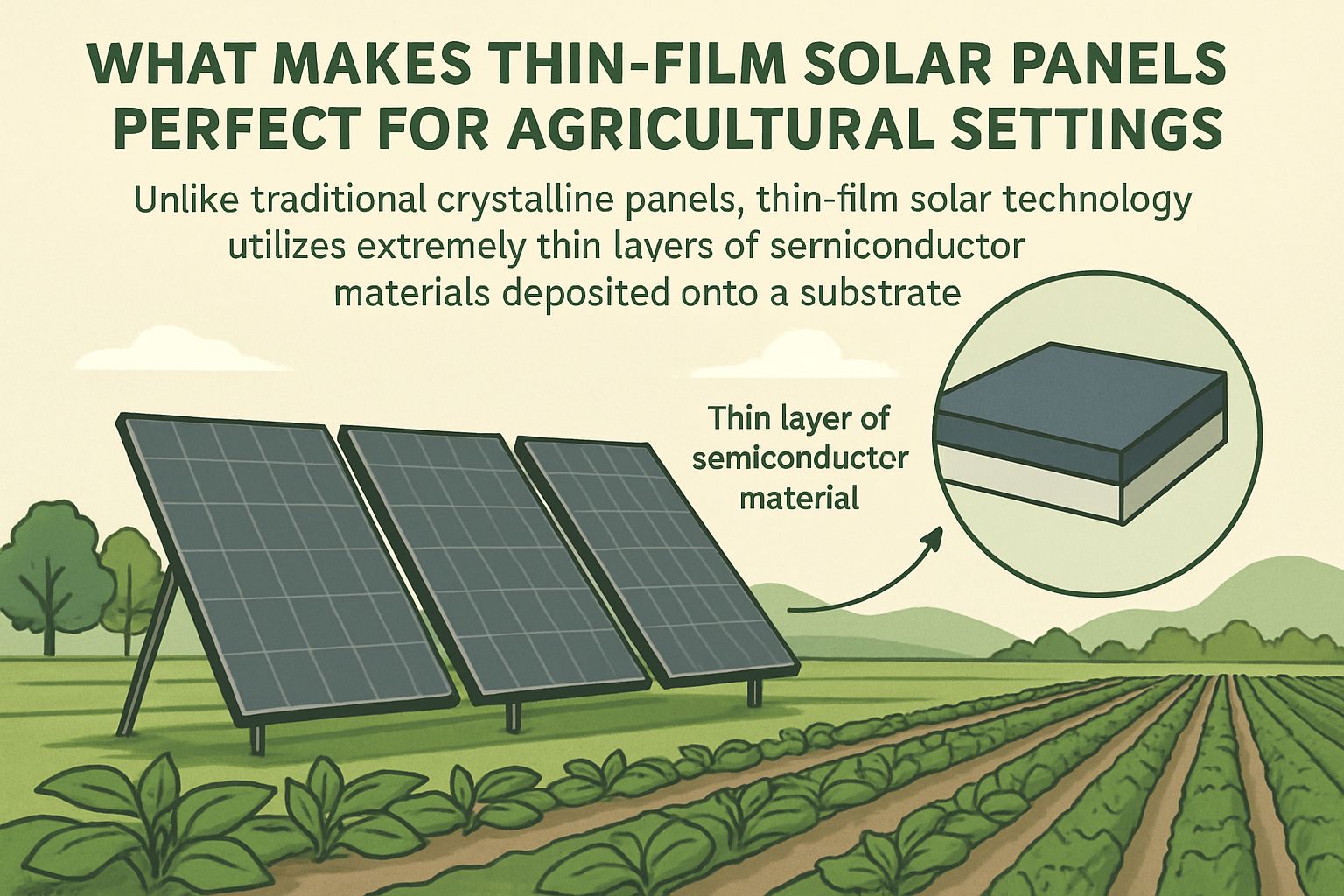
What Makes Thin-Film Solar Panels Perfect for Agricultural Settings
Unlike traditional crystalline panels, thin-film solar technology utilizes extremely thin layers of semiconductor materials deposited onto a substrate. This fundamental difference in construction creates several advantages that are particularly beneficial in farm environments. The reduced silicon content and manufacturing process results in panels that can perform in conditions where conventional panels struggle.
Agricultural operations present unique challenges for solar implementation including irregular building structures, partial shading from equipment or trees, and often harsh weather conditions. Thin-film technology addresses these challenges through its inherent flexibility, better low-light performance, and simplified mounting requirements that make installation possible on structures that couldn’t support heavier conventional panels.
While traditional panels might offer higher efficiency ratings in laboratory conditions, thin-film panels often deliver superior real-world performance in the variable conditions found on working farms. This practical advantage translates to more consistent energy production throughout the day and across seasons, which is essential for reliable farm operations.
- Reduced sensitivity to partial shading conditions
- Better performance at high temperatures common in rural areas
- Lower installation costs on irregular surfaces
- Less visually intrusive in agricultural landscapes
- Potential for integration with specialized farm structures like greenhouses
Flexibility for Irregular Farm Structures
Farm buildings rarely offer the ideal flat, south-facing surfaces that conventional solar installations require. Barns, equipment sheds, and processing facilities often feature irregular rooflines, curved surfaces, or non-optimal orientations. Thin-film panels excel in these environments due to their inherent flexibility and adaptability to irregular mounting surfaces.
The bendable nature of many thin-film products allows for installation on curved metal roofs, corrugated surfaces, and even cylindrical grain storage facilities that would be impossible with rigid crystalline panels. This flexibility dramatically expands the potential solar footprint on a typical farm property, allowing farmers to utilize structures that would otherwise be unsuitable for solar energy production. Some farmers have even successfully integrated thin-film panels onto mobile equipment sheds and portable structures that move throughout the property seasonally.
Better Performance in Partial Shade Conditions
Agricultural settings frequently involve partial shading from trees, equipment, and neighboring structures. Unlike conventional panels where shade on a single cell can significantly reduce output across an entire panel, thin-film technology features more resilient circuit designs. The unique construction of thin-film panels allows them to continue producing electricity even when portions are shaded, maintaining higher overall energy yields in real-world farm conditions.
- Maintains up to 80% efficiency with partial shading compared to 50% for conventional panels
- Less sensitive to early morning and late afternoon shadow patterns
- Better performance under diffuse light conditions common in many agricultural regions
- Reduced need for complex shade mitigation strategies during installation
This shade tolerance makes thin-film technology particularly valuable in agroforestry operations, farms with windbreaks, or properties with natural terrain features that create variable shading throughout the day. The ability to generate power even in less-than-ideal light conditions translates to more consistent energy production across seasons and weather patterns.
Temperature Tolerance for Hot Rural Areas
Unlike crystalline panels that lose efficiency as temperatures rise, thin-film technology maintains consistent performance even during scorching summer days. This temperature tolerance represents a significant advantage for farms in hot climates where traditional panels might experience efficiency losses of 10-25% during peak production hours. Thin-film panels typically experience only a 0.2-0.5% efficiency reduction per degree Celsius above standard testing conditions, compared to 0.4-0.5% for polycrystalline panels. For more information on choosing the best solar panel types for farms, explore our detailed guide.
For livestock operations requiring consistent climate control or irrigation systems that must run during the hottest parts of the day, this heat resistance ensures power generation remains stable when demand is highest. Farms in southern regions particularly benefit from thin-film’s temperature coefficient advantage, with some installations reporting 15-20% higher real-world annual yields compared to similarly rated crystalline systems due to better hot-weather performance.
Lightweight Design for Easy Installation
The reduced weight of thin-film panels—often 50-60% lighter than traditional panels—makes installation possible on structures that couldn’t support heavier systems. Many agricultural buildings weren’t designed with the additional load of solar panels in mind, and structural reinforcement can add significant costs to solar projects. Thin-film’s lighter profile often eliminates this expense entirely, making previously unsuitable buildings viable candidates for solar installations.
This weight advantage extends beyond existing structures to temporary installations and portable farm applications. Some innovative farmers have implemented thin-film systems on seasonal structures, mobile livestock shelters, and even irrigation equipment covers. The reduced weight also translates to lower shipping costs and easier handling during installation, further reducing overall project expenses for budget-conscious farm operations.
Top 5 Thin-Film Solar Panels for Farm Applications
After evaluating dozens of products specifically for agricultural applications, these five thin-film solar panel systems have proven most effective in farm settings. Each offers unique advantages depending on specific farm needs and conditions, with proven track records in agricultural installations across diverse climate zones.
|
Panel Model |
Best For |
Efficiency |
Weight |
Special Features |
|---|---|---|---|---|
|
First Solar Series 6 |
Large ground installations |
17-18% |
33 lbs |
Excellent high-temp performance, lowest carbon footprint |
|
Miasole FLEX-03W |
Curved metal roofs |
16% |
0.7 lbs/ft² |
Peel-and-stick application, bends up to 175° |
|
Solar Frontier CIS |
Partially shaded areas |
14.6% |
43 lbs |
Superior low-light performance, salt-spray resistant |
|
Hanergy HanTile |
Building integration |
17.5% |
Variable |
Replaces conventional roofing, aesthetic design |
|
Flisom eFlex |
Portable applications |
13.6% |
0.5 lbs/ft² |
Ultra-thin, highly flexible, impact-resistant |
Thin-Film vs. Traditional Crystalline Panels: What Farmers Need to Know
Understanding the fundamental differences between thin-film and crystalline technologies helps farmers make informed decisions based on their specific operational needs rather than marketing claims. While traditional crystalline panels have dominated the residential market, thin-film technology offers distinct advantages in many agricultural applications due to its different physical properties and performance characteristics.
“After installing both types on different farm buildings, we found our thin-film system outperformed crystalline panels by nearly 12% on annual production despite lower rated capacity. The difference was especially noticeable during summer months when our irrigation demand is highest.” — Robert Henderson, Dairy Farmer, Wisconsin
The performance gap between technologies narrows each year as manufacturing improves, but the inherent characteristics of each panel type remain consistent. Thin-film excels in challenging conditions and irregular installations, while crystalline typically delivers higher efficiency in optimal conditions. Most importantly, the “best” technology varies widely depending on specific farm needs, regional climate, and installation constraints.
Beyond efficiency ratings, farmers should consider maintenance requirements, degradation rates, and compatibility with existing farm structures when comparing options. While crystalline panels might generate more power per square foot initially, thin-film often delivers better long-term value in agricultural settings due to more stable output under varying farm conditions and generally lower degradation rates over decades of use.
Cost Comparison and Long-Term Value
Initial purchase price often favors crystalline technology, with current polycrystalline panels averaging $0.70-0.90 per watt compared to $0.85-1.10 for comparable thin-film products. However, this upfront cost difference tells only part of the story. When factoring installation expenses, thin-film systems typically cost 10-15% less to install due to lighter weight, reduced racking requirements, and simplified mounting options. For many agricultural buildings, the eliminated need for structural reinforcement alone can offset the higher panel cost entirely.
Space Requirements and Installation Differences
Crystalline panels currently offer higher efficiency ratings (18-22%) compared to thin-film options (10-18%), requiring approximately 20-30% less space for equivalent power generation under ideal conditions. For farms with limited suitable roof space or premium ground area, this space efficiency might favor crystalline technology despite other advantages of thin-film. However, the flexible mounting options of thin-film often allow utilization of surfaces unsuitable for rigid panels, effectively expanding the potential installation area beyond what’s possible with crystalline technology.
Installation complexity also differs significantly between technologies. Thin-film’s lighter weight reduces structural requirements and allows for innovative mounting solutions including direct adhesion to surfaces, flexible frames, and integration into building materials. This installation flexibility can dramatically reduce labor costs and enable solar adoption on farms where traditional rack-mounted crystalline panels would be impractical or prohibitively expensive to install.
Durability in Agricultural Environments
Farm environments present unique challenges for solar equipment including exposure to dust, ammonia from livestock operations, agricultural chemicals, and severe weather events. Thin-film panels typically offer better resistance to chemical exposure due to their sealed construction, with some models specifically engineered for high-ammonia environments found in livestock operations. The monolithic construction of many thin-film products also eliminates the micro-crack issues that affect crystalline cells during thermal cycling and mechanical stress, resulting in degradation rates as low as 0.5% annually compared to 0.7-1% for many crystalline products in agricultural settings.
Financial Analysis: Making Thin-Film Solar Work for Your Farm Budget
The financial implications of thin-film solar adoption extend far beyond simple equipment costs. When calculating the true investment value, farmers must consider installation expenses, maintenance requirements, energy production expectations, available incentives, and financing options. A comprehensive analysis typically reveals payback periods of 5-8 years for thin-film systems in agricultural applications, with positive cash flow continuing for decades afterward. For more information on the best solar panel types for farms, consider exploring additional resources.
USDA REAP Grants and Agricultural Solar Incentives
The USDA Rural Energy for America Program (REAP) represents one of the most valuable financial resources for farm solar projects, offering grants covering up to 25% of project costs and loan guarantees for an additional 75%. This program specifically targets rural small businesses and agricultural producers, with simplified applications for projects under $80,000 and dedicated funding allocations for smaller farms. The competitive application process favors projects demonstrating innovation and significant energy savings, areas where thin-film technology often excels.
Beyond REAP, many states offer agriculture-specific solar incentives that can be combined with federal programs. These range from direct rebates based on system capacity to performance-based incentives that pay for each kilowatt-hour generated. In some regions, specialized agricultural net metering policies allow farmers to offset electricity used across multiple meters or receive premium rates for solar electricity that supports grid stability in rural areas.
Tax Benefits for Farm Solar Investments
The federal Investment Tax Credit currently allows farmers to deduct 30% of solar system costs from their tax liability, significantly reducing effective project expenses. Agricultural operations can also benefit from accelerated depreciation through the Modified Accelerated Cost Recovery System (MACRS), permitting depreciation of the entire system over just five years rather than the 20+ year physical lifespan. When combined with state-level tax incentives available in many agricultural regions, these benefits can reduce the effective cost of thin-film systems by 40-60% compared to sticker price.
Calculating Your Farm’s Solar ROI
Return on investment for farm solar installations depends on multiple operation-specific factors including energy consumption patterns, electricity rates, panel performance in your climate, and available incentives. While simplified online calculators provide rough estimates, accurate projections require analysis of your farm’s actual electrical demand throughout the year. The most successful agricultural solar implementations align production capacity with seasonal usage patterns, particularly for operations with predictable high-demand periods like irrigation during growing seasons or climate control for livestock during temperature extremes.
Financing Options for Agricultural Operations
Beyond traditional loans, agricultural operations can access specialized financing vehicles including USDA-backed lending programs, rural development funds, and agricultural equipment loans that recognize solar as farm equipment rather than building improvements. Power Purchase Agreements (PPAs) and solar leases eliminate upfront costs entirely, though these arrangements typically capture a portion of the long-term savings that would otherwise benefit the farm. Some agricultural cooperatives have established shared investment programs allowing member farmers to jointly finance larger systems with proportional benefits, creating economies of scale typically unavailable to individual operations.
When evaluating financing options, consider how the arrangement affects your eligibility for tax incentives and grants, as some structures transfer these benefits to the financing entity rather than the farm business. The ideal financing approach aligns with your farm’s cash flow patterns and tax situation while preserving maximum long-term ownership benefits.
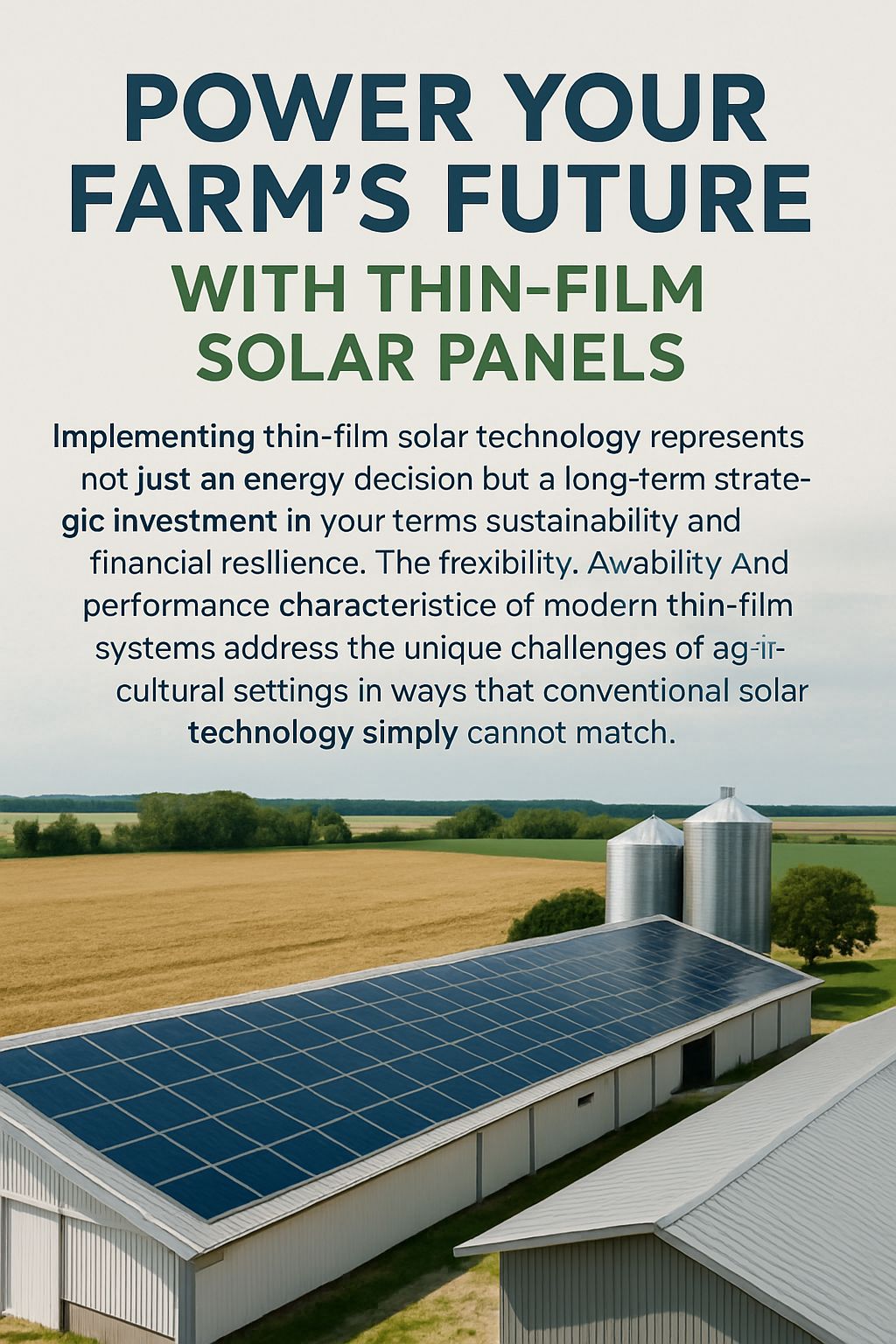
Power Your Farm’s Future with Thin-Film Solar Panels
Implementing thin-film solar technology represents not just an energy decision but a long-term strategic investment in your farm’s sustainability and financial resilience. The flexibility, durability, and performance characteristics of modern thin-film systems address the unique challenges of agricultural settings in ways that conventional solar technology simply cannot match. By carefully selecting the appropriate thin-film solution for your specific operation and taking advantage of agriculture-specific incentives, your farm can achieve energy independence while improving your bottom line for decades to come. SolarFarm Technologies specializes in custom thin-film solar solutions designed specifically for agricultural applications—contact our farm energy specialists to explore how this technology can transform your operation.
Frequently Asked Questions
Farmers considering thin-film solar technology typically share common concerns about system longevity, performance capabilities, and maintenance requirements. These practical questions reflect the unique considerations of agricultural implementations where reliability, durability, and minimal maintenance are particularly valuable. The answers below address the most frequent inquiries based on real-world agricultural installations across diverse climate zones and farm types.
Understanding these practical aspects of thin-film technology helps farmers make informed decisions based on their specific operational needs rather than general solar industry claims that often focus on residential or commercial applications with very different requirements and priorities.
How long do thin-film solar panels typically last on a farm?
Modern thin-film panels are engineered for 25-30 year operational lifespans in agricultural environments, with manufacturers typically providing 25-year production warranties guaranteeing at least 80% of initial output capacity throughout this period. The actual degradation rate for quality thin-film installations averages 0.5-0.7% annually—slightly better than conventional panels in comparable farm settings. Systems installed on agricultural properties in the early 2000s continue functioning at 80-85% of their original capacity, demonstrating real-world durability that matches or exceeds warranty claims even in challenging farm conditions.
Can thin-film panels power heavy farm equipment like irrigation systems?
Thin-film solar arrays can indeed power substantial agricultural equipment when properly sized, with numerous farms successfully operating irrigation pumps, grain dryers, and climate control systems using thin-film technology. The key consideration isn’t the panel type but rather the overall system capacity and electrical integration. For high-load equipment with motors exceeding 10HP, additional electrical components including soft-starters or variable frequency drives are typically recommended regardless of panel type. Many farmers implement hybrid approaches where solar handles baseline operations during daylight hours with grid power supplementing during peak demands or nighttime operation.
For irrigation specifically, direct solar-powered pumps (without batteries) have proven extremely cost-effective when system design accounts for variable power availability throughout the day. These direct-drive systems typically incorporate water storage to compensate for fluctuating solar production, maintaining consistent irrigation while eliminating battery costs.
“Our 30kW thin-film system powers two 7.5HP irrigation pumps that run whenever the sun shines, filling our elevated storage tanks. This gravity-fed system then handles overnight irrigation without batteries or grid power. We’ve eliminated over $14,000 in annual electricity costs while gaining immunity from power outages during critical growing periods.” — Maria Rodriguez, Organic Vegetable Farm, California
The scalability of thin-film technology allows farmers to start with modest systems addressing specific energy needs before expanding as budget permits, gradually reducing dependence on grid electricity without requiring massive initial investments.
Will thin-film solar panels work in northern states with less sunlight?
Thin-film technology actually offers performance advantages in northern climates compared to conventional panels due to better low-light response and improved performance in diffuse light conditions. While total annual production will be lower than in sunnier regions, the technology efficiently captures available light even during overcast days and low-angle winter sun conditions. Several studies have documented thin-film installations in Minnesota, Michigan, and Maine outperforming similarly rated crystalline systems during winter months by 5-15%, partially offsetting the overall annual production advantage that crystalline panels show in ideal conditions.
For northern farms, system orientation becomes particularly important, with slightly steeper tilt angles (typically 5-10° more than the location’s latitude) optimizing winter production when utility rates are often highest. Some northern agricultural operations implement seasonally adjustable mounting systems to maximize summer production during growing seasons while optimizing winter angle during livestock-focused months with different energy requirements.
How do I maintain thin-film panels in dusty farm environments?
Maintenance requirements for thin-film panels in agricultural settings are typically minimal compared to conventional panels due to their smooth surface design that reduces dust accumulation and promotes natural cleaning during rainfall. Most installations require only periodic visual inspections and occasional cleaning if located near particularly dusty operations like grain handling or field tillage. Unlike textured crystalline panels that trap dust in microscopic surface patterns, the flat glass surface of most thin-film products allows dust to slide off more easily during even light precipitation or morning dew. For extremely dusty environments, automated cleaning systems using minimal water can be integrated with existing irrigation infrastructure to maintain optimal performance with virtually no manual intervention.
Can I install thin-film panels myself or do I need specialized contractors?
The feasibility of DIY installation varies significantly by thin-film product type and mounting system. Flexible peel-and-stick products designed for metal roofing can be relatively straightforward for farmers with basic construction experience, while glass-substrate panels typically require professional installation with specialized equipment. The electrical integration represents the most technically challenging aspect of any solar project, with most jurisdictions requiring licensed electricians to complete final grid connections regardless of who installs the physical panels. Many manufacturers offer farmer-friendly installation kits with comprehensive documentation specifically designed for agricultural applications, and some agricultural extension programs provide workshops on solar installation basics. For most farm operations, a hybrid approach works best: professional design and electrical work combined with farm labor for basic mounting tasks, significantly reducing overall project costs while ensuring safety and code compliance.
When considering self-installation, carefully review equipment warranty requirements, as some manufacturers specify professional installation for warranty validation. Also examine your farm insurance policy, as coverage for both the system and the building it’s mounted on may be affected by installation method.
For farmers seeking maximum energy independence, thin-film solar technology offers a compelling combination of adaptability, performance, and value that addresses the unique challenges of agricultural applications. With proper system design, incentive utilization, and installation, these innovative panels can transform farm energy expenses into productive assets generating returns for decades while reducing environmental impact.
Thin-film solar panels have become increasingly popular among farmers due to their lightweight design and flexibility. These panels can be easily integrated into various farm structures, providing a versatile energy solution. Farmers looking to enhance their farm’s energy efficiency can explore solar panel types for agricultural use to find the best fit for their needs. Additionally, the advancements in thin-film technology have made them more affordable and efficient, further driving their adoption in the agricultural sector.







Leave a Reply