

Solar Panel Power Solutions — What Farmers Need to Know
- Solar panel power solutions can dramatically cut farm energy costs, with most systems paying for themselves within 5 to 10 years.
- The type of solar panel you choose — monocrystalline, polycrystalline, or thin-film — directly impacts how much power your farm generates per square foot.
- Agrivoltaics, the practice of running solar panels and crops on the same land, is one of the most exciting developments in farm energy and land use efficiency.
- Federal tax credits and agricultural solar incentives can offset a significant portion of upfront installation costs.
- Sizing your system correctly from the start is the single most important decision you’ll make — get it wrong and you’ll either overpay or come up short on power when it matters most.
Farm energy bills are one of the biggest drains on agricultural profit margins, and solar is one of the most practical ways to take back control. Growing Solar Mist provides farmers with the tools and guidance needed to make smarter, more sustainable energy decisions on working land.
Farms Are Paying Too Much for Energy — Solar Changes That
The average commercial farm spends tens of thousands of dollars per year on electricity alone. Irrigation systems, climate-controlled livestock facilities, grain dryers, cold storage units — each one running around the clock, each one adding to an energy bill that never seems to shrink. Traditional grid electricity prices have increased steadily, and there’s little reason to expect that trend to reverse.
Solar panel power solutions flip this equation. Instead of buying power from a utility company every month, a properly sized solar system lets a farm generate its own electricity directly from sunlight. The fuel is free. The source is inexhaustible. And once the system is installed, the operating costs drop to near zero.
Farms are actually ideal candidates for solar. They tend to have large areas of open land or south-facing roof space, high daytime energy consumption that aligns with peak solar production hours, and enough long-term land tenure to make a 25-year energy investment worthwhile. The economics have never been more favorable, especially with federal incentives currently in play.
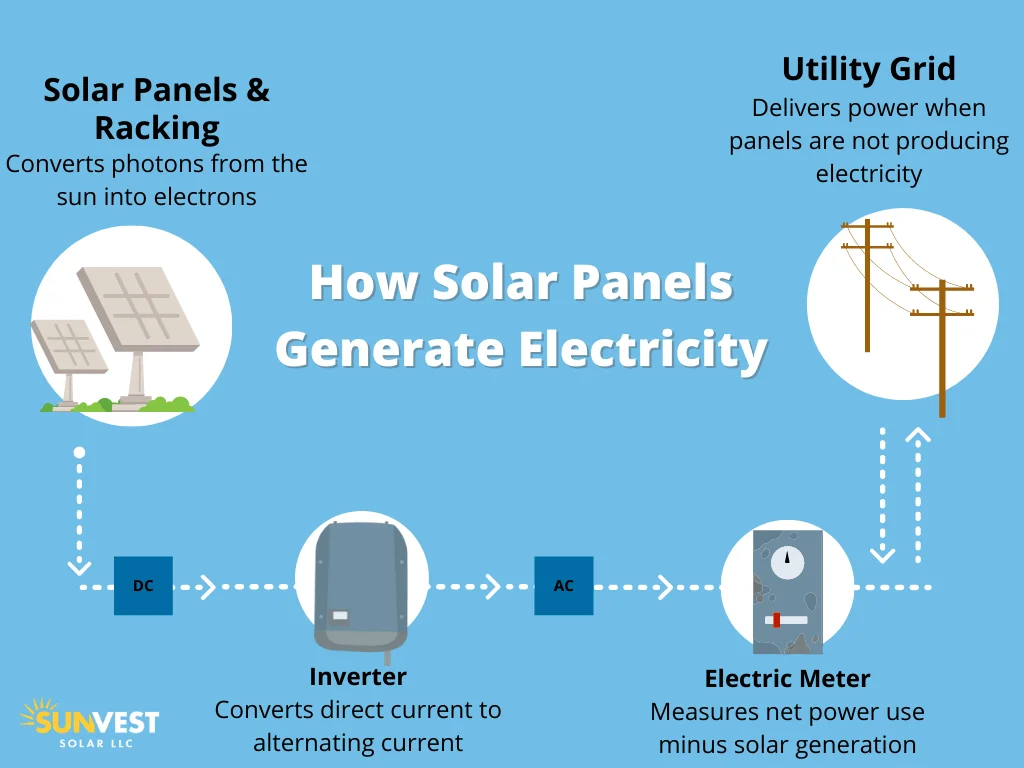
“How Do Solar Panels Work? – SunVest” from www.sunvest.com and used with no modifications.
How Solar Panels Actually Turn Sunlight into Farm Power
Understanding the basic mechanics of solar power helps you make smarter decisions about system design, panel selection, and storage. You don’t need an engineering degree — just a clear picture of what’s happening between the sun hitting your panel and your pump motor switching on.
The Photovoltaic Effect: How Solar Cells Capture Light
Every solar panel is made up of photovoltaic (PV) cells, typically constructed from silicon semiconductor material. When photons from sunlight strike these cells, they knock electrons loose from their atomic structure. That movement of electrons is what creates an electric current. A single PV cell produces only a small amount of electricity, which is why panels link dozens of cells together, and systems link multiple panels into arrays to reach useful power levels.
DC to AC: How Raw Solar Energy Becomes Usable Farm Electricity
The electricity produced by PV cells is direct current (DC), which is not the form most farm equipment uses. Nearly all standard farm machinery, lighting, and appliances run on alternating current (AC). This is where the inverter comes in — it converts the raw DC output from your panels into AC power that your farm can actually use.
String inverters handle the output of an entire array at once and work well for installations where all panels receive consistent sunlight. Microinverters, attached to each individual panel, are better suited for situations where shading from trees or structures might affect some panels but not others. The right choice depends entirely on your farm’s layout and local geography.
The Role of Inverters, Meters, and Battery Storage
Beyond the inverter, two other components define how well your system performs in real-world conditions. A bi-directional utility meter tracks both the power your farm draws from the grid and any surplus power you send back to it — this is the foundation of net metering programs that can earn farmers bill credits. Battery storage systems, such as the Tesla Powerwall or LG RESU series, capture excess daytime solar production so it can be used after dark or during cloudy stretches, reducing dependence on grid power to near zero in well-designed setups.
Which Farm Operations Benefit Most from Solar Power
Not every farm load is equal when it comes to solar payback. Some operations are almost perfectly suited to run on solar power, while others require more careful system design to make economic sense. Knowing where solar delivers the biggest return helps prioritize where to start.
Irrigation Pumps and Water Systems
Solar-powered irrigation is one of the highest-value applications on any farm. Pumps typically run during daylight hours — exactly when solar production peaks — creating a near-perfect alignment between energy supply and demand. A solar irrigation system eliminates the need for diesel generators in remote fields and can reduce water system energy costs by up to 100% in optimally designed setups.
Solar water pump systems are typically sized based on the pump’s horsepower rating and daily run hours. A 5 HP irrigation pump running 8 hours per day requires roughly 30 kWh of energy daily. Depending on your region’s peak sun hours, that translates to a solar array between 6 kW and 10 kW to reliably cover that load without storage.
Remote fields that previously required expensive trenching for electrical lines or ongoing diesel fuel costs are now economically viable candidates for dedicated solar pump systems. The elimination of fuel logistics alone can make the return on investment compelling within just a few growing seasons.
Livestock Facilities and Climate Control
Poultry houses, hog confinement buildings, and dairy facilities run ventilation fans, heating systems, and lighting continuously. These are among the most energy-intensive structures on any livestock operation, and their loads are consistent enough to plan solar systems around with high accuracy.
A broiler poultry house measuring 40 feet by 500 feet can consume between 70,000 and 120,000 kWh of electricity per year. A well-designed rooftop or ground-mounted solar array can offset a substantial portion of this load, with some producers achieving 60% to 80% reduction in purchased electricity within the first year of operation.
Climate control is where solar storage starts to matter more. Nighttime ventilation and heating requirements mean that a battery backup system — or a grid-tied system with net metering — becomes an important part of the design for livestock applications.
Grain Drying and Cold Storage
- Grain dryers are among the most energy-hungry pieces of equipment on a crop farm, often consuming thousands of kWh during harvest season.
- Cold storage facilities for produce or dairy products run around the clock and represent a consistent, predictable solar load.
- Solar systems paired with thermal storage or battery backup can significantly reduce peak demand charges from utilities during high-consumption harvest periods.
- In some regions, time-of-use utility pricing makes solar-plus-storage especially valuable during the late-afternoon peak rate windows when dryers and coolers are working hardest.
Grain drying represents a seasonal but very high-intensity energy demand. While solar alone may not cover 100% of a dryer’s load during peak harvest, it can meaningfully offset baseline consumption and reduce the size of the utility bill during those critical months. Pairing solar with propane or natural gas hybrid dryer systems is one approach that’s gaining traction among grain producers looking to control costs without sacrificing drying capacity.

“Best Solar Panel Types for Farms …” from growingsolarmist.com and used with no modifications.
Solar Panel Types Best Suited for Agricultural Use
Walk into any solar conversation without knowing the difference between panel types, and you’ll likely end up with a system that’s either overpriced for your needs or underpowered for your loads. Each panel technology has a specific profile of efficiency, cost, durability, and ideal use case — and agriculture has its own set of priorities that don’t always match what a rooftop residential installer would recommend.
The four main panel types used in agricultural solar installations are monocrystalline silicon, polycrystalline silicon, thin-film, and bifacial. Each one occupies a different position on the efficiency-vs-cost spectrum, and the right choice depends on your available land area, budget, and how hard you need each square foot of panel to work.
Monocrystalline Silicon Panels: High Efficiency for Space-Limited Farms
Monocrystalline panels are cut from a single continuous crystal of silicon, which gives them the most uniform structure and the highest efficiency ratings of any mainstream panel type. Most monocrystalline panels on the market today achieve between 17% and 22% efficiency, with premium options like the SunPower Maxeon 3 reaching up to 22.8%. For farms where roof space or ground area is limited but energy demand is high, monocrystalline panels deliver the most power per square foot of any option available.
Polycrystalline Silicon Panels: A Cost-Effective Middle Ground
Polycrystalline panels are made by melting multiple silicon fragments together, which creates a less uniform crystal structure and slightly lower efficiency — typically between 13% and 17%. What they give up in efficiency, they make up for in cost. Polycrystalline panels are generally 10% to 20% cheaper per watt than their monocrystalline counterparts, which makes them a practical choice for large ground-mounted arrays where land is not a limiting factor. For those considering backup options, exploring LiFePO4 batteries can be beneficial for solar panel systems.
For a farm with several open acres available for a ground-mounted solar field, the lower cost per watt of polycrystalline panels can mean significant savings on total system cost without a meaningful sacrifice in total energy production. The math often works out in their favor when square footage is abundant and budget is the primary constraint. Learn more about how solar power works to maximize your farm’s energy efficiency.
That said, polycrystalline panels do tend to perform slightly worse in high-heat conditions compared to monocrystalline. In regions with intense summer heat, the efficiency gap between the two technologies widens somewhat — a detail worth factoring into your regional performance estimates before committing to a panel type.
Thin-Film Panels: Flexible but Lower Output
Thin-film panels are produced by depositing photovoltaic material onto a substrate like glass, plastic, or metal. They are lightweight, flexible, and can be applied to curved or irregular surfaces that rigid crystalline panels cannot accommodate. Efficiency ranges from roughly 10% to 13%, which means they require significantly more surface area to generate the same output as a monocrystalline array.
On a farm, thin-film panels have niche applications — think curved barn roofs, agricultural shade structures, or low-power remote monitoring stations where flexibility matters more than peak output. For primary farm power generation, thin-film rarely makes sense as the main technology, but it fills genuine gaps where conventional panels simply cannot go.
Bifacial Panels: Double-Sided Energy Capture
Bifacial panels capture sunlight on both the front and rear faces of the panel, picking up reflected light from the ground surface below. In open agricultural settings with light-colored soil, gravel, or snow cover, bifacial panels can produce 10% to 27% more energy than equivalent single-sided panels. Ground-mounted bifacial arrays elevated 3 to 5 feet above reflective surfaces consistently outperform conventional panels in real-world farm conditions, making them one of the most compelling options for large-scale agricultural solar installations.
Here is a comparison table of the four best solar panel types for agricultural use — focusing on features, efficiency, and suitability for farms.
|
Solar Panel Type |
Efficiency Range |
Cost per Watt (Approx.) |
Key Advantages for Agriculture |
Limitations |
Best Farm Applications |
|---|---|---|---|---|---|
|
Monocrystalline Panels |
17–22% 1 |
$0.90–$1.50 2 |
High efficiency, compact design, long lifespan, performs well in all climates |
Higher upfront cost |
Space-limited farms, rooftops, and irrigation systems 1 |
|
Polycrystalline Panels |
13–17% 3 |
$0.70–$1.00 3 |
Lower cost, durable, long lifespan, strong in direct sunlight |
Requires more space, less efficient in cloudy conditions | |
|
Thin-Film Panels |
10–13% 5 |
$0.50–$0.90 2 |
Lightweight, flexible, better low-light/shaded performance |
Lower efficiency, shorter lifespan |
Greenhouses, barns, shaded or irregular terrain 5 |
|
Bifacial Panels |
18–22% 6 |
$1.00–$1.60 6 |
Captures light from both sides, high energy yield, great for reflective surfaces like grass or soil |
Higher cost, more complex installation |
Agrivoltaics (dual-use with crops), open-field installations 6 |
These four types of solar panels represent the most effective options for agricultural operations, allowing farmers to select between high efficiency (monocrystalline, bifacial) and lower-cost scalability (polycrystalline, thin-film) depending on land availability, sunlight exposure, and budget.
The Real Cost of Going Solar on a Farm
Cost is where many farm solar conversations stall, and usually because the numbers get presented without enough context. The upfront price of a solar system is only one part of the equation. The other parts — incentives, energy savings, and payback period — are what determine whether a solar investment actually makes financial sense for a specific operation.
Average System Costs for Small vs. Large Farm Operations
As of recent industry data, commercial agricultural solar systems typically cost between $2.50 and $3.50 per watt before incentives. A small farm system in the 25 kW range would run approximately $62,500 to $87,500 before any credits or rebates. A larger operation requiring a 250 kW system could see total costs between $625,000 and $875,000 before incentives — though per-watt costs often decrease at larger system sizes due to economies of scale in equipment and installation labor.
Federal Tax Credits and Agricultural Solar Incentives
The federal Investment Tax Credit (ITC), currently set at 30% under the Inflation Reduction Act, is the single most impactful financial incentive available to farm solar projects. A $200,000 solar installation becomes a $140,000 net cost after the ITC alone. Farms structured as pass-through business entities, such as LLCs or S-corporations, can apply this credit directly against their federal tax liability, making it one of the most straightforward incentives to capture.
Beyond the federal ITC, the USDA Rural Energy for America Program (REAP) offers grants covering up to 50% of eligible project costs for agricultural producers and rural small businesses. REAP grants and loan guarantees can be stacked with the federal ITC, meaning a qualifying farm project could potentially reduce its net cost by 60% to 70% before factoring in any state-level incentives or utility rebates. Not every project qualifies, but for farms that do, the combination of REAP and ITC fundamentally changes the economics of going solar.
How Long Before a Farm Solar System Pays for Itself
Payback periods for farm solar systems typically range from 5 to 10 years depending on system size, local electricity rates, available incentives, and energy consumption patterns. Farms in states with higher utility rates and strong net metering programs tend to see payback on the shorter end of that range. After payback, the system continues producing electricity for another 15 to 20 years with minimal maintenance cost, representing pure financial return on the original investment.

Agrivoltaics: Growing Crops and Generating Power on the Same Land
Agrivoltaics is one of the most promising developments in agricultural solar — and it solves a problem that has held some farmers back from adopting solar: the concern that solar panels compete with productive cropland. In an agrivoltaic system, solar panels are mounted high enough above the ground to allow farming operations to continue beneath them. The panels generate electricity while the land below continues producing food. For farmers looking to optimize energy storage, exploring solar panel backup batteries can be essential for nighttime and weather-related power solutions.
- Shade from solar panels can reduce water evaporation in crops below by up to 29%, according to research from the University of Arizona.
- Certain shade-tolerant crops including leafy greens, herbs, and some berry varieties have shown increased yields when grown under solar panels compared to full-sun conditions.
- Sheep grazing under solar arrays is already a well-established dual-use practice in the United States, with hundreds of utility-scale solar sites incorporating managed grazing programs.
- Pollinator habitat planted beneath and around solar arrays supports local bee populations and can contribute to improved yields in surrounding crop fields.
The structural requirements of agrivoltaic systems do add cost compared to standard ground-mounted arrays. Panels need to be mounted higher — typically 8 to 15 feet above grade — to allow equipment and livestock to pass underneath, and the racking systems must be engineered to accommodate those heights. That said, the ability to generate dual income from the same acre of land makes agrivoltaics increasingly attractive as both solar and land costs continue to rise.
Research from Oregon State University and the National Renewable Energy Laboratory (NREL) has demonstrated that agrivoltaic systems can be more land-efficient than using separate plots for energy and food production. The concept of land equivalent ratio — a measure of how productively a given area of land is being used — consistently comes out higher for agrivoltaic systems than for single-use land, which is a compelling argument for farmers weighing solar adoption against productive land loss.
How to Size a Solar System for Your Farm’s Energy Needs
Getting the system size right is the most technically critical decision in any farm solar project. An undersized system leaves energy savings on the table and may not qualify for optimal incentive tiers. An oversized system costs more upfront than necessary and may produce more electricity than your farm can use or your utility will credit through net metering.
The sizing process follows a logical sequence that starts with understanding your farm’s actual energy consumption, then works through sunlight availability, load timing, and storage requirements to arrive at a panel capacity and battery specification that fits your specific operation. Most experienced agricultural solar installers will conduct a formal energy audit before recommending system specifications — if yours doesn’t, consider that a red flag.
Here is the sequence to follow when sizing a farm solar system: understanding the benefits of backup batteries is crucial for ensuring continuous power supply.
- Step 1: Pull 12 months of utility bills and calculate your farm’s total annual kWh consumption.
- Step 2: Identify seasonal peaks — harvest season dryer loads, summer irrigation peaks, or winter heating demands — that will define your maximum system requirements.
- Step 3: Use your location’s peak sun hours data (available through NREL’s PVWatts Calculator) to determine how many kWh each installed kW of solar will produce annually in your area.
- Step 4: Divide your target annual kWh production by the per-kW output from Step 3 to get your required system size in kilowatts.
- Step 5: Factor in system losses of approximately 14% to 20% for wiring, inverter inefficiency, temperature effects, and soiling to arrive at your final installed capacity target.
1. Calculate Your Farm’s Total Energy Consumption
Start with 12 months of utility statements rather than a single month’s bill. Agricultural energy use is highly seasonal — a grain farm’s October electricity consumption during harvest can be three to five times higher than its February baseline. Using an annual total gives your solar installer an accurate picture of the full demand profile and prevents the common mistake of sizing a system around average monthly use rather than actual peak-season requirements. Add any planned future loads — a new grain bin, an additional well pump, or an EV charging station for farm equipment — into your consumption estimate before finalizing system size.
2. Assess Your Available Sunlight Hours by Region
Peak sun hours are not the same as daylight hours. A peak sun hour represents one hour of sunlight at an intensity of 1,000 watts per square meter — the standard measure used to calculate how much electricity a solar panel will actually produce in a given location. A farm in Arizona might receive 6 to 7 peak sun hours per day, while a farm in the Pacific Northwest might average only 3.5 to 4.5. That difference has a direct and significant impact on how large a system you need to meet the same energy target.
NREL’s PVWatts Calculator is the most reliable free tool available for determining location-specific solar production estimates. Enter your farm’s address, your planned system size, and basic panel orientation details, and the tool returns monthly and annual production estimates that account for your regional weather patterns, not just theoretical peak sunlight. This is the data your installer should be using — and the data you should verify independently before signing a contract.
Regional sun hour averages matter enormously for system sizing and financial projections. A farm in Kansas with 5.5 peak sun hours per day will generate roughly 35% more electricity from the same 100 kW system than a farm in northern Minnesota averaging 4.0 peak sun hours. That gap translates directly into payback period, annual savings, and return on investment over the life of the system. For more information on how solar panels convert sunlight to electricity, visit this detailed guide.
Regional Average Peak Sun Hours for U.S. Farm Regions:
• Southwest (Arizona, New Mexico, Southern California): 6.0 – 7.5 peak sun hours/day
• Great Plains (Kansas, Nebraska, Oklahoma): 5.0 – 6.0 peak sun hours/day
• Midwest Corn Belt (Iowa, Illinois, Indiana): 4.5 – 5.5 peak sun hours/day
• Southeast (Georgia, Alabama, North Carolina): 4.5 – 5.5 peak sun hours/day
• Northeast (New York, Pennsylvania, Vermont): 3.5 – 4.5 peak sun hours/day
• Pacific Northwest (Oregon, Washington): 3.5 – 4.5 peak sun hours/day
3. Match Panel Capacity to Peak Energy Demand
Once you know your annual energy consumption and your regional peak sun hours, calculating your required system capacity is straightforward. Divide your annual kWh target by the number of peak sun hours per day, then divide again by 365 days. The result is the minimum system capacity in kilowatts needed to meet your annual demand — before accounting for system losses. For a farm consuming 200,000 kWh annually in a 5.0 peak sun hour region, the base calculation points to a system just over 109 kW before loss adjustments.
After applying a standard 15% to 20% system loss factor for inverter inefficiency, wiring resistance, soiling, and temperature degradation, that same farm would need an installed capacity of approximately 125 kW to 135 kW to reliably meet its annual energy target. This is why undersized systems are so common — installers who skip the loss factor calculation deliver systems that consistently fall short of projected production, leaving farm owners frustrated and still paying larger utility bills than they expected.
Matching capacity to peak demand timing is equally important. A farm that runs its highest loads during midday summer hours — irrigation pumps, ventilation fans, refrigeration compressors — will see nearly all of that demand met directly by solar production without any need for battery storage. A farm with heavy nighttime or early morning loads needs to either rely on grid power during those windows or invest in battery storage large enough to cover the off-sun hours. That distinction changes both the system design and the total project cost substantially.
4. Factor in Battery Storage for Overnight or Cloudy Day Use
Battery storage is not mandatory for every farm solar system, but it becomes critical the moment you want to reduce grid dependence beyond daylight hours or protect against power outages that could threaten livestock or refrigerated perishables. Lithium iron phosphate (LFP) battery systems — the chemistry used in the Tesla Powerwall 3, the Generac PWRcell, and the sonnenCore+ — are currently the most practical choice for agricultural applications due to their long cycle life, stable chemistry at temperature extremes, and declining cost per kWh of storage capacity. When sizing storage, calculate the kWh load your farm must cover during non-solar hours, then add a 20% buffer for depth-of-discharge limits and efficiency losses during the charge-discharge cycle.
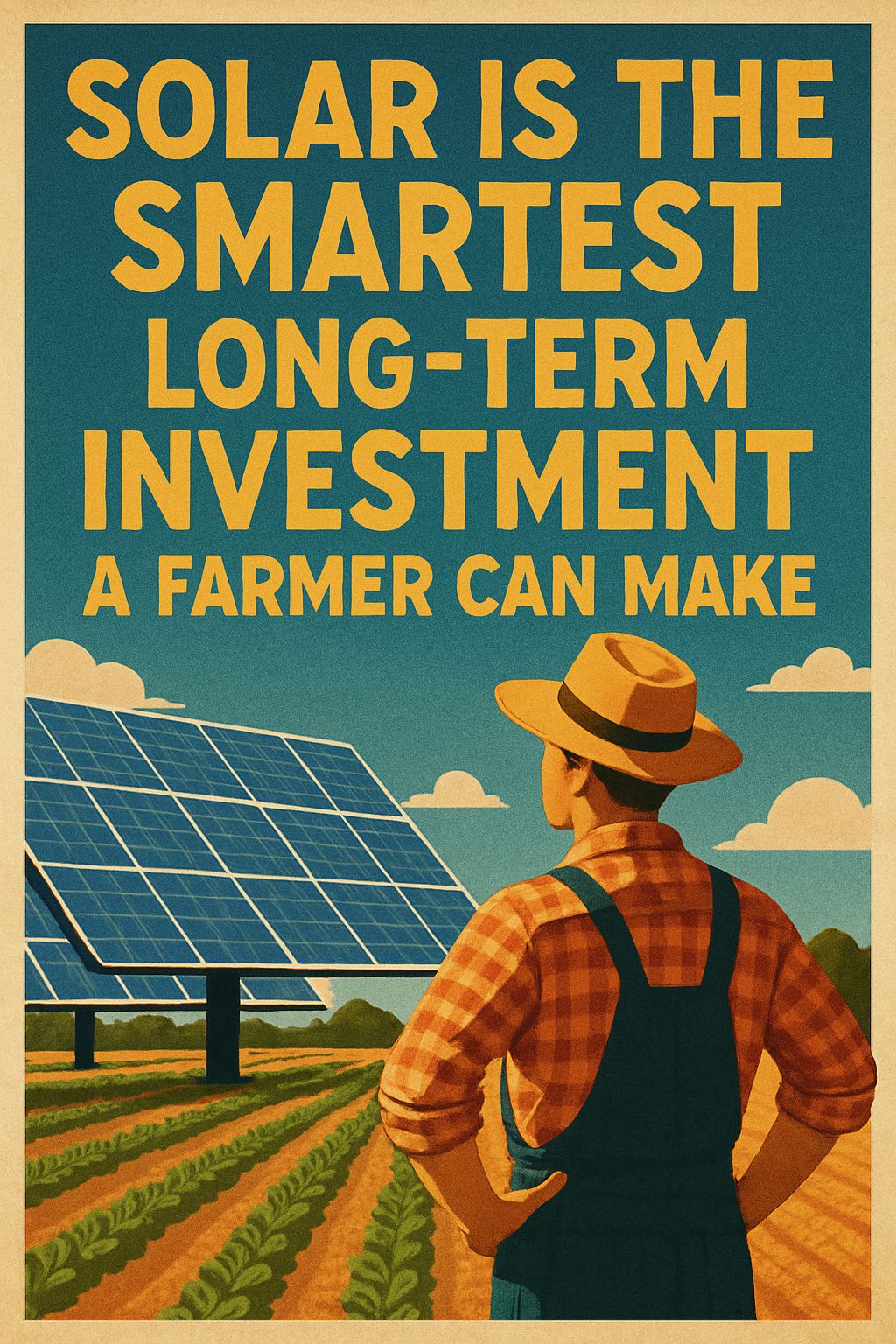
Solar Is the Smartest Long-Term Investment a Farmer Can Make
No other single capital investment available to a farm operation today offers the combination of guaranteed fuel cost elimination, federal tax incentives, 25-plus year asset life, and increasing land productivity that a properly designed solar system delivers. Grid electricity prices will continue to rise. Diesel fuel costs will remain volatile. But the sun will keep producing the same number of peak hours it always has, powering a system that’s already paid for, generating returns every single day for decades after the original investment is recovered. For farmers serious about long-term financial resilience and operational independence, solar is not a question of whether — it’s a question of when and how to do it right.
Frequently Asked Questions
Farm solar projects generate a lot of questions, and rightfully so — the technology, the financing, and the installation process all involve decisions that affect farm operations for 25 years or more. The most common questions tend to cluster around system capability, sizing, regional performance, and financial mechanics.
The answers below address the questions farmers ask most often when evaluating solar panel power solutions for their operations. Where numbers are cited, they reflect real-world agricultural system performance rather than laboratory or best-case projections.
Can a solar panel system power an entire farm operation?
Yes — a correctly sized solar system can offset 100% of a farm’s annual electricity consumption. Whether it powers the farm entirely at every moment depends on storage and grid connection. Grid-tied systems without batteries rely on the grid during nighttime hours and periods of low solar production, but net metering credits earned during high-production periods can bring net annual electricity costs to zero or near zero. Farms with battery storage and high solar resource can achieve near-complete independence from grid power, though the cost of the battery system must be factored into the financial analysis.
What size solar system does an average farm need?
Farm solar system sizes vary enormously depending on the type of operation and its energy loads. A small diversified farm with modest irrigation and basic outbuilding power needs might be well served by a 25 kW to 50 kW system. A mid-size grain operation with commercial grain drying equipment could require 100 kW to 300 kW. Large livestock confinement facilities or intensive vegetable operations with extensive refrigeration and climate control loads might need 500 kW or more to meaningfully offset their utility bills. For these operations, understanding the types of backup batteries available can be crucial for ensuring consistent power supply.
The only reliable way to determine the right system size for a specific farm is to complete a detailed energy audit covering all loads, seasonal consumption patterns, and any planned future expansions. Generic sizing estimates based on farm acreage alone are not a reliable basis for system design and have led to many undersized or poorly performing installations. Start with your utility bills, not your acre count.
Do solar panels work well in cloudy or cold farming regions?
Solar panels work in cloudy and cold climates — often better than farmers in those regions expect. Germany, one of the world’s leading solar energy producers, has a climate comparable to the U.S. Pacific Northwest and northern Midwest. Cold temperatures actually improve panel efficiency slightly because semiconductor performance improves as temperatures drop. Overcast skies reduce output but do not eliminate it — diffuse light still generates electricity. A well-sized system in a 3.5 to 4.5 peak sun hour region will produce meaningful and financially valuable energy year-round, with summer months compensating strongly for lower winter production.
Can farmers sell excess solar energy back to the grid?
In most U.S. states, yes. Net metering policies allow grid-tied solar system owners to send surplus electricity back to the utility grid and receive credits on their bill — effectively running their meter backward during periods of excess production. Those credits can then be drawn down during nighttime hours or low-production periods, reducing or eliminating the net monthly electricity charge. The specific credit rate and program structure varies by state and utility, with some offering full retail rate credit and others offering a lower avoided-cost rate.
Farmers should research their specific utility’s net metering policy before finalizing system size. In states or utility territories with less favorable net metering compensation, oversizing a system can result in surplus electricity that’s credited at a very low rate — reducing the financial return on the portion of the system producing that excess. Matching system size to consumption rather than simply maximizing panel count is the more financially sound approach in those markets.
How long do farm solar panel systems typically last?
Most commercial-grade solar panels carry manufacturer performance warranties guaranteeing at least 80% of rated output at year 25, with many premium manufacturers now offering 30-year performance warranties. Real-world panel degradation rates typically run between 0.5% and 0.7% per year, meaning a panel producing 400 watts at installation will still produce around 330 to 350 watts at the end of a 25-year warranty period. Inverters generally have shorter lifespans of 10 to 15 years and should be factored into long-term maintenance budgets as a planned replacement cost. For those considering energy storage options, exploring solar panel backup battery types can be beneficial for planning efficient farm operations.
Typical Farm Solar System Component Lifespans:
• Solar Panels: 25 – 35 years (with gradual efficiency decline)
• String Inverters: 10 – 15 years (planned replacement)
• Microinverters: 20 – 25 years
• Lithium Battery Systems: 10 – 15 years (chemistry and cycle-count dependent)
• Racking and Mounting Hardware: 25 – 40 years (galvanized or aluminum systems)
• Wiring and Conduit: 25 – 30 years with proper installation
Maintenance requirements for farm solar systems are genuinely minimal compared to most other farm infrastructure investments. Panels should be inspected annually for physical damage, soiling, and shading from vegetation growth. In dry regions with limited rainfall, occasional washing of panel surfaces can recover 3% to 5% of lost output due to dust accumulation. Inverters should be monitored through their built-in performance tracking software, which will flag any production anomalies that might indicate a failing component before it becomes a larger system-wide problem.
The structural integrity of racking systems should be inspected after severe weather events — high winds, hail, or heavy snow loading — to verify that mounting hardware remains secure and panel alignment has not shifted. Most agricultural solar installers offer annual operations and maintenance contracts that cover these inspections along with inverter firmware updates and performance reporting, typically at a cost of $0.01 to $0.02 per installed watt per year.
When comparing the longevity of a solar system to other farm capital expenditures, the value proposition becomes clear. A grain dryer might last 15 to 20 years with significant maintenance costs throughout its life. A tractor depreciates steadily and requires ongoing fuel and service expenses. A solar array, by contrast, produces value every single day with declining — not increasing — maintenance demands as the system matures. It is one of the few pieces of farm infrastructure that gets less expensive to own over time.
For farms already evaluating solar panel power solutions, the most important next step is not finding the cheapest installer — it is finding the most knowledgeable one. The difference between a well-designed agricultural solar system and a poorly designed one is not visible on the day of installation. It shows up in energy production shortfalls, incentive eligibility mistakes, and system undersizing that compounds over 25 years of operation. Invest the time upfront in a thorough energy audit, a detailed financial analysis, and a comparison of at least three qualified agricultural solar installers before committing to a system design.

Leave a Reply