
Key Takeaways
- LiFePO4 batteries last 3,000–7,000 charge cycles — up to 5x longer than conventional lithium-ion — making them the clear long-term winner for farm solar backup systems.
- Safety is non-negotiable on farms: LiFePO4 chemistry is highly resistant to thermal runaway, making it significantly safer near barns, hay, livestock, and fuel storage than traditional lithium-ion batteries.
- LiFePO4 operates reliably from -4°F to 140°F, handling unheated barns and scorching summer heat that would degrade conventional lithium-ion performance and lifespan.
- The upfront cost premium of 20–40% for LiFePO4 disappears fast when you calculate total cost of ownership over a 10–15 year operational life on a working farm.
- Keep reading to find out which specific battery models are best suited for farm operations of every size — from hobby homesteads to large commercial agricultural facilities.
LiFePO4 Wins for Most Farms — Here’s the Fast Answer
If you’re powering a farm with solar and need to choose between LiFePO4 and lithium-ion batteries, the short answer is: LiFePO4 wins for most agricultural applications — and the reasons go well beyond marketing claims.
Farming doesn’t forgive unreliable power. A failed battery bank during a summer heatwave can mean dead livestock, failed irrigation, or spoiled grain. The stakes are real, and the battery chemistry you choose has direct consequences on your operation’s resilience. GrowingSolarmist.com covers this topic in depth for farmers serious about making the right energy investment.
Why Farmers Are Switching to LiFePO4
The shift is happening for practical reasons. Farmers running solar backup systems need batteries that perform in dusty equipment sheds, unheated barns, and outdoor enclosures that swing between freezing winters and blazing summers. Traditional lithium-ion batteries — the same chemistry in your laptop or phone — were never engineered for those conditions. LiFePO4 (lithium iron phosphate) was built with stability and longevity as core design priorities, and those traits translate directly to agricultural value.
LiFePO4 vs Lithium-Ion at a Glance
Before diving into the technical details, here’s a side-by-side snapshot of how these two battery types compare across the metrics that matter most on a working farm.
|
Feature |
LiFePO4 |
Conventional Lithium-Ion |
Impact for Farmers |
|---|---|---|---|
|
Operating Temperature Range |
-4°F to 140°F |
50°F to 95°F (optimal) |
LiFePO4 works in unheated barns and equipment sheds year-round |
|
Cycle Life |
3,000–7,000 cycles |
500–1,500 cycles |
LiFePO4 lasts 3–5x longer under regular farm use |
|
Thermal Runaway Risk |
Very low |
Moderate to high |
Critical safety advantage near hay, fuel, and livestock |
|
Depth of Discharge |
Up to 100% usable |
~80% recommended max |
More usable energy per cycle for LiFePO4 |
|
Operational Lifespan |
10–15 years |
3–5 years |
Fewer replacements, lower long-term cost |
|
Upfront Cost Premium |
20–40% higher |
Lower initial price |
LiFePO4 pays back through longer service life |
|
Fire Safety in Storage |
High resistance |
Higher fire risk |
LiFePO4 is far safer for barn and indoor installations |
What Makes LiFePO4 and Lithium-Ion Batteries Different
Both battery types belong to the broader lithium battery family, but their internal chemistry creates fundamentally different performance profiles. Understanding that difference is what separates a well-designed farm energy system from an expensive mistake.
The cathode material is where everything diverges. LiFePO4 uses iron phosphate, while conventional lithium-ion batteries typically use cobalt-based cathodes like lithium cobalt oxide (LiCoO2) or lithium manganese oxide. That single chemical difference cascades into major real-world distinctions in heat tolerance, stability, and longevity.
How LiFePO4 Battery Chemistry Works
LiFePO4 batteries move lithium ions between an iron phosphate cathode and a graphite anode during charge and discharge cycles. The iron-phosphate bond is exceptionally strong and thermally stable, which means the cathode doesn’t break down easily under stress, heat, or deep discharge. This structural integrity is the direct reason LiFePO4 batteries can withstand thousands of charge cycles without significant capacity loss.
The chemistry also resists oxygen release during failure — the mechanism that causes lithium-ion fires. Even under physical damage or overcharging scenarios, LiFePO4 cells tend to vent rather than combust, an important distinction when you’re installing a battery bank inside a wooden structure full of dry hay and diesel fuel. For farmers considering solar solutions, understanding the benefits of solar panel dual-axis trackers can be crucial in optimizing energy efficiency and safety.
How Traditional Lithium-Ion Battery Chemistry Works
Conventional lithium-ion batteries use cobalt-oxide cathodes that offer higher energy density — meaning more power packed into a smaller, lighter package. That’s a genuine advantage for consumer electronics and electric vehicles where weight and size matter. On a farm, where the battery sits stationary in a shed, that energy density advantage shrinks considerably while the downsides — thermal sensitivity, shorter cycle life, and fire risk — remain fully present.
Why Battery Chemistry Matters on a Farm
Farm environments are chemically hostile to sensitive battery systems. Temperature swings, dust, moisture, vibration from nearby machinery, and the irregular charge-discharge patterns of solar systems all accelerate degradation in conventional lithium-ion cells. LiFePO4’s iron phosphate structure tolerates all of these stressors better, which is why agricultural energy professionals consistently recommend it for stationary farm backup applications.
Concretely: a conventional lithium-ion bank installed in an unheated Montana barn in January, cycling daily to power waterers for cattle, could degrade to 70% capacity within two years. The same application with a quality LiFePO4 system could still be performing above 80% capacity after a decade of identical use.
Safety on the Farm: Fire Risk and Chemical Stability
This is the section most farmers should read twice. Battery fires in agricultural settings are not hypothetical — they represent a catastrophic risk to structures, animals, equipment, and lives. The fire safety profile of your battery bank is not a secondary consideration; it’s often the most important one.
The core safety concern with conventional lithium-ion batteries is thermal runaway — a chain reaction where rising cell temperature triggers more heat generation, which can escalate rapidly to fire or explosion. The cobalt-oxide cathode in standard lithium-ion cells becomes thermally unstable above approximately 302°F (150°C), releasing oxygen that feeds combustion internally. Barns regularly reach high temperatures in summer, and internal temperatures inside battery enclosures can climb even higher.
- LiFePO4 thermal runaway threshold: above 518°F (270°C) — nearly double that of standard lithium-ion
- Conventional lithium-ion thermal runaway threshold: as low as 302°F (150°C)
- LiFePO4 oxygen release on failure: minimal — the iron-phosphate bond does not readily release oxygen
- Cobalt-based lithium-ion on failure: releases oxygen, creating self-sustaining combustion
- Risk environments on farms: hay storage, wooden barn structures, diesel and propane fuel, dry grain
Every one of those farm environments is a fire accelerant. Installing a battery chemistry that has even a moderate thermal runaway risk in these locations isn’t just a bad financial decision — it’s a safety liability.
LiFePO4 Thermal Runaway Resistance in Barn Environments
LiFePO4 cells are engineered with an olivine crystal structure in the cathode that physically prevents the oxygen release cycle responsible for thermal runaway fires. Independent testing has consistently shown LiFePO4 cells surviving nail penetration, overcharging, and short-circuit tests without catching fire — scenarios that cause immediate combustion in cobalt-based lithium-ion cells.
For barn installations specifically, this means LiFePO4 batteries can be safely mounted on walls or in utility rooms adjacent to livestock areas, something most safety-conscious installers would refuse to do with standard lithium-ion systems. Agricultural-grade LiFePO4 units from manufacturers like Battle Born and EG4 also include reinforced steel casings and internal battery management systems (BMS) with multiple layers of overtemperature protection.
Real-world example: A 200Ah LiFePO4 system installed in a wooden equipment shed in the Texas Hill Country — where summer ambient temperatures regularly exceed 100°F — continued operating safely and efficiently through multiple seasons. A comparable cobalt-based lithium-ion installation in the same location would have faced significant degradation risk and potential thermal safety concerns within the first summer.
Many agricultural-grade LiFePO4 systems include additional protective features like waterproof casings, reinforced connection points, and dust-resistant ventilation — all designed specifically for the challenging conditions found on working farms.
Lithium-Ion Fire Hazards Near Hay, Livestock, and Fuel
Standard lithium-ion battery fires burn at extremely high temperatures and cannot be extinguished with conventional fire suppression methods. Water can actually accelerate the reaction by generating hydrogen gas from the lithium chemistry. For a farm setting where a fire extinguisher is the first line of defense, this is a critical operational problem. A lithium-ion fire in a hay barn can become catastrophically uncontrollable within minutes.
Livestock proximity compounds the risk further. Animals cannot self-evacuate a burning structure, and smoke inhalation is lethal well before flames reach them. The risk calculus strongly favors LiFePO4 in any installation scenario where animals, dry vegetation, or flammable fuel storage is within proximity of the battery bank.
Insurance and Code Considerations for Farm Battery Storage
An increasing number of agricultural insurance providers and local building codes are beginning to distinguish between battery chemistries in farm installations. Some insurers now require documentation of battery chemistry and installation method for coverage of solar backup systems on insured agricultural properties. LiFePO4’s superior safety profile can directly influence your insurability and premium costs — a financial factor that belongs in any honest total-cost-of-ownership calculation.
Battery Lifespan and Cycle Life in Real Farm Conditions
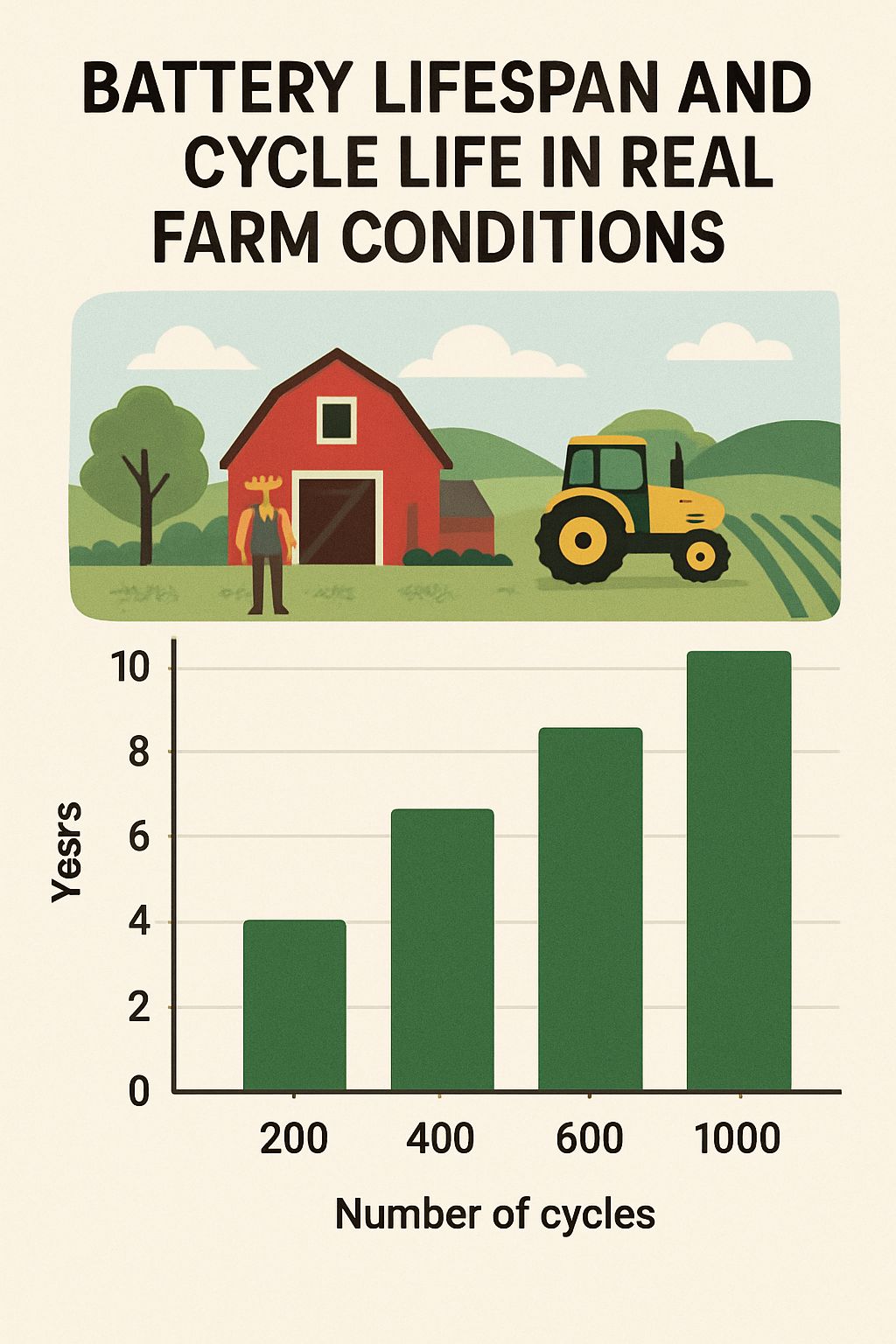
Longevity is where LiFePO4 makes its most financially convincing argument. On a farm with daily solar cycling — charging during daylight, discharging through the night to power waterers, security lighting, refrigeration, or ventilation systems — a battery goes through one complete cycle every single day. Over ten years, that’s roughly 3,650 cycles.
A conventional lithium-ion battery rated for 500–1,500 cycles at 80% depth of discharge hits end-of-useful-life within 1.5 to 4 years under that same daily cycling pattern. A quality LiFePO4 battery rated for 3,000–7,000 cycles handles the same workload for 8–19 years. The replacement math is stark.
LiFePO4 Cycle Life: 3,000–7,000 Charges vs. Lithium-Ion’s 500–1,500
The cycle life advantage isn’t just a specification sheet number — it directly determines how many times you’ll pay for a new battery bank. At current agricultural-grade pricing, replacing a lithium-ion bank every 2–3 years costs significantly more over a 10-year period than purchasing a premium LiFePO4 system once. Quality systems like the Renogy 200Ah 12V LiFePO4 are rated for over 4,000 cycles at 80% depth of discharge, which at daily cycling translates to more than 10 years of reliable service.
Most agricultural LiFePO4 systems will match or exceed the warranty period of the solar panels they support — typically 25 years for panels — meaning your battery bank won’t become the weak link in your solar investment timeline.
How Deep Discharge Affects Each Battery Type
Deep discharge — draining a battery to very low state of charge — is hard on any battery chemistry. But the two technologies respond very differently. Conventional lithium-ion batteries suffer accelerated capacity loss when regularly discharged below 20% state of charge. Manufacturers recommend limiting discharge to 80% depth of discharge (DoD) to protect cycle life, which means only 80% of rated capacity is actually usable in practice.
LiFePO4 batteries, by contrast, are designed to handle 100% depth of discharge without the same degradation penalty. In practice, most installers recommend 80–90% DoD for maximum longevity, but even at 100% DoD, LiFePO4 cells tolerate the stress far better than cobalt-based alternatives. For farm applications where a power outage might demand every available amp-hour from your battery bank, this tolerance for deep discharge is not a minor technical footnote — it’s the difference between keeping your well pump running through day three of a grid outage or not.
What Lifespan Differences Mean for Your Farm Budget
The numbers tell a clear story. A conventional lithium-ion bank sized for a mid-scale livestock operation might cost $3,000–$5,000 upfront and need replacement every 2–3 years under daily cycling. Over a 10-year period, that’s potentially 3–4 replacements — a total expenditure of $9,000–$20,000, not counting installation labor each time. A comparable LiFePO4 system priced at $4,000–$7,000 upfront may never need replacement within that same window.
Installation costs are a hidden multiplier in this equation. Every battery bank replacement means labor, potential system downtime, and possible upgrades to wiring or inverter compatibility. Farmers running LiFePO4 systems sidestep that recurring cost entirely. When you add in the operational disruption of a battery failure during planting season or a summer heat event, the true cost of choosing the cheaper chemistry becomes even harder to justify.
The bottom line: over a 10-year ownership horizon, LiFePO4 consistently delivers a lower total cost of ownership for agricultural solar backup applications — despite the higher sticker price at purchase.
Budget Comparison Over 10 Years (Mid-Scale Farm Example):
Conventional Lithium-Ion: $4,000 initial cost + 3 replacements at $4,000 each = $16,000 total
LiFePO4: $6,000 initial cost + 0 replacements = $6,000 totalEstimated 10-year savings with LiFePO4: $10,000 — before accounting for installation labor savings and reduced downtime.
Temperature Performance in Agricultural Environments
A battery that performs beautifully in a climate-controlled lab can fail completely in a February equipment shed in Wisconsin or a July hog barn in Alabama. Temperature performance isn’t a bonus feature for farm battery systems — it’s a core operational requirement that many farmers only discover matters after their first cold-weather battery failure.
How LiFePO4 Handles Extreme Cold and Heat
LiFePO4 batteries maintain reliable operation across a range of -4°F to 140°F (-20°C to 60°C). In practice, this means they continue delivering usable power in unheated winter barns where temperatures routinely drop well below freezing overnight. Most quality LiFePO4 systems retain 70–80% of their rated capacity even at 14°F (-10°C), which is sufficient to power critical waterers, ventilation fans, and lighting through a cold snap. For more insights on maintaining solar efficiency in varying conditions, explore solar tracker benefits for farmers.
Heat performance is equally impressive. In enclosed equipment sheds during summer, internal temperatures can easily reach 110–120°F. LiFePO4 chemistry handles sustained high-temperature operation without the accelerated electrolyte degradation that shortens conventional lithium-ion life in the same conditions. Some premium agricultural LiFePO4 units include built-in self-heating elements — like those found in the SOK 206Ah 48V LiFePO4 — that automatically activate below freezing to maintain charge acceptance during cold mornings. For more on how technology is enhancing agriculture, check out how drones are transforming solar power management in farming.
One practical note: while LiFePO4 batteries can discharge reliably in freezing temperatures, most should not be charged below 32°F (0°C) without a heating system in place. Charging a cold LiFePO4 battery causes lithium plating on the anode, which permanently reduces capacity. This is a manageable limitation — most quality BMS units include low-temperature charge cutoff protection — but it’s worth factoring into your installation design if you’re in a cold climate.
Lithium-Ion Degradation in Uninsulated Farm Buildings
Conventional lithium-ion batteries operate optimally between 50°F and 95°F — a narrow window that excludes most uninsulated agricultural structures for significant portions of the year. Outside that range, capacity drops sharply, charge efficiency decreases, and cycle life accelerates downward. A lithium-ion bank installed in an uninsulated Minnesota equipment shed can lose 20–30% of its effective capacity within the first winter simply from repeated cold-temperature cycling. Over two to three years of that exposure, the battery that looked affordable at purchase has degraded into a system delivering a fraction of its rated power — often with no clear warning signs until it fails during a critical load event.
Power Output for Critical Farm Equipment
Battery capacity ratings on a spec sheet only tell part of the story. What actually matters on a farm is whether your battery bank can deliver sufficient power — at the right rate, for the right duration — to keep critical systems running when the grid goes down or during peak solar demand periods.
Farm loads are not gentle. Well pumps, grain augers, electric fencing energizers, ventilation fans, milking equipment, and irrigation controllers all draw significant power, and many of them create inrush current spikes — brief surges of 3–6 times normal running current that occur at motor startup. A battery system that can’t handle those spikes without voltage sag will cause equipment to fail to start, trip inverter protection circuits, or sustain internal damage over time.
LiFePO4 batteries have a naturally low internal resistance, which directly enables high-current delivery without significant voltage drop. This is a measurable, consistent electrochemical advantage. The Battle Born 100Ah 12V LiFePO4, for example, can deliver sustained discharge rates of 100A continuous with peak discharge capabilities that handle motor startup surges without the voltage collapse that plagues higher-resistance battery chemistries under identical load conditions.
Conventional lithium-ion batteries — particularly as they age and internal resistance rises — struggle increasingly with high-current transient loads. An aging lithium-ion bank that tests at 85% state of health might still appear functional under light loads but fail to start a 2-horsepower well pump motor during a grid outage. That failure mode is dangerous on a farm where that pump is the only water source for livestock in summer heat.
- Well pumps: 750W–2,000W running load, with 3–6x inrush current at startup
- Grain dryers: 5,000W–15,000W depending on capacity — typically requires a substantial battery bank or staged operation
- Irrigation controllers and pivot systems: 1,500W–7,500W depending on pump size and system pressure
- Livestock ventilation fans: 200W–800W per fan, often running continuously in summer
- Milking equipment: 1,500W–3,000W with periodic high-draw cycles
- Electric fence energizers: 5W–50W — low draw but must remain continuous for animal containment
Well Pumps, Grain Dryers, and Irrigation Load Demands
Well pumps are the single most common critical load on farms relying on battery backup. A typical 1.5 HP submersible well pump draws approximately 1,200W at running load but requires 3,600–7,200W of starting surge for the first 1–2 seconds of operation. For a 48V battery bank, that startup surge translates to 75–150 amps instantaneously. LiFePO4’s low internal resistance handles this without meaningful voltage drop; conventional lithium-ion systems — especially aging ones — can sag enough under that load to trigger low-voltage shutdown on the inverter.
Grain dryers represent a more demanding challenge. Commercial grain dryers running propane heat with electric blower motors can require 5,000–15,000W of sustained electrical load. Running grain drying operations entirely on battery backup isn’t practical for most farms, but powering blower controls, monitoring systems, and auxiliary functions during grid outages is a realistic application where battery bank sizing and peak discharge capability both matter significantly.
Irrigation systems present a unique challenge because they combine high motor loads with long runtime requirements. A center-pivot irrigation system powering a 5 HP pump motor can draw 4,000–5,500W continuously for 8–12 hours per irrigation cycle. Backing that with LiFePO4 batteries requires careful system sizing — but the deep discharge tolerance and consistent voltage delivery of LiFePO4 chemistry makes it the only realistic lithium battery option for this application. Conventional lithium-ion’s shallower usable depth of discharge means you’d need significantly more battery capacity to deliver the same practical energy output.
Load Reference Guide for Farm Battery Sizing:
Equipment
Running Load
Startup Surge
Typical Daily Runtime
1.5 HP Well Pump
1,200W
3,600–7,200W
2–4 hours
Center Pivot Irrigation (5 HP)
4,000–5,500W
12,000–16,500W
8–12 hours
Grain Dryer (blower only)
5,000–15,000W
15,000–45,000W
Variable
Livestock Ventilation Fan
400W avg.
800–1,200W
12–24 hours (summer)
Milking Equipment
2,000W
4,000–6,000W
2–3 hours/day
Electric Fence Energizer
10–50W
Minimal
24 hours
Which Battery Handles Sudden Power Spikes Better
LiFePO4 handles inrush current spikes decisively better than conventional lithium-ion, and the gap widens as batteries age. Internal resistance in LiFePO4 cells remains relatively stable over thousands of cycles — the Ampere Time 200Ah 12V LiFePO4 maintains internal resistance below 0.25mΩ even after extensive cycling. Conventional lithium-ion internal resistance climbs steadily with each cycle and with temperature stress, meaning the voltage sag under high-current startup loads becomes progressively worse over time. For farmers looking to optimize their solar panel systems, single-axis solar trackers can also enhance efficiency and reliability.
For farm applications where motor startups are daily or multiple-times-daily events — well pumps, milking equipment, ventilation fans — this difference in voltage stability under load is one of the most tangible real-world performance distinctions between the two chemistries. It’s not theoretical; farmers running undersized or aging lithium-ion banks report inverter faults and failed pump starts as the most common symptoms of a battery system that’s no longer keeping up with farm demands.
Runtime Comparison During 3–5 Day Outages
Extended grid outages — whether from severe weather, infrastructure failure, or rural grid fragility — are a reality that farm energy systems must be designed around. A 3–5 day outage demands a battery bank with deep usable capacity, stable voltage delivery throughout the discharge curve, and the ability to recover fully from deep discharge without permanent damage. LiFePO4 meets all three requirements. A properly sized LiFePO4 bank — such as a system built around four EG4 LifePower4 48V 100Ah units providing 19.2 kWh of storage — can power essential farm loads including well pump cycling, refrigeration, lighting, and livestock systems continuously through a 72–120 hour outage when paired with even modest solar recharging during daylight hours.
Cost Comparison: Upfront Price vs. Long-Term Farm Value
Cost is where most farmers start the conversation — and where the LiFePO4 case is often initially weakest and ultimately strongest. The upfront price difference is real, but it only represents the full picture if you plan to replace your farm’s battery system every few years indefinitely.
Typical LiFePO4 System Costs for Agricultural Installations
Agricultural-grade LiFePO4 systems currently range from approximately $800–$1,200 per kWh of usable storage capacity at the battery level, before inverter, wiring, and installation. A small farm system providing 10 kWh of usable storage — sufficient for essential loads on a hobby farm or small livestock operation — runs $8,000–$12,000 in battery costs alone. A mid-scale operation requiring 20–40 kWh of storage for well pumps, ventilation, refrigeration, and lighting can expect $16,000–$48,000 in battery costs, with total system costs including solar panels, inverters, charge controllers, and installation running significantly higher.
Why Lithium-Ion’s Lower Price Often Costs More Over Time
The initial price appeal of conventional lithium-ion batteries dissolves when you apply realistic cycle life expectations to actual farm use patterns. At daily cycling — which is standard for any farm running solar backup — a lithium-ion bank rated for 1,000 cycles reaches end of useful life in under three years. Rated for 1,500 cycles under ideal conditions, and derated for the temperature and deep-discharge realities of farm use, you’re still looking at replacement every 2–4 years.
Each replacement cycle also carries soft costs that rarely appear in battery comparison articles: installer labor (typically $500–$2,000 per job), potential downtime during replacement, disposal fees for old battery banks, and the risk that replacement units require updated wiring, breakers, or inverter settings to accommodate changed specifications. None of those costs exist in a well-designed LiFePO4 installation that runs for 10–15 years without replacement.
How to Calculate Total Cost of Ownership for Your Farm
Total cost of ownership (TCO) for a farm battery system has three components: initial purchase price, replacement costs over the ownership period, and operational costs including maintenance and energy efficiency losses. LiFePO4 wins on all three over any horizon longer than 3–4 years.
To calculate your farm’s TCO comparison, start with your planned system size in kWh. Multiply the lithium-ion price per kWh by the number of replacements you’ll need over your target ownership period (typically 10 years). Add $1,000–$2,500 per replacement for labor and soft costs. Compare that total to a single LiFePO4 purchase at 20–40% higher per-kWh cost with zero replacements over the same period.
The crossover point — where LiFePO4’s cumulative cost drops below lithium-ion’s cumulative cost — typically occurs between years 3 and 5 for most farm applications. After that crossover, every additional year of LiFePO4 service represents pure savings relative to the lithium-ion replacement cycle. For a farm that plans to operate for decades, that compounding savings effect is substantial, especially when considering the benefits of solar panel dual-axis trackers for agricultural efficiency.
Best Use Cases: Which Battery Fits Your Farm Operation
Not every farm has identical power needs, budget constraints, or infrastructure realities. The right battery system for a 2-acre homestead with chickens and a garden looks very different from the right system for a 500-acre row crop operation with grain storage and center-pivot irrigation. Understanding where each battery type fits — and where LiFePO4 is the clear choice — helps you make a decision that matches your actual operation.
The honest answer is that LiFePO4 is the right choice for the overwhelming majority of agricultural applications. The only scenario where conventional lithium-ion might make short-term sense is a very limited-budget operation with minimal daily cycling needs and a controlled-environment installation — a climate-controlled utility room on a small property, for example, where temperature extremes are eliminated. Outside of that narrow scenario, LiFePO4’s safety, longevity, and temperature performance advantages are too significant to overlook on a working farm.
Small Hobby Farms and Homesteads
For hobby farms and homesteads with essential loads under 5 kWh per day — well pump, refrigerator, lighting, small power tools, phone and electronics charging — a modest LiFePO4 system in the 10–20 kWh range provides reliable independence from grid outages without oversizing. The Battle Born 100Ah 12V LiFePO4 or Ampere Time 200Ah 12V LiFePO4 are well-suited entry points for this scale, offering manageable upfront costs with 10+ year service life that eliminates the replacement anxiety common with budget lithium-ion alternatives.
At this scale, the safety argument for LiFePO4 is also particularly compelling. Hobby farms and homesteads often install batteries in spaces shared with living areas, root cellars, or small outbuildings without dedicated fire suppression systems. The reduced thermal runaway risk of LiFePO4 chemistry provides meaningful peace of mind that no specification sheet comparison fully captures.
Mid-Size Crop and Livestock Operations
Mid-size operations — 50 to 500 acres with active livestock, irrigation, grain handling, or dairy components — represent the core market where LiFePO4 delivers its most compelling return on investment. Daily energy demands at this scale typically range from 20–80 kWh, requiring battery banks built around rack-mount or high-capacity units like the EG4 LifePower4 48V 100Ah or SOK 206Ah 48V LiFePO4. The combination of high daily cycling, exposure to temperature extremes, critical load requirements (especially well pumps and livestock ventilation), and the financial stakes of equipment failure all make LiFePO4’s advantages count for the most at this operational scale. For those interested in maximizing energy efficiency, exploring solar panel dual-axis trackers can provide additional benefits for agriculture.
Large Commercial Agricultural Facilities
Large commercial operations — dairies, feedlots, large grain facilities, commercial greenhouses, and row crop farms exceeding 500 acres — face energy demands that dwarf smaller operations, but the core battery chemistry decision remains the same. At commercial scale, the financial stakes of battery failure are measured in tens of thousands of dollars per incident, and the cost of replacing an entire battery bank compounds accordingly. Commercial facilities running 100–500+ kWh of daily energy demand should be building systems around high-voltage rack-mount LiFePO4 configurations, typically at 48V or higher, using modular server-rack battery systems that can be expanded as energy needs grow. The EG4 LifePower4 rack-mount architecture is specifically designed for this kind of scalable commercial deployment. For those interested in enhancing their solar setups, consider exploring the benefits of single-axis solar trackers for increased efficiency.
The Verdict: LiFePO4 Is the Smarter Long-Term Farm Investment
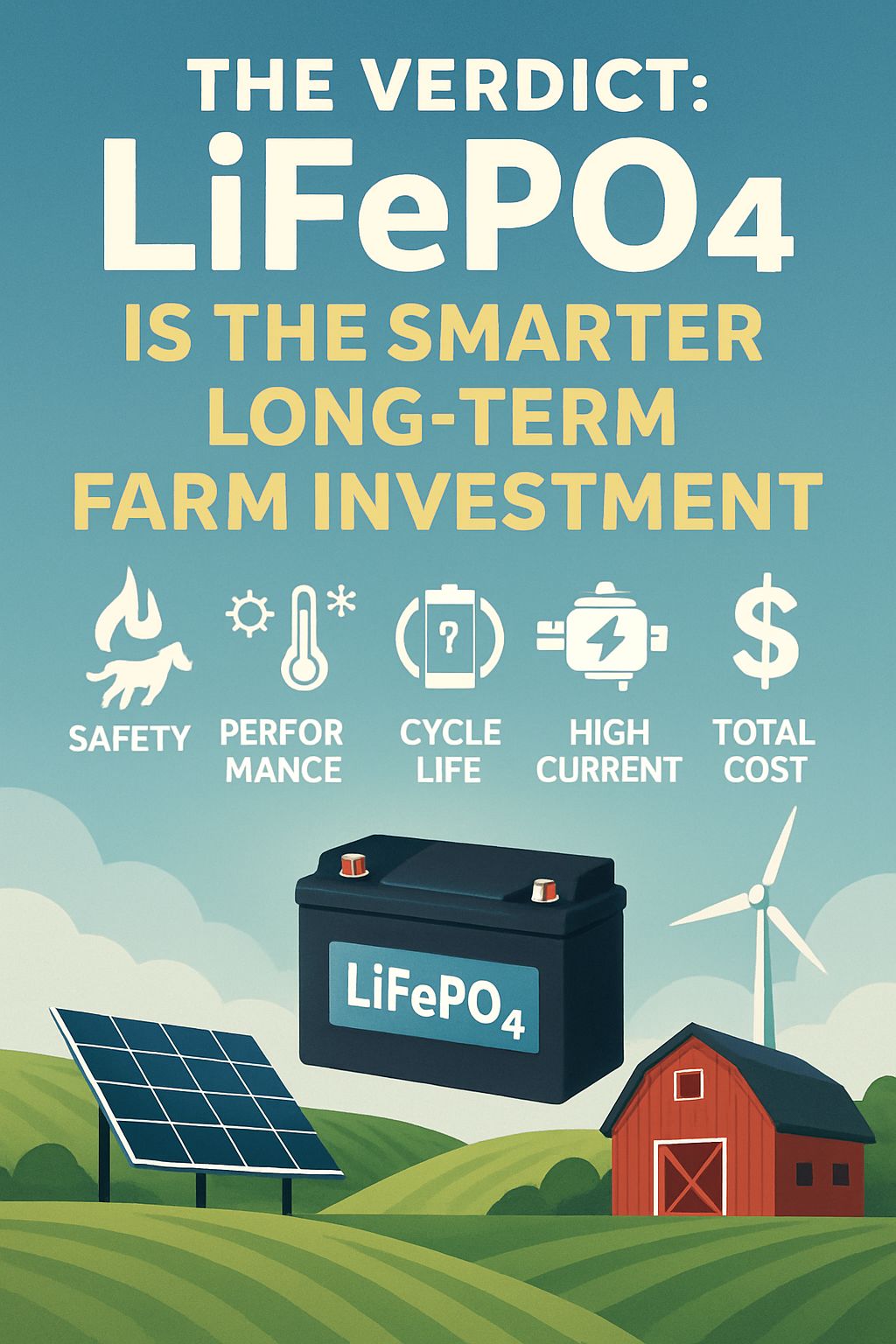
When you stack every variable that matters on a working farm — safety near combustible materials and livestock, performance across extreme temperature swings, cycle life under daily solar use, ability to deliver high current for motor loads, and total cost over a realistic 10–15 year ownership horizon — LiFePO4 wins comprehensively. Conventional lithium-ion batteries were designed for consumer electronics and electric vehicles where energy density and weight are the dominant engineering priorities. Farms need the opposite: stable chemistry, deep discharge tolerance, thermal resilience, and longevity. LiFePO4 was built for exactly those requirements. The 20–40% upfront price premium disappears within 3–5 years of daily operation and converts into significant savings — often $10,000 or more over a decade — for any farm running a solar backup system with regular cycling. If you’re building or upgrading a farm energy system today, LiFePO4 is not the premium option. It’s the practical one.
Frequently Asked Questions
Can I replace my existing lithium-ion farm battery system with LiFePO4?
Yes — in most cases, LiFePO4 batteries can directly replace conventional lithium-ion in an existing farm solar system, but there are important compatibility checks to complete first. LiFePO4 cells have a slightly different voltage profile than cobalt-based lithium-ion: a fully charged 12V LiFePO4 battery reaches approximately 14.6V versus 14.2V for lithium-ion, and the discharge curve is flatter. Your existing charge controller and inverter-charger must be configurable to LiFePO4 charge parameters — most modern units from Victron, Schneider, SMA, and Sol-Ark support this through firmware settings. You should never mix LiFePO4 and conventional lithium-ion batteries in the same bank, even temporarily, as the different voltage profiles cause one chemistry to stress the other. Replace the entire bank simultaneously, verify your charge controller settings before activating the system, and confirm your BMS communication settings are compatible with your inverter if using a managed battery system.
How many LiFePO4 batteries do I need to run a farm through a 3-day outage?
The answer depends on your farm’s daily energy consumption and whether you have solar panels continuing to recharge the system during the outage. Start by calculating your total daily load in kilowatt-hours — add up the wattage of all critical systems (well pump, ventilation, refrigeration, lighting) multiplied by their daily runtime hours. For a modest livestock operation running a 1.5 HP well pump (3 hours/day), four ventilation fans (12 hours/day), refrigeration (8 hours/day), and basic lighting (6 hours/day), total daily consumption typically falls in the 18–28 kWh range. Multiply that by 3 days for a 72-hour outage target: 54–84 kWh of total storage needed. With even modest solar recharging during daytime hours, you can reduce that storage requirement by 30–50%. A practical starting point for this scenario would be four EG4 LifePower4 48V 100Ah units providing 19.2 kWh, paired with a solar array sized to partially recharge daily — sufficient for most critical farm loads through a 3-day outage with careful load management.
Are LiFePO4 batteries safe to store inside a barn with livestock?
LiFePO4 batteries are significantly safer than conventional lithium-ion for barn installations, and with proper installation practices, they are considered safe for use in proximity to livestock. The key safety measures are straightforward:
- Mount batteries in a dedicated, ventilated enclosure or utility cabinet — not loose on shelves or floors where animals could contact them
- Ensure proper fusing and disconnect switches are installed at the battery terminals
- Keep batteries away from direct exposure to moisture, urine, or feed dust
- Install a battery management system (BMS) with over-temperature shutoff if not already integrated
- Avoid placing the battery bank directly adjacent to hay storage, bedding material, or fuel containers as an added precaution
- Check local fire code and agricultural building code requirements for battery storage — some jurisdictions have specific setback and ventilation rules
No battery chemistry is completely risk-free, but LiFePO4’s resistance to thermal runaway, non-toxic iron phosphate chemistry, and stable behavior under physical stress make it the most appropriate lithium battery technology available for barn environments. Many commercial dairy and poultry operations run LiFePO4 systems inside their production buildings without incident.
Do LiFePO4 batteries work with existing solar panel setups on farms?
LiFePO4 batteries are compatible with virtually all solar panel technologies and most existing solar charge controllers and inverters, with one important configuration requirement: your charge controller must be programmable to LiFePO4 charge voltage parameters. MPPT charge controllers from Victron, Outback, Midnite Solar, and most major brands include a LiFePO4 or “lithium” preset that sets correct absorption voltage (typically 14.6V for 12V systems) and float voltage (13.6V). PWM controllers are less commonly configurable and may require replacement when switching to LiFePO4. Your solar panels themselves — regardless of whether they’re monocrystalline, polycrystalline, or thin-film — are completely chemistry-agnostic and will charge LiFePO4 banks identically to how they charged your previous battery system. The transition to LiFePO4 is primarily a charge controller configuration task, not a panel replacement one.
What is the typical warranty period for agricultural-grade LiFePO4 batteries?
Warranty periods for agricultural-grade LiFePO4 batteries vary by manufacturer and product tier, but typically range from 5 to 10 years for the products best suited to farm applications. Battle Born offers a 10-year warranty on their LiFePO4 products. Renogy provides a 5-year warranty on their LiFePO4 battery line. EG4 warrants the LifePower4 for 10 years. SOK provides a 5-year warranty with documented capacity retention guarantees. Ampere Time offers a 5-year warranty across their LiFePO4 product range.
Warranty terms typically guarantee a minimum capacity retention percentage — commonly 70–80% of rated capacity — over the warranty period, rather than guaranteeing full original capacity throughout. Read the fine print on cycle life warranty conditions: most require that the battery be operated within specified temperature ranges, charge voltage parameters, and depth of discharge limits to maintain warranty validity. For agricultural installations, this means documenting your charge controller settings and BMS configuration at commissioning — a practice that protects your warranty claim if a capacity issue arises years later.
Beyond the warranty period itself, consider the manufacturer’s track record and financial stability. A 10-year warranty is only valuable if the company still exists in year 8 when you need to make a claim. Battle Born, Renogy, and EG4 are all established companies with multi-year market presence and demonstrated warranty service histories — a meaningful consideration when committing to a decade-long farm energy infrastructure investment.
Ready to build a farm energy system that lasts as long as your operation? GrowingSolarmist.com provides expert guidance on agricultural solar and battery storage solutions to help farmers achieve true energy independence.




Leave a Reply