

Key Takeaways
- Polycrystalline solar panels cost 10-20% less per watt than monocrystalline panels, making them a budget-friendly entry point into solar energy.
- These panels typically operate at 13-17% efficiency and come with warranties lasting 25 to 30 years, offering solid long-term value.
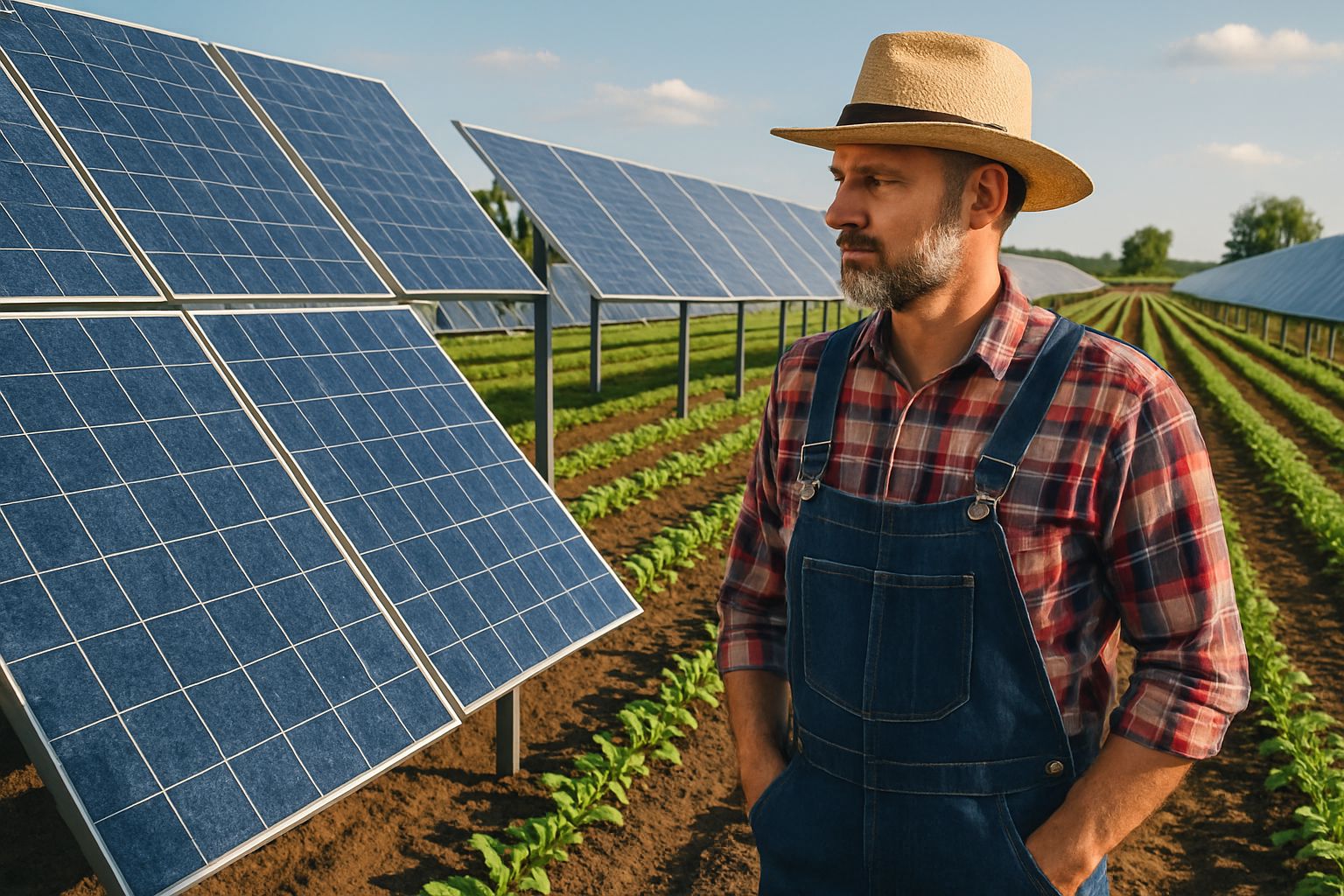
- Farmers are increasingly pairing polycrystalline panels with agrivoltaic systems, growing crops beneath elevated solar arrays while generating power.
- Despite slightly lower efficiency than monocrystalline alternatives, polycrystalline panels hold up well against hail, wind, and temperature swings.
- Curious how bifacial technology and PERC upgrades are pushing polycrystalline efficiency higher than ever? We’ll get into that shortly.
Blue, speckled, and quietly powering homes and farms across the globe, polycrystalline solar panels remain one of the most practical entry points into renewable energy.
If you’ve been shopping for solar panels, you’ve probably noticed the price gap between different types. Polycrystalline panels sit at a sweet spot where affordability meets reliable performance, which is exactly why they’ve become a go-to choice for homeowners, farmers, and large-scale solar developers alike.
Why Polycrystalline Panels Deserve Your Attention
Solar technology has evolved rapidly, yet polycrystalline panels continue to hold their ground against flashier, more expensive alternatives. Their staying power comes down to a simple equation: lower manufacturing costs translate into lower prices for consumers, without sacrificing the durability or lifespan that makes solar investments worthwhile. Whether you’re outfitting a single-family roof or planning a 10-megawatt solar farm, understanding what these panels offer can help you make a smarter energy decision.
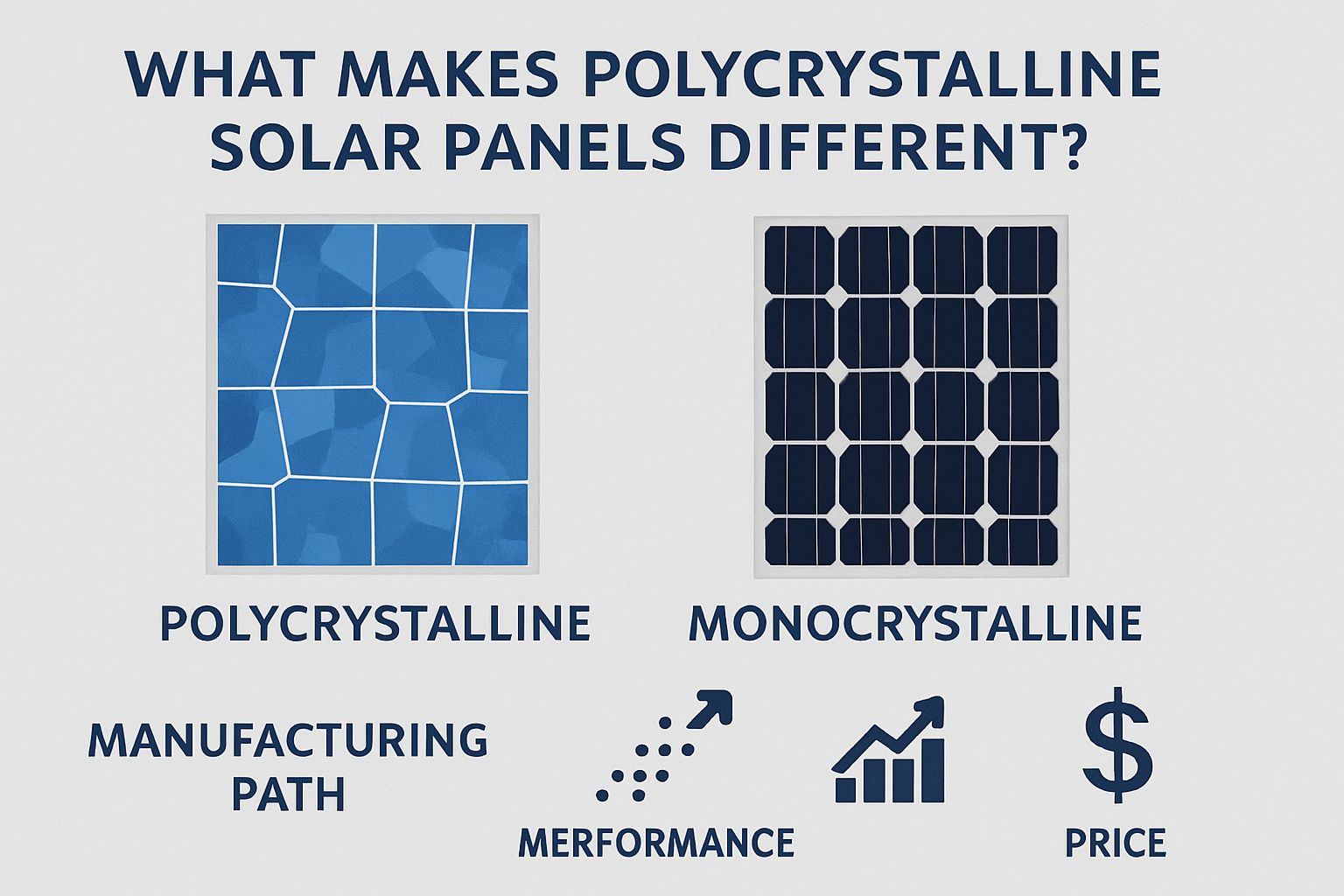
What Makes Polycrystalline Solar Panels Different
Every solar panel starts with silicon, but how that silicon gets processed determines everything from cost to efficiency to appearance. Polycrystalline panels take a different manufacturing path than their monocrystalline cousins, and that difference shows up in both performance and price.
Understanding this distinction isn’t just technical trivia. It directly explains why polycrystalline panels have carved out such a strong niche in the solar market, especially for budget-conscious buyers and large-scale installations where total surface area isn’t a limiting factor.
Multiple Silicon Crystals vs Single Crystal Design
Monocrystalline panels are made from a single, continuous silicon crystal, grown slowly and carefully to create a pure, uniform structure. Polycrystalline panels take a shortcut. Manufacturers melt raw silicon fragments together, pour the molten material into a mold, and let it cool into an ingot containing multiple crystal structures fused together. To explore more about the advantages of polycrystalline panels, check out the benefits of polycrystalline solar panels.
That ingot gets sliced into thin wafers, typically 156 mm x 156 mm or 158.75 mm square, which then become the solar cells assembled into the finished panel. Most residential and commercial modules contain either 60 cells arranged in a 6×10 grid or 72 cells in a 6×12 configuration, following standard industry sizing.
This multi-crystal approach is faster and cheaper than growing a single crystal from scratch. It’s also why polycrystalline panels can be produced at scale more affordably, passing those savings directly to buyers.
The Blue, Speckled Appearance Explained
You can usually spot a polycrystalline panel from across a parking lot. The multiple crystal structures fused together during manufacturing create a distinctive blue hue with a speckled, almost glittery texture across the panel surface.
Monocrystalline panels, by contrast, have a sleek, uniform black appearance since they’re made from a single crystal structure. For some buyers, this visual difference matters quite a bit, particularly on residential installations where curb appeal factors into the decision.
Functionally, though, the color and texture don’t impact performance. It’s purely a byproduct of the manufacturing process, not an indicator of quality or output capability.
Standard Wafer Sizes and Cell Configurations
Standardization matters a lot in solar manufacturing, and polycrystalline panels follow well-established industry conventions. The 156 mm and 158.75 mm square wafer sizes have become the norm, allowing manufacturers to produce compatible components across different brands and models.
This standardization benefits installers and consumers too. Replacement parts, mounting hardware, and electrical components are designed around these common dimensions, which keeps installation and maintenance costs predictable.
How Grain Boundaries Affect Electrical Performance
Here’s where the multi-crystal structure creates a trade-off. Within a polycrystalline wafer, the individual silicon crystals range in size from a few microns up to several millimeters. Where these different crystals meet, grain boundaries form.
Electrons moving through the silicon encounter these grain boundaries and scatter more than they would in a single, uniform crystal structure. This increased scattering reduces electrical conductivity compared to monocrystalline silicon, which is the primary reason polycrystalline panels operate at slightly lower efficiency levels. It’s a direct trade-off: faster, cheaper manufacturing in exchange for a modest efficiency reduction.
How Polycrystalline Panels Convert Sunlight Into Electricity
Regardless of crystal structure, every silicon solar panel relies on the same fundamental principle to generate power. Understanding this process helps explain why panel placement, angle, and maintenance all matter so much for maximizing output.
The Photovoltaic Effect at Work
French physicist Edmond Becquerel discovered the photovoltaic effect back in 1839, and it remains the foundation of every solar panel in operation today. When sunlight strikes the silicon cells inside a polycrystalline panel, photons transfer their energy to electrons within the silicon structure, knocking those electrons loose and setting them into motion.
That movement of electrons creates an electric current. Before reaching the silicon cells, sunlight first passes through an anti-reflective coating designed to maximize absorption and minimize wasted light bouncing away from the panel surface.
From Photons to Usable AC Power
The electricity generated at this stage is direct current, or DC, which isn’t compatible with most household appliances or the electrical grid. Metal contacts on the panel collect this DC electricity and route it toward an inverter.
The inverter handles the critical conversion from DC to alternating current, or AC, making the generated power usable for running appliances, lighting, and everything else connected to your electrical system. Beyond simple conversion, quality inverters also help optimize power output, squeezing maximum efficiency out of the DC electricity before transforming it into a grid-compatible form.
A front contact layer, made from a transparent conductive material, sits on the surface of each silicon wafer. This layer allows sunlight to pass through to the silicon while simultaneously helping collect the generated current, a small but essential piece of the overall energy conversion puzzle. Learn more about the environmental benefits of solar power for farmers.
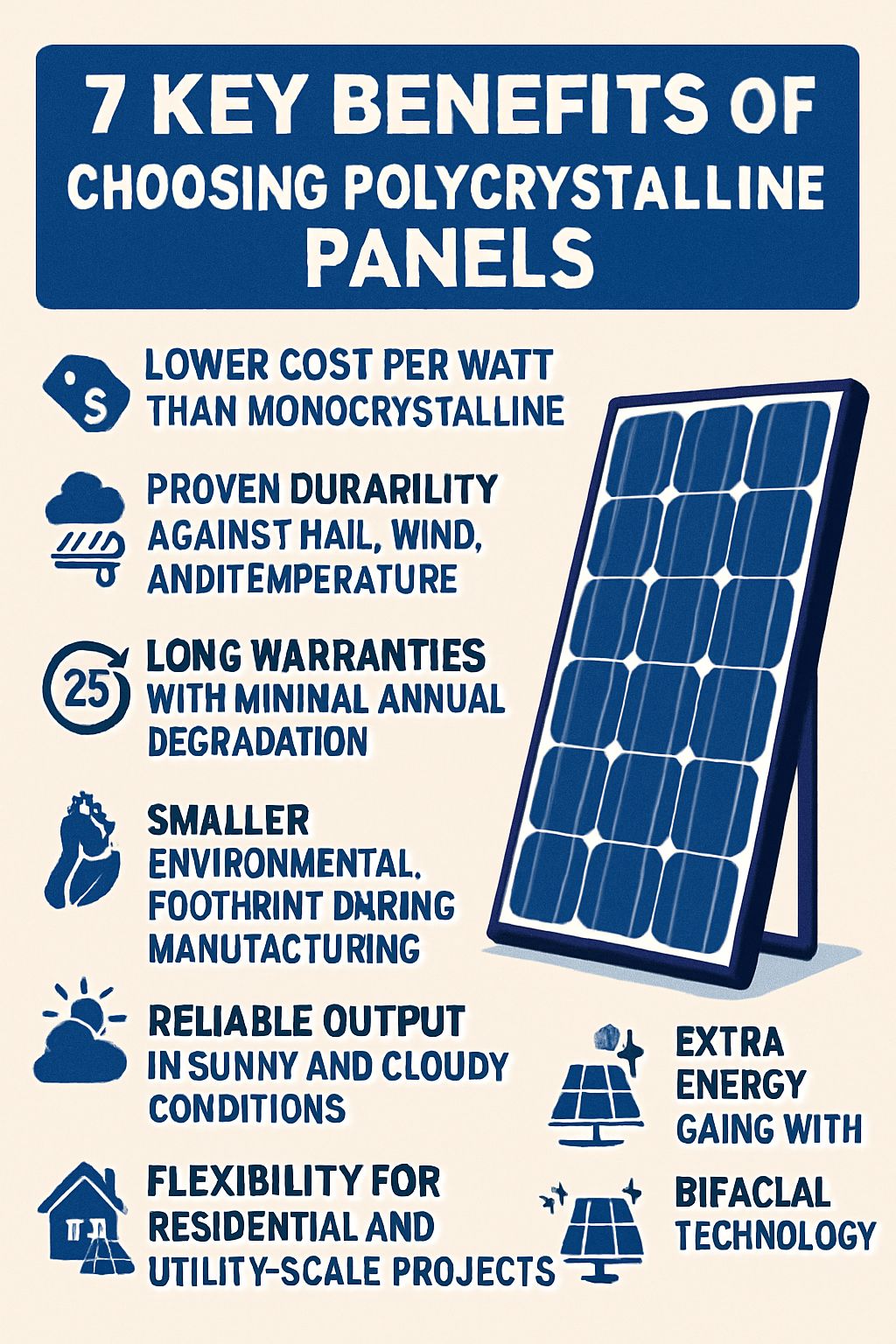
7 Key Benefits of Choosing Polycrystalline Panels
Price alone doesn’t explain why polycrystalline panels have remained a dominant force in the solar industry for decades. When you stack up their full range of advantages, a clearer picture emerges of why they’re such a smart choice for so many different applications.
1. Lower Cost Per Watt Than Monocrystalline
Polycrystalline panels typically run $0.70 to $1.10 per watt before installation costs, compared to $0.90 to $1.50 per watt for monocrystalline alternatives. That 10-20% savings adds up fast on larger installations, whether you’re outfitting a single rooftop or building out a utility-scale solar farm spanning acres of land.
2. Proven Durability Against Hail, Wind, and Temperature Extremes
These panels aren’t fragile. Testing under IEC 61215 protocols confirms polycrystalline modules can withstand 25 mm hailstones at terminal velocity, wind loads up to 2400 Pa, and thermal cycling between -40°C and +85°C without structural failure. For more on how these solar panels can benefit your farm, check out polycrystalline solar panels benefits.
3. Long Warranties with Minimal Annual Degradation
Manufacturers back polycrystalline panels with warranties ranging from 25 to 30 years, and for good reason. Annual degradation typically sits between 0.5% and 0.7% under standard operating conditions, meaning a panel installed today will still be producing the vast majority of its original output decades from now.
4. Smaller Environmental Footprint During Manufacturing
Producing polycrystalline silicon consumes less energy and raw silicon feedstock than growing single-crystal ingots for monocrystalline panels. That translates into less manufacturing waste and a smaller carbon footprint before the panel even reaches your roof.
5. Reliable Output in Sunny and Cloudy Conditions
While polycrystalline panels do experience sharper efficiency drops under diffuse light compared to monocrystalline models, they still deliver dependable performance across a wide range of weather conditions. This versatility makes them a solid choice for regions that see a mix of sunny days and overcast skies throughout the year. For more information on their advantages, you can explore the benefits of polycrystalline solar panels.
6. Flexibility for Residential and Utility-Scale Projects
From single-family homes to massive solar farms, polycrystalline panels scale remarkably well. Their favorable capital expenditure profile makes them especially attractive for utility-scale developers who need to balance upfront costs against long-term energy output across thousands of panels.
Community solar initiatives have leaned into this scalability too. Solar Plus Garden’s 10 MW solar plant demonstrates how polycrystalline technology can anchor an agrivoltaic community model, generating clean power while supporting local food production on the same land.
Large-scale installations benefit from the predictable, bulk-friendly economics of polycrystalline manufacturing. When you’re purchasing hundreds or thousands of panels, even small per-watt savings compound into significant project-wide cost reductions.
This flexibility doesn’t come at the expense of reliability, either. The same durability standards that protect a residential rooftop installation apply equally to sprawling utility-scale arrays.
|
Project Type |
Typical System Size |
Why Polycrystalline Fits |
|---|---|---|
|
Residential Rooftop |
5-10 kW |
Lower upfront cost, long warranty |
|
Agricultural/Barn Roof |
50-70 kW |
Budget-friendly for large surface areas |
|
Community Solar Farm |
1-10 MW |
Favorable CAPEX for bulk deployment |
7. Extra Energy Gains with Bifacial Technology
Modern polycrystalline modules aren’t stuck in the past. Bifacial polycrystalline panels, which capture sunlight on both the front and back surfaces, can boost total energy yield by 10-15% depending on mounting height and the reflectivity of surrounding surfaces.
This technology pairs especially well with agricultural installations, where reflective soil and surrounding crops can bounce extra sunlight onto the panel’s rear surface, squeezing additional output from the same footprint.
Efficiency Numbers You Should Know
Numbers tell the real story when comparing solar panel options, and polycrystalline panels have a well-documented efficiency profile that’s worth understanding before you buy.
Under Standard Test Conditions, which involve irradiance of 1000 W/m², a cell temperature of 25°C, and an air mass 1.5 spectrum, polycrystalline panels consistently land in a predictable efficiency range.
- Standard polycrystalline efficiency: 13-17%
- Monocrystalline comparison: 18-22%
- Thin-film comparison: 10-13%
- Bifacial polycrystalline with PERC: up to 18.5%
These figures matter most when you’re calculating how much roof or land space you’ll need to hit a target power output. For more information on selecting the best solar panels for your farm, consider the efficiency and space requirements of each type.
Typical Efficiency Range Under Standard Test Conditions
The 13-17% range isn’t arbitrary. It reflects the real-world impact of grain boundaries scattering electrons within the multi-crystal silicon structure, a trade-off that comes bundled with the lower manufacturing costs discussed earlier.
How Temperature Impacts Power Output
Heat is the enemy of solar panel efficiency, and polycrystalline panels feel this more than some alternatives. With a temperature coefficient of approximately -0.43% to -0.45% per degree Celsius above 25°C, these panels lose meaningful output as temperatures climb.
Run the math on a hot summer day, and the impact becomes clear. A temperature rise from 25°C to 45°C under full sun can degrade output power by roughly 8.6% to 9%. This is a key consideration for installations in consistently hot climates, where ventilation and mounting height can help mitigate some of that heat-related loss.
PERC Technology and Efficiency Gains
Passivated Emitter Rear Cell technology, better known as PERC, has given polycrystalline panels a meaningful efficiency boost. By adding a dielectric passivation layer to the rear cell surface, PERC increases photon absorption and reduces electron recombination, improving overall efficiency by about 1% to 1.5% relative to standard polysilicon modules.
This upgrade doesn’t fundamentally change the manufacturing cost structure, which means buyers get a meaningful performance bump without a dramatic price increase. It’s one of the clearest examples of how incremental technology improvements keep polycrystalline panels competitive against pricier alternatives.
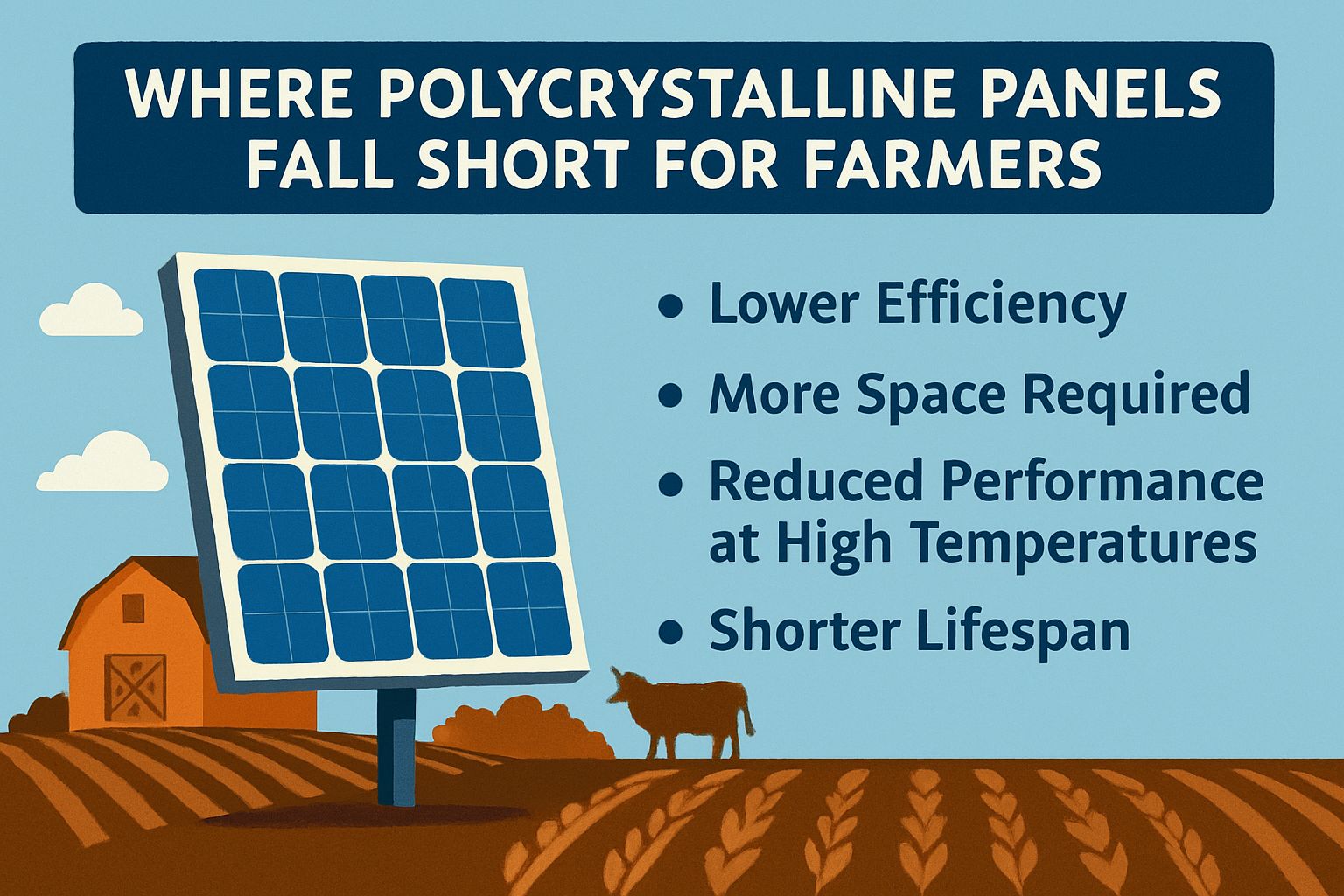
Where Polycrystalline Panels Fall Short
No solar technology is perfect, and honest buyers deserve a clear picture of the trade-offs involved. Polycrystalline panels earn their lower price tag through a handful of specific limitations. For more details on their advantages and disadvantages, check out this article on polycrystalline solar panels.
Lower Efficiency Means More Roof or Land Space
Because polycrystalline panels convert less sunlight into electricity per square meter than monocrystalline panels, you’ll need roughly 10-15% more panel surface area to match the output of an equivalent monocrystalline system. For homeowners with limited roof space, this can be a genuine constraint worth factoring into your decision.
Faster Performance Drop in Shade or Diffuse Light
While polycrystalline panels handle direct sunlight well, their performance dips more sharply under diffuse light or partial shading compared to monocrystalline alternatives. If your installation site has trees, nearby buildings, or frequent cloud cover casting shadows across the array, this limitation deserves careful consideration.
Microcracks are another concern worth monitoring. These tiny fractures can develop along grain boundaries due to mechanical stress from transportation, installation, or ongoing thermal expansion and contraction. Early detection through infrared thermography or electroluminescence imaging during routine maintenance can catch these issues before they significantly impact output.
Aesthetic Trade-Offs Compared to Monocrystalline
That distinctive blue, speckled look isn’t for everyone. Homeowners prioritizing a sleek, uniform rooftop appearance often gravitate toward the solid black finish of monocrystalline panels instead, even if it means paying a premium.
Polycrystalline Panels in Agrivoltaic Farming
One of the most exciting applications for polycrystalline panels isn’t on rooftops at all. It’s happening in open fields, where farmers are discovering that solar energy and crop production can coexist on the very same acreage.
Agrivoltaic systems pair solar panel arrays with active farmland, creating a dual-income strategy that generates both electricity and agricultural yield from a single piece of land. Polycrystalline panels, with their favorable cost-per-watt economics, have become a natural fit for farmers looking to maximize return on investment across large tracts of property.
Elevated Racking That Lets Farm Equipment Operate Underneath
Unlike residential rooftop installations, agrivoltaic systems require specialized mounting that keeps panels well above ground level.
- Panels are typically elevated 8-14 feet off the ground on reinforced racking structures
- This height clearance allows tractors, harvesters, and other farm equipment to operate freely underneath the array
- Wider spacing between rows accommodates equipment turning radius and crop maintenance access
- Structural engineering accounts for both wind load on the panels and the weight distribution across elevated support posts
This design approach requires more upfront engineering than a standard ground-mount system, but it unlocks the dual-use potential that makes agrivoltaics so appealing to forward-thinking farmers.
Ground-mounted installations in general run about 10-20% more per watt than rooftop systems, and agrivoltaic configurations with elevated racking typically land at the higher end of that range given the additional structural requirements.
Despite the added cost, many farmers find the long-term payoff worthwhile. Combining solar income with continued crop or livestock production creates a diversified revenue stream that helps insulate farm operations against fluctuating commodity prices.
Crops That Thrive Under Solar Arrays
Not every crop benefits equally from growing beneath solar panels, but research has identified several standout performers. Lettuce, spinach, tomatoes, and various root vegetables have shown higher yields in agrivoltaic systems compared to traditional open-field growing.
The explanation comes down to microclimate effects. Partial shading from the panels reduces heat stress on sensitive plants during peak summer temperatures, while also helping retain soil moisture that would otherwise evaporate under direct, unobstructed sunlight.
This creates a genuinely symbiotic relationship rather than a simple trade-off. The crops get a more favorable growing environment, and the reflective qualities of the soil and surrounding vegetation can actually enhance energy capture for bifacial polycrystalline modules positioned above.
Real-World Example: 500 kW Ground-Mounted Farm Array
Consider a mid-sized farm operation that installs a 500 kW ground-mounted polycrystalline array across several acres of underutilized land. At current pricing of roughly $0.70 to $1.10 per watt for the panels alone, plus the additional 10-20% premium for ground-mounted structural requirements, this type of installation represents a substantial but increasingly common investment for diversified farm operations.
The real value shows up over time. With a 25 to 30 year expected lifespan and degradation rates as low as 0.5% to 0.7% annually, that same array continues generating meaningful electricity output decades after installation, all while the land underneath remains productive for crops suited to the agrivoltaic growing environment.
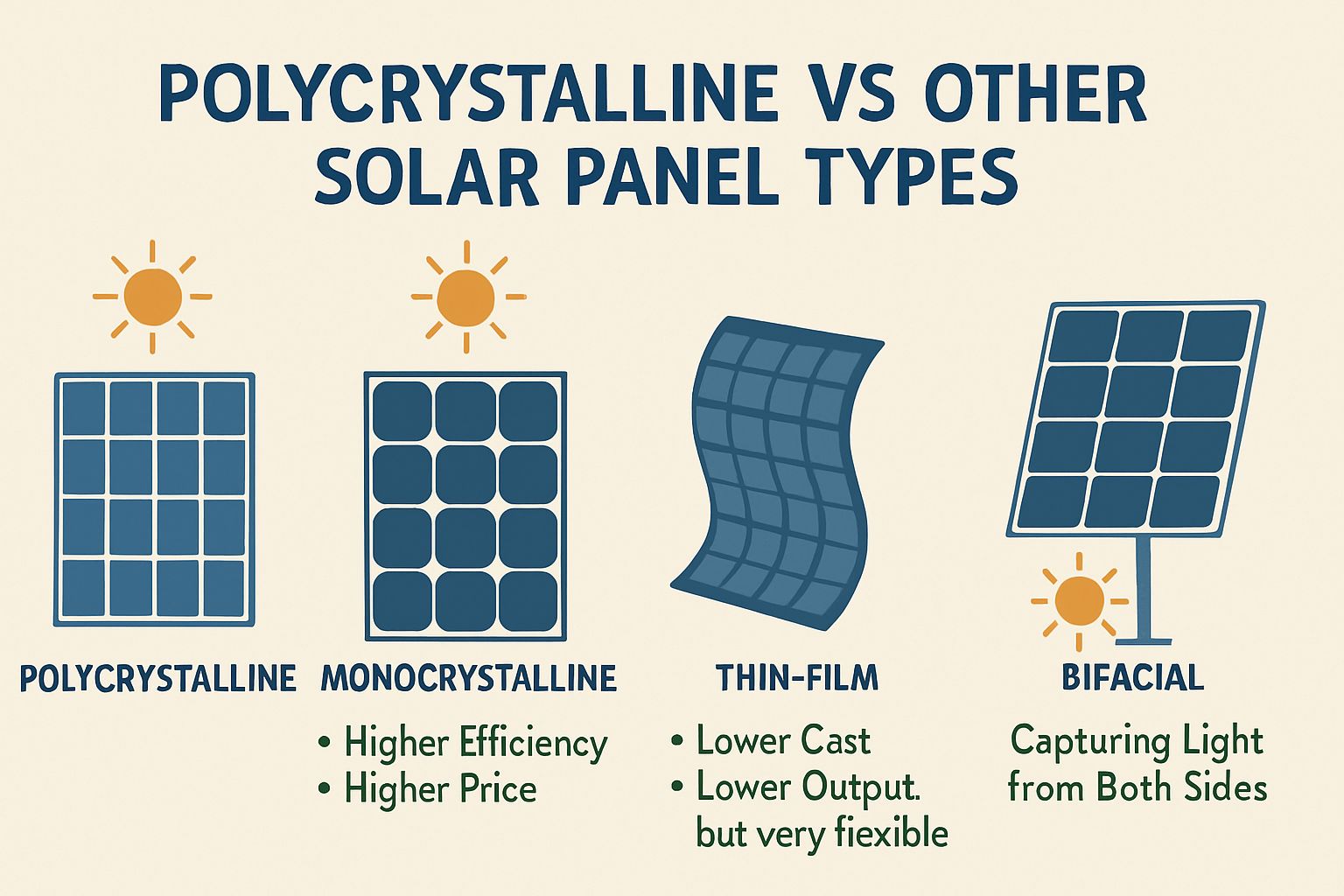
Polycrystalline vs Other Solar Panel Types
Choosing the right panel type ultimately comes down to matching technology to your specific priorities, whether that’s maximum efficiency, lowest cost, or the best balance of both. For a deeper understanding of the advantages of polycrystalline panels, you can explore their benefits over other solar panels.
Monocrystalline: Higher Efficiency, Higher Price
Monocrystalline panels operate at 17-22% efficiency, with premium models pushing into the 22-23% range. That performance advantage comes at a cost, typically $0.90 to $1.50 per watt, making monocrystalline the better choice when roof space is limited and maximizing output per square foot matters most.
Thin-Film: Lower Cost, Lower Output
Thin-film panels occupy the budget end of the spectrum, running $0.50 to $0.90 per watt with efficiency ratings of 10-13%. Their lower temperature coefficient, closer to -0.20% per °C, gives them an edge in extremely hot climates, though the reduced efficiency means significantly more surface area is needed to match output from polycrystalline or monocrystalline alternatives.
Bifacial: Capturing Light from Both Sides
Bifacial panels, whether built on monocrystalline or polycrystalline cells, generate 10-30% more energy than standard single-sided panels by harvesting sunlight reflected onto their rear surface. Pricing typically runs $1.00 to $1.60 per watt, positioning bifacial technology as a premium option best suited for ground-mounted and agrivoltaic installations where reflective surroundings can be leveraged.
What Polycrystalline Panels Mean for Your Investment
Sticker price only tells part of the financial story. Smart buyers look beyond the per-watt cost of the panels themselves to understand the full investment picture.
Balance of System Costs to Factor In
Balance of system components, including inverters, mounting hardware, wiring, and labor, typically add an estimated 40-60% overhead on top of the panel cost itself. This means a quoted price per watt for the panels alone doesn’t reflect your total project cost, so it’s worth requesting a complete itemized estimate before committing to any installation.
Land Use and Structural Cost Considerations
For agricultural installations specifically, elevated racking and ground-mounted structural requirements push costs higher than a standard rooftop system. However, the dual-use potential of agrivoltaic land, generating both solar income and crop yield, can offset that premium over the system’s 25 to 30 year lifespan. Payback periods ultimately depend on local feed-in tariffs and electricity market prices, both of which remain subject to regulatory shifts worth monitoring as you plan your investment timeline.
The Bottom Line on Polycrystalline Solar Power for Running a Farm Operation
Polycrystalline panels have earned their reputation as a dependable, cost-conscious choice for anyone serious about renewable energy, and that’s especially true for farmers exploring agrivoltaic opportunities. Lower upfront costs, proven durability, and genuine compatibility with dual-use farmland make this technology a practical stepping stone toward both energy independence and diversified farm income.
Frequently Asked Questions
How long do polycrystalline solar panels actually last?
Polycrystalline panels typically last 25 to 30 years with proper maintenance, backed by warranties covering that same timeframe. Annual degradation stays low, generally between 0.5% and 0.7%, meaning most panels continue producing strong output well into their third decade of service. For more information on choosing the best solar panels for your farm, consider the various options available.
Are polycrystalline panels worth it if I have limited roof space?
If roof space is tight, polycrystalline panels require roughly 10-15% more surface area than monocrystalline panels to produce the same amount of electricity. In space-constrained situations, monocrystalline panels may deliver better value despite the higher per-watt cost.
Can polycrystalline panels work well on a farm with livestock or heavy equipment?
Yes, when installed with appropriately elevated racking. Mounting panels 8-14 feet above ground level creates enough clearance for tractors and other farm equipment to operate freely underneath, making agrivoltaic configurations a practical option for working farms.
What’s the real efficiency difference between polycrystalline and monocrystalline panels?
Polycrystalline panels typically operate at 13-17% efficiency, while monocrystalline panels range from 17-22%, with premium models reaching as high as 23%. That gap stems from grain boundaries in polycrystalline silicon that scatter electrons and slightly reduce conductivity.
Do polycrystalline panels need special maintenance in agricultural settings?
Routine cleaning every quarter to six months helps recover 3-5% of output lost to dust and debris, which tends to accumulate faster in agricultural environments. Periodic infrared or electroluminescence imaging can also catch early-stage microcracks before they impact long-term performance.
Bifacial Modules and Reflective Soil Advantages
Bifacial polycrystalline modules take the agrivoltaic concept a step further by harvesting sunlight from both the top and bottom surfaces of each panel. When these panels sit above farmland with light-colored soil, cover crops, or even snow cover during winter months, that reflected light bounces up into the rear surface and gets converted into additional electricity.
This combination of crops and reflective ground cover can meaningfully boost backside irradiance, making bifacial technology a natural pairing for agricultural installations. Farmers running agrivoltaic systems often see this as a quiet efficiency bonus, since the same land that’s already growing food is simultaneously helping squeeze more power out of the solar array above it.
Polycrystalline vs Other Solar Panel Types
Comparing polycrystalline panels against their competitors makes the trade-offs easier to visualize. Each panel type occupies a distinct spot on the cost-versus-performance spectrum, and understanding where polycrystalline fits helps clarify when it’s the smarter pick.
Monocrystalline: Higher Efficiency, Higher Price
Monocrystalline panels operate at 17-22% efficiency, with premium models pushing into the 22-23% range. That extra performance comes from the single, pure silicon crystal structure, which allows electrons to move with less resistance than they encounter in polycrystalline silicon.
This higher efficiency comes at a price, typically $0.90 to $1.50 per watt before installation. Monocrystalline panels also carry a slightly better temperature coefficient, around -0.35% to -0.45% per °C, meaning they lose a touch less output as temperatures rise compared to polycrystalline modules.
Thin-Film: Lower Cost, Lower Output
Thin-film panels sit at the opposite end of the pricing spectrum, running $0.50 to $0.90 per watt. Efficiency drops to 10-13%, but thin-film technology makes up some ground with a lower temperature coefficient near -0.20% per °C, giving it an edge in extremely hot climates where heat-related losses hit crystalline panels harder.
Bifacial: Capturing Light from Both Sides
Bifacial panels generate 10-30% more energy than standard single-sided panels by harvesting sunlight reflected onto their rear surface, a feature that pairs beautifully with agrivoltaic installations and reflective ground surfaces. Pricing typically runs $1.00 to $1.60 per watt, positioning bifacial technology as a premium upgrade rather than an entry-level option.
When you line up all four panel types side by side, the decision usually comes down to available space, budget, and climate. Tight roof space favors monocrystalline or bifacial options, while expansive farmland or budget-driven projects often lean toward polycrystalline or thin-film technology.
- Polycrystalline: 13-17% efficiency, $0.70-$1.10 per watt, best overall value
- Monocrystalline: 17-23% efficiency, $0.90-$1.50 per watt, best for limited space
- Thin-film: 10-13% efficiency, $0.50-$0.90 per watt, best for extreme heat
- Bifacial: 18-22% efficiency, $1.00-$1.60 per watt, best for reflective ground mounts
What Polycrystalline Panels Mean for Your Investment
The panel price tag is just the opening line in a longer financial story. Smart buyers dig into the full cost structure before committing to any solar project, especially on larger agricultural or utility-scale installations.
Balance of System Costs to Factor In
Balance of system components, including inverters, mounting hardware, wiring, and labor, typically add an estimated 40-60% overhead on top of the panel cost itself. A quoted per-watt panel price never tells the whole story, so always request a complete itemized estimate before signing off on any installation plan.
Land Use and Structural Cost Considerations
Ground-mounted and agrivoltaic installations run roughly 10-20% more per watt than standard rooftop systems, largely due to the elevated racking and reinforced structural engineering required to support panels 8-14 feet off the ground. That premium reflects the added steel, foundation work, and labor needed to keep the array stable while leaving clearance for equipment and crops underneath.
Despite the higher upfront structural cost, the dual-income potential of agrivoltaic land often justifies the investment over a 25 to 30 year system lifespan. Farmers generating both solar revenue and crop yield from the same acreage frequently recover that premium faster than a single-use solar farm would.
A 500 kW ground-mounted polycrystalline array, priced at roughly $0.70-$1.10 per watt for panels plus a 10-20% structural premium, illustrates how agrivoltaic economics work in practice. Over 25-30 years with degradation as low as 0.5-0.7% annually, that same array keeps generating power while the land underneath stays productive for agrivoltaic-friendly crops like lettuce, spinach, and root vegetables.
Payback timelines ultimately hinge on local feed-in tariffs and electricity market pricing, both of which shift with regulatory changes. Keeping an eye on these market conditions helps you time your investment for the strongest possible return.
The Bottom Line on Polycrystalline Solar Power on Running a Farms Operations
Polycrystalline panels have earned their place as a dependable, budget-friendly entry into renewable energy, and that reputation holds especially true for farmers exploring agrivoltaic opportunities. Lower upfront costs, durable construction, and genuine compatibility with dual-use farmland make this technology a practical path toward both energy independence and diversified income.
Frequently Asked Questions
Solar shoppers tend to ask the same handful of questions once they start comparing panel types for real-world projects. Here are the answers that come up most often.
These responses draw directly from testing standards, manufacturer warranties, and documented agrivoltaic case studies, so you can use them as a practical starting point for your own research.
How long do polycrystalline solar panels actually last?
Polycrystalline panels typically last 25 to 30 years with proper maintenance, backed by warranties covering that same timeframe. For farmers looking to invest in solar technology, understanding the best solar panels can help in making informed decisions that maximize both longevity and efficiency.
- Annual degradation generally stays between 0.5% and 0.7%
- Thermal cycling tolerance ranges from -40°C to +85°C
- Hail impact resistance is rated for 25 mm hailstones at terminal velocity
These numbers come from IEC 61215 testing protocols, which govern design qualification for crystalline silicon photovoltaic modules sold in the EU and most global markets.
Panels that pass these benchmarks tend to perform reliably well past their warranty period, provided they receive basic routine maintenance.
Regular cleaning plays a surprisingly large role here too, since dust and debris buildup can quietly chip away at output long before any actual hardware degradation occurs.
Are polycrystalline panels worth it if I have limited roof space?
If your roof space is tight, polycrystalline panels require roughly 10-15% more surface area than monocrystalline panels to produce the same amount of electricity.
That extra space requirement can be a dealbreaker on smaller residential roofs, where every square foot of usable surface counts toward your total system capacity.
In those space-constrained situations, monocrystalline panels often deliver better overall value despite the higher per-watt price, simply because they squeeze more output from a limited footprint.
Can polycrystalline panels work well on a farm with livestock or heavy equipment?
Yes, as long as the installation uses appropriately elevated racking designed for agricultural use. Mounting panels 8-14 feet above ground level creates enough clearance for tractors, harvesters, and other farm equipment to operate freely underneath, while also keeping the array safely out of reach of grazing livestock.
What’s the real efficiency difference between polycrystalline and monocrystalline panels?
Polycrystalline panels typically operate at 13-17% efficiency, while monocrystalline panels range from 17-22%, with premium models reaching as high as 23%.
That performance gap traces back to grain boundaries within polycrystalline silicon, where multiple crystal structures meet and scatter electrons as they move through the material.
Monocrystalline silicon’s single, uniform crystal structure allows for smoother electron flow, which explains the consistent efficiency advantage across nearly every head-to-head comparison.
Still, the efficiency gap doesn’t automatically make monocrystalline the better buy for every project, especially when space isn’t a limiting factor.
- Large farmland installations rarely need the extra efficiency since space is abundant
- Budget-conscious buyers often find the cost savings outweigh the efficiency trade-off
- Utility-scale projects frequently favor polycrystalline for its favorable CAPEX profile
Do polycrystalline panels need special maintenance in agricultural settings?
Routine cleaning every quarter to six months helps recover 3-5% of output lost to dust and debris, which tends to accumulate faster in agricultural environments than in typical residential settings.
Water-based cleaning methods without abrasive chemicals are the safest approach, since harsh scrubbing can micro-scratch the panel glass and gradually reduce light absorption over time. For more information on how solar panels can benefit farming, check out our article on solar panels boosting crop growth.
Periodic infrared thermography or electroluminescence imaging during routine maintenance checks can also catch early-stage microcracks before they develop into bigger performance problems, giving farm operators a proactive way to protect their solar investment for decades to come.







Leave a Reply