
Key Takeaways
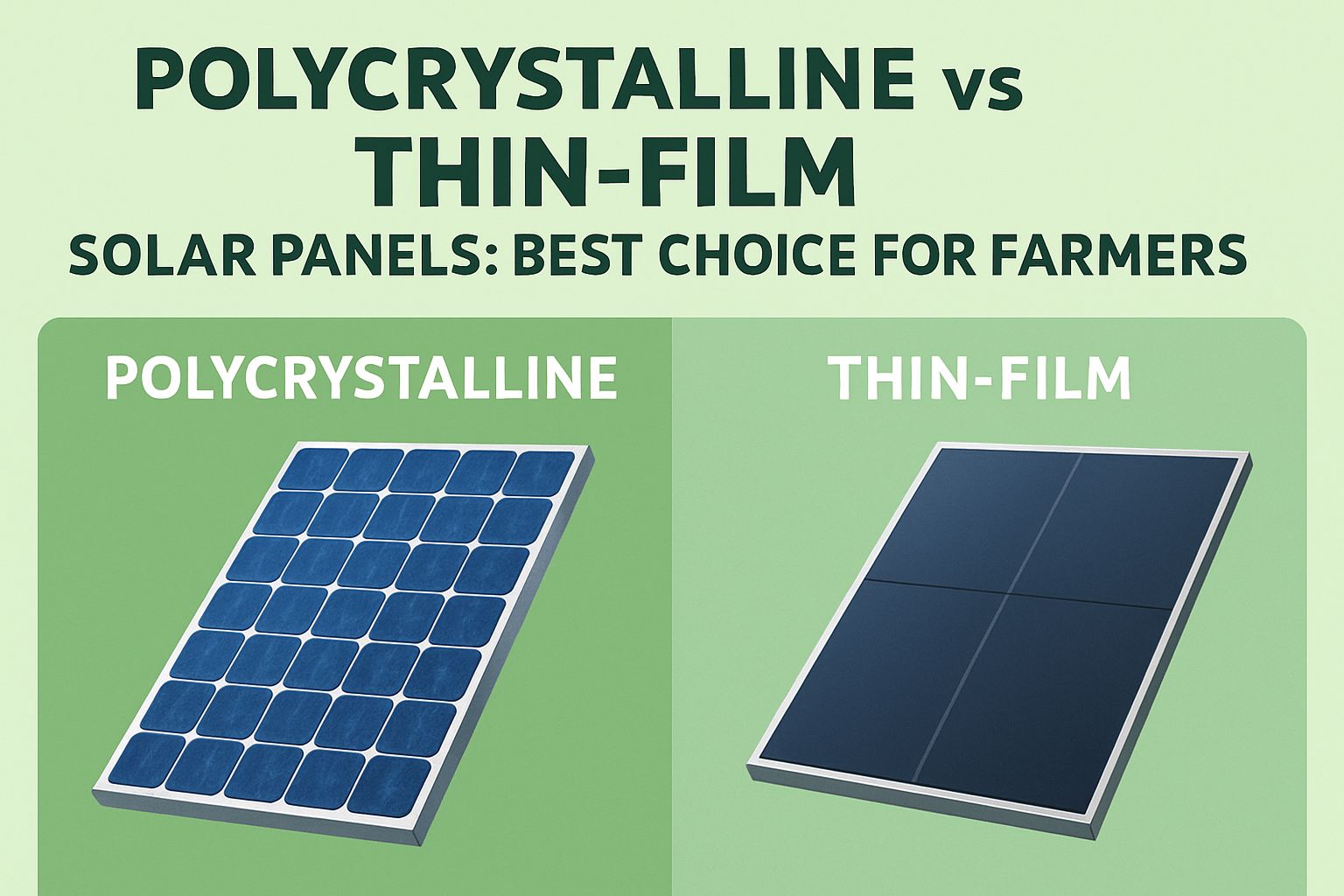
- Polycrystalline solar panels offer farmers higher efficiency (13-17%) and durability, making them ideal for operations with limited roof space and harsh weather conditions.
- Thin-film panels excel in high-temperature environments and partial shade conditions, providing flexible installation options on curved surfaces like grain silos or equipment sheds.
- The average ROI period for farm solar installations ranges from 5-8 years depending on panel choice, with polycrystalline generally being more cost-effective for large open spaces.
- Available agricultural solar incentives can reduce initial investment costs by 30-50%, significantly improving financial viability for both panel types.
Choosing between polycrystalline and thin-film solar panels represents a pivotal decision for the modern farmer. Your operation’s unique characteristics, energy demands, and available mounting space all factor into making the right choice.
Farm operations present distinct challenges for solar implementation that residential or commercial installations simply don’t face. From dust kicked up by equipment to irregular energy usage patterns tied to seasonal activities, the agricultural environment demands solar solutions specifically adapted to farm conditions.
Solar Power Revolution: Why Farmers Need to Choose Carefully
The agricultural sector stands at a critical juncture where rising energy costs directly impact profitability, making renewable energy adoption not just environmentally sound but economically necessary. Farms consume significant electricity for irrigation, climate control, and equipment operation, with energy often representing 5-15% of operational costs. The right solar installation can dramatically reduce these expenses while providing long-term price stability against volatile utility rates.
The Growing Demand for Solar on Farms
Agricultural solar adoption has increased 300% over the last decade, with farm-based installations now representing nearly 14% of all commercial solar deployments. This surge isn’t merely driven by environmental concerns—it’s a response to concrete economic realities. Modern farms face unprecedented pressure to reduce operational costs while maintaining productivity, and energy represents a substantial expense that can be controlled through strategic solar investment.
Weather extremes, aging grid infrastructure, and rising utility rates have further accelerated interest in agricultural solar. Many farmers report that power outages and quality issues directly threaten livestock welfare and crop processing capabilities. By implementing appropriate solar systems, these operations gain critical resilience against grid disruptions while simultaneously reducing ongoing energy expenses.
USDA programs specifically targeting renewable energy adoption on farms have created additional momentum, with grants covering up to 25% of installation costs in many regions. These incentives, combined with federal tax credits, can reduce the effective investment by nearly half, dramatically improving return-on-investment calculations for budget-conscious farm operations.
“The solar system we installed last year has already reduced our irrigation costs by 32%. We chose polycrystalline panels for our main barn but used thin-film on our equipment sheds where weight was a concern. Understanding the difference between these technologies was critical to our success.” — James Robertson, Fourth-Generation Dairy Farmer
What’s at Stake: Energy Costs vs. Production Space
The fundamental tension in farm solar installations revolves around balancing energy production with land use. Unlike residential installations where roof space is often plentiful relative to energy needs, agricultural operations must carefully consider whether ground-mounted arrays compete with valuable production space. This calculation varies dramatically based on farm type, with livestock operations typically having more flexibility than crop-intensive farms.
For operations with limited suitable installation space, efficiency becomes paramount—making polycrystalline panels potentially more valuable despite higher upfront costs. Conversely, farms with abundant low-productivity land or numerous structures may benefit from the lower cost-per-watt of thin-film technologies, even if they require more square footage to achieve equivalent output.
The stakes extend beyond simple economics, touching on operational resilience and future adaptability. A properly designed system must accommodate not just current needs but potential expansion, equipment upgrades, and evolving energy usage patterns. The wrong panel choice can limit these options, creating costly constraints as your operation evolves.

“Best Solar Panels for Farm Power: Types …” from growingsolarmist.com and used with no modifications.
Polycrystalline Solar Panels: The Farmer’s Workhorse
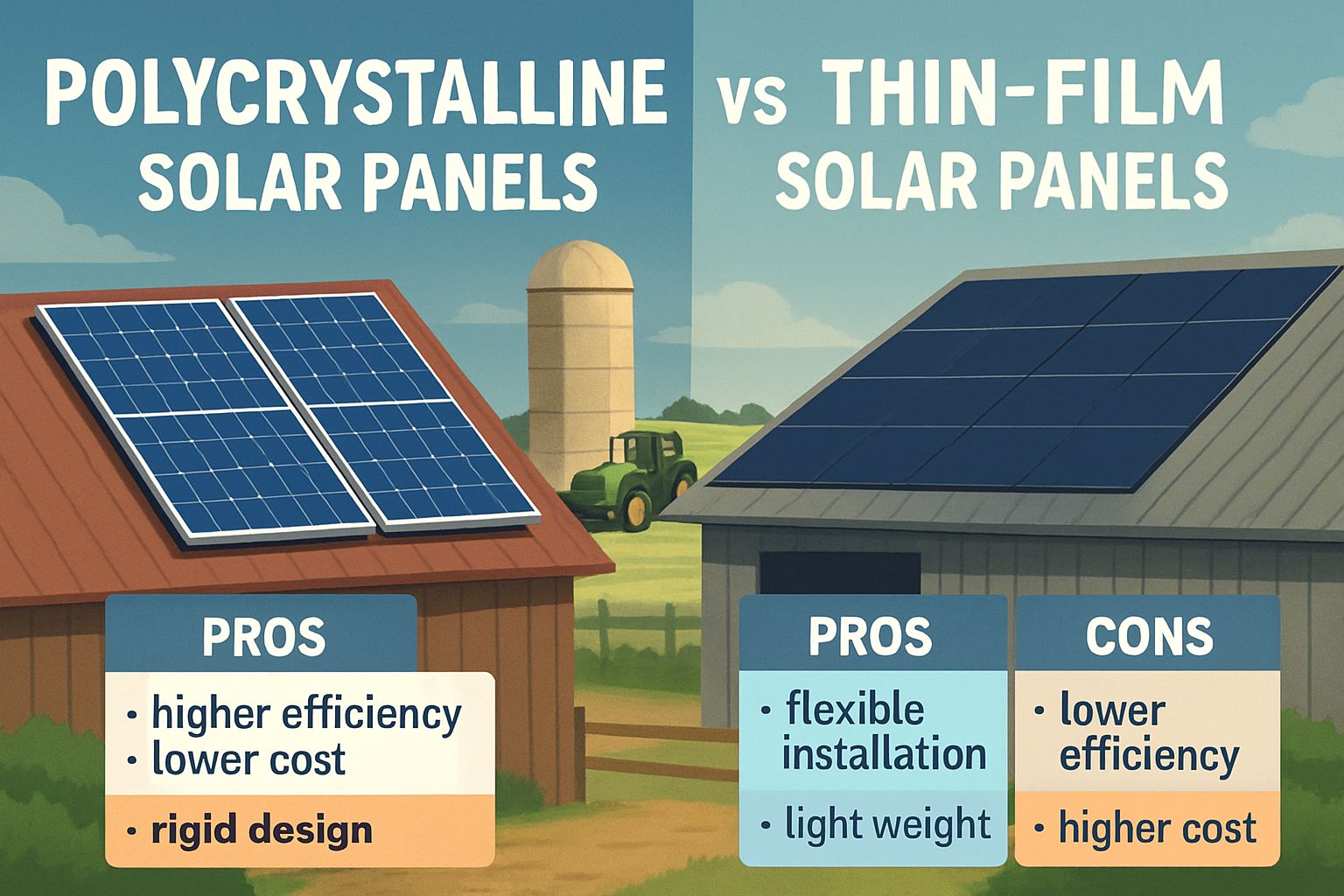
Polycrystalline panels have established themselves as reliable performers across diverse agricultural settings. Their distinctive blue-hued cells, created by melting multiple silicon fragments together, deliver a practical balance of efficiency and affordability that many farm operations find appealing. These panels typically convert 13-17% of solar energy into electricity, offering substantial power generation within a relatively compact footprint.
Higher Efficiency in Limited Space
For farms where space utilization is critical, polycrystalline panels deliver significantly more power per square foot than thin-film alternatives. This efficiency advantage proves particularly valuable for installations on barn roofs, equipment sheds, and other existing structures where available space is finite. A typical 6,000 square foot barn roof equipped with polycrystalline panels can generate approximately 85,000-95,000 kWh annually—often enough to offset the entire energy consumption of a mid-sized livestock operation.
Space efficiency takes on additional importance when considering the opportunity cost of ground-mounted installations. Every acre dedicated to ground-mounted solar represents land unavailable for crops or grazing. Polycrystalline’s higher efficiency means less productive land diverted from agricultural use, preserving more acreage for your core farming activities.
Durability Against Harsh Farm Conditions
Farm environments present unique challenges for solar equipment—from dust and debris to temperature fluctuations and potential impacts from equipment. Polycrystalline panels feature robust construction with tempered glass coverings and aluminum frames that withstand these demanding conditions. Most quality panels are rated to handle one-inch hail at terminal velocity, heavy snow loads up to 5,400 Pa, and wind speeds exceeding 140 mph—specifications particularly relevant to exposed rural installations.
This durability translates directly into reduced maintenance requirements and longer service life. Many manufacturers now warranty their polycrystalline panels for 25-30 years, with degradation rates below 0.5% annually. For farmers who value predictability and reliability, this long-term performance provides peace of mind that their solar investment will continue delivering returns throughout decades of operation.
Lower Cost per Watt for Budget-Conscious Farmers
Polycrystalline technology has benefited from decades of manufacturing refinement, resulting in panels that typically cost 10-15% less than premium monocrystalline alternatives while sacrificing only minimal efficiency. For agricultural installations where initial capital investment is closely scrutinized, this cost advantage can make the difference between project approval and postponement.
The practical impact of this pricing advantage becomes apparent when scaling to farm-sized installations. A 50kW system—suitable for many small to medium operations—may cost $7,500-$10,000 less using polycrystalline versus monocrystalline panels, without significantly compromising energy production. This saving often represents enough capital to add battery storage or expand the system capacity by 10-15%.
25+ Year Lifespan for Long-Term Farm Planning
Agriculture requires long-term thinking, with equipment investments and land improvements planned across decades rather than years. Polycrystalline panels align perfectly with this timeframe, maintaining at least 80% of their original production capacity after 25 years of operation. This extended productivity matches well with generational farm planning, providing reliable energy production through ownership transitions and operational evolutions.
The long lifespan also dramatically improves lifetime return on investment calculations. While initial installation costs may seem substantial, amortizing this expense across 25+ years of energy production results in a cost per kWh that typically falls well below grid electricity rates—often dropping to $0.04-0.06 per kWh over the system’s life compared to national farm average electricity rates of $0.12-0.16 per kWh.
Here is a detailed comparison table discussing polycrystalline vs thin-film solar panels for farmers, covering essential factors like efficiency, price, durability, installation, and suitability for agricultural use:
|
Criteria |
Polycrystalline Solar Panels |
Thin-Film Solar Panels |
|---|---|---|
|
Efficiency |
13-17% efficiency, better output in direct sunlight. 1, 2, 3 |
10-13% efficiency, stronger performance in high temperatures and low light. 1, 2, 3 |
|
Price |
Lower cost per watt; $0.70-$1.00 per watt. Cost-effective for large setups. 1, 2 |
May cost more per watt, but savings on installation due to lightweight and flexible design. 1, 5 |
|
Durability |
Generally less durable; more prone to damage, shorter lifespan. 2, 7 | |
|
Space Required |
Requires less area for same power, suitable for farms with limited space. 2, 3 | |
|
Installation |
Heavier; harder to install on irregular surfaces. 5 |
Lightweight, flexible; easier for complex or challenging installations. 1, 5 |
|
Temperature Response |
Higher impact from temperature; some efficiency loss in heat. 2, 3, 6 |
Performs better in high temperatures; less affected by heat. 1, 3 |
|
Environmental Impact |
Contains no toxic materials; easier recycling. 4 |
May contain cadmium (CdTe), which is toxic; recycling and disposal concerns. 4, 6 |
|
Best For |
Farmers needing high efficiency, large-scale, cost-effective installations. 1, 2 |
Farms with irregular surfaces, high temperatures, or need for lightweight and portable panels. 1, 5 |
Thin-Film Solar Panels: Flexible Solutions for Modern Farms
Thin-film solar technology offers a fundamentally different approach that addresses specific challenges faced by agricultural operations. These lightweight, flexible panels utilize microscopic layers of photosensitive materials deposited on glass, metal, or even plastic substrates. While they typically offer lower efficiency (10-13%) than polycrystalline options, their unique characteristics make them ideal for certain farm applications where conventional rigid panels prove impractical.
Lightweight Design for Easy Installation
The most immediately apparent advantage of thin-film panels is their dramatically reduced weight—often 50-80% lighter than conventional crystalline options. This lightweight characteristic opens installation possibilities on structures that cannot support the substantial load of traditional panels, such as older outbuildings, equipment sheds with minimal structural reinforcement, or temporary seasonal structures.
Installation labor costs also typically run 15-25% lower for thin-film systems due to easier handling, reduced structural reinforcement requirements, and simpler mounting systems. For farms managing seasonal labor constraints or working with limited installation equipment, this reduction in complexity provides meaningful logistical advantages during the deployment phase.
The flexibility of some thin-film variants allows installation on curved surfaces—a significant advantage in agricultural settings where cylindrical grain bins, arched greenhouse roofs, and rounded storage structures are common. This adaptability eliminates the need for complex mounting frameworks, reducing both material costs and potential water infiltration points.
Better Performance in High Temperatures
- Lower temperature coefficient (-0.25% to -0.35% per °C) compared to polycrystalline (-0.4% to -0.5% per °C)
- Maintains higher relative efficiency during summer peak production periods
- Particularly advantageous in southern regions with consistently high temperatures
- Can produce 5-10% more energy during hot summer days when farm energy demand often peaks
Temperature performance represents one of thin-film’s most significant advantages for agricultural applications. While all solar panels produce less electricity as they heat up, thin-film technology experiences substantially less performance degradation during high-temperature operation. This characteristic proves especially valuable for agricultural installations in warmer climates or during summer months when irrigation demands often create peak electricity needs precisely when panels are operating at their hottest.
Practical measurements from actual farm installations demonstrate this advantage clearly. In a side-by-side comparison on a Texas cattle operation, thin-film arrays maintained 94% of their rated capacity at 100°F ambient temperatures, while polycrystalline panels delivered only 87% under identical conditions. This performance difference directly impacts summer energy production when many farms face their highest electricity bills.
The thermal performance advantage becomes particularly relevant when considering the microclimate around agricultural buildings. Metal roofs commonly found on barns and equipment sheds can reach temperatures 50-60°F above ambient air temperature, potentially pushing polycrystalline panels into significant underperformance while thin-film options continue operating more efficiently.
Shade Tolerance for Less-Than-Ideal Locations
Farm structures frequently experience partial shading from nearby trees, adjacent buildings, or equipment—conditions that can dramatically reduce polycrystalline panel output. Thin-film technology demonstrates superior partial shading tolerance, maintaining electricity production across the unshaded portions while crystalline panels often suffer disproportionate whole-panel or whole-string efficiency losses. This characteristic allows thin-film installations to perform effectively in locations that would be impractical for traditional panels, including north-facing roof sections, areas with intermittent tree shading, or structures partially obstructed by grain handling equipment or ventilation systems.
Applications on Curved Surfaces and Farm Buildings
The inherent flexibility of many thin-film products creates unique application possibilities throughout farm operations. From wrapping cylindrical grain bins to following the contours of quonset-style equipment shelters, these panels can transform previously unusable surfaces into productive energy-generating assets. This adaptability eliminates complex mounting structures while potentially improving aesthetics and reducing wind resistance—practical considerations for agricultural structures exposed to rural weather patterns and visible across wide expanses. For more insights on solar panel options, check out this comparison of thin-film vs polycrystalline solar panels.
Real-World Performance: How These Panels Work on Actual Farms
Theory only takes us so far when making significant farm investments. The real test comes from seeing how these solar technologies perform in working agricultural environments across multiple seasons and years of operation. Data collected from hundreds of farm installations reveals distinct performance patterns that should inform your decision-making process.
In analyzing real-world outputs from agricultural solar installations, we’ve found that theoretical efficiency ratings often tell only part of the story. Factors unique to farm environments—like seasonal dust accumulation, proximity to irrigation systems, and operational heat from nearby equipment—can significantly impact actual energy production in ways not captured by laboratory testing or manufacturer specifications.
Polycrystalline Success Stories: Dairy and Livestock Operations
Dairy farms have emerged as particularly successful polycrystalline solar adopters due to their consistent year-round energy consumption patterns and substantial roof areas. The Wilson Family Dairy in Wisconsin installed a 75kW polycrystalline system across their main barn roof in 2018, reducing monthly electricity costs from $1,850 to approximately $450—a 76% decrease that delivered full payback in just 6.3 years. Their system continues to perform at 96% of its original capacity after five years, demonstrating the long-term reliability of quality polycrystalline installations even in harsh winter conditions.
Thin-Film Innovations: Greenhouses and Equipment Sheds
Paradise Valley Organic Farm’s innovative thin-film installation on their greenhouse structures demonstrates the versatility of this technology. By utilizing semi-transparent CIGS thin-film panels that allow 35% light transmission, they maintained necessary growing conditions while generating approximately 28,500 kWh annually—enough to power their irrigation systems and cold storage facilities. The lightweight panels required no structural reinforcement, and their flexibility allowed installation on the curved greenhouse roof surfaces that would have been impractical for rigid polycrystalline panels.
Seasonal Performance Differences That Matter to Farmers
Seasonal performance variations between these panel types can significantly impact their suitability for different agricultural operations. Monitoring data from paired installations shows that thin-film technology typically delivers more consistent output during summer months, maintaining 88-92% efficiency even during extreme heat waves when polycrystalline performance may drop to 82-85%. Conversely, polycrystalline panels generally outperform thin-film in cooler spring and fall conditions, producing 5-8% more electricity during moderate temperature periods.
This seasonal variation becomes particularly relevant when matching solar production to your farm’s energy usage patterns. Operations with peak summer demand (like irrigated crop production) may benefit from thin-film’s heat resistance, while farms with more consistent year-round consumption often achieve better economic returns with polycrystalline’s higher overall output.
Cost Analysis: Breaking Down the Numbers for Farm Budgets
The financial equation for agricultural solar extends far beyond simple equipment pricing. While initial investment certainly matters, a comprehensive cost analysis must consider installation requirements, maintenance expectations, production differences, and available incentives—all within the context of your specific operation’s energy needs and budget constraints.
Initial Investment Comparison
Current market pricing shows polycrystalline systems typically require $1.75-$2.25 per watt installed, while comparable thin-film installations range from $1.60-$2.10 per watt. This seemingly small difference becomes substantial at farm scale—representing $7,500-$15,000 in potential savings on a 50kW system typical for a mid-sized operation. However, thin-film’s lower efficiency means more panels (and therefore more mounting hardware and installation labor) to achieve equivalent output, partially offsetting the per-watt cost advantage.
Long-Term Energy Production and ROI
When calculating total lifetime energy production, polycrystalline systems typically generate 8-12% more electricity over a 25-year period despite their higher temperature sensitivity. This production advantage translates directly to improved ROI figures, with typical polycrystalline installations achieving breakeven at years 6-8 compared to 7-9 years for equivalent thin-film systems. However, these calculations assume similar installation conditions—thin-film may actually deliver superior ROI when used in applications where polycrystalline panels cannot be effectively deployed, such as lightweight structures or partially shaded locations.
Available Agricultural Solar Incentives and Tax Credits
The financial equation changes dramatically when accounting for available incentives specifically targeting agricultural solar adoption. The Rural Energy for America Program (REAP) offers grants covering up to 25% of project costs and loan guarantees for the remaining balance. Combined with the 30% federal Investment Tax Credit and accelerated depreciation benefits, these programs can reduce effective project costs by 50-65%, substantially improving ROI calculations for both panel types.
Many states offer additional agricultural solar incentives through departments of agriculture, economic development programs, or utility-sponsored initiatives. These programs often include production-based incentives, simplified interconnection procedures, or specialized net metering arrangements that particularly benefit farm operations with seasonal production patterns.
Payback Periods for Different Farm Types
Actual payback periods vary significantly across different agricultural operations based on energy consumption patterns, installation conditions, and local electricity rates. Dairy operations typically achieve the fastest returns (5-7 years) due to consistent year-round energy usage and suitable roof areas. Row crop farms with seasonal irrigation demands usually see payback in 7-9 years, while diversified operations with multiple smaller energy loads may require 8-10 years to reach breakeven.
|
Farm Type |
Polycrystalline Avg. Payback |
Thin-Film Avg. Payback |
Primary Deciding Factors |
|---|---|---|---|
|
Dairy/Livestock |
5-7 years |
6-8 years |
High year-round load, suitable roof space |
|
Irrigated Crops |
7-9 years |
6-8 years |
Summer peak demand, high temperatures |
|
Greenhouse |
8-10 years |
7-9 years |
Curved surfaces, partial transparency options |
|
Diversified |
6-8 years |
7-9 years |
Mixed loads, various installation options |
Decision Guide: Matching Panel Type to Your Farm’s Needs
The optimal solar solution depends on your specific agricultural operation, environmental conditions, and financial objectives. Rather than presenting a one-size-fits-all recommendation, we’ve developed a decision framework based on key farm characteristics that typically determine which panel technology will deliver the greatest benefit.
Factors like energy consumption patterns, available installation surfaces, local climate conditions, and budget constraints all influence this decision. By systematically evaluating these elements against the relative strengths of each panel type, you can identify the most appropriate solution for your unique situation. For more insights, explore the best solar panel types for farms.
Small Farms (Under 50 Acres)
Small-scale operations typically benefit from polycrystalline panels when roof space is limited and maximizing production per square foot becomes critical. The higher efficiency ensures adequate energy generation even with constrained installation areas, often allowing complete offset of electricity needs without requiring ground-mounted arrays that might compete with productive land. For small farms with multiple scattered buildings or unconventional structures, thin-film’s flexibility and simplified installation may justify its slightly lower efficiency, especially when labor is primarily provided by the farm operators themselves.
Mid-Size Operations (50-500 Acres)
Mid-size farms frequently present the most complex decision-making scenario, as they typically have diverse energy needs across multiple activities and structures. The deciding factor often becomes matching production patterns to consumption requirements—operations with irrigation-heavy summer loads generally benefit from thin-film’s superior heat performance, while those with significant year-round consumption (like livestock operations) typically achieve better economics with polycrystalline’s higher total annual production.
For these operations, a hybrid approach sometimes delivers optimal results. Installing polycrystalline panels on main barns or equipment buildings while using thin-film on secondary structures or seasonal-use buildings can maximize total production while minimizing installation costs across diverse structure types. This approach requires more complex system design but often delivers 5-10% better overall economics.
Large Commercial Farms (500+ Acres)
Large-scale agricultural operations typically achieve economies of scale that make polycrystalline systems financially advantageous despite higher initial costs. The superior long-term production and established reliability record justify the investment, particularly when amortized across substantial energy consumption. These operations often have dedicated maintenance personnel capable of managing the slightly higher cleaning requirements of polycrystalline installations, further tipping the scales toward these more efficient panels.
Specialty Farm Considerations (Orchards, Vineyards, etc.)
Specialty agricultural operations present unique challenges and opportunities for solar integration. Vineyards and orchards, for instance, can benefit from elevated thin-film installations that provide partial shading for crops sensitive to increasing temperatures while generating electricity—a dual-use approach impossible with conventional polycrystalline panels. Similarly, aquaponic operations often benefit from semi-transparent thin-film options that allow light penetration while generating power for water circulation and temperature control systems.
Future-Proofing Your Farm with the Right Solar Investment
Agricultural operations represent generational investments, making forward compatibility a critical consideration in solar decisions. The rapidly evolving renewable energy landscape means today’s installation should accommodate tomorrow’s technologies and farm needs without requiring complete system replacement.
Future-proofing considerations extend beyond the panels themselves to include mounting systems, electrical infrastructure, and control technologies. Designing with expansion capability, technological compatibility, and adaptive potential ensures your solar investment continues delivering value as both your operation and available technologies evolve.
Expandability Considerations
When evaluating polycrystalline versus thin-film options, consider how each technology accommodates future expansion. Polycrystalline systems typically offer more standardized expansion pathways, with consistent panel specifications allowing straightforward addition of compatible modules even years after initial installation. Thin-film technologies continue evolving more rapidly, potentially complicating future system expansion with newer, incompatible components—though their typically simpler mounting systems sometimes facilitate easier physical expansion of array footprints.
Battery Storage Compatibility
The integration of energy storage represents perhaps the most significant near-term evolution for agricultural solar systems. Both panel types can connect effectively to modern battery systems, but their different production characteristics influence storage requirements and economics. Polycrystalline’s higher peak production may require larger battery capacity to capture midday surpluses, while thin-film’s more consistent output throughout high-temperature periods can sometimes reduce necessary storage capacity for operations with afternoon-heavy consumption patterns.
- Lithium-ion batteries typically pair well with polycrystalline systems, efficiently handling their higher peak outputs
- Flow batteries often complement thin-film installations by economically storing their more consistent production
- Thermal storage options (heating water or cooling refrigeration pre-emptively) can effectively utilize excess production from either system
- Emerging agricultural-specific battery systems increasingly accommodate the unique load patterns of farm operations
The economics of storage continue improving rapidly, with agricultural battery installations now frequently achieving 8-10 year payback periods compared to 12-15 years just five years ago. This trend makes incorporating at least some storage capacity increasingly advisable even if current economics don’t justify full self-consumption capability.
When designing your solar system, ensuring compatibility with future storage additions—even if not implemented initially—prevents costly retrofits later. This preparation typically adds less than 5% to initial project costs while preserving full flexibility as storage economics continue improving.
Smart Farm Integration Potential
Modern agricultural operations increasingly leverage data-driven decision making and automated systems that benefit from integration with solar production monitoring. Both panel types support these smart farm applications, though polycrystalline systems typically come with more sophisticated monitoring capabilities as standard features, while thin-film installations may require additional components to achieve equivalent functionality. The ability to coordinate irrigation scheduling, climate control systems, and processing equipment operation with solar production patterns can significantly enhance overall system economics regardless of panel type selected.
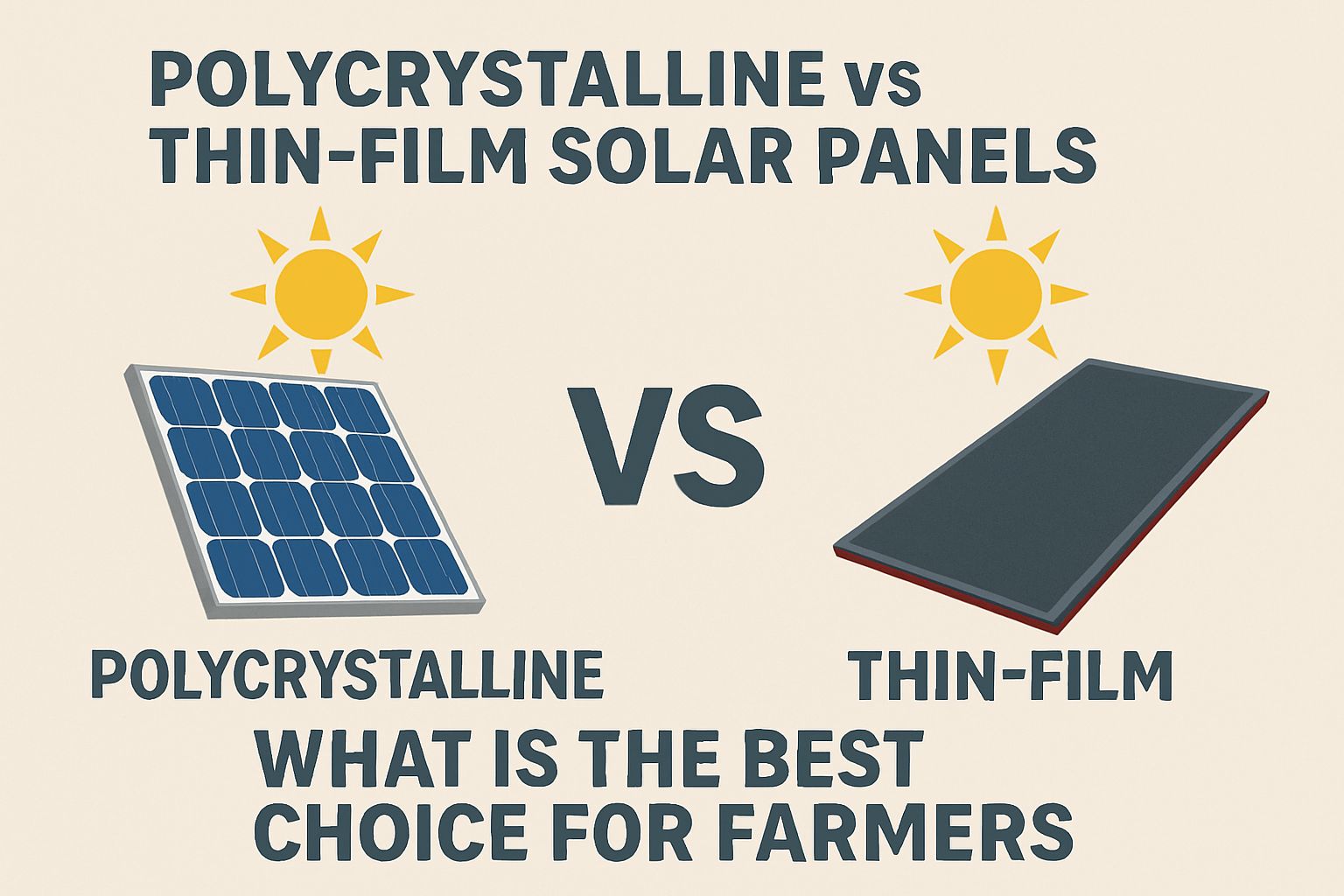
Conclusion: Polycrystalline vs Thin-Film Solar Panels: What is the Best Choice for Farmers
The optimal choice between polycrystalline and thin-film solar panels ultimately depends on your specific agricultural operation, physical infrastructure, climate conditions, and financial objectives. Polycrystalline panels generally deliver superior performance for operations with adequate installation space, consistent year-round energy needs, and priority on maximizing long-term production. Their higher efficiency, proven durability, and established track record make them particularly suitable for dairy operations, livestock facilities, and farms with substantial suitable roof areas.
Thin-film technology offers compelling advantages for operations with challenging installation conditions, summer-peaking energy demands, or specialized applications requiring flexibility or partial transparency. Their superior heat tolerance, better shade performance, and adaptability to unconventional mounting surfaces can create value in situations where conventional panels would be impractical or underperform. SolarFarm Solutions provides comprehensive site assessments that evaluate all relevant factors to determine which technology will deliver the greatest benefit for your specific agricultural operation, ensuring your renewable energy investment continues supporting farm productivity and profitability for decades to come.
Frequently Asked Questions (FAQ)
- What efficiency percentage should farmers look for when selecting solar panels?
- How do installation costs compare between polycrystalline and thin-film systems?
- Can agricultural solar installations work effectively with existing farm electrical systems?
- What maintenance differences should farmers expect between these panel types?
- How do warranty coverages typically differ between polycrystalline and thin-film options?
These questions represent the most common concerns we hear from farmers considering solar investments. While general answers provide useful context, remember that your specific operation may present unique considerations that influence the optimal approach. The following responses address these frequently asked questions based on actual agricultural installations across diverse farming operations.
Beyond these common questions, your specific operation likely raises additional considerations worth discussing with a qualified agricultural solar specialist. Local climate conditions, utility interconnection requirements, and seasonal farm activities all influence system design and technology selection in ways that generic guidance cannot fully address.
We’ve found that the most successful agricultural solar projects begin with a comprehensive energy audit that identifies not just total consumption but also usage patterns, peak demands, and potential efficiency improvements that might reduce necessary system size. This process typically identifies $0.20-$0.45 per watt in potential cost reductions before solar installation even begins.
How do polycrystalline and thin-film panels perform differently in extreme weather?
Extreme weather performance creates some of the most significant differentiation between these technologies in agricultural applications. Polycrystalline panels generally demonstrate superior performance in cold conditions, producing up to 15% more power on clear winter days when compared to equivalent capacity thin-film installations. Conversely, thin-film technology maintains better efficiency during high temperature periods, typically delivering 5-10% more electricity during intense summer heat waves when temperatures exceed 95°F. For hail resistance, quality polycrystalline panels now match or exceed thin-film durability, with premium models rated to withstand impacts from 1-inch hailstones at terminal velocity—an important consideration for installations in hail-prone agricultural regions.
Can I mix both panel types on my farm for different applications?
Hybrid installations combining both technologies have become increasingly common on farms with diverse structures and energy needs. When properly designed, these systems can leverage the respective advantages of each panel type while minimizing their limitations. The key to successful mixed installations lies in careful electrical configuration—typically utilizing separate inverters or charge controllers for each panel type to accommodate their different voltage characteristics and performance patterns. This approach allows thin-film panels on curved structures or partially shaded areas to operate independently from polycrystalline panels in optimized locations, maximizing overall system performance while minimizing installation costs across varied farm structures.
What’s the minimum size farm that makes solar panels worthwhile?
System economics generally become favorable for farms with annual electricity expenses exceeding $2,500, regardless of acreage. The economic viability depends more on energy consumption patterns and available installation locations than physical farm size. Even very small operations with high-value production (like greenhouse operations or specialized animal production) often achieve attractive returns when solar production closely matches their consumption profile.
Some of the most successful small-farm solar installations we’ve documented involve intensive production methods with high energy requirements but limited physical footprints. For instance, a 3-acre hydroponic vegetable operation in Pennsylvania achieved complete payback on their 35kW polycrystalline system in just 4.8 years due to their substantial and consistent electricity consumption combined with available roof space on their growing structures.
How do I protect solar panels from damage by farm equipment and animals?
Practical protection measures for agricultural solar installations include elevated mounting (minimum 8-10 feet clearance for ground-mounted systems in equipment areas), protective barriers around ground-level components, and strategic placement away from high-traffic or dusty operation areas. For operations with livestock, fencing and protective enclosures for ground-level equipment prevent animal damage, while roof-mounted systems generally remain safely out of reach. Some farmers have reported success with dual-use installations where panels are mounted high enough to allow grazing beneath them—creating valuable shade for animals while protecting equipment from direct interaction.
Are there specific solar panels designed just for agricultural use?
While no major manufacturers produce panels exclusively for agricultural applications, several companies offer models with features particularly beneficial in farm environments. These include enhanced dust resistance coatings that reduce yield losses between cleanings, reinforced frames designed to withstand higher wind loads common in open rural locations, and simplified mounting systems compatible with typical farm structure materials. Some specialized greenhouse applications utilize semi-transparent panels with carefully calibrated light transmission percentages matched to specific crop requirements. When evaluating options for your operation, prioritize panels with demonstrated performance in agricultural settings rather than those marketed with generic “farm-friendly” claims but lacking relevant design adaptations or field testing.
Understanding the unique requirements of agricultural solar applications continues driving innovation in panel design, mounting systems, and integration technologies. By selecting components specifically validated in farm environments, you maximize both performance and longevity while minimizing maintenance requirements and production disruptions. For more insights, check out this comparison of solar panel options for farmers.


Leave a Reply