
Key Takeaways
- Farmers can reduce operational costs by up to 70% through strategic solar panel installation, with systems paying for themselves in as little as 5-7 years
- USDA REAP grants can cover up to 50% of solar project costs, while the federal ITC offers a 30% tax credit on total system costs
- Solar installations create multiple revenue streams by reducing energy expenses, stabilizing long-term costs, and converting unused land into income-generating assets
- Agricultural-specific financing options include low-interest loans, power purchase agreements with zero upfront costs, and specialized equipment leasing arrangements
- The right solar system for your farm depends on your specific operation type – dairy farms benefit most from panels that offset refrigeration costs while irrigation-heavy farms should focus on solar-powered pump systems
The rising cost of powering farm operations continues to squeeze agricultural profits nationwide. With electricity rates climbing annually and farm energy demands increasing with modernization, solar power has emerged as a financial game-changer for forward-thinking farmers. The numbers tell a compelling story: well-designed solar systems routinely deliver 15-30 year energy cost reductions exceeding 70% while creating new revenue opportunities.
Solar installations on agricultural properties aren’t just an environmental choice—they’re increasingly becoming the fiscally responsible option for operations of all sizes. From small family farms to large commercial enterprises, solar panels are transforming agricultural energy expenses from unpredictable liabilities into controlled, predictable assets. 8M Solar helps farmers across the country identify their ideal solar solutions that match their specific operational needs and financial goals, ensuring maximum return on investment.
The financial case for agricultural solar has never been stronger, with multiple incentive programs specifically designed for farmers, decreasing installation costs, and increasingly efficient panel technology. Let’s examine exactly how these systems deliver measurable financial benefits to modern farming operations.
Why Farmers Are Slashing Energy Bills With Solar Panels
Agriculture represents one of the most energy-intensive industries in America. From irrigation and climate control to product processing and storage, farms require consistent, reliable power to maintain operations and protect valuable crops and livestock. This dependency creates financial vulnerability as utility rates continue their upward trajectory with little seasonal consideration for farmers’ peak usage periods.
Solar panels create immediate financial relief by generating electricity on-site exactly when farms need it most. During summer months when irrigation demands spike, solar production also reaches its peak—creating a perfect alignment between energy generation and consumption patterns. This natural synchronization allows farmers to significantly reduce or eliminate grid electricity purchases during their highest-usage periods.
The financial impact is most dramatic for operations with high daytime energy consumption. Dairy farms running milk cooling equipment, poultry operations managing ventilation systems, and irrigated crop productions all see substantial cost reductions from properly sized solar installations. Some operations report utility bill reductions exceeding 90% during peak production months.
The Real Financial Numbers Behind Farm Solar Systems
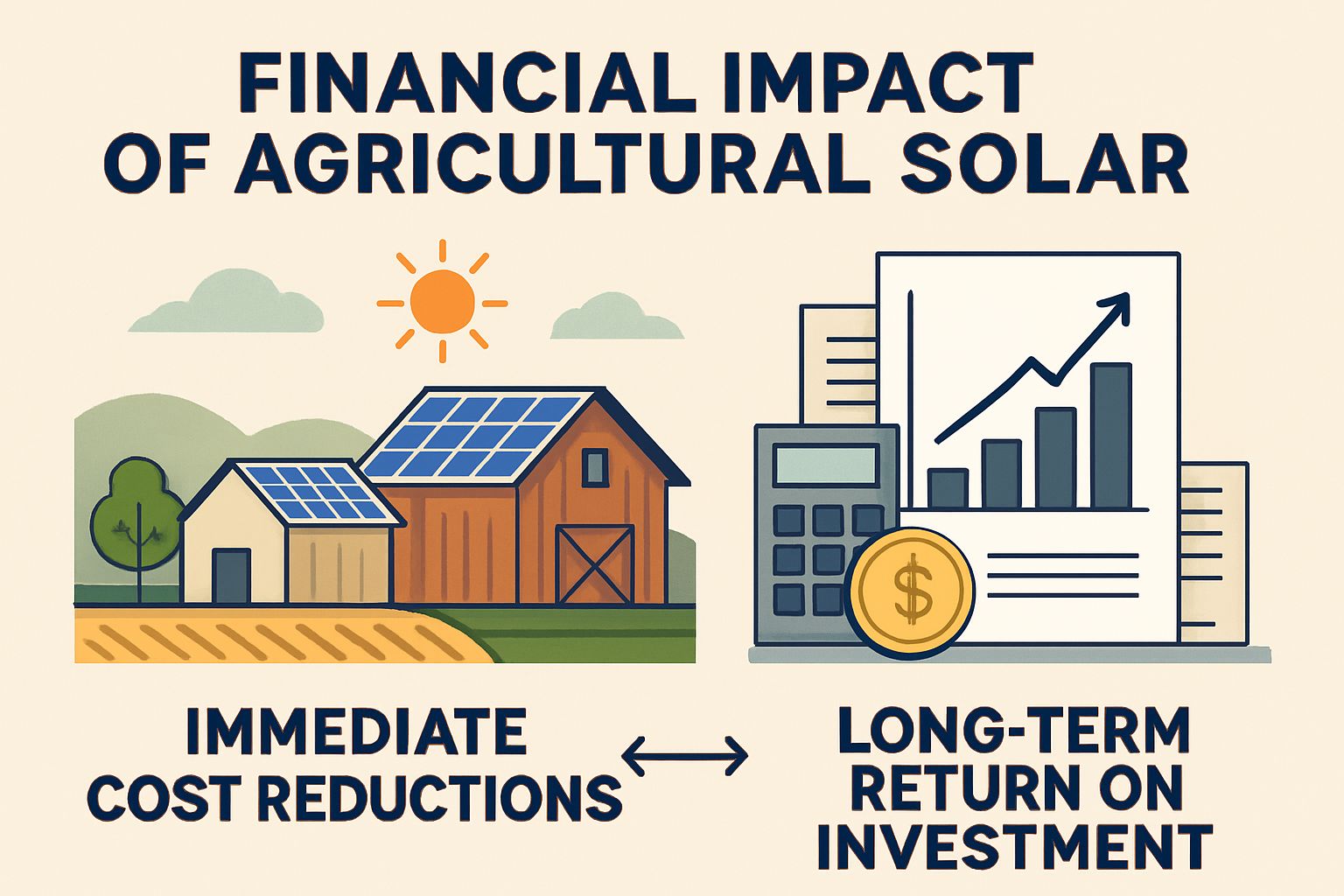
Understanding the true financial impact of agricultural solar installations requires examining both immediate cost reductions and long-term return on investment calculations. While system costs vary based on size, configuration, and location, the financial fundamentals follow consistent patterns across most farm installations.
A typical 50-kilowatt system suitable for a medium-sized farm operation might cost $100,000-150,000 before incentives. After applying available agricultural grants, tax credits, and accelerated depreciation benefits, farmers often see their net system cost reduced by 50-75%, bringing effective investment down to $25,000-75,000 depending on qualification for various incentive programs.
These systems typically generate 60,000-80,000 kilowatt-hours annually, offsetting $7,000-12,000 in utility purchases each year at current electricity rates. When properly maintained, quality systems continue producing at over 80% efficiency for 25+ years, delivering decades of predictable energy savings with minimal maintenance costs. For more information on how solar panels can reduce farm energy bills, check out our detailed guide.
“Our solar installation reduced our dairy operation’s monthly electricity expense by 83% during summer months. With milk prices fluctuating beyond our control, having predictable energy costs has been crucial for maintaining profitability.”
– James Henderson, 5th generation dairy farmer
Average Energy Cost Reduction for Different Farm Types
The financial impact of solar installations varies significantly between different agricultural operations based on energy usage patterns, equipment requirements, and seasonal factors. Understanding these variations helps farmers develop realistic financial projections when considering solar investments.
|
Farm Type |
Average Energy Cost Reduction |
Key Energy Applications |
Typical Payback Period |
|---|---|---|---|
|
Dairy Operations |
60-80% |
Milk cooling, refrigeration, water heating |
5-7 years |
|
Poultry Farms |
50-70% |
Ventilation, heating, cooling systems |
6-8 years |
|
Irrigated Crop Farms |
70-95% |
Pumping systems, pivot irrigation |
4-6 years |
|
Greenhouse Operations |
40-60% |
Climate control, lighting, ventilation |
7-9 years |
|
Livestock Operations |
45-65% |
Water pumping, lighting, ventilation |
6-8 years |
Calculating Your Farm’s Potential Savings
To accurately project solar savings for your specific operation, start by analyzing 12-24 months of electricity bills to identify consumption patterns and peak usage periods. This baseline data provides the foundation for system sizing and financial projections. Most agricultural operations benefit from systems that offset 70-100% of annual electricity consumption, depending on available installation space and budget constraints. For more information on how to profit with solar farming, explore additional resources.
The calculation formula includes several key variables: current electricity rates ($/kWh), annual consumption (kWh), projected electricity rate increases (typically 3-5% annually), available incentives, and system production estimates for your geographic location. Professional solar assessments include detailed financial projections showing monthly cash flows and cumulative savings throughout the system’s lifespan.
Many farmers find that their actual financial returns exceed initial projections due to three factors: utility rate increases often outpace conservative estimates, modern panels frequently outperform warranty specifications, and operational changes that shift energy usage to daylight hours can maximize direct consumption of generated electricity.
Payback Period: When Your System Starts Making You Money
The agricultural solar payback period—the time required for cumulative energy savings to equal initial investment—has shortened dramatically in recent years. While early adopters often faced 12-15 year payback timelines, today’s combination of improved technology, lower installation costs, and enhanced incentives delivers break-even points typically between 4-8 years, depending on farm type and location.
This accelerated payback period means many farmers see their solar systems become net positive financial investments during the first third of the system’s operational lifespan. After reaching break-even, all subsequent energy savings represent direct profit improvement that continues for decades with minimal additional investment beyond basic maintenance.
25+ Year Return on Investment Timeline
The long-term economics of agricultural solar installations create compelling financial returns that few other farm investments can match. Quality solar panels carry 25-30 year production warranties but typically continue generating electricity for 30-40 years with gradual efficiency decreases. This extended production capability means the total lifetime return on investment often exceeds 300% of the original capital expense.
For context, a $50,000 net investment (after incentives) in a properly sized and installed farm solar system will typically generate $150,000-200,000 in energy savings over its operational lifespan. Few agricultural investments offer this combination of predictable returns, minimal risk, and operational benefits. Learn more about the financial benefits of solar panels for farmers.
5 Government Incentives That Make Solar Affordable for Farmers
The current incentive landscape specifically advantages agricultural solar installations with programs designed to reduce initial costs, accelerate financial returns, and minimize risks. Understanding these programs is essential for maximizing the financial benefits of farm solar projects.
1. USDA REAP Grants: Up to 50% of Project Costs Covered
The Rural Energy for America Program (REAP) represents one of the most valuable financial incentives available to agricultural producers. These competitive grants cover up to 25% of total eligible project costs with a maximum individual grant of $500,000. The program also offers guaranteed loan financing for up to 75% of total eligible project costs, creating a powerful combination of grant funding and favorable financing terms specifically designed for agricultural renewable energy projects.
REAP applications require detailed energy assessments, financial projections, and project documentation. While the application process is rigorous, the significant financial benefits justify the effort. Successful applicants typically work with experienced agricultural grant writers who understand USDA priorities and requirements.
2. Federal Investment Tax Credit (ITC)
The federal solar Investment Tax Credit provides a dollar-for-dollar reduction in federal income tax liability equal to 30% of the total system cost (including equipment, installation, and related expenses). This credit applies to both personal and corporate tax returns, making it valuable for farms operating under various business structures. The 30% rate is currently available for systems installed through 2032, with scheduled reductions in subsequent years. For more insights on how solar can enhance farm sustainability, explore enhancing sustainability on farms through solar.
For farms without sufficient tax liability to utilize the full credit in the installation year, the ITC can be carried forward for up to 20 years, allowing maximum utilization of this powerful financial incentive. This extended carryforward provision ensures that even operations with fluctuating profitability can capture the full benefit.
3. Accelerated Depreciation Benefits
Agricultural solar installations qualify for Modified Accelerated Cost Recovery System (MACRS) depreciation, allowing farms to depreciate the entire system cost (minus 50% of the ITC) over just five years instead of the system’s 25+ year useful life. This accelerated schedule creates significant early-year tax benefits that improve project cash flow and effectively reduces the net system cost.
Additionally, many agricultural solar installations qualify for bonus depreciation provisions, which currently allow 80% first-year depreciation on qualifying assets. This front-loaded tax benefit creates immediate financial advantages that dramatically improve first-year project economics. For more information on how these incentives make solar panels affordable, check out tax incentives for solar panels.
4. State-Specific Agricultural Solar Incentives
Beyond federal programs, many states offer agricultural-specific renewable energy incentives that provide additional financial benefits for farm solar projects. These programs include production-based incentives, additional tax credits, property tax exemptions, and specialized grant programs targeted specifically at agricultural producers.
State incentive values vary significantly by location, with some states offering benefits that can reduce net system costs by an additional 10-30% beyond federal incentives. Consulting with agricultural energy specialists familiar with local programs ensures you identify all available opportunities specific to your operation’s location.
5. Net Metering: Selling Excess Power Back to the Grid
Net metering policies allow farms to receive credit for excess electricity generation that flows back to the utility grid. These programs effectively turn the electric meter backward during periods of excess production, creating monetary credits that offset electricity purchases during nighttime or low-production periods. For more insights on how solar panels can revolutionize farm operations, check out this article on solar panels revolutionizing farm operations.
While net metering policies vary by state and utility, they typically provide near-retail value for excess generation, dramatically improving solar economics compared to wholesale compensation models. The most favorable policies allow indefinite carryforward of credits, enabling seasonal operations to bank summer production credits for winter usage. For more insights on how solar can enhance sustainability on farms, check out this article on enhancing sustainability through solar.

“Solar Panels Income Revenue Streams for …” from growingsolarmist.com and used with no modifications.
How Solar Panels Create Multiple Revenue Streams
Beyond direct energy savings, agricultural solar installations create multiple financial benefits that compound over time to improve farm profitability and operational resilience. These diverse revenue streams provide both immediate returns and long-term financial advantages.
Reducing Operational Costs in Energy-Intensive Farm Activities
Agricultural operations typically contain several energy-intensive activities that create significant financial drain. Irrigation pumps, refrigeration systems, ventilation equipment, and heating systems often represent 70-80% of a farm’s total electricity consumption. By targeting these high-consumption processes with solar power, farmers can dramatically reduce their largest operational expenses.
Solar-powered irrigation systems demonstrate particularly compelling economics. With water pumping requirements naturally aligning with sunny conditions, these systems often achieve 90%+ offset of irrigation energy costs. For farms with significant irrigation needs, this single application can justify the entire solar investment, with all other benefits representing additional financial upside. To explore further, consider how solar panels reduce farm energy bills and contribute to cost savings.
Climate-controlled operations like poultry houses and greenhouses see similarly dramatic cost reductions through strategic solar implementation. These facilities require consistent temperature and humidity management regardless of outside conditions, creating substantial year-round energy demands that solar can effectively offset during daylight hours.
Stabilizing Long-Term Energy Expenses
Perhaps the most valuable financial aspect of agricultural solar installations is their ability to convert variable, unpredictable energy expenses into fixed, known costs. By generating electricity on-site at a known cost per kilowatt-hour over decades, solar systems effectively lock in energy prices at current levels, creating immunity from future utility rate increases.
This price stabilization creates significant competitive advantage as energy costs continue rising for competitors reliant on traditional utility power. Farms with solar installations effectively pre-purchase 25+ years of electricity at today’s prices, protecting operational margins from energy inflation that historically averages 3-5% annually but can spike significantly higher during energy market disruptions.
Turning Unused Land into Income-Generating Assets
Ground-mounted solar installations create new productive purpose for marginally productive agricultural land, field edges, or underutilized areas. Particularly for farms with irregular field shapes, drainage issues, or access limitations, solar arrays can transform low-yield acreage into highly productive energy generation zones that deliver consistent financial returns regardless of weather conditions, commodity prices, or input costs.
Some farmers have discovered that strategic placement of solar arrays can actually enhance overall land productivity through dual-use approaches. Agrivoltaic systems that combine solar panels with compatible crop production or grazing can maintain agricultural output while adding energy generation as a supplemental revenue stream. These innovative approaches maximize financial returns per acre while maintaining traditional agricultural activities.
Best Solar Panel Systems for Different Farm Operations
The optimal solar configuration varies significantly between different agricultural operations, with system design, mounting approach, and technology selection all impacting financial performance. Working with specialists experienced in agricultural applications ensures your system addresses your specific operational requirements and energy usage patterns.
Dairy Farm Solutions: Offsetting High Refrigeration Costs
Dairy operations benefit most from systems sized to cover consistent base loads from milk cooling equipment, water heating, and refrigeration. These systems typically utilize roof-mounted arrays on existing structures like barns, equipment sheds, and milking parlors to minimize land use while positioning generation close to consumption points. The consistent energy demand profile of dairy farms creates exceptionally favorable solar economics with systems frequently achieving 5-6 year payback periods.
Poultry Operation Systems: Ventilation and Climate Control
Poultry houses require energy-intensive ventilation and precise climate control throughout the year. Solar installations for these operations often combine roof-mounted arrays with ground-mounted supplements to achieve the necessary scale. Advanced monitoring systems that synchronize solar production with ventilation schedules can maximize direct consumption of generated electricity, improving financial performance by reducing grid exports during production peaks. To explore more about enhancing sustainability on farms, consider reading this article on solar farming.
Crop Irrigation: Solar-Powered Pump Systems
Irrigation-focused solar solutions offer particularly compelling economics for crop farmers. These systems can be configured either grid-tied or as stand-alone direct-drive systems that operate pumps without battery storage. Direct-drive configurations eliminate the complexity and cost of battery systems while providing irrigation capacity precisely when it’s most needed – during sunny conditions. For remote pumping stations without existing grid connections, solar irrigation systems eliminate expensive utility line extensions while providing reliable, maintenance-free operation.
How to Finance Your Farm’s Solar Project
“The financing options available for agricultural solar have completely transformed the accessibility of these systems. With tax incentives, zero-down options, and immediate positive cash flow structures, solar has become a financial no-brainer for many farm operations.”
– Michael Rodriguez, Agricultural Finance Specialist
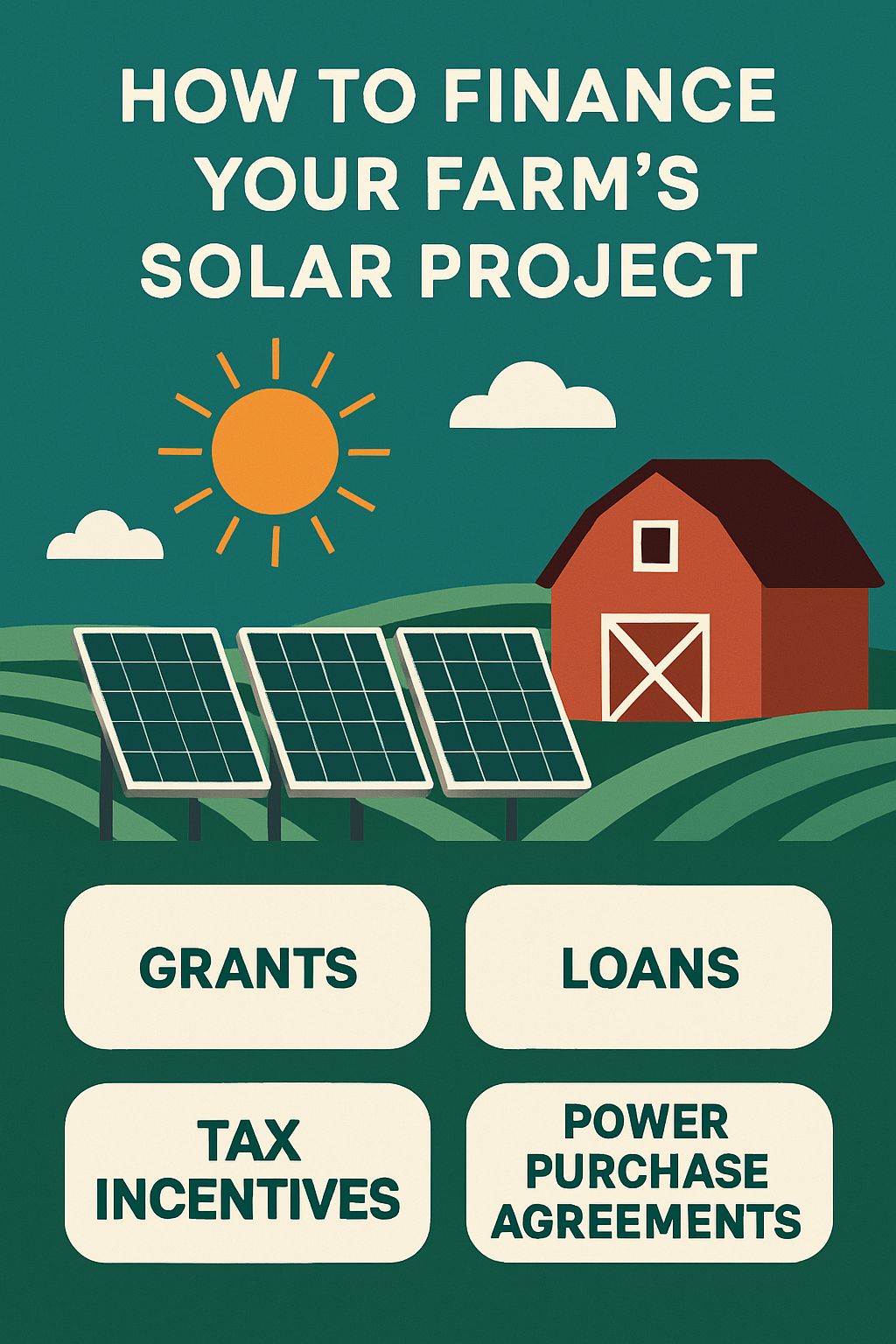
The agricultural industry benefits from specialized financing options designed specifically for renewable energy projects. These programs recognize the unique cash flow patterns of farming operations and offer terms aligned with agricultural business cycles.
Agricultural-Specific Loan Programs with Low Interest Rates
Farm Credit associations, the USDA, and many local agricultural lenders offer specialized loan products tailored specifically for on-farm renewable energy projects. These programs typically feature lower interest rates, extended terms (10-20 years), and repayment schedules aligned with seasonal farm cash flows. Many programs allow flexible structures that match loan payments to projected energy savings, ensuring positive monthly cash flow from installation forward.
Power Purchase Agreements: Zero Upfront Cost Options
For farms seeking to eliminate upfront costs entirely, Power Purchase Agreements (PPAs) provide an increasingly popular alternative. Under these arrangements, a third-party investor owns the solar system installed on your farm while you purchase the generated electricity at a predetermined rate typically 10-30% below utility costs. These agreements require no capital investment from the farm while immediately reducing energy expenses, effectively transforming the solar project from a capital investment into a simple operational expense.
Equipment Leasing vs. Ownership: Tax Implications
Solar leasing programs provide another zero-down option with significant tax advantages for certain farm operations. Operating leases allow farms to deduct the entire lease payment as a business expense while eliminating responsibility for system maintenance. Capital leases and lease-to-own arrangements provide pathways to eventual ownership while spreading costs over 5-7 years. The optimal structure depends on your farm’s tax situation, cash flow needs, and long-term objectives.
Working With Local Agricultural Credit Associations
Farm Credit associations and agricultural banks frequently offer the most favorable terms for solar projects due to their deep understanding of farm operations and comfort with agricultural lending. Many have developed specialized renewable energy lending teams that understand both the technical aspects of solar systems and the financial realities of modern farming operations. These lenders can often structure packages that combine grants, loans, and tax incentives into comprehensive funding solutions tailored to your specific situation.
Step-by-Step Guide to Implementing Solar on Your Farm
|
Implementation Phase |
Timeline |
Key Considerations |
|---|---|---|
|
Initial Assessment |
2-4 weeks |
Energy audit, site evaluation, preliminary system design |
|
Financial Planning |
4-8 weeks |
Incentive applications, financing arrangements, ROI calculations |
|
System Design |
2-4 weeks |
Final system sizing, equipment selection, engineering plans |
|
Permitting |
4-12 weeks |
Local building permits, utility interconnection applications |
|
Installation |
1-3 weeks |
Physical construction, minimal farm operation disruption |
|
Commissioning |
1-2 weeks |
System testing, utility approval, monitoring setup |
Successfully implementing solar on your farm requires careful planning, partner selection, and project management. Following a systematic approach ensures you maximize financial benefits while minimizing disruption to your agricultural operations. For more insights, explore how solar farming can be profitable.
The entire process from initial consultation to system activation typically takes 3-6 months, with the actual on-farm construction phase requiring only 1-3 weeks in most cases. This timeline allows for strategic implementation during seasonal low periods in your agricultural calendar, minimizing any potential impact on critical farm activities.
Working with partners who understand the unique requirements of agricultural operations ensures your project addresses farm-specific concerns like equipment access, seasonal considerations, and integration with existing farm infrastructure.
Conducting a Farm Energy Audit First
Before designing any solar system, conduct a comprehensive energy audit to identify consumption patterns, peak usage periods, and opportunities for efficiency improvements. Professional agricultural energy audits examine 12-24 months of utility data alongside detailed equipment inventories and operational schedules to create an accurate energy profile. This critical first step ensures your solar system addresses your actual needs rather than simply matching historical consumption that might include inefficiencies or outdated equipment.
Finding Agricultural Solar Specialists (Not General Installers)
The unique requirements of farm solar installations demand specialized expertise beyond standard residential or commercial solar experience. Agricultural solar specialists understand critical factors like dust mitigation for livestock operations, vibration concerns near grain handling equipment, and integration with farm equipment movement patterns. Look for installers with substantial agricultural project portfolios, familiarity with USDA programs, and references from other farmers in your region who can verify their agricultural expertise.
Securing Permits and Grid Interconnection Approval
Agricultural solar projects require various permits and approvals, including local building permits, electrical inspections, utility interconnection agreements, and sometimes specialized agricultural land use permissions. Experienced agricultural solar partners navigate these requirements efficiently, managing paperwork and maintaining communication with relevant authorities. Interconnection applications should be submitted early in the process, as utility review timelines can extend several months in some regions, potentially becoming the longest lead-time item in your project schedule.
Installation Timeline and Minimizing Operational Disruption
Strategic scheduling minimizes impact on farm operations during solar installation. Most agricultural installations complete the physical construction phase in 1-3 weeks, with experienced teams organizing work to accommodate critical farm activities. Ground-mounted systems typically require minimal interaction with existing structures and can often proceed with virtually no disruption to ongoing operations. Roof-mounted installations on working buildings require more coordination but can typically be phased to maintain building access throughout the installation process.
Many farmers schedule installations during seasonal transitions to ensure completion before peak energy demand periods. For example, irrigation-focused systems are often installed during fall or early spring to ensure availability for the full growing season, while ventilation-supporting systems for livestock operations might target shoulder seasons when temperature management demands are lower.
The Smart Farmer’s Path to Energy Independence
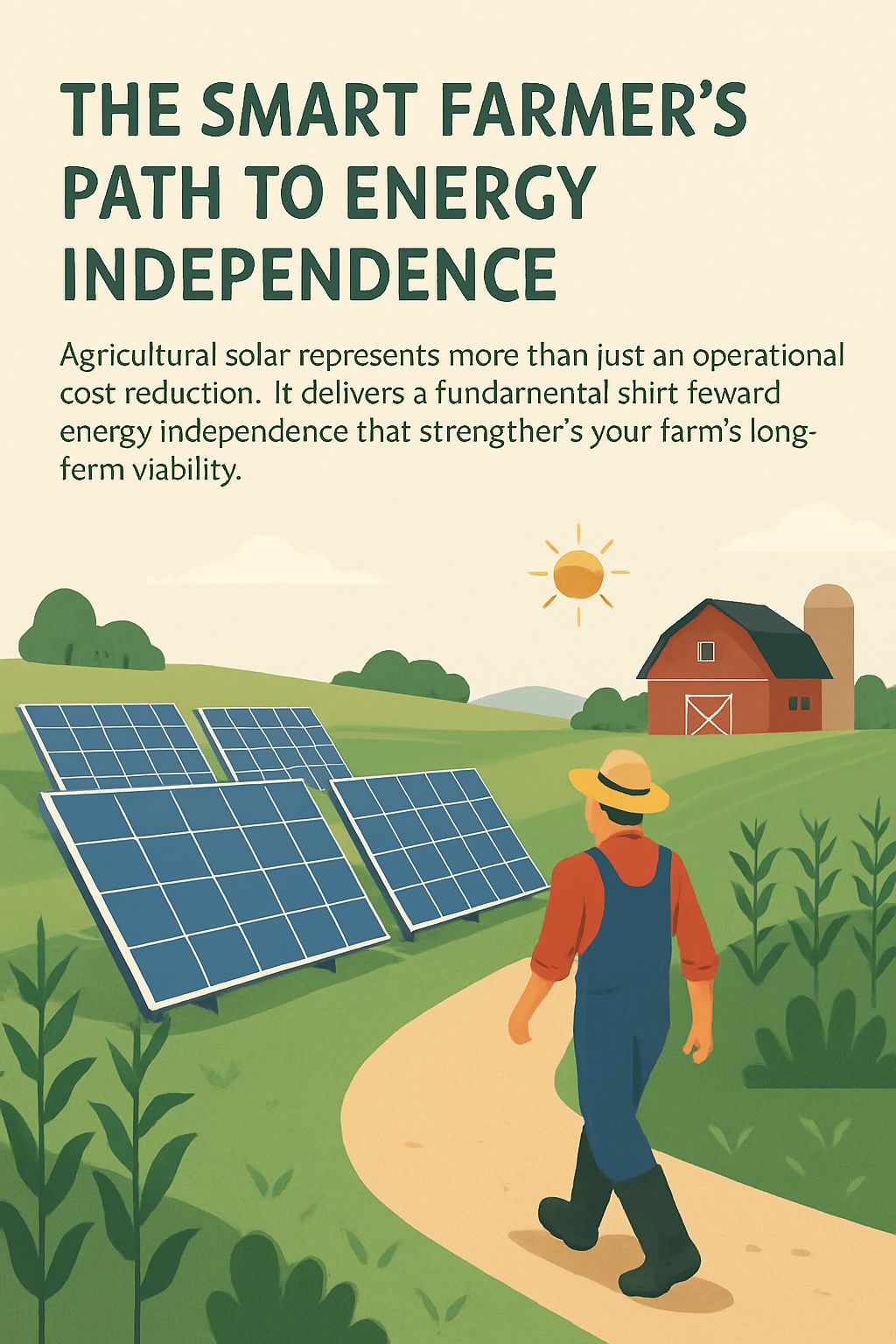
Agricultural solar represents more than just an operational cost reduction—it delivers a fundamental shift toward energy independence that strengthens your farm’s long-term viability. By generating your own electricity on-site, you gain protection from utility rate fluctuations, grid reliability issues, and energy market disruptions that have increasingly impacted agricultural operations nationwide.
This energy autonomy provides a competitive advantage that becomes increasingly valuable as traditional energy costs continue rising. Farms with established solar infrastructure effectively lock in electricity costs for decades, creating predictability that improves long-term planning and investment decisions across all aspects of your operation. For multi-generational family farms, solar installations represent an investment in continued operational viability that benefits current and future farm operators while demonstrating commitment to sustainable agricultural practices that increasingly influence market access and product pricing.
Frequently Asked Questions
- What’s the minimum farm size needed to benefit from solar power?
- How does solar affect my property insurance and taxes?
- Can I phase my solar implementation over multiple years?
- What happens with excess power my farm doesn’t use?
- How do solar panels affect aerial spraying operations?
While solar installations benefit farms of all sizes, system economics improve with scale and higher electricity consumption. Operations spending at least $300-500 monthly on electricity typically find compelling financial returns from appropriately sized solar systems. Smaller operations can still benefit, particularly when targeting specific high-consumption activities or utilizing specialized agricultural grant programs designed for small producers.
Insurance considerations include adding the solar system to existing farm property policies, which typically increases premiums only marginally relative to the system value. Many insurers offer specific renewable energy coverage options designed for agricultural operations that provide comprehensive protection with minimal premium impact. Property tax implications vary significantly by location, with many states offering partial or complete exemptions for renewable energy improvements on agricultural properties.
Phased implementation approaches allow farms to spread capital investments across multiple tax years or growing seasons while gaining experience with solar operations. This strategy can be particularly effective when coordinating with equipment replacement schedules or facility expansions that create natural opportunities for solar integration.
How much land do I need to dedicate for a farm solar system?
Land requirements for ground-mounted agricultural solar systems average approximately 7-10 acres per megawatt of capacity, with most small to mid-sized farm installations requiring 0.5-2 acres total. Modern high-efficiency panels reduce space requirements compared to older systems, while strategic placement on marginal land, field borders, or dual-use configurations with grazing or shade-tolerant crops minimizes impact on productive acreage. Many farms avoid land-use concerns entirely by utilizing existing roof space on barns, equipment sheds, and other agricultural buildings, with these structures often providing ideal south-facing exposure without consuming any productive land.
Can I still qualify for farm subsidies if I install solar panels?
Installing solar panels typically does not impact eligibility for most agricultural subsidy programs, particularly when systems are installed on existing structures or non-cropland areas. USDA farm programs generally consider renewable energy systems as compatible with continued agricultural use, and in many cases, agricultural solar installations actually enhance eligibility for certain conservation and sustainability-focused subsidy programs. For ground-mounted systems on previously farmed land, specific regulations apply regarding classification of that acreage, but proper system siting and documentation minimize any potential subsidy impacts. Learn more about how solar panels help farmers in various ways.
What maintenance costs should I expect for agricultural solar panels?
Agricultural solar systems require minimal maintenance, with annual costs typically averaging 0.5-1% of the initial system cost. Standard maintenance includes periodic panel cleaning (particularly important in dusty farming environments), annual electrical inspections, and monitoring system checks. Most agricultural systems include remote monitoring capabilities that provide real-time production data and automatic alerts for any performance issues, minimizing the need for regular physical inspections.
The primary components (panels and mounting structures) have no moving parts and rarely require attention beyond occasional cleaning. Inverters represent the most maintenance-intensive component, typically requiring replacement after 12-15 years at a cost of approximately 10% of the original system investment. Many agricultural solar installations include this anticipated expense in their financial projections to ensure accurate lifetime cost calculations.
For ground-mounted systems, vegetation management represents an ongoing maintenance requirement, though many farmers address this efficiently by grazing sheep or other livestock beneath and around the arrays—a practice that provides both maintenance benefits and continued agricultural productivity from the same land. To explore more about enhancing sustainability on farms, visit 8MSolar.
“Maintenance has been minimal for our 200kW system. We clean the panels twice yearly during our regular facility maintenance schedule, and the monitoring system handles everything else. In five years, our only unplanned expense was replacing a minor component after a lightning strike, which was covered by insurance.”
– Carlos Mendez, Almond grower
How do extreme weather conditions affect the performance of farm solar systems?
Modern agricultural solar installations are engineered to withstand challenging farm environments including high winds, hail, snow loads, and temperature extremes. Systems designed for agricultural applications typically include:
- Wind ratings of 120+ mph for ground-mounted systems
- Impact-resistant panels tested with 1″ hail at terminal velocity
- Heavy-duty mounting systems designed for agricultural environments
- Temperature performance ratings from -40°F to 185°F
- Enhanced lightning protection systems
Agricultural solar systems are designed specifically to withstand the environmental challenges common to farm operations. Quality installations include engineering considerations for local weather conditions including wind loads, snow accumulation, and temperature extremes. Most agricultural systems maintain 95%+ of their rated production capacity even during challenging weather conditions, with automatic safety systems that protect components during extreme events.
Snow typically clears naturally from properly angled panels within 24-48 hours as dark panel surfaces absorb available solar radiation, though production is reduced during accumulation periods. High temperatures reduce panel efficiency slightly (approximately 0.5% per degree above 77°F), but this impact is already factored into production estimates for properly designed agricultural systems.
Weather-related production variability is mitigated through accurate system sizing that accounts for seasonal patterns specific to your location. Properly designed agricultural systems include production buffers that ensure financial projections remain valid even during years with less-than-ideal weather conditions.
Can I combine solar panels with other renewable energy systems on my farm?
Agricultural operations often benefit from integrated renewable energy approaches that combine multiple technologies to address diverse farm energy needs. Solar-wind hybrid systems provide complementary generation patterns that reduce variability and increase self-consumption percentages. Biomass systems utilizing agricultural waste can provide heating capabilities that complement solar’s electricity generation, creating comprehensive energy solutions for operations with diverse requirements.
Battery storage systems have become increasingly cost-effective additions to agricultural solar installations, allowing farms to store excess daytime production for evening use or backup power during grid outages. These systems provide particular value for livestock operations requiring uninterrupted power for ventilation, irrigation systems with time-specific watering requirements, or processing facilities with evening operations.
Integrated system approaches qualify for many of the same incentive programs as standalone solar while often delivering superior economics through more complete energy independence. Working with agricultural energy specialists experienced in these comprehensive approaches ensures optimal system integration and maximum financial benefit across all your farm’s energy needs.
For any agricultural operation looking to control costs, improve resilience, and position for long-term success, solar energy represents one of the most compelling investments available in today’s challenging farm economy. With proper planning, appropriate system design, and strategic utilization of available incentives, agricultural solar installations deliver financial returns few other farm improvements can match. 8M Solar specializes in helping farmers develop customized solar solutions that address their specific operational needs while maximizing financial returns and sustainability benefits.


Leave a Reply