
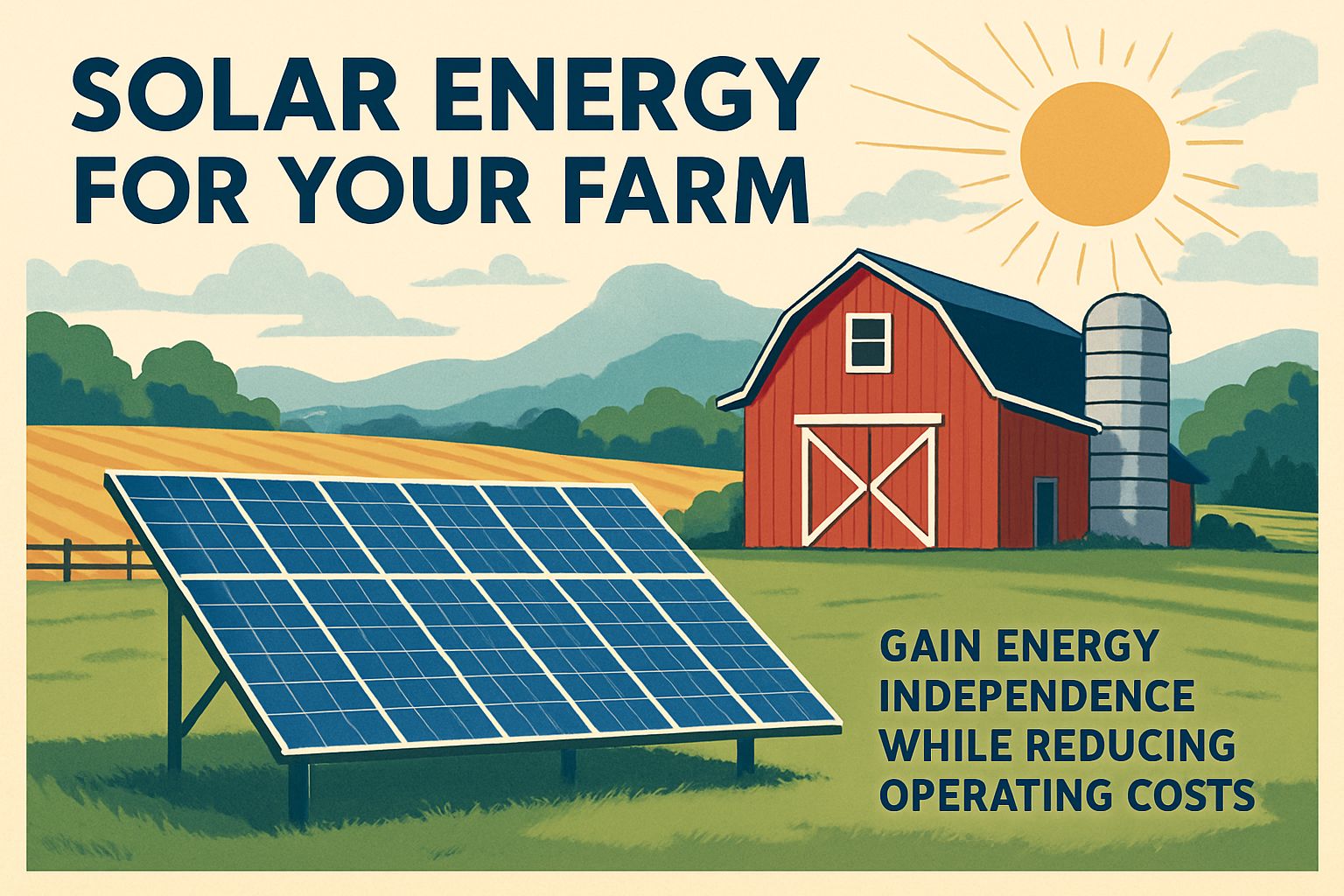
“Best Solar Panel Types for Farms …” from growingsolarmist.com and used with no modifications.
Article-At-A-Glance
- Solar panel systems can reduce farm operating costs by up to 90%, providing significant long-term savings against rising energy prices
- Modern agricultural solar installations can be mounted on rooftops, ground mounts, or even floating arrays, preserving valuable farmland
- Federal incentives currently offer a 30% tax credit for farm solar installations, with USDA REAP grants covering up to an additional 25% of system costs
- Solar battery storage systems ensure continuous power for critical farm operations like irrigation and climate control during outages
- Farm-scale solar systems typically achieve complete return on investment in 5-10 years while providing 25+ years of operational benefits
Rising energy costs are eating into farm profits nationwide. I’ve seen firsthand how power bills have become one of the biggest operating expenses for modern agricultural operations, often second only to labor. With electricity rates increasing by an average of 3-5% annually, farmers need sustainable solutions to secure their long-term financial viability. Solar energy systems offer precisely that opportunity.
Solar panels for farms provide a unique opportunity to slash operational costs while making your agricultural business more sustainable and resilient. Through agricultural solar power systems, farmers are taking control of their energy production and establishing predictable costs for decades to come. This fundamental shift in energy sourcing represents one of the smartest financial moves available to farm operators today.
Whether you’re running a dairy operation with significant refrigeration needs, a poultry farm requiring constant climate control, or crop production with substantial irrigation demands, agricultural solar installations can be tailored to your specific energy profile. Let’s explore exactly how these systems can transform your farm’s financial outlook.
Farm Energy Bills Are Skyrocketing – Here’s How Solar Saves Thousands
Agricultural operations face unique energy challenges that have grown more severe in recent years. Dairy farms require consistent power for milk cooling and processing. Livestock operations need reliable electricity for ventilation, lighting, and automated feeding systems. Crop producers depend on energy for irrigation pumps, processing equipment, and cold storage facilities. These essential functions create substantial and often unpredictable energy costs that directly impact a farm’s bottom line.
The financial math behind farm solar is compelling. A typical mid-sized farming operation might spend $25,000 to $50,000 annually on electricity. By investing in an appropriately sized solar system, that same farm could eliminate 70-90% of those costs. Over the 25+ year lifespan of quality solar panels, this represents $437,500 to $1,125,000 in operational savings (accounting for inflation in energy costs). This calculation doesn’t even include the substantial tax benefits and incentives currently available to agricultural producers.
Beyond direct cost savings, farm solar systems provide price certainty in an increasingly volatile energy market. Unlike traditional utility power, which fluctuates with fuel prices and infrastructure costs, solar generation costs remain fixed after installation. This predictability allows for more accurate long-term financial planning and budgeting for agricultural businesses, reducing exposure to market volatility that can devastate farm profitability during critical production periods.
How Solar Power Works Specifically for Farms
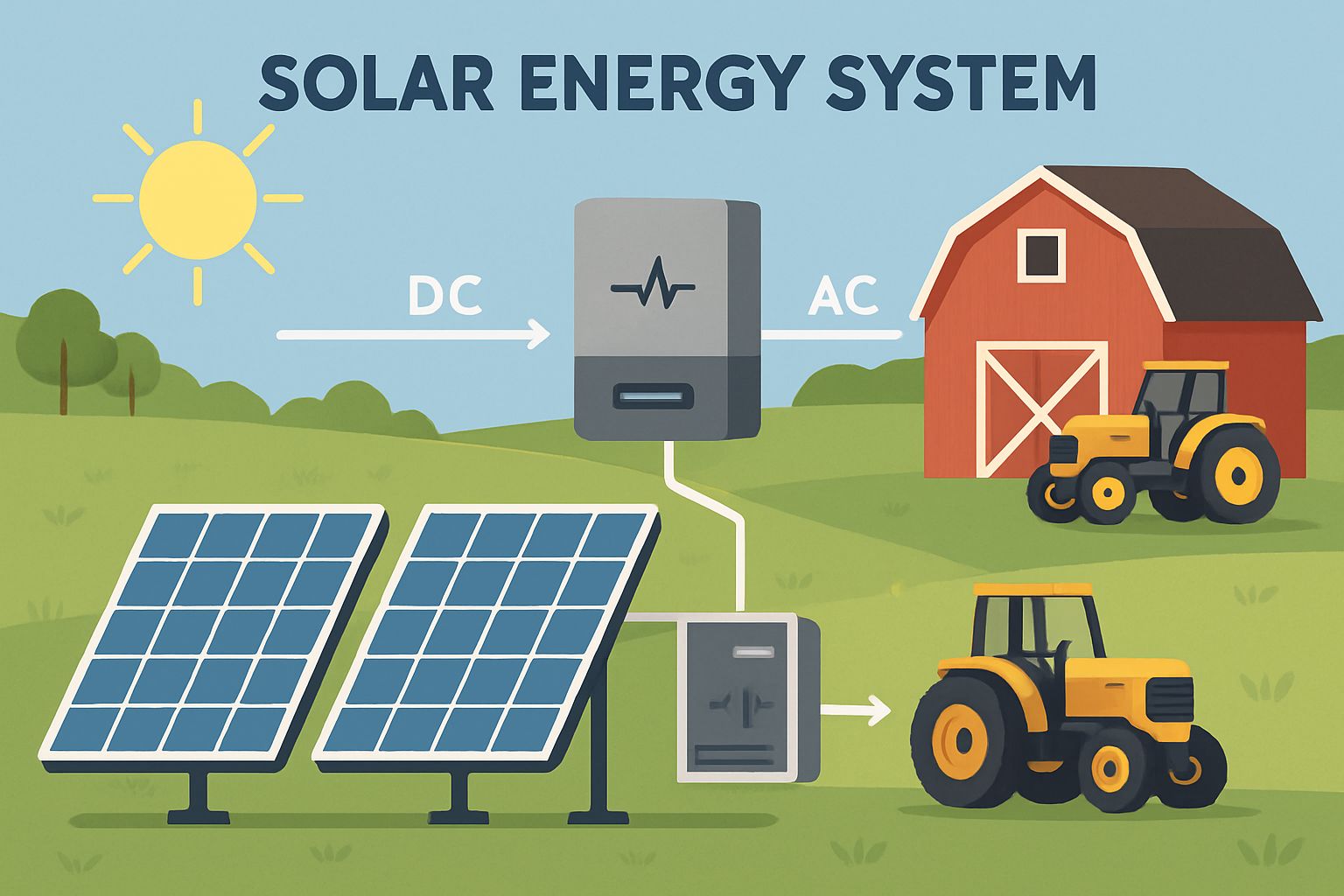
Solar energy systems convert sunlight into electricity through photovoltaic panels, which can be strategically placed throughout your farm property. These panels generate direct current (DC) electricity that inverters convert to alternating current (AC) for use in powering farm equipment. The system integrates with your existing electrical infrastructure, ensuring seamless operation of everything from water pumps to barn lighting. Modern agricultural solar installations are specifically engineered to withstand harsh farming environments, including dust, extreme temperatures, and exposure to agricultural chemicals. Learn more about agricultural solar energy and its benefits for farmers.
Off-Grid vs. Grid-Tied Systems for Agricultural Applications
Farm operations can choose between two primary solar system configurations based on their specific needs. Grid-tied systems remain connected to the utility network, allowing excess solar production to be fed back to the grid (often generating credits through net metering programs). These systems typically offer the fastest return on investment but don’t provide power during utility outages unless paired with battery storage.
Off-grid systems operate independently from utility infrastructure, making them ideal for remote agricultural operations or areas with unreliable power service. These systems require battery storage to maintain consistent power availability but offer complete energy independence. Hybrid systems combine both approaches, maintaining utility connections while incorporating battery backup to ensure critical farm functions remain operational during outages. The optimal configuration depends on your farm’s location, operational requirements, and financial objectives.
Solar Panel Placement Options: Rooftop, Ground-Mount, and Floating Arrays
Agricultural solar installations offer exceptional flexibility in placement to maximize both energy production and land utilization. Rooftop systems installed on existing barns, equipment sheds, and processing facilities preserve valuable farmland while utilizing otherwise unused space. These installations typically require minimal structural modifications for modern agricultural buildings designed to support snow loads.
Ground-mounted arrays can be strategically positioned to optimize solar exposure while minimizing impact on productive land. Modern agricultural solar installations increasingly incorporate agrivoltaics—the practice of farming beneath elevated solar panels. This approach allows for continued agricultural production (particularly for shade-tolerant crops) while simultaneously generating electricity above. The dual-use approach can actually increase overall land productivity in certain applications.
“We installed a 150kW ground-mounted system that takes up less than half an acre but produces enough electricity to offset our entire dairy operation’s energy needs. The panels are elevated enough that we can still graze sheep beneath them, effectively using the same land twice.” — James Wilson, Dairy Farmer, Wisconsin
Floating solar arrays represent an emerging option for farms with irrigation ponds, water retention basins, or aquaculture operations. These systems mount panels on floating platforms, utilizing water surface area while reducing evaporation and algae growth. The water provides natural cooling that increases panel efficiency by 5-10% compared to land-based installations. For farms with substantial water features, floating arrays offer a compelling way to generate power without impacting arable land.
Key Farm Equipment You Can Power With Solar Energy
Agricultural solar systems can power virtually all electrical equipment found on modern farms. Irrigation systems, which often represent the largest energy expense for crop producers, operate efficiently on solar power—especially when paired with variable frequency drive pumps that adjust to available solar production. Cold storage facilities and refrigeration equipment for dairy operations can similarly transition to solar power, often with minimal modifications.
Ventilation systems, critical for livestock operations, adapt particularly well to solar power generation patterns. Barns typically require maximum ventilation during daylight hours when solar production peaks naturally. Grain drying operations, processing equipment, and workshop tools all operate effectively on solar power, requiring only standard electrical connections to the farm’s solar system. Even electric tractors and farm vehicles can be charged using on-site solar generation, further reducing operational costs.
- Irrigation pumps and water distribution systems
- Milk cooling and processing equipment
- Ventilation and climate control systems
- Grain drying and processing machinery
- Cold storage and refrigeration units
- Workshop equipment and electric farm vehicles
- Automated feeding systems and livestock monitoring
- Security lighting and monitoring systems
Farm solar systems are typically designed to accommodate seasonal variations in both energy production and agricultural requirements. For operations with predictable seasonal demand patterns, solar arrays can be sized and oriented to maximize production during peak usage periods. This strategic approach ensures optimal system economics while meeting the farm’s operational needs throughout the growing season.
5 Ways Solar Panels Cut Farm Operating Costs
When evaluating solar energy for your farm, it’s important to understand the multiple avenues through which these systems deliver financial benefits. The savings extend far beyond simply reducing your monthly utility bill, though that’s certainly a major advantage. Let’s explore the five primary financial benefits that make agricultural solar installations such compelling investments for modern farm operations.
1. Eliminate or Drastically Reduce Monthly Electricity Bills
The most immediate and obvious benefit of farm solar installations is the dramatic reduction in monthly electricity expenses. A properly sized system can eliminate 70-100% of your farm’s utility bills, depending on your energy consumption patterns and solar production capacity. For a dairy operation consuming 150,000 kWh annually at $0.14/kWh, this represents potential savings of $21,000 per year. These savings begin immediately upon system commissioning and continue throughout the 25+ year operational lifespan of the equipment.
What makes these savings particularly valuable is their predictability. Unlike traditional power sources with constantly fluctuating rates, your solar-generated electricity maintains a fixed cost over time, effectively locking in your energy expenses for decades. This predictability allows for more accurate budgeting and improved financial planning across your entire agricultural operation.
2. Protection Against Rising Utility Rates
Utility electricity rates have historically increased at an average of 3-5% annually, far outpacing general inflation. This trajectory means a farm paying $30,000 annually for electricity today could face bills exceeding $70,000 yearly in just 20 years. Solar installations provide essential insulation against these escalating costs, effectively freezing a significant portion of your energy expenses at current levels.
This protection becomes increasingly valuable over time as the gap between utility rates and your fixed solar production cost widens. In essence, each kilowatt-hour generated by your solar array becomes more valuable every year as utility alternatives become progressively more expensive. For agricultural operations with high electricity demands and multi-decade planning horizons, this inflation protection represents one of solar’s most significant long-term financial benefits.
3. Income Generation Through Excess Energy Sales
Many agricultural solar installations produce excess energy during peak production periods, particularly during summer months when daylight hours are extended. Through net metering programs available in most states, this surplus electricity can be fed back to the grid, generating credits or direct payments from your utility company. Some farms effectively transform their operations into small power plants, creating a new revenue stream that complements their agricultural production.
For operations with substantial land availability, larger solar installations can be developed specifically as income-generating assets through Power Purchase Agreements (PPAs) with utilities. These arrangements provide guaranteed income for 15-25 years, diversifying farm revenue sources and improving financial resilience. The dual-use nature of agrivoltaic installations further enhances this benefit by maintaining agricultural productivity while simultaneously generating electricity income.
4. Reduced Maintenance Costs Compared to Diesel Generators
Many farms rely on diesel generators for backup power or to operate equipment in remote locations. These generators require regular maintenance, fuel delivery, and eventual replacement—all representing substantial ongoing costs. Solar systems with battery storage can replace these generators, eliminating fuel expenses and drastically reducing maintenance requirements.
Modern solar installations require minimal maintenance, typically limited to occasional panel cleaning and routine inverter inspections. With no moving parts in the panels themselves, these systems offer exceptional reliability with maintenance costs averaging just $0.01-0.02 per watt annually. Compared to diesel generators costing $0.30-0.50 per kWh to operate (including fuel, maintenance, and depreciation), solar provides dramatically lower lifetime operating expenses.
5. Lower Water Pumping and Irrigation Expenses
Irrigation represents one of the largest energy expenses for many agricultural operations. Solar-powered pumping systems can dramatically reduce these costs by operating pumps directly from solar generation without requiring battery storage. Direct DC pumping systems prove especially efficient, eliminating the conversion losses associated with traditional AC pumps.
Beyond direct energy savings, solar irrigation systems offer improved water management capabilities through smart controllers that optimize irrigation scheduling based on available solar production. This integration can reduce water usage by 15-30% while simultaneously decreasing energy consumption. For farms in drought-prone regions facing both water restrictions and high electricity costs, solar irrigation provides a dual solution to these interconnected challenges.

“Solar Panels Save Farmers Energy Costs …” from growingsolarmist.com and used with no modifications.
Real Cost Savings: Farm Solar Case Studies
Real-world examples provide compelling evidence of solar’s financial impact on agricultural operations across diverse farming sectors. These case studies demonstrate how thoughtfully designed systems deliver substantial returns on investment while improving operational resilience. The experiences of these pioneering agricultural producers offer valuable insights for farmers considering similar investments. For more information on the financial benefits of solar panels in farming operations, explore our detailed guide.
Dairy Farm Saves $25,000 Annually on Milk Cooling
Hillcrest Dairy in California installed a 200kW solar array specifically sized to address their substantial refrigeration load for milk cooling. The system offsets approximately 310,000 kWh of annual electricity consumption, representing 85% of their total usage. With California’s high utility rates averaging $0.18/kWh for agricultural customers, this production translates to approximately $55,800 in first-year savings. After accounting for the investment cost (reduced by tax incentives and USDA grants), the system achieved complete payback in just 4.5 years. Discover more about the financial benefits of solar panels for farmers.
Beyond the direct electricity savings, Hillcrest reports improved milk quality due to more consistent cooling even during summer heat waves that previously strained the local utility grid. The system’s battery backup component ensures uninterrupted power for critical cooling functions during outages, preventing potential milk spoilage that could cost thousands in lost product. This operational resilience represents an additional financial benefit beyond the direct utility savings.
Poultry Operation Cuts HVAC Costs by 70%
Eagle Creek Farms, a poultry operation in North Carolina with six large production houses, installed a 350kW solar array with battery backup to address their substantial climate control energy consumption. The system reduced their annual electricity expenses from $72,000 to approximately $21,600—a 70% reduction that significantly improved their profit margins in an industry with tight operational economics. The battery component ensures ventilation systems remain operational during grid outages, preventing catastrophic bird loss events that had previously threatened their business viability.
What makes this case particularly instructive is how the farm integrated solar production with their operational patterns. They adjusted feeding schedules to coincide with peak solar production hours, installed energy-efficient ventilation equipment that operates effectively at variable power levels, and implemented thermal mass solutions that reduce overnight heating requirements. These operational adaptations maximize the financial benefits of their solar investment while improving production conditions.
Tax Incentives and Grants Make Solar More Affordable
The financial case for agricultural solar installations becomes even more compelling when accounting for the substantial incentives currently available to farm operations. These programs dramatically reduce the effective cost of solar installations, improving return on investment and shortening payback periods. Understanding and leveraging these incentives is critical to maximizing the financial benefits of farm solar systems.
The combined impact of these incentives can reduce the effective cost of agricultural solar installations by 50-65%, transforming the economics from merely attractive to exceptionally compelling. For farm operations with substantial tax liabilities and strong credit profiles, these incentives make solar one of the highest-return investments available in today’s agricultural landscape. Timing considerations are important, however, as some incentives are scheduled for reduction in coming years.
Federal Tax Credits That Reduce Installation Costs by 30%
The Investment Tax Credit (ITC) represents the most significant financial incentive for farm solar adoption. Currently set at 30% through 2032, this federal tax credit allows farm businesses to deduct nearly one-third of their solar installation costs directly from their federal tax liability. Unlike deductions that merely reduce taxable income, this credit provides a dollar-for-dollar reduction in taxes owed. For a $200,000 solar installation, this represents an immediate $60,000 in tax savings in the first year.
To qualify for the full ITC benefit, farm operations must have sufficient tax liability to utilize the credit. However, the credit can be carried forward for up to 20 years if your current tax liability doesn’t allow for immediate full utilization. This extended availability ensures farms can capture the full benefit regardless of year-to-year variations in profitability. Construction must begin before the credit steps down to 26% in 2033, making action within the current timeframe particularly advantageous. For more insights on solar energy benefits for farms, check out this agricultural solar energy guide.
USDA REAP Grants Can Cover Up to 25% of System Costs
The Rural Energy for America Program (REAP) provides agricultural producers with grants covering up to 25% of renewable energy system costs. These grants don’t require repayment and can be combined with tax credits to dramatically reduce out-of-pocket expenses. REAP funding is competitive, with applications evaluated on technical merit, financial need, and environmental benefits. Successful applications typically demonstrate how solar investments improve farm viability while advancing rural energy independence.
REAP also offers guaranteed loan programs that can finance up to 75% of project costs with favorable terms and interest rates. When combined with grants and tax incentives, these loan guarantees can enable farm operations to install solar systems with minimal initial capital investment. The application process requires detailed energy audits and project proposals, making partnership with experienced agricultural solar developers particularly valuable for accessing these funds.
State-Specific Agricultural Solar Incentives
Beyond federal programs, many states offer additional incentives specifically targeted at agricultural producers adopting solar technology. California’s Net Energy Metering Aggregation (NEMA) program allows farms to install solar arrays on non-productive land while applying credits to multiple meters across their property. New York’s NY-Sun program provides performance-based incentives that can exceed $0.40/watt for qualifying agricultural installations. Minnesota’s Renewable Energy Production Incentive pays agricultural producers $0.13/kWh for solar electricity generated over 10 years. For more information on how solar energy can benefit farmers, check out this article on solar storage for farmers.
State agricultural departments frequently offer additional grants specifically targeting on-farm renewable energy. These programs typically focus on smaller installations and may have simplified application processes compared to federal programs. Check with your state’s energy office and department of agriculture for programs that might complement federal incentives, potentially stacking multiple benefits for maximum financial advantage. To understand more about these financial benefits, explore the solar panels financial benefits for farmers’ operations.
Accelerated Depreciation Benefits for Farm Businesses
Agricultural businesses can utilize Modified Accelerated Cost Recovery System (MACRS) depreciation for solar assets, allowing for recovery of system costs through accelerated depreciation deductions over just 5 years. This accelerated schedule significantly improves project cash flow compared to standard depreciation methods. When combined with 100% bonus depreciation (available through 2022, with phased reductions through 2026), farms can potentially deduct the entire cost basis of solar installations in the first year of service after accounting for the 30% ITC.
The tax savings from depreciation benefits can be substantial, effectively reducing the net system cost by an additional 15-30% depending on your tax bracket and business structure. For agricultural operations structured as pass-through entities, these depreciation benefits flow directly to owners’ personal tax returns, potentially offsetting income from both farm and off-farm sources. Consultation with a tax professional familiar with agricultural businesses and renewable energy incentives is essential to maximize these benefits.
Solar Battery Storage Options for Farms
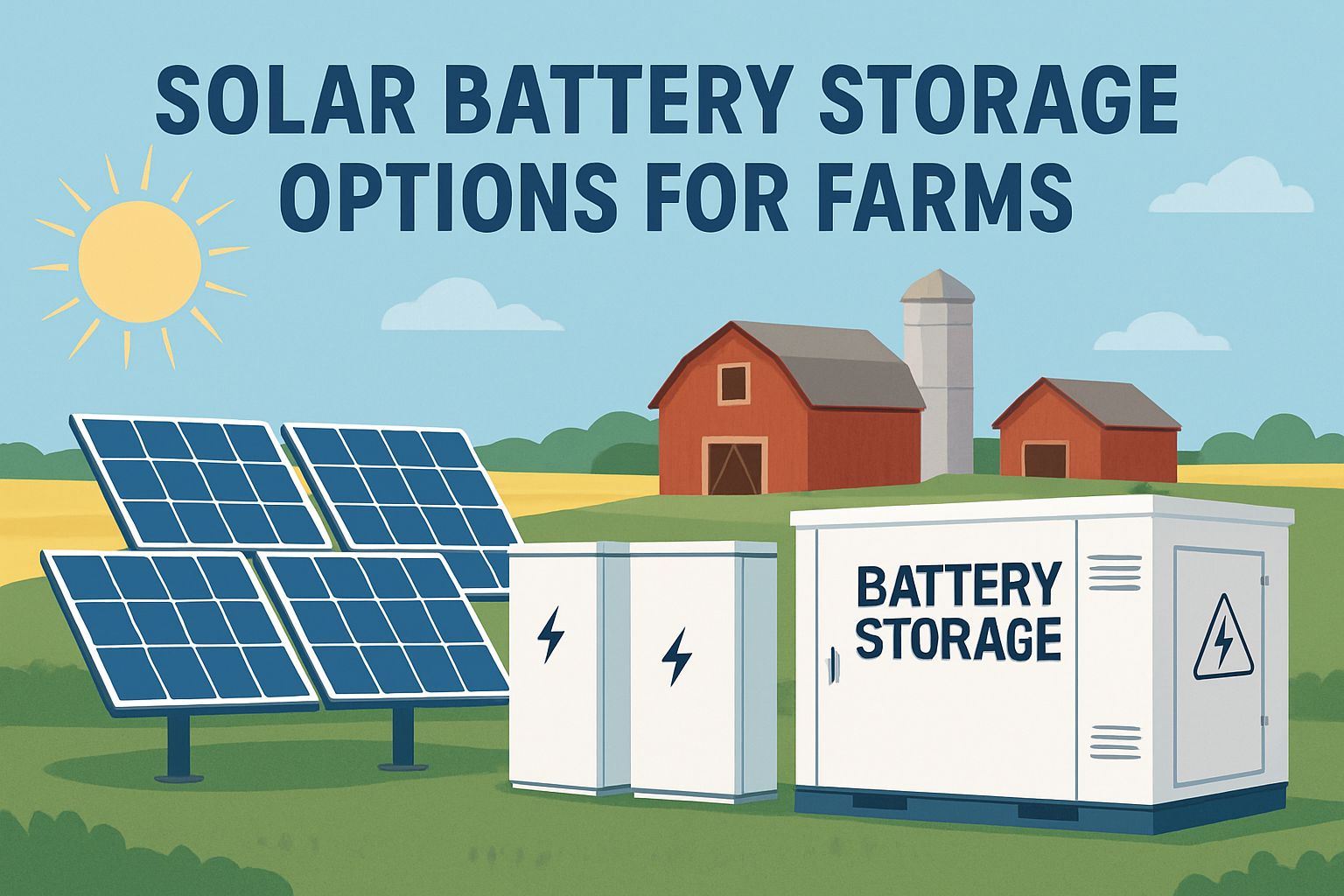
Modern agricultural operations increasingly incorporate battery storage alongside solar panels to maximize both financial returns and operational resilience. Battery systems capture excess daytime solar production for use during evening hours or cloudy days, effectively extending the usability of solar-generated electricity. For farms with time-of-use utility rates, batteries can provide substantial additional savings by avoiding peak-rate grid electricity during high-demand periods.
The economics of battery storage have improved dramatically in recent years, with costs declining by over 85% in the past decade. Today’s agricultural battery systems typically add $400-700/kWh of capacity to system costs, with this investment often delivering 10-15% additional utility savings beyond solar panels alone. For operations with critical power needs that cannot tolerate interruptions, the operational security provided by battery backup represents an essential risk management tool.
Why Battery Storage Is Critical for Farm Operations
Agricultural processes often require uninterrupted power to maintain product quality and animal welfare. Dairy operations face potential catastrophic losses if bulk tank cooling fails for extended periods. Poultry and swine facilities require continuous ventilation to prevent heat stress and maintain appropriate ammonia levels. Irrigation systems interruptions during critical growth periods can significantly impact crop yields. Battery storage provides essential backup power for these critical functions during grid outages.
Beyond emergency backup, batteries enable farms to optimize their energy usage patterns to maximize financial returns. By storing excess midday solar production for use during evening peak rate periods, batteries can effectively arbitrage electricity prices. For operations with demand charges based on peak usage, batteries can discharge during anticipated peak periods, shaving these expensive demand spikes and reducing overall energy costs by 15-25% beyond solar savings alone.
Battery Sizing Based on Your Farm’s Energy Patterns
Proper battery sizing requires detailed analysis of your farm’s specific energy consumption patterns. Livestock operations typically benefit from larger battery systems sized to maintain critical life-support systems for 24-48 hours during outages. Crop producers might focus on smaller systems designed primarily for irrigation pump backup during critical growth periods. Processing facilities often require medium-sized systems that bridge shorter outages while allowing for orderly shutdown procedures during extended interruptions.
Modern lithium-ion batteries typically provide 5,000-8,000 discharge cycles, representing 10-15 years of useful life in agricultural applications. Emerging technologies like flow batteries offer longer operational lifespans (potentially 20+ years) with unlimited cycles, though at higher initial costs. For farms with significant seasonal variation in energy requirements, modular battery solutions provide flexibility to adapt storage capacity throughout the year, maximizing system economics while ensuring sufficient capacity during critical periods.
Your Solar Investment Returns: Breaking Down the Numbers
Agricultural solar investments deliver returns through multiple financial mechanisms: direct energy savings, tax benefits, potential income from excess production, and long-term appreciation of property values. When properly structured, these combined benefits typically deliver internal rates of return exceeding 15-20%—far outperforming most alternative farm investments. The combination of immediate tax benefits, steady annual savings, and long-term inflation protection creates a uniquely advantageous financial profile.
Most importantly, agricultural solar investments provide exceptional certainty compared to other farm capital expenditures. While equipment purchases face unpredictable maintenance costs and market-dependent utilization rates, solar systems deliver highly predictable returns throughout their operational lifespan. This certainty proves particularly valuable in agricultural settings where weather variability, market fluctuations, and policy changes create significant financial uncertainty in other aspects of operation.
Average Payback Period for Farm Solar Systems
When accounting for all available incentives, typical farm solar installations achieve complete payback in 5-10 years depending on local electricity rates, system design, and available incentives. Dairy operations and other electricity-intensive farming sectors typically experience the shortest payback periods due to their high consistent energy usage patterns. After this initial payback period, the systems continue generating essentially free electricity for an additional 15-20+ years, representing pure profit that significantly improves long-term farm viability.
Long-Term ROI Calculation Method
Calculating solar ROI requires consideration of several factors beyond simple payback period. A comprehensive analysis includes the net present value (NPV) of future energy savings, factoring in electricity price inflation (historically 3-5% annually), system performance degradation (typically 0.5-0.7% annually), maintenance costs (averaging 0.5% of system cost annually), and appropriate discount rates reflecting your farm’s cost of capital. When properly modeled, these calculations typically demonstrate that solar investments deliver returns 2-3 times greater than their initial costs over their operational lifetime.
Energy Cost Comparison: Before and After Solar
The direct financial impact of solar adoption becomes clear when comparing pre- and post-installation energy economics. A 100-acre irrigation-intensive vegetable operation might face annual electricity costs of $36,000 ($0.14/kWh for 257,000 kWh) before solar installation. With an appropriately sized 150kW solar array producing approximately 230,000 kWh annually, their utility purchases would drop to roughly 27,000 kWh annually, reducing utility expenses to just $3,780—a 90% reduction in out-of-pocket energy costs.
“Our 200kW solar system reduced our annual electricity expenses from $43,200 to just $5,400 in the first year. Over the 25-year warranty period, we’ll save over $1.2 million in electricity costs from an initial investment of $390,000, which was reduced to $185,000 after incentives. No other farm investment delivers that kind of guaranteed return.” — Robert Martinez, Almond Grower, California
This direct utility savings represents only part of the financial benefit. When accounting for the 30% federal tax credit ($117,000), accelerated depreciation benefits (approximately $80,000 in tax savings), and potential REAP grant funding ($97,500), the net system cost drops to approximately $95,500. Against annual savings of $32,220, this results in a simple payback period of just under 3 years and a 25-year return on investment exceeding 800% before accounting for electricity price inflation that will make future savings even more valuable.
Beyond these quantifiable returns, agricultural solar installations deliver additional benefits that, while harder to monetize, provide real economic value: reduced exposure to energy price volatility, enhanced operational resilience during grid disturbances, potential marketing advantages from sustainable production practices, and reduced carbon footprint that may become increasingly valuable as carbon markets develop and consumer preferences evolve.
Take Action Now to Slash Your Farm Energy Costs with Solar Panels
The economic case for agricultural solar has never been stronger than it is today. With the 30% federal tax credit secured through 2032, USDA REAP grants readily available, and electricity prices continuing to rise, farms that act decisively stand to gain significant competitive advantages through reduced operating costs and improved energy security. The first step is conducting a detailed energy audit to understand your consumption patterns and identify the optimal system configuration for your specific agricultural operation.
Frequently Asked Questions
As you evaluate solar energy for your farm operation, several common questions arise regarding system performance, economics, and implementation. These answers address the most frequent concerns raised by agricultural producers considering solar investments. Each farm’s situation will have unique considerations, but these responses provide a starting framework for your evaluation process.
Remember that consulting with agricultural solar specialists familiar with farm operations provides the most accurate guidance for your specific situation. Many reputable providers offer free initial consultations and preliminary system designs that can help clarify the potential benefits for your particular agricultural enterprise. For more insights, explore the financial benefits of solar panels for farmers.
How long do solar panels last on a farm property?
Modern agricultural solar installations typically carry 25-year manufacturer warranties guaranteeing at least 85% of original production capacity at the warranty’s end. In practice, quality panels often exceed these guarantees, with many installations continuing to produce at 80-85% of their original capacity even after 30-35 years. The actual functional lifespan frequently extends well beyond warranty periods, particularly for premium panel brands specifically designed for agricultural environments.
- Performance warranties typically guarantee 97-98% production in year one, declining by 0.5-0.7% annually thereafter
- Inverters generally carry 10-15 year warranties, with replacements representing the primary system maintenance expense
- Mounting hardware and racking systems typically carry 20-25 year structural warranties
- Battery storage components usually include 10-year warranties with defined cycle limitations
The extended operational lifespan of solar equipment creates exceptional long-term value, with many agricultural installations continuing to generate substantial electricity savings decades after achieving complete return on initial investment. This extended productive lifespan distinguishes solar from most other farm capital investments that typically require replacement after 10-15 years of service.
Will solar panels work during power outages on my farm?
Standard grid-tied solar systems without battery storage will shut down during utility outages for safety reasons, regardless of available sunlight. This automatic shutdown prevents potentially dangerous back-feeding of electricity into grid lines being repaired. However, solar systems paired with battery storage and appropriate transfer switches or microinverters can continue operating during outages, providing power to critical farm functions. These battery backup systems can be designed to power entire operations or configured to support only essential equipment like refrigeration, ventilation, or water pumping, depending on your backup power requirements and budget constraints.
Can I install solar panels myself to save on costs?
While DIY installation might seem appealing from a cost-saving perspective, agricultural solar systems require specialized expertise to ensure safety, performance, and eligibility for incentives. Most insurance policies and incentive programs require professional installation by licensed electricians and certified solar installers. Improper installation can void equipment warranties, create fire hazards, damage expensive components, and potentially disqualify your project from critical tax credits and grants that typically deliver far greater savings than those achieved through self-installation. The complexity of agricultural electrical systems, utility interconnection requirements, and structural engineering considerations for roof or ground-mounted arrays generally necessitates professional installation for systems beyond very small off-grid applications.
How do weather conditions affect farm solar production?
Solar production varies with weather conditions, but modern systems perform effectively even in less-than-ideal circumstances. Panels generate electricity whenever light reaches them, producing approximately 10-25% of their rated capacity during heavy overcast conditions and 50-80% during light cloud cover. System designs account for these variations using historical weather data specific to your location, ensuring appropriate sizing to meet your farm’s annual electricity requirements despite day-to-day fluctuations in production. For more insights, explore the top benefits of solar panels for farming.
- Snow typically clears from panels within 1-2 days due to their dark surface and tilt angle
- Rain actually improves performance by cleaning dust and debris from panel surfaces
- High temperatures slightly reduce panel efficiency (approximately 0.3-0.5% per degree above 77°F)
- Hail resistance is incorporated into modern panels, with most rated to withstand 1″ hailstones at terminal velocity
- Wind load calculations ensure mounting systems can withstand local maximum wind conditions
Agricultural solar installations are engineered specifically for rural environments, incorporating robust mounting systems, enhanced surge protection, and appropriate clearances to accommodate farm equipment and operations. These design considerations ensure reliable performance across all weather conditions typically encountered in agricultural settings, providing dependable electricity production throughout the growing season.
What maintenance do farm solar systems require?
Solar systems require minimal maintenance compared to other farm equipment, with no moving parts in the panels themselves. In most agricultural settings, natural rainfall provides adequate panel cleaning in all but the dustiest environments. For installations in very dusty areas or near pollen-intensive crops, occasional cleaning (1-2 times annually) using a simple water spray may improve production by 3-5%. System monitoring typically identifies any performance issues automatically, alerting you to potential maintenance needs before they impact production significantly.
Annual electrical inspections of connection points, inverters, and safety equipment represent best practice for agricultural installations. These inspections typically require just 1-2 hours of technician time and help ensure optimal system performance while identifying any developing issues before they lead to production losses. Battery systems require slightly more attention, with quarterly performance checks and potential electrolyte maintenance for certain battery chemistries, though modern lithium systems are essentially maintenance-free beyond monitoring.
The exceptional reliability and minimal maintenance requirements of solar systems represent significant advantages in agricultural settings where equipment maintenance already demands substantial time and attention. The simplicity and durability of properly designed solar installations allow farm operators to focus on their core agricultural activities while their energy systems quietly generate savings year after year with minimal intervention.


Leave a Reply