

Key Takeaways
- The One Big Beautiful Bill extends the 30% solar Investment Tax Credit (ITC) for agricultural operations, allowing farmers to significantly reduce installation costs.
- New direct pay options eliminate the need for tax liability to benefit, making solar accessible to more agricultural businesses.
- Farmers can choose between immediate write-offs and various depreciation schedules to maximize tax advantages for their specific situation.
- Agricultural operations can combine federal incentives with USDA grants and state-level programs for potential cost reductions exceeding 50%.
- Solar investments typically achieve complete payback within 4-7 years for farms, while providing 25+ years of energy savings.
Big Savings for Farmers: How the One Big Beautiful Bill Changes Solar Investment
The One Big Beautiful Bill has drastically shifted the renewable energy landscape for American farmers. After years of uncertainty about solar incentives, this comprehensive legislation establishes clear, long-term benefits that make solar investments more financially attractive than ever before. AgAmerica agricultural finance specialists confirm these changes represent a significant opportunity for farming operations looking to reduce operating costs while building energy independence.
For agricultural producers facing rising energy costs, the timing couldn’t be better. The new legislation addresses previous limitations that prevented many farmers from accessing solar incentives and introduces more flexible options for claiming benefits. What’s most remarkable is how the bill creates pathways for operations of every size and structure to participate—from small family farms to large agricultural corporations.
Understanding these changes now is crucial for maximizing your farm’s financial position in the coming years. With certain provisions set to phase out beginning in 2027, farmers who act sooner rather than later stand to gain the most substantial benefits from these historic incentives.
30% Tax Credit Extended for Agricultural Solar Projects
The cornerstone of the solar incentives package is the extension and enhancement of the Investment Tax Credit (ITC). Previously scheduled to decrease, the One Big Beautiful Bill firmly establishes a 30% tax credit for qualified solar energy systems installed on agricultural properties. This means farmers can immediately reduce their federal tax bill by nearly one-third of their solar investment costs—a substantial offset that dramatically improves project economics.
This extension provides certainty for agricultural operations planning capital investments. A 100-kilowatt system costing $200,000 would generate a $60,000 tax credit, directly reducing your federal tax liability dollar-for-dollar. Unlike tax deductions that only reduce taxable income, these credits represent actual dollars kept in your operation rather than paid to the IRS.
“Important tax provisions will help farmers save money that can be used to pay bills, invest in new technologies, and pass the family farm to the next generation.” – Zippy Duvall, President, American Farm Bureau Federation
New Direct Pay Options for Tax-Exempt Agricultural Organizations
One of the most innovative provisions in the legislation addresses a long-standing barrier for agricultural cooperatives, non-profit farming organizations, and farmers with limited tax liability. The new “direct pay” option essentially converts the tax credit into a cash grant, allowing entities with insufficient tax liability to receive the incentive as a direct payment rather than a credit against taxes owed.
For example, a newly established farm operation that hasn’t yet generated significant taxable income can still benefit from the full 30% incentive through this direct payment mechanism. Similarly, agricultural cooperatives organized as tax-exempt entities can now participate fully in solar incentive programs that were previously inaccessible. This fundamental shift makes renewable energy financially viable for a much broader segment of the agricultural community.
Faster Depreciation Schedules for Farm Solar Equipment
Beyond tax credits, the One Big Beautiful Bill enhances depreciation benefits for solar equipment, allowing farmers to recover their investment costs more quickly through tax deductions. Agricultural operations can now utilize a 5-year Modified Accelerated Cost Recovery System (MACRS) depreciation schedule for solar energy property, dramatically accelerating the tax benefits compared to typical farm improvements.
This accelerated depreciation, combined with 100% bonus depreciation options in the first year of service, creates powerful timing advantages for farm tax planning. Strategic farmers can effectively offset income during high-profit years by installing solar systems and claiming both the 30% ITC and significant depreciation deductions. The tax-saving combination often reduces the effective cost of solar installations by over 50% when all incentives are properly utilized.
For farms with seasonal cash flow patterns, these accelerated write-offs align perfectly with agricultural business cycles. The flexibility to time these substantial deductions provides a valuable tool for sophisticated tax planning that wasn’t previously available to most agricultural operations.
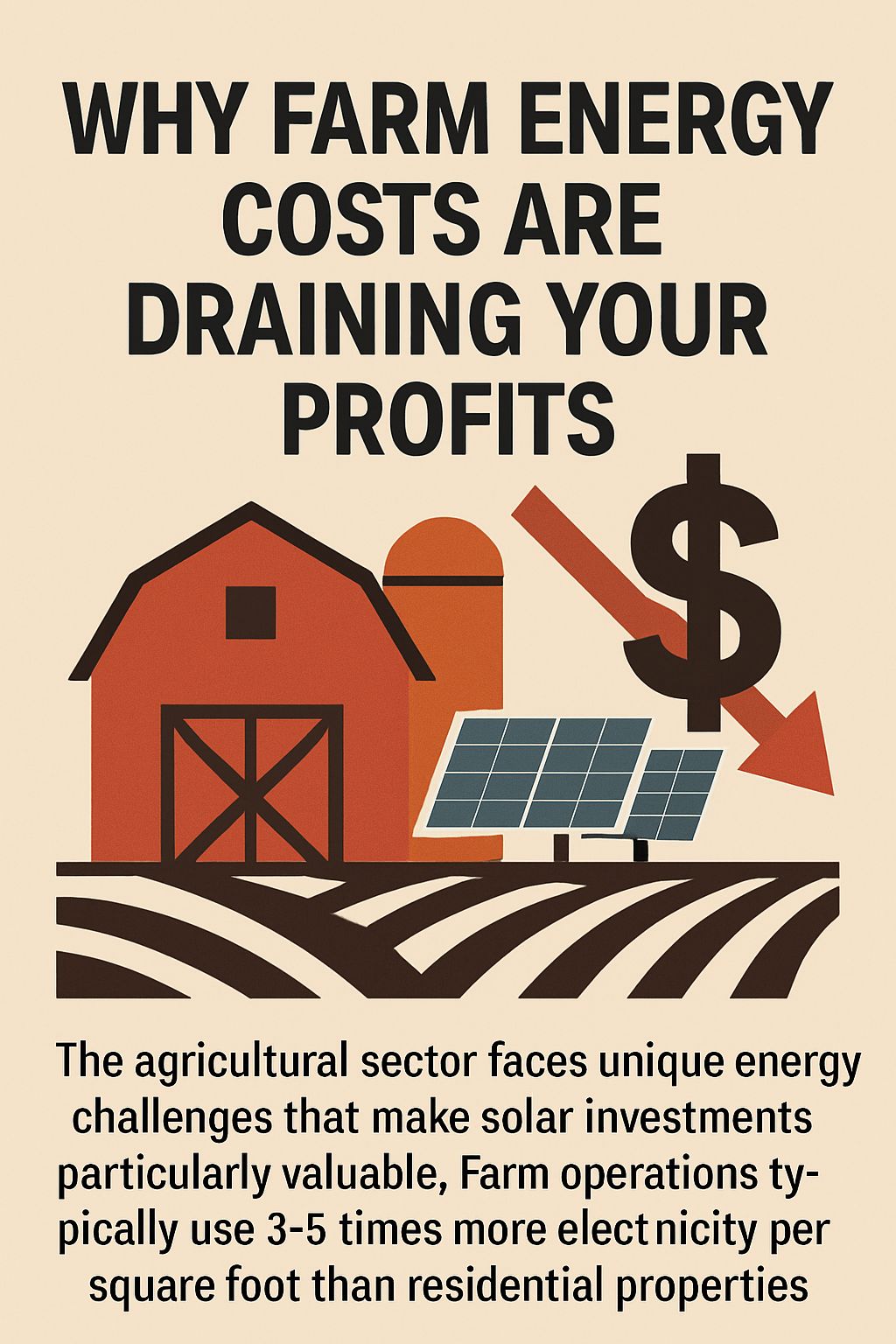
Why Farm Energy Costs Are Draining Your Profits
The agricultural sector faces unique energy challenges that make solar investments particularly valuable. Farm operations typically use 3-5 times more electricity per square foot than residential properties, with energy often representing the third largest operational expense after labor and materials. This energy intensity makes agricultural businesses especially vulnerable to utility rate increases and fuel price volatility.
Rising Electricity Rates Hit Agricultural Operations Hardest
Nationwide, agricultural electricity rates have increased an average of 5% annually over the past decade, outpacing inflation and creating significant pressure on farm profit margins. These increases disproportionately impact rural utilities serving agricultural areas, where infrastructure maintenance costs are spread across fewer customers. Large farming operations with substantial irrigation, climate control, or processing requirements feel these increases most acutely, often seeing annual power bills in the tens of thousands. For more information on how these challenges affect energy and natural resources, check out this analysis of energy winners and losers in recent legislation.
High Energy Demands of Modern Farming Equipment
Modern agricultural operations rely increasingly on sophisticated, energy-intensive equipment. From automated milking systems consuming 40-50 kilowatt-hours per cow daily to climate-controlled storage facilities operating year-round, today’s farms require consistent, reliable power. The electrification of previously diesel-powered equipment adds another layer of demand, with electric irrigation pumps, grain dryers, and material handling systems replacing fuel-burning predecessors. For farmers looking to manage these demands, exploring the financial benefits of solar panels can be a viable solution.
Additionally, the growth in precision agriculture technologies has introduced new power requirements. Automated monitoring systems, data processing equipment, and smart farming devices create a constant baseline power demand even during off-peak growing seasons. For operations investing in these productivity-enhancing technologies, securing affordable electricity becomes even more crucial to realizing their intended benefits.
Unpredictable Fuel Costs Impact Your Bottom Line
Beyond electricity, agricultural operations face volatile costs for propane, natural gas, and diesel fuel. These energy sources power essential farming functions from grain drying to greenhouse heating. Recent years have demonstrated how international events can trigger sudden price spikes, leaving farmers with difficult decisions about delaying critical operations or absorbing unplanned costs.
Solar installations with battery storage capabilities offer a compelling solution to this energy vulnerability. By generating on-site power and storing excess production, farms can significantly reduce exposure to both utility rate increases and fuel market volatility. The One Big Beautiful Bill specifically addresses this challenge by including energy storage systems in the qualifying technologies for tax incentives when paired with solar generation.
Solar Tax Credits: Your Biggest Financial Opportunity in the Bill
The Investment Tax Credit represents the single most valuable incentive for agricultural solar adopters. This dollar-for-dollar reduction in federal tax liability dramatically improves project economics and accelerates return on investment. Understanding the nuances of how these credits apply to different agricultural scenarios is essential for maximizing their value. For more insights, explore the investment benefits of solar panels for farmers.
Investment Tax Credit (ITC) Explained for Farmers
The ITC allows farm businesses to claim 30% of qualified solar expenditures as a direct credit against federal taxes owed. This includes all equipment, installation labor, and interconnection costs associated with your solar energy system. For agricultural operations, the credit applies to both building-mounted and ground-mounted systems, giving farmers flexibility in system design and placement to maximize production.
To claim the credit, farmers file IRS Form 3468 with their annual tax return for the year the system is “placed in service” – meaning when it’s ready and available for its intended use. Importantly, there’s no maximum credit amount, allowing larger agricultural operations to install systems sized appropriately for their energy needs without hitting incentive caps. If the credit exceeds your tax liability for the year, excess credits can be carried forward for up to 20 years, ensuring you capture the full benefit eventually. For more insights, explore the financial benefits of solar panels for agricultural operations.
Production Tax Credit Alternative for Large-Scale Operations
For larger agricultural operations planning multi-megawatt solar installations, the One Big Beautiful Bill offers an alternative to the ITC through the Production Tax Credit (PTC). Rather than providing a single up-front credit based on investment cost, the PTC delivers tax benefits based on actual electricity production over a 10-year period. This “pay-for-performance” approach can yield greater total incentives for high-performing systems in sunny locations.
The PTC calculation is based on kilowatt-hours generated, with the current rate approximately 2.75 cents per kWh produced, adjusted annually for inflation. For a 1-megawatt system generating 1.5 million kWh annually, this represents over $41,000 in tax credits each year for a decade. Agricultural operations must choose between the ITC and PTC – you cannot claim both – but having this option allows sophisticated operations to model different scenarios and select the most advantageous approach.
Bonus Credits for Projects in Rural Communities
The legislation includes additional incentives specifically benefiting rural agricultural communities. Solar projects located in designated “energy communities” – including many rural areas with historical ties to fossil fuel industries – qualify for a 10% bonus credit above the standard 30% ITC. Similarly, projects meeting domestic content requirements can receive another 10% bonus, potentially bringing the total credit to 50% of project costs for qualifying agricultural installations.
These bonus provisions recognize the unique opportunity for renewable energy development in rural agricultural areas and aim to ensure economic benefits remain within these communities. For farmers in eligible regions, these enhancements make solar investments particularly attractive, often reducing payback periods to under four years when combined with agricultural production benefits.
How Credits Stack with State and Local Incentives
Federal tax credits can be combined with state, local, and utility incentives to create even more compelling financial packages. Many agricultural states offer additional tax incentives, rebates, or performance-based incentives specifically for farm-based renewable energy. Unlike some tax benefits that interact negatively, these incentives generally stack favorably with federal credits, allowing farmers to capture multiple benefits simultaneously.
For example, farmers in states with property tax exemptions for renewable energy equipment avoid increased assessments when adding solar assets. Similarly, states offering net metering at retail rates effectively increase the value of solar-generated electricity. The combined effect of these layered incentives often makes agricultural solar installations 60-70% less expensive than retail price, dramatically improving investment returns.
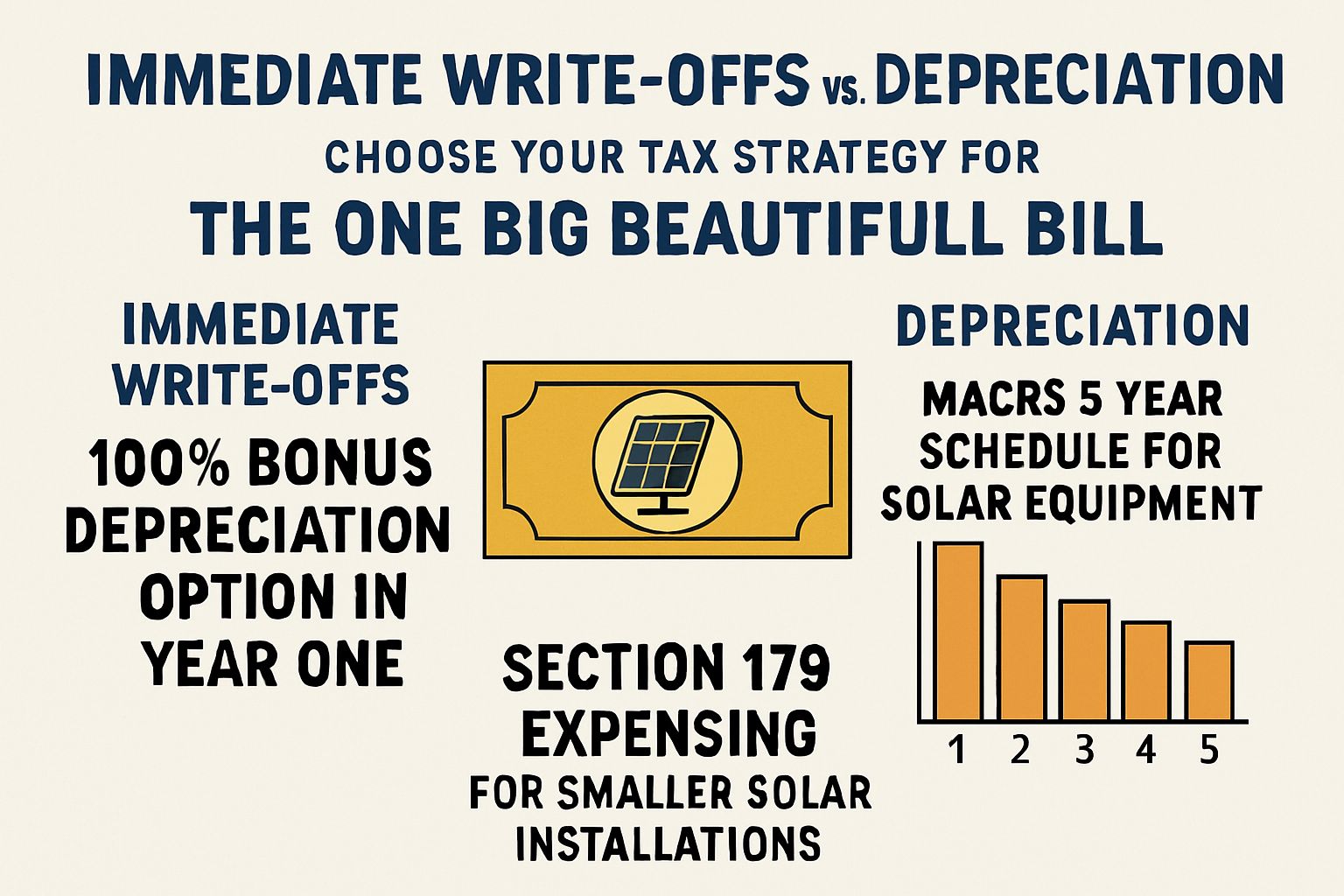
Immediate Write-Offs vs. Depreciation: Choose Your Tax Strategy
The One Big Beautiful Bill creates unprecedented flexibility in how farmers account for solar investments. You now have multiple options for depreciation and expensing, allowing customized tax strategies based on your operation’s specific financial situation. Working with an agricultural tax specialist to model these options can reveal substantial differences in total benefit.
100% Bonus Depreciation Option in Year One
For farmers with sufficient tax liability, the bonus depreciation provision offers immediate financial benefits. This option allows deduction of 100% of the remaining cost basis (after applying the 30% ITC) in the first year of service. For a $200,000 solar system, this means claiming $140,000 in depreciation deductions immediately, rather than spreading them over several years. For farms in higher tax brackets, this acceleration can generate tens of thousands in additional first-year tax savings.
This aggressive depreciation strategy works particularly well for farm operations experiencing an exceptionally profitable year. By installing solar before year-end, the combined ITC and bonus depreciation can significantly reduce tax liability during high-income periods. However, it’s important to note that claiming bonus depreciation requires having sufficient income to offset—farms operating near breakeven may benefit more from alternative approaches.
- Best for: Highly profitable operations seeking immediate tax reductions
- Considerations: Requires sufficient taxable income to utilize full deduction
- Impact: Maximizes first-year tax benefits but eliminates future deductions
- Strategy: Often paired with Section 48 Investment Tax Credit for maximum impact
The decision to utilize bonus depreciation should be made as part of comprehensive tax planning. While the immediate write-off is appealing, some operations benefit more from spreading deductions across multiple years to align with projected income patterns. The One Big Beautiful Bill preserves this flexibility, giving farmers options rather than forcing a one-size-fits-all approach.
Remember that bonus depreciation applies to the adjusted basis of the solar property after the ITC is applied. This means you’ll depreciate 70% of the system cost if claiming the full 30% tax credit, avoiding double-dipping on tax benefits while still maximizing overall incentives. For more insights on energy-related tax incentives, check out the energy winners and losers in the One Big Beautiful Bill.
MACRS 5-Year Schedule for Solar Equipment
For agricultural operations preferring to spread tax benefits over time, the Modified Accelerated Cost Recovery System (MACRS) offers an attractive alternative to bonus depreciation. Solar equipment qualifies for an accelerated 5-year depreciation schedule, much faster than the 20+ year physical lifespan of modern solar components. This accelerated timeline allows farms to recover their investment through tax deductions years before the equipment requires replacement.
Section 179 Expensing for Smaller Solar Installations
Smaller farming operations can utilize Section 179 expensing as an alternative to bonus depreciation. This provision allows businesses to immediately expense up to $1.16 million in qualifying equipment purchases, including solar energy systems. The key advantage is flexibility—unlike bonus depreciation, Section 179 allows partial expensing, giving farmers precise control over how much of the investment to deduct immediately versus depreciating over time.
For example, a farm adding a $100,000 solar system could choose to expense $60,000 immediately under Section 179 while depreciating the remaining $40,000 over five years. This strategic approach allows tailoring of tax benefits to match expected income patterns, particularly valuable for operations with fluctuating profitability due to weather, commodity prices, or expansion plans.
3 Ways to Qualify Your Farm for Maximum Solar Incentives
The One Big Beautiful Bill introduced specific requirements that determine eligibility for enhanced solar incentives. Understanding these qualifications is essential for agricultural operations seeking to maximize available benefits. Strategic planning during the system design and procurement phases can significantly increase total incentive values, often with minimal additional cost.

Get Started: 5 Steps to Claim Your Farm Solar Tax Benefits
Navigating the solar incentive landscape requires careful planning and execution. With the significant tax benefits available through the One Big Beautiful Bill, following a structured approach ensures you’ll maximize available incentives while avoiding common pitfalls. Here’s a proven pathway to capturing the full value of agricultural solar tax benefits.
1. Conduct a Farm Energy Audit
Before investing in solar, understand your operation’s energy consumption patterns. A comprehensive farm energy audit identifies not only total usage but also peak demand periods, seasonal variations, and opportunities for efficiency improvements. Many rural electric cooperatives and agricultural extension services offer subsidized or free energy audits specifically designed for farm operations.
These audits typically analyze 12-24 months of utility bills, identifying consumption patterns and determining optimal solar system sizing. Properly sized systems maximize financial returns by avoiding over-investment while ensuring sufficient capacity for current and planned operations. For diversified farms with multiple buildings or production areas, the audit will identify which locations offer the best solar potential.
Most importantly, energy audits often identify efficiency measures that should be implemented before solar installation. Reducing base consumption through LED lighting, variable frequency drives on motors, and improved insulation can significantly decrease required solar capacity, reducing initial investment while improving overall economics.
2. Obtain Multiple Solar Installation Quotes
The solar marketplace for agricultural installations has matured significantly, with numerous providers now specializing in farm applications. Request detailed proposals from at least three qualified installers with specific agricultural experience, as farm systems often have unique requirements different from residential or commercial installations. These quotes should include comprehensive financial analyses showing expected tax benefits, annual production estimates, and projected return on investment calculations specific to your operation’s energy profile and tax situation.
3. Check Eligibility with Your Tax Professional
Before proceeding, consult with an agricultural tax specialist to verify your operation’s eligibility for specific incentives. Tax professionals can determine which ownership structures and installation approaches maximize available benefits. They’ll also confirm your tax liability is sufficient to utilize available credits or identify if direct pay options better suit your situation. This consultation often reveals timing strategies—such as installing systems in high-income years—that can significantly enhance overall financial returns.
4. File IRS Form 3468 for Investment Credit
To claim the Investment Tax Credit, you’ll file IRS Form 3468 (Investment Credit) with your tax return for the year the system is placed in service. This form documents your qualifying solar expenditures and calculates the credit amount. The “placed in service” date is when your system is fully installed and operational—not necessarily when you make the initial payment or when construction begins.
Maintain detailed documentation of all system costs, including equipment, installation labor, and interconnection expenses. The IRS may request supporting documentation during an audit, so preserve all contracts, invoices, payment records, and commissioning reports. Your agricultural tax preparer should also document how you determined the system qualifies for the credit, particularly if claiming any bonus credit amounts for domestic content or energy community locations.
5. Track Ongoing Benefits for Maximum Returns
Solar incentives extend beyond the initial installation year. Track system performance to document production-based incentives, maintain depreciation schedules, and verify energy savings against projections. Many agricultural operations benefit from integrated monitoring systems that provide real-time production data while documenting total generation for incentive compliance. For systems with battery storage components, separate tracking may be required as different tax treatments may apply to generation versus storage equipment depending on installation timing and configuration.
Future-Proof Your Farm with Solar Investment Today
The One Big Beautiful Bill creates a limited window of opportunity for agricultural operations to secure long-term energy independence while capturing unprecedented tax advantages. While the core 30% credit remains available through 2030, certain bonus provisions begin phasing out as early as 2027. Forward-thinking farmers are acting now to lock in maximum benefits while building resilience against future energy price volatility. By investing in solar today, you’re not just reducing current operating costs—you’re securing predictable energy pricing for decades while positioning your operation to thrive in an increasingly electrified agricultural landscape.

Conclusion: Does The One Big Beautiful Bill Hurt or Help the Farmer with Solar Panel Investment?
The One Big Beautiful Bill represents a clear win for agricultural operations considering solar investments. While the legislation does phase out certain wind and solar credits beginning in 2027, it establishes a stable framework of incentives that dramatically improves the economics of farm solar installations for the next several years. The combination of tax credits, accelerated depreciation options, and direct pay provisions creates unprecedented flexibility for farms of all sizes and structures to benefit.
For the average agricultural operation, these incentives reduce effective solar installation costs by 50-60% when all tax benefits are properly utilized. This dramatic reduction shifts typical payback periods from 8-12 years down to 4-7 years for most farm applications, while the systems continue producing free electricity for 25+ years. The mathematics are compelling: few farm investments offer similar returns with comparable risk profiles and guaranteed operating cost reductions.
Perhaps most importantly, the bill addresses previous barriers that prevented many agricultural operations from accessing solar incentives. The direct pay option helps farms with limited tax liability, while the flexible depreciation options accommodate seasonal and cyclical farm income patterns. These thoughtful provisions ensure the legislation’s benefits reach a broad cross-section of American agriculture rather than just the largest, most profitable operations.
- Smaller family farms benefit from improved cash flow and reduced operating costs
- Mid-sized operations gain energy independence and protection from utility rate increases
- Large agricultural businesses can strategically reduce tax liability while building long-term assets
- All farms contribute to sustainability goals increasingly demanded by consumers and supply chain partners
The verdict is clear: the One Big Beautiful Bill creates a historic opportunity for agricultural operations to invest in solar technology. Farmers who seize this opportunity stand to benefit not only from immediate tax advantages but also from decades of reduced operating costs and enhanced energy resilience. As with any significant business decision, consult with qualified agricultural financial advisors to develop a solar strategy tailored to your operation’s specific circumstances and goals.
Frequently Asked Questions
The intersection of agricultural operations, tax policy, and renewable energy creates complexity that often raises questions for farmers considering solar investments. Here are answers to the most common questions we receive from agricultural producers evaluating solar incentives under the One Big Beautiful Bill.
These responses reflect current IRS guidance and industry best practices, but tax situations vary widely. Always consult with qualified tax professionals for advice specific to your operation’s circumstances. For more insights, you can explore the Big Beautiful Bill Series on tax policy.
What size solar system does my farm need to qualify for tax incentives?
There’s no minimum system size requirement to qualify for federal solar tax incentives. Even small systems powering individual farm buildings or equipment qualify for the full 30% Investment Tax Credit. The incentives scale proportionally with system size, so your eligible credit is simply 30% of qualified expenditures whether you’re installing a 10kW system for a farm office or a 500kW system for a large dairy operation. For more information on the investment benefits of solar panels for farmers, you can explore additional resources.
That said, economies of scale do impact overall project economics. Installation costs per watt typically decrease as system size increases, often making larger systems more cost-effective. Most agricultural operations find the optimal system size aligns with 70-90% of annual electricity consumption, as net metering policies in many states limit the financial benefit of oversizing systems.
When determining appropriate system size, consider both current and future energy needs. If expansion plans may increase electricity demand in coming years, it’s often more economical to install a slightly larger system initially than to add capacity later. The One Big Beautiful Bill’s incentive structure fully supports this forward-looking approach.
Can I claim solar tax credits if I lease my farmland instead of owning it?
Yes, land tenure arrangements generally don’t affect solar tax credit eligibility. The critical factor is who owns the solar equipment, not the underlying land. Tenant farmers can claim the full solar tax credit for systems they purchase and install, even on leased property. However, you’ll need written permission from the landowner and should have lease terms that extend beyond the solar system’s payback period to ensure you capture the full economic benefits.
How do solar incentives work if my farm operates as an LLC or S-corporation?
The One Big Beautiful Bill specifically addresses pass-through entities like LLCs and S-corporations, ensuring these common agricultural business structures can fully utilize available incentives. For pass-through entities, tax credits flow through to individual members or shareholders in proportion to their ownership percentage. The tax credits are then claimed on personal returns, with each owner’s ability to utilize the credits dependent on their individual tax situation.
- Single-member LLCs: The sole owner claims 100% of eligible tax credits
- Multi-member LLCs: Credits allocated according to ownership percentages or special allocations in the operating agreement
- S-corporations: Credits flow to shareholders based on stock ownership percentages
- Agricultural cooperatives: Special provisions allow passing credits to members
For depreciation benefits, similar pass-through principles apply. The entity claims depreciation deductions on its informational return, which then flow through to owners’ individual returns. This allows agricultural business owners to benefit from both the tax credit and accelerated depreciation provisions, even when operating under common agricultural business structures.
The legislation also creates important new options for pass-through entities with insufficient tax liability to fully utilize available credits. The direct pay provision allows eligible agricultural businesses to receive the value of unused credits as a direct payment, rather than carrying them forward to future tax years. This significantly improves cash flow for growing operations and those experiencing temporarily reduced profitability.
Before proceeding with a solar installation, have your tax professional model the specific impact on both the entity and individual owners to ensure optimal structuring of the investment. In some cases, modest adjustments to ownership timing or entity structure can significantly enhance available benefits. For more insights, you can explore the Big Beautiful Bill series on tax policy.
Will installing solar panels affect my agricultural property tax assessment?
“Many states have enacted specific property tax exemptions for renewable energy equipment installed on agricultural land. These exemptions prevent increased assessments that might otherwise offset the financial benefits of solar installations.” – American Farm Bureau Federation Tax Guide
Property tax treatment varies significantly by state and sometimes by county. Currently, 38 states offer some form of property tax exemption, exclusion, or special assessment for solar energy systems. In many agricultural regions, these provisions specifically prevent solar installations from increasing property tax assessments on farm properties. However, the details matter—some exemptions apply only to specific system types or sizes. For more insights on how the Big Beautiful Bill impacts tax policy, you can explore related resources.
Before installation, check with your county assessor’s office to understand local policies. In some jurisdictions, you may need to file for exemption certificates or special classifications to ensure your solar equipment doesn’t increase property tax burdens. Your solar installer should be familiar with local requirements, but verification through official channels provides additional certainty.
What happens to my solar tax credits if the One Big Beautiful Bill is modified in the future?
Solar tax credits are claimed in the tax year when systems are placed in service, not when future tax returns are filed. This creates important “grandfather” protection—once your system is installed and operational, your tax credit eligibility is generally locked in under the rules in effect at that time, even if legislation changes in subsequent years. This provides significant certainty for agricultural investors making long-term capital decisions.
This grandfathering principle has been consistently applied through multiple previous extensions and modifications of renewable energy tax credits. Systems installed during periods of higher credit rates maintained those rates even when credits were reduced for future installations. The IRS has established clear precedent that placed-in-service dates, not claim dates, determine applicable incentive levels.
For additional guidance on agricultural solar investments, contact AgAmerica’s agricultural finance specialists, who can help you develop a comprehensive funding strategy that maximizes available incentives while supporting your operation’s long-term success.






Leave a Reply