
Key Takeaways
- Farmers can reduce solar installation costs by up to 80% through combined federal tax credits, USDA REAP grants, and accelerated depreciation benefits
- The 30% Federal Investment Tax Credit (ITC) for solar is guaranteed through 2032, making long-term planning possible
- USDA’s REAP program offers grants covering up to 50% of solar project costs specifically for agricultural producers
- Many farmers see complete return on investment in 4-7 years with current incentives, compared to 10-15 years previously
- Beyond financial benefits, solar provides farmers energy independence during critical growing seasons when utility rates often spike
The economics of solar power have fundamentally shifted for America’s farmers. What was once considered a costly green luxury has transformed into one of the smartest financial moves agricultural operations can make in 2025. With unprecedented tax incentives and grants now available, many farmers are discovering they can slash their energy costs while receiving substantial government support that makes the upfront investment remarkably affordable.
As Artin Energy has documented through hundreds of agricultural installations, the combined effect of federal, state, and local incentives often reduces solar costs by 70-80% for qualifying farm operations. This dramatic reduction transforms the return-on-investment timeline from the previous decade-plus to just a few years for many agricultural producers, while delivering decades of reduced operating costs afterward.
The current landscape of solar incentives represents a perfect alignment of policy support that specifically benefits agricultural producers who often face substantial electricity costs for irrigation, dairy operations, cold storage, and other essential farm functions. Understanding how these programs work together is crucial for farmers looking to maximize their financial benefits while investing in long-term energy independence.
The Perfect Storm of Solar Savings for Agricultural Operations
Unlike previous years where incentives came and went unpredictably, the current tax benefits for farm solar installations offer unprecedented stability and value. The combination of multiple programs simultaneously available creates a multiplier effect that dramatically reduces out-of-pocket costs for agricultural producers.
30% Federal Solar Investment Tax Credit (ITC)
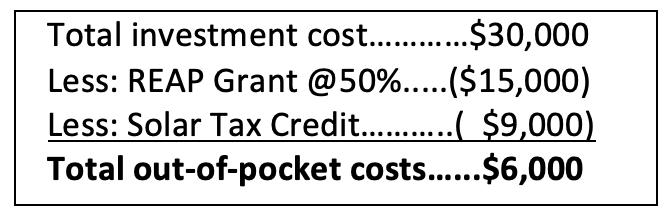
The cornerstone of solar savings for farmers remains the Federal Investment Tax Credit, which provides a direct reduction of federal tax liability equal to 30% of the total solar system cost. This isn’t a deduction but a dollar-for-dollar reduction in taxes owed. For example, a $100,000 solar system generates a $30,000 tax credit that can be applied to federal taxes in the installation year, with carryforward provisions if the full amount can’t be used immediately. The 30% ITC is guaranteed through 2032 before beginning a phase-down, giving farmers long-term planning certainty that was previously unavailable.
50% USDA REAP Grant Funding Available
The USDA’s Rural Energy for America Program (REAP) represents perhaps the most significant opportunity for farmers considering solar. This program offers grants covering up to 50% of total project costs specifically for agricultural producers and rural small businesses investing in renewable energy systems. While competitive, REAP grants don’t need to be repaid and can be combined with the 30% ITC. This combination alone can cover up to 80% of a farm’s solar installation costs, transforming the financial equation dramatically in favor of immediate adoption.
“After accounting for both the REAP grant and federal tax credit, our 75kW solar array had an out-of-pocket cost of just $35,000 instead of the original $175,000 price tag. The system now covers 90% of our dairy operation’s electricity, with a payback period of just 4.3 years based on our previous utility spending.” — Ohio dairy farmer, REAP grant recipient
100% Bonus Depreciation Tax Benefits
Beyond the direct credits and grants, farmers can also take advantage of accelerated depreciation for solar equipment. Agricultural operations can write off the entire adjusted basis of a new solar system in the first year through bonus depreciation provisions. This creates significant additional tax savings beyond the ITC, especially valuable for farm operations with substantial tax liability. When calculated properly, this depreciation benefit often adds another 15-25% effective discount to the total system cost, depending on the farm’s tax bracket.
State and Local Incentives That Stack With Federal Programs
Beyond federal incentives, many states offer additional financial support for agricultural solar installations. These programs vary considerably by location but can provide substantial additional savings. States like California, New York, Massachusetts, and Minnesota offer performance-based incentives, property tax exemptions, and specialized agricultural solar grants that can be combined with federal programs. Many utility companies also provide rebates or production-based incentives specifically for farm operations installing renewable energy systems.
The stackable nature of these incentives means that farmers in certain regions can potentially cover nearly all installation costs through combined programs. Even in states with more modest incentive programs, the combination of state and federal benefits typically reduces net system costs by 70-80% compared to retail pricing. This has fundamentally altered the economic calculus of farm solar investments across the country.
How the USDA REAP Grant Works for Farm Solar Projects
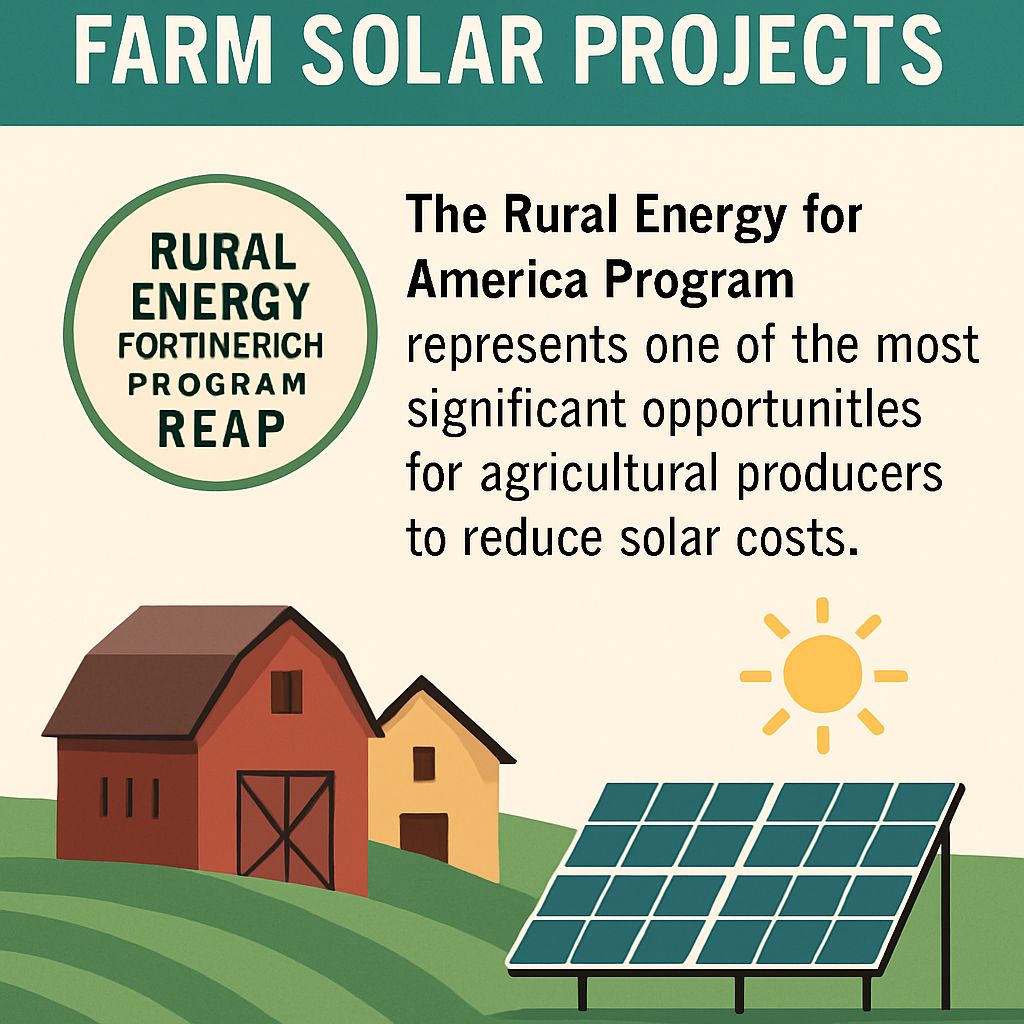
The Rural Energy for America Program represents one of the most significant opportunities for agricultural producers to reduce solar costs, but understanding how to successfully navigate the application process is critical. While the program can cover up to 50% of project costs, the competitive nature of the grants requires careful preparation and timing.
Eligibility Requirements for Agricultural Producers
To qualify for REAP funding, applicants must be agricultural producers with at least 50% of their gross income coming from agricultural operations. The program is designed specifically to assist farmers, ranchers, and rural small businesses in implementing renewable energy systems that reduce energy costs and increase efficiency. The property where the solar system will be installed must be located in a rural area, though exceptions exist for agricultural producers. The grant funding is available for both grid-connected and off-grid solar systems, providing flexibility for various farm configurations. For more information, explore how solar tax credits can benefit farmers.
Application Deadlines and Funding Cycles
The USDA typically accepts REAP applications through multiple funding cycles throughout the year, with the primary deadlines falling on March 31 and October 31. Applications submitted by these deadlines are given full consideration for that fiscal year’s funding allocation. The application process requires detailed documentation including energy audits, financial projections, and technical specifications for the proposed solar system. While the paperwork requirements are significant, most agricultural solar installers now provide comprehensive assistance with REAP applications, substantially increasing approval chances.
System Size and Project Requirements
REAP grants are available for solar systems of various sizes, though the program is particularly advantageous for medium to large agricultural operations with substantial energy needs. The grant can cover up to 50% of eligible project costs, with maximum grant amounts of $1,000,000 for renewable energy systems. Smaller grants of up to $20,000 are also available through a simplified application process, making the program accessible to smaller farming operations. The system must be sized appropriately to the farm’s energy needs, and projects must comply with all applicable local, state, and federal regulations.
Real Farm Energy Savings: Dollars and Cents
The financial impact of solar adoption for farming operations goes well beyond the initial installation savings. The long-term economics of agricultural solar provide substantial operational benefits that continue for decades after incentive programs have been applied. For many farmers, solar has transformed from being viewed as an environmental choice to a fundamental financial strategy for controlling and reducing operational costs.
Detailed financial analysis shows that farms with high daytime energy usage patterns—such as those with irrigation systems, dairy operations, or cold storage facilities—often see the most dramatic financial benefits from solar investments. These operations can directly offset their highest-cost electricity during peak rate periods, maximizing the value of every kilowatt-hour produced.
Average ROI Timeline With Current Incentives
With the combined impact of current tax incentives, grants, and depreciation benefits, the average return-on-investment timeline for agricultural solar systems has shortened dramatically. Most farms now achieve complete payback in 4-7 years, compared to the 10-15 years common just a decade ago. After this payback period, the solar system effectively provides free electricity for the remainder of its 25-30 year warranted lifespan, representing decades of pure profit through energy savings.
3. Apply for the REAP Grant
The REAP grant application process requires careful attention to detail and thorough documentation. Begin by contacting your local USDA Rural Development office for guidance specific to your state and to confirm upcoming deadlines. The application will require detailed information about your farm operation, energy usage history, and projected savings from the solar installation. You’ll need to include vendor quotes, technical specifications, and proof that your project meets all program requirements.
A strong REAP application demonstrates both financial need and positive environmental impact. Most successful applications include a professional energy audit that clearly shows current energy consumption patterns and projected savings. The application also requires evidence that the solar system is technically feasible and appropriately sized for your operation’s needs. While the paperwork is substantial, the potential 50% cost coverage makes this effort extremely worthwhile.
Many farmers find the most success when they start the REAP application process 3-6 months before the submission deadline. This timeline allows adequate opportunity to gather all required documentation, refine the project proposal, and have the application professionally reviewed. Applications submitted closer to the beginning of the fiscal year (March 31 deadline) typically face less competition for funding than those submitted later in the year.
4. Secure Additional State Funding
After applying for federal incentives, investigate state-specific agricultural energy programs that can further reduce your costs. Many states offer dedicated funding for farm energy improvements, solar rebates, performance-based incentives, and agricultural modernization grants that can be combined with federal programs. Contact your state energy office, department of agriculture, and local electric utility to identify all available programs. Some states like Minnesota, Oregon and New York offer specialized agricultural energy programs with incentives specifically designed for farming operations that can cover an additional 10-25% of system costs.
5. Work With Agricultural Solar Specialists
Select a solar provider with specific experience in agricultural installations and a proven track record of maximizing farmer incentives. Agricultural solar systems have unique requirements regarding mounting options, durability in farm environments, and integration with existing farm electrical systems. Experienced agricultural solar installers can design systems that minimize impact on farmland while maximizing production during peak farm energy usage periods.
Ask potential solar partners about their experience with REAP grant applications, success rates, and their ability to provide required technical documentation. The best agricultural solar providers typically offer comprehensive service packages that include incentive application assistance, system design optimization for agricultural settings, and ongoing production monitoring. These specialists can also help identify opportunities to integrate solar with other farm energy systems such as grain drying, irrigation controls, or refrigeration units.
Schedule site assessments with multiple agricultural solar specialists to compare approaches and system recommendations. During these consultations, discuss specific placement options that minimize impacts on productive land while maximizing solar exposure. Experienced agricultural installers will provide realistic production estimates based on your location’s solar resource and specific farm energy usage patterns.
Future-Proof Your Farm Operations
Solar investments provide a powerful hedge against rising agricultural electricity costs, which have increased at an average rate of 3-5% annually in most regions. With fixed solar production costs locked in at installation, the effective value of your solar production increases every time utility rates rise. This predictability allows for more accurate long-term financial planning and budgeting than is possible with conventional utility power. For many farming operations, energy costs represent one of the few major expense categories that can be substantially reduced and stabilized through strategic investment.
Beyond pure economics, solar installations can provide additional operational benefits including enhanced energy resilience during grid outages (when paired with battery storage), reduced environmental compliance concerns, and strengthened marketing opportunities for sustainability-focused agricultural products. Many farmers report that their solar investments have opened new market opportunities with environmentally-conscious buyers and distributors willing to pay premium prices for sustainably-produced agricultural products.

“Solar Panels Investment Benefits for …” from growingsolarmist.com and used with no modifications.
Conclusion: Does the Tax Incentives Make the Solar Panel Investment Worth While for the Farmer
With current incentives reducing installation costs by up to 80%, predictable 25+ year system lifespans, and protection against rising utility rates, agricultural solar investments now represent one of the most financially sound decisions available to modern farming operations. The combination of upfront savings through tax incentives and grants, coupled with decades of reduced operational costs, creates a compelling economic case that extends well beyond environmental benefits. For most agricultural operations with suitable land or roof space and moderate to high electricity usage, the question is no longer whether solar makes financial sense, but rather how to maximize the available incentives before they potentially decrease in future years.
Frequently Asked Questions (FAQ)
The decision to invest in solar for your agricultural operation comes with many questions about implementation, financial impact, and practical considerations. Below are answers to the most common questions farmers ask when considering solar investments.
- What happens if my tax liability is less than the available solar tax credits?
- Can I install solar on leased farmland?
- Will my property taxes increase after installing solar panels?
- How does agricultural solar affect farm insurance policies?
- Can I use solar to power irrigation systems directly?
Understanding these practical considerations helps farmers make fully informed decisions about integrating solar into their agricultural operations. While the financial incentives are compelling, addressing these common concerns ensures the investment aligns with your specific farming situation.
Let’s explore some of these questions in more detail to provide a comprehensive understanding of how solar integration works specifically for agricultural settings.
How much farmland will solar panels require for a typical agricultural operation?
The land requirements for agricultural solar systems depend primarily on your energy needs and the mounting method chosen. For ground-mounted systems, farmers can expect to use approximately 5-10 acres of land per megawatt of solar capacity. A typical 100kW system (suitable for medium-sized operations) requires about 0.5-1 acre of land. However, modern agricultural solar installations increasingly utilize dual-use approaches that maintain agricultural productivity beneath and around panels.
Roof-mounted systems require no additional land, making them ideal for operations with suitable barn, equipment shed, or other agricultural building roof space. Pole-mounted systems can be strategically placed along field borders, in less productive areas, or integrated into existing infrastructure footprints to minimize impact on valuable cropland. For more information on how these systems can benefit your farm, check out this guide on solar panels for farming.
Many farmers now implement agrivoltaic approaches that combine solar production with continued agricultural use of the same land – including grazing livestock beneath panels, growing shade-tolerant crops, or incorporating panels into existing orchard or vineyard operations. These innovative approaches maintain agricultural productivity while generating clean energy and additional farm revenue.
Can I still claim tax incentives if I lease my farmland instead of owning it?
Yes, farmers who lease their land can still qualify for solar incentives, though the specific arrangement requires careful consideration. The most straightforward approach is to secure a long-term land lease amendment that explicitly permits solar installation and specifies ownership of the system. As the system owner (even on leased land), you would qualify for the federal tax credit, depreciation benefits, and potentially REAP grants if all other eligibility requirements are met.
“Our family has farmed leased land for three generations. When we approached our landowner about installing solar to power our irrigation systems, they were supportive. We drafted a lease amendment that extended our lease term to 25 years and explicitly permitted solar installation while confirming our ownership of the system. This allowed us to claim all available incentives while reducing our operating costs substantially.” – California vegetable farmer
Alternative arrangements include partnership structures where the landowner and farmer share the investment and benefits, or Power Purchase Agreements where a third party owns the system and sells discounted electricity to the farming operation. Each approach has different financial and tax implications that should be reviewed with qualified legal and financial advisors.
If the lease situation makes claiming incentives difficult, consider focusing solar installations on structures you own (such as barns or equipment buildings) rather than ground-mounted arrays on leased land. This approach simplifies ownership questions while still providing substantial energy benefits.
Will installing solar panels affect my farm’s soil quality or agricultural productivity?
Modern agricultural solar installations are designed to have minimal impact on soil quality and can actually improve certain aspects of agricultural productivity. Studies from the National Renewable Energy Laboratory show that properly installed ground-mounted systems with adequate spacing between panel rows have negligible effects on soil health and can provide benefits including reduced soil erosion, decreased water evaporation, and creation of beneficial microclimates for certain crops. Removable mounting systems with minimal ground penetration preserve soil structure, while elevated panel designs allow for continued agricultural activities underneath and between arrays.
How long do agricultural solar panel systems typically last?
Agricultural solar panel systems are built for longevity, with standard performance warranties of 25 years and expected operational lifespans of 30-40 years. Most manufacturers guarantee that panels will still produce at least 80% of their original capacity after 25 years of operation. The inverter components typically have shorter warranty periods of 10-15 years and may need replacement once during the system’s life. Agricultural installations often utilize heavier-duty mounting systems specifically designed to withstand farm environmental conditions, further enhancing durability and longevity compared to residential installations.
Can I combine solar incentives with other agricultural sustainability programs?
Yes, solar incentives can generally be combined with other agricultural sustainability programs to maximize financial benefits. Many farmers successfully pair solar investments with USDA conservation programs, energy efficiency initiatives, and sustainable agriculture grants. For instance, the Environmental Quality Incentives Program (EQIP) can be used alongside solar incentives to implement comprehensive energy management strategies that include both renewable generation and efficiency improvements.
State-level programs often specifically encourage combining multiple sustainability initiatives. For example, some states offer enhanced incentives when solar is paired with pollinator habitat establishment, water conservation measures, or soil health initiatives. These integrated approaches create multiple revenue and savings streams while addressing several sustainability goals simultaneously.
The USDA’s Conservation Stewardship Program (CSP) often provides additional payments for comprehensive resource management that can include renewable energy components. By strategically combining these programs, forward-thinking farmers can create sustainability systems that generate multiple financial benefits while improving long-term farm resilience.
Working with agricultural extension agents or sustainable farming organizations can help identify program combinations that maximize both financial returns and environmental benefits for your specific operation. The key is developing an integrated approach that leverages multiple funding sources to support a comprehensive sustainability strategy.
For comprehensive guidance on maximizing solar incentives for your specific agricultural operation, contact ArtIn Energy for a free farm solar assessment. Our agricultural energy specialists can evaluate your current usage patterns, identify optimal system designs, and provide detailed financial projections including all available incentives for your location.



Leave a Reply