
Key Takeaways
- Solar-powered traveling gun irrigation systems can cut farm energy costs by 60–80% compared to diesel alternatives — making them one of the highest-ROI sustainability upgrades available to row crop and pasture farmers.
- Not every farm is a good fit. Field size, terrain, soil type, and sunlight availability all determine whether this system will perform or underperform on your land.
- Remote and off-grid farmland benefits the most — solar traveling guns eliminate the need for grid infrastructure entirely, opening up irrigation options for land that was previously too costly to water.
- Battery storage and cloudy-day performance are the two biggest challenges farmers face — and there are practical solutions covered in this article.
What a Traveling Gun Sprinkler System Actually Does
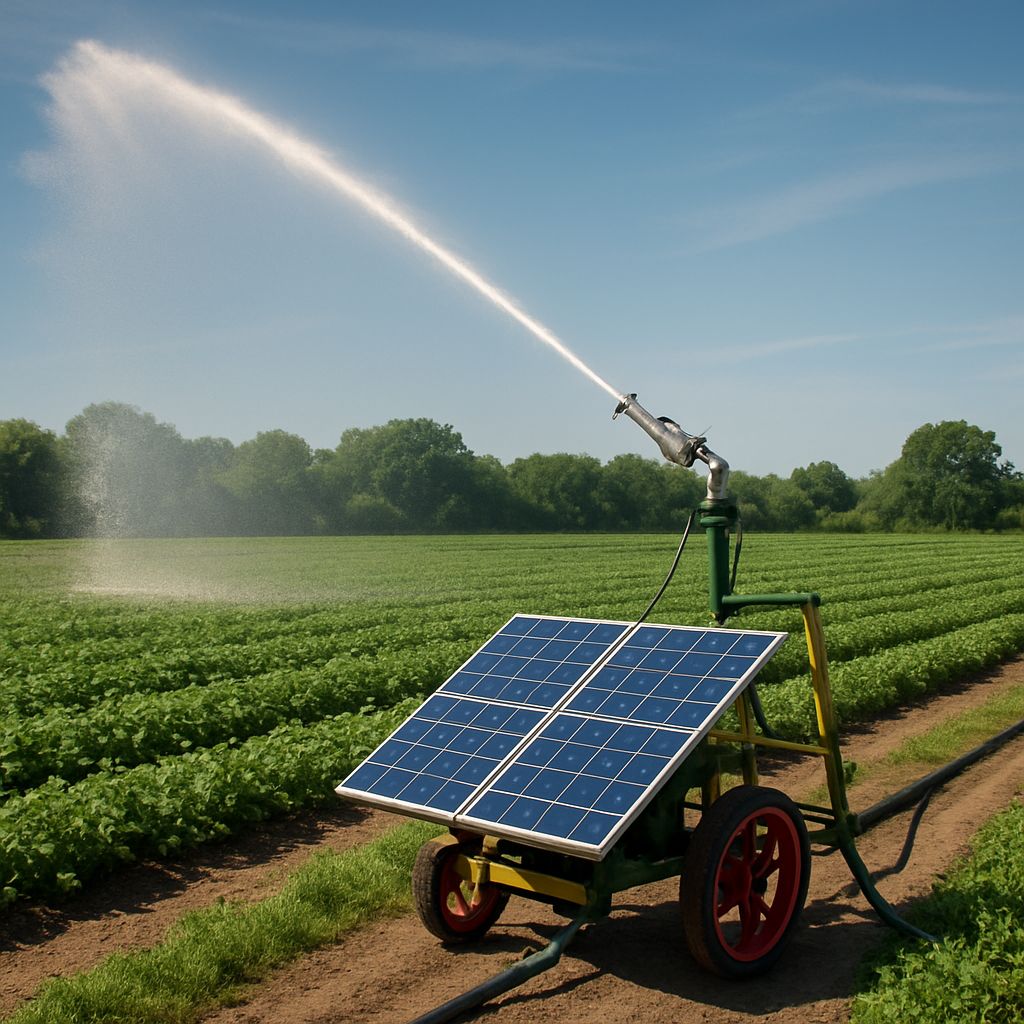
A traveling gun sprinkler system is exactly what it sounds like — a large-volume sprinkler head mounted on a wheeled cart that moves itself across a field while irrigating. Water is supplied through a flexible hose connected to a pump, and as pressure pushes water through the gun, a separate cable or water-powered turbine mechanism pulls the cart slowly across the field. The result is a wide, even arc of water coverage that follows the cart’s path from one end of the field to the other.
These systems are built for scale. A single traveling gun can cover anywhere from 1 to 5 acres per hour depending on the nozzle size, pressure, and travel speed. That kind of throughput makes them genuinely practical for mid-to-large operations where drip lines or stationary sprinklers would require enormous infrastructure investment to achieve the same coverage. Growing Solar Mist highlights this scalability as one of the primary reasons farmers are pairing traveling guns with solar power — the combination delivers broad coverage without grid dependency.
How the Gun Moves Across the Field
Movement is driven by one of two mechanisms: a water-powered turbine built into the cart, or an electric motor. In turbine-driven models, water pressure itself powers a gearbox that reels in the supply hose, pulling the cart forward at a controlled pace. Electric motor models draw power directly from the solar array or battery bank, giving farmers more precise speed control independent of water pressure variations. Either way, the cart follows a straight path defined by the hose lay, making field layout planning a critical part of effective operation.
Water Coverage and Application Rates
Coverage width depends on nozzle size and operating pressure. Most traveling guns operate between 60 and 100 PSI, throwing water in an arc of 100 to 300 feet in diameter. Application rates typically range from 0.25 to 1.5 inches per hour — adjustable by changing travel speed, nozzle diameter, or both. This flexibility is one of the system’s strongest practical advantages, since different crops and soil types demand very different water delivery rates. For farms looking to optimize energy usage, solar panels can power farm equipment and enhance irrigation efficiency.
How Solar Power Replaces Grid Electricity in These Systems
The pump is the system’s primary power draw. In a conventionally powered setup, that pump runs on grid electricity or a diesel generator — both of which carry ongoing fuel or utility costs. Solar replaces that energy source with panels feeding power directly to the pump motor, either in real time during daylight or via a battery bank that stores energy for early morning or late evening operation.
For small operations irrigating 5–10 acres, a 5–10 kW solar array typically provides sufficient power. Larger operations covering 50+ acres may require 25–50 kW systems with battery backup to maintain consistent pressure and flow. The solar components add upfront cost, but they eliminate the per-hour fuel expense that makes diesel-powered systems increasingly expensive to run at scale. Learn more about the benefits of solar panels for farm irrigation systems.
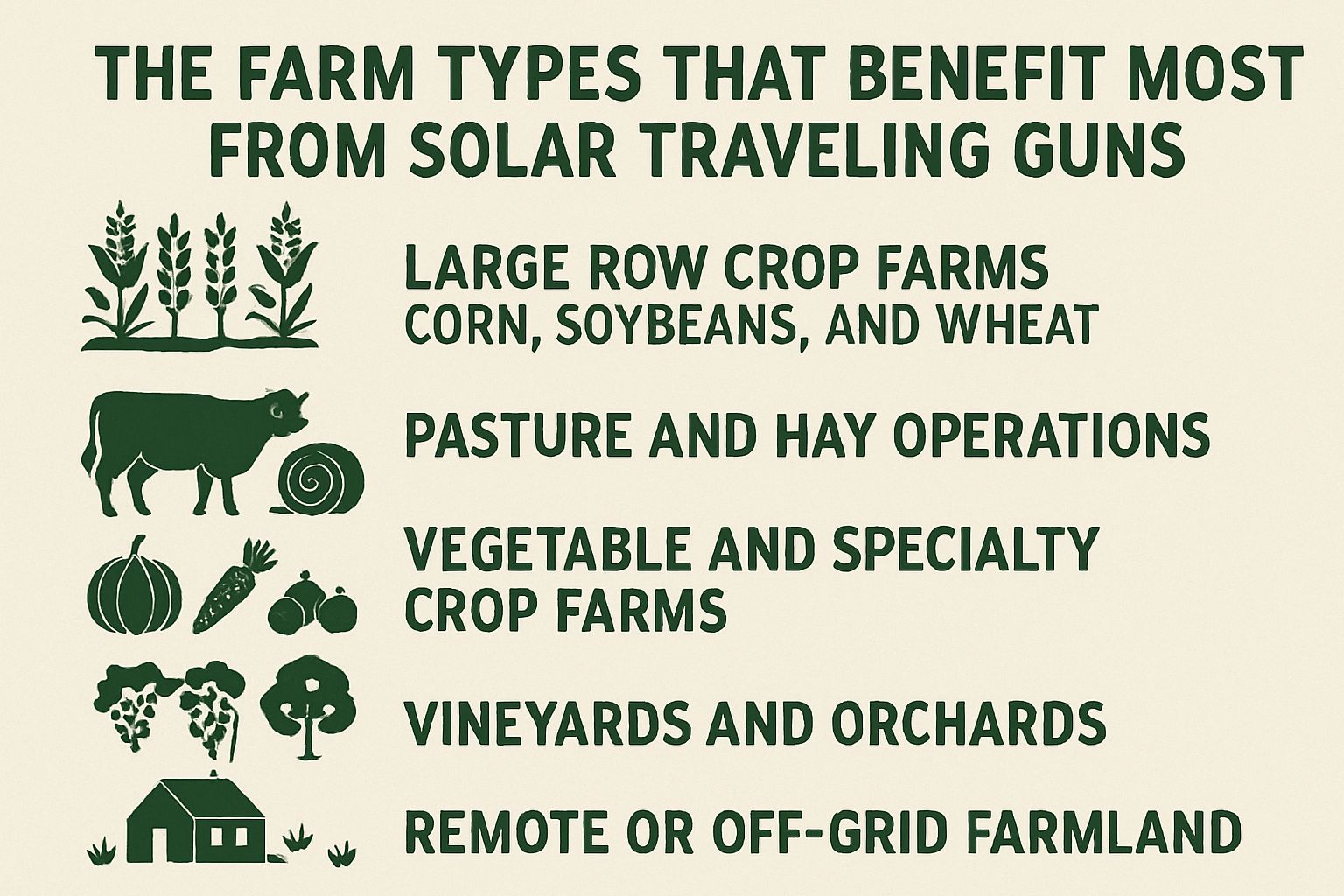
The Farm Types That Benefit Most From Solar Traveling Guns
Solar traveling gun systems are not universally ideal — but for the right farm profile, they are one of the most cost-effective and sustainable irrigation investments available. The farms that get the most value share a few common traits: open fields with consistent sun exposure, moderate to large acreage, and either limited grid access or a strong motivation to reduce energy costs long-term.
Large Row Crop Farms: Corn, Soybeans, and Wheat
Row crop operations are the classic use case for traveling gun irrigation. Corn, soybeans, and wheat all benefit from periodic deep watering rather than frequent light applications — a delivery pattern that traveling guns handle extremely well. The wide coverage arc means a single system can service a large field in one pass, and the adjustable travel speed lets farmers fine-tune application depth to match crop growth stage. For a 200-acre corn operation, a well-sized solar traveling gun system can replace thousands of dollars in annual diesel or electricity costs while maintaining the same irrigation performance.
Pasture and Hay Operations
Pasture irrigation is often overlooked, but traveling guns are particularly well-matched to it. Hay fields and grazing pastures tend to be large, relatively flat, and don’t require the precision irrigation that vegetable crops demand. That simplicity makes them ideal for solar traveling gun systems — lower pressure requirements mean smaller pump sizes, which in turn means smaller solar arrays and lower installation costs. Farmers running cattle or sheep operations in drier climates have found that irrigating pastures through the dry season dramatically increases carrying capacity and reduces the need to purchase supplemental feed.
Vegetable and Specialty Crop Farms
Vegetable farms present a more nuanced picture. Traveling guns work well for field vegetables like sweet corn, pumpkins, melons, and potatoes — crops grown in rows with enough spacing to tolerate overhead irrigation without disease pressure becoming a serious issue. However, crops sensitive to foliar moisture, like tomatoes or peppers grown for processing, require careful scheduling to avoid fungal problems. When managed correctly — irrigating in the morning so foliage dries quickly — solar traveling guns can be highly effective on vegetable operations.
The mobility of a traveling gun system is a major advantage on diversified vegetable farms. Rather than installing fixed infrastructure across multiple fields, a single system can be relocated as crop rotation demands. This flexibility reduces capital investment while keeping every field accessible to supplemental irrigation when needed.
- Sweet corn and pumpkins — high water demand, wide row spacing, tolerates overhead application
- Potatoes — consistent moisture critical during tuber development, large acreage common
- Melons and squash — benefits from deep, infrequent watering aligned with traveling gun output
- Cover crops and green manures — establishment irrigation is straightforward and low-pressure
- Forage crops (alfalfa, clover) — high water volume needs matched well by traveling gun capacity
What ties these crops together is their tolerance for overhead water delivery and their scale — most are grown across enough acreage to make a traveling gun system more economical than drip or micro-irrigation alternatives.
Vineyards and Orchards
Vineyards and orchards are less common applications for traveling gun systems, but they’re not off the table. Young plantings in establishment years often benefit from the kind of broad-area irrigation a traveling gun provides, particularly when drip systems haven’t yet been installed. For established vineyards, traveling guns are sometimes used as a frost protection measure — circulating water over vines during cold nights to prevent ice damage — rather than as primary irrigation. Solar power makes this application particularly attractive since frost events happen at night and in shoulder seasons when grid costs can be high.
Orchard applications follow similar logic. Mature tree crops typically rely on drip or microjet irrigation for precision water delivery, but traveling guns fill a useful role in establishment irrigation, cover crop management between rows, and heat stress mitigation during extreme temperature events.
Remote or Off-Grid Farmland
- No grid connection required — solar panels and battery storage provide complete energy independence
- Eliminates diesel transport costs — no need to haul fuel to remote field locations
- Opens previously unirrigated land — acreage that was too costly to develop becomes viable
- Lower infrastructure investment — no need to extend power lines across long distances to reach the field
Remote farmland is arguably where solar traveling gun systems deliver their strongest value proposition. Extending grid power to an isolated field can cost anywhere from $15,000 to $50,000 per mile depending on terrain and local utility rates. A solar array capable of running a traveling gun pump on the same field might cost $8,000 to $20,000 installed — with zero ongoing fuel or utility expenses.
Farmers with dryland acreage that sits far from existing infrastructure have used solar traveling gun systems to convert previously rain-dependent fields into reliably productive ones. The ability to store solar energy in batteries and run the pump during optimal morning hours — even when direct sunlight isn’t hitting the panels — makes the system genuinely functional across a full growing season, not just on clear summer days.
The economics shift decisively in favor of solar when you factor in the 60–80% energy cost reduction over diesel alternatives, combined with the elimination of grid extension capital costs. For remote operations, the payback period on a solar traveling gun system is frequently shorter than for farms with existing grid access — simply because the baseline cost of the alternative is so much higher.
Field Conditions That Determine If This System Fits Your Farm
Before investing in a solar traveling gun system, the physical characteristics of your land matter as much as the crop you’re growing. A system that performs flawlessly on a flat 100-acre wheat field may struggle on an irregularly shaped pasture with variable soil depth. Evaluating these conditions upfront prevents costly mismatches between system design and field reality.
- Field size — Traveling gun systems are most cost-effective on fields of 20 acres or more
- Field shape — Long, rectangular fields maximize system efficiency; irregular shapes require repositioning and reduce coverage consistency
- Soil type — Sandy soils require slower application rates; clay-heavy soils need careful scheduling to prevent runoff
- Terrain slope — Grades above 5% can cause uneven water distribution and cart drift
- Sun exposure — Panels need unobstructed southern exposure for 6+ hours daily during peak growing season
- Water source proximity — The pump location relative to the field affects hose length requirements and pressure loss calculations
Understanding these variables doesn’t just help you decide whether a traveling gun system fits your farm — it shapes every specification decision that follows, from pump sizing to panel count to battery capacity. Skipping this assessment is the most common reason farmers end up with undersized or over-engineered systems that don’t perform as expected.
Each condition below deserves individual attention because the interaction between them determines your system’s real-world output. A farm with ideal soil but poor sun exposure will underperform just as reliably as one with perfect sun but problematic terrain.
Field Size and Shape Requirements
Traveling gun systems reach their efficiency ceiling on large, open, rectangular fields. The reason is straightforward — the cart travels in a straight line, and the hose layout defines that line before the run begins. On a 40-acre rectangular field, you might complete full coverage in two or three hose lays with minimal repositioning. On an L-shaped or triangular field of the same acreage, you’ll spend significantly more time repositioning the cart and resetting hose runs, reducing effective irrigation hours per day.
The practical minimum for cost-effective operation is generally 20 acres, though smaller fields can justify the investment when solar eliminates the need for grid infrastructure. Fields narrower than 200 feet present challenges with water overlap and cart alignment, while fields wider than 600 feet may require larger nozzle configurations to achieve complete coverage in a single pass.
Soil Type and Water Absorption Rate
Soil infiltration rate is the factor most often overlooked during system selection, and it directly controls how fast you can apply water without generating runoff. Sandy loam soils with infiltration rates of 1–2 inches per hour can handle a traveling gun’s full output capacity. Heavy clay soils with infiltration rates below 0.5 inches per hour require slower cart travel speeds, lower application rates, or both — which in turn reduces daily acreage coverage and may require a larger or second system to meet crop water demand during peak summer heat.
Terrain and Slope Considerations
Flat to gently rolling terrain — slopes under 3% — is the ideal operating environment for a traveling gun cart. Steeper grades create two distinct problems: the cart may drift off its intended path as it travels uphill or downhill, and water distribution becomes uneven as gravity pulls the spray pattern toward the lower side of the slope. On fields with grades between 3–5%, anchoring systems and heavier cart designs can compensate. Above 5%, traveling guns become genuinely difficult to operate reliably without significant engineering adjustments.
Terrain also affects pump performance. Every 10 feet of elevation change between the water source and the field adds approximately 4.3 PSI of additional pressure requirement. On hilly farms where the water source sits below field level, this elevation head must be factored into pump sizing — and by extension, into solar array sizing — to ensure the system maintains adequate operating pressure throughout the irrigation run.
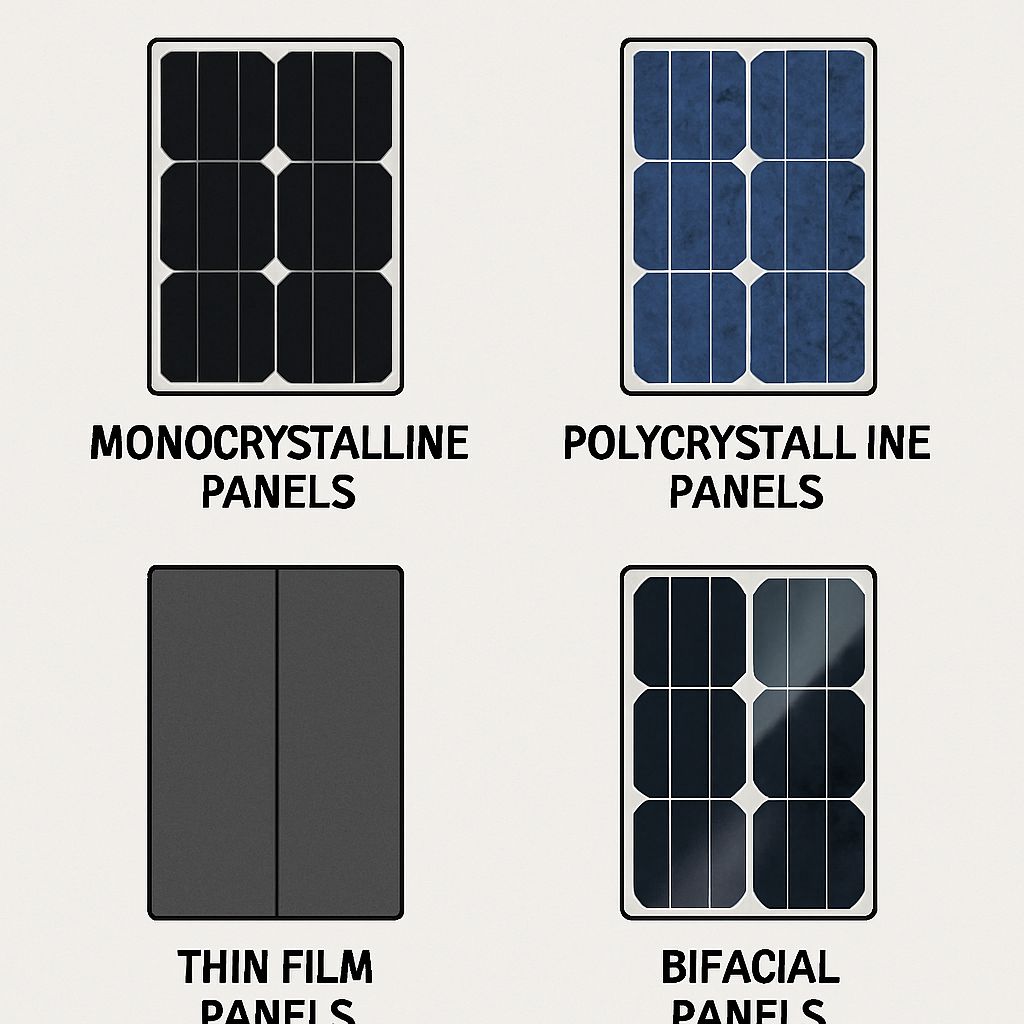
Solar Panel Types Used in Traveling Gun Irrigation Systems
The solar panels in an irrigation system aren’t just a power source — they determine how efficiently your system converts available sunlight into pump output, and how well it performs under real-world conditions like heat, partial shading, and seasonal changes in sun angle. Choosing the right panel type for your specific climate and field setup is a decision that compounds over the 25–30 year lifespan of the array.
Four main panel technologies appear in agricultural solar irrigation installations: monocrystalline, polycrystalline, thin film, and bifacial. Each has a distinct efficiency profile, cost point, and performance characteristic that makes it more or less suitable depending on your operation’s priorities.
Efficiency ratings in solar panels refer to the percentage of incoming sunlight converted to usable electricity. For irrigation purposes, higher efficiency means fewer panels are needed to drive the same pump — which matters significantly when mounting space on a mobile or semi-permanent installation is limited. A 400W monocrystalline panel occupying roughly 22 square feet will outperform a 300W polycrystalline panel of similar size in most conditions. For more information, check out the benefits of solar panels for farm irrigation systems.
Temperature coefficient is another specification that directly affects irrigation performance. All solar panels lose efficiency as they heat up — but the rate of that loss varies by panel type. In hot summer conditions when irrigation demand is highest, a panel with a lower temperature coefficient (expressed as %/°C) will maintain better output than one with a higher coefficient, even if their rated wattages are identical.
Here is a comparison table of the four best solar panel types for agricultural use — focusing on features, efficiency, and suitability for farms:
|
Solar Panel Type |
Efficiency Range |
Cost per Watt (Approx.) |
Key Advantages for Agriculture |
Limitations |
Best Farm Applications |
|---|---|---|---|---|---|
|
Monocrystalline Panels |
17–22% 1 |
$0.90–$1.50 2 |
High efficiency, compact design, long lifespan, performs well in all climates |
Higher upfront cost |
Space-limited farms, rooftops, and irrigation systems 1 |
|
Polycrystalline Panels |
13–17% 3 |
$0.70–$1.00 3 |
Lower cost, durable, long lifespan, strong in direct sunlight |
Requires more space, less efficient in cloudy conditions | |
|
Thin-Film Panels |
10–13% 5 |
$0.50–$0.90 2 |
Lightweight, flexible, better low-light/shaded performance |
Lower efficiency, shorter lifespan |
Greenhouses, barns, shaded or irregular terrain 5 |
|
Bifacial Panels |
18–22% 6 |
$1.00–$1.60 6 |
Captures light from both sides, high energy yield, great for reflective surfaces like grass or soil |
Higher cost, more complex installation |
Agrivoltaics (dual-use with crops), open-field installations 6 |
These four types of solar panels represent the most effective options for agricultural operations, allowing farmers to select between high efficiency (monocrystalline, bifacial) and lower-cost scalability (polycrystalline, thin-film) depending on land availability, sunlight exposure, and budget.
Monocrystalline Panels
Monocrystalline panels are the most widely used option in solar irrigation installations, and for good reason. Their 17–22% efficiency rating means more watts per square foot than any other standard technology, which is critical when mounting space on a pump skid or mobile cart is limited. They also carry the lowest temperature coefficient among crystalline silicon panels, holding output better during the mid-afternoon heat when irrigation demand peaks.
The tradeoff is cost — monocrystalline panels carry a price premium of roughly 20–30% over polycrystalline equivalents. For a permanent installation where the panels will run for 25+ years, that premium is typically recovered within the first few years of operation through better energy yield. For temporary or seasonal setups, the calculus shifts depending on how many operating hours per year the system accumulates.
Polycrystalline Panels
Polycrystalline panels offer a practical middle ground for farmers who need to cover large arrays at lower upfront cost. Their 13–17% efficiency means you’ll need roughly 25% more panel area to match the output of a monocrystalline array, but on a ground-mounted farm installation where space isn’t constrained, that’s often an acceptable tradeoff. They perform best in mild-temperature climates where the higher temperature coefficient is less of a liability during operating hours. For more information on solar-powered systems for farmers, you can explore solar-powered traveling gun irrigation systems.
Thin Film Panels
Thin film technology has the lowest efficiency of the four types at 10–13%, but it compensates with the best temperature performance and the most flexibility in mounting configuration. In climates where summer temperatures regularly exceed 95°F — the American Southwest, Southern Plains, and similar regions — thin film panels can outperform crystalline silicon on a per-hour basis during peak heat despite their lower rated wattage. They’re also lighter and more flexible, making them worth considering for mobile installations where weight is a constraint.
Bifacial Panels
Bifacial panels generate electricity from both their front and rear surfaces, capturing reflected light from the ground or any surface beneath the array. On a ground-mounted installation over light-colored soil or gravel, rear-side gain of 10–20% above the panel’s rated output is achievable — effectively making a 400W bifacial panel perform like a 440–480W standard panel without any additional hardware. This makes bifacial technology particularly compelling for permanent pump station installations where the panels are mounted on fixed ground structures.
The higher upfront cost of bifacial panels is offset faster than the table above might suggest, because the effective energy output exceeds the nameplate rating in a way that standard efficiency comparisons don’t fully capture. For a farmer sizing a system to run a 10 HP pump for 8 hours daily, switching from monocrystalline to bifacial panels can reduce the total panel count required by 15–20%, which partially offsets the per-panel price difference.
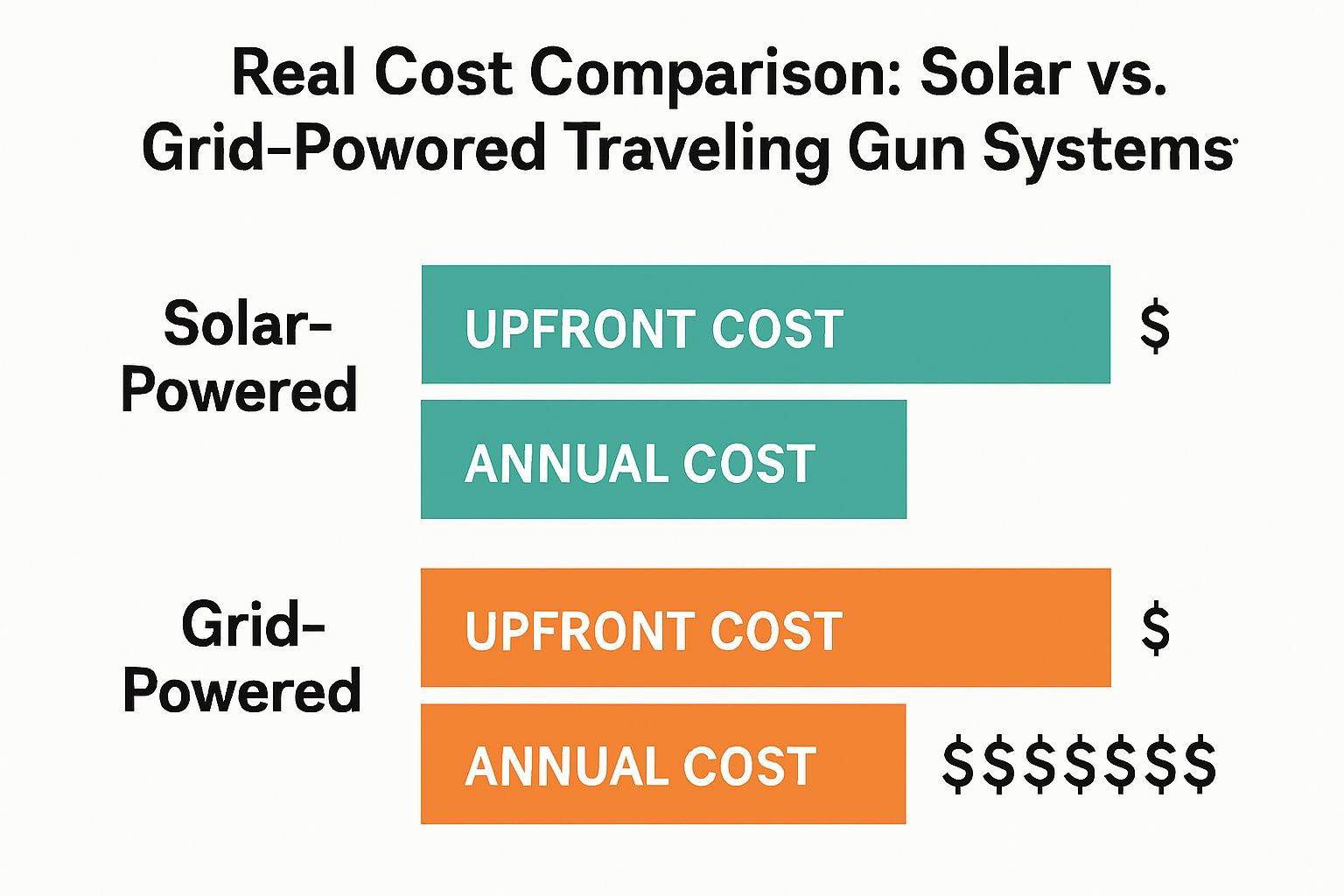
Real Cost Comparison: Solar vs. Grid-Powered Traveling Gun Systems
The financial case for solar traveling gun irrigation comes down to two numbers: what you pay upfront and what you stop paying every year afterward. Understanding both sides of that equation — with real figures rather than generalizations — is what turns a theoretical sustainability argument into a concrete farm business decision.
Upfront Installation Costs
A complete solar-powered traveling gun system includes the traveling gun cart and hose reel, the pump and motor assembly, the solar array, mounting structure, charge controller, battery bank (if included), wiring, and installation labor. Each component carries its own cost, and system size scales with acreage and crop water demand. For more details on these solar-powered traveling gun irrigation systems, you can explore further resources.
For a small operation irrigating 10–20 acres with moderate water requirements, a complete system — including a 5–7.5 HP pump, 5–8 kW solar array, basic battery storage, and a mid-range traveling gun cart — typically runs between $12,000 and $22,000 installed. Mid-scale operations covering 50–100 acres with a 15–25 HP pump and 20–30 kW array should budget $35,000 to $65,000. Large operations exceeding 200 acres with high-volume pumping requirements can reach $80,000 to $150,000 for a fully solar-powered system with substantial battery backup.
By comparison, a diesel-powered traveling gun system at the same pump sizes carries lower hardware costs but adds ongoing fuel expenses of $8,000 to $25,000 per season depending on hours of operation and local diesel prices. A grid-connected system eliminates fuel costs but may require $15,000 to $50,000 in power line extension costs for remote fields, plus ongoing electricity rates that have risen consistently over the past decade.
Cost Snapshot: 50-Acre Row Crop Operation
Solar System: ~$45,000 installed | $0 fuel cost annually | Est. payback: 6–9 years
Diesel System: ~$18,000 installed | $12,000–$18,000/year fuel | Costs compound annually
Grid-Connected: ~$28,000 (includes line extension) | $4,000–$8,000/year electricity | Subject to rate increasesOver a 15-year period, the solar system typically delivers the lowest total cost of ownership of the three options.
Federal tax incentives can significantly reduce the net cost of solar agricultural installations. The Investment Tax Credit (ITC) currently allows farmers to deduct 30% of the solar system cost from federal taxes — a $45,000 system effectively costs $31,500 after the credit. USDA REAP (Rural Energy for America Program) grants can cover up to 50% of project costs for eligible agricultural operations, further compressing the payback period.
Long-Term Energy Savings
The 60–80% energy cost reduction that solar traveling gun systems deliver over diesel alternatives is not a marketing figure — it reflects the fundamental difference between a fuel-burning engine running at $3.50–$5.00 per gallon and a solar array that, after the initial investment, generates electricity at effectively zero marginal cost. A farmer running a diesel pump for 600 hours per season at a fuel burn rate of 1.5 gallons per hour is spending $3,150 to $4,500 on fuel alone — every single season, indefinitely. The solar array eliminates that recurring expense from year one of operation.
Challenges Farmers Face with Solar Traveling Gun Systems
No irrigation technology is without trade-offs, and solar traveling gun systems are no exception. The challenges that come with this setup are real and manageable — but only if you go in with a clear understanding of what they are and how to address them before they affect your operation mid-season.
The three most significant challenges are weather-dependent power generation, battery storage limitations, and the maintenance demands of a system that combines mechanical, electrical, and hydraulic components. Each one has practical solutions, but each also requires deliberate planning at the design stage rather than reactive fixes after installation.
What separates farmers who get excellent long-term results from those who feel burned by the investment is almost always the quality of the upfront system design. An undersized battery bank, a poorly positioned solar array, or a maintenance schedule that doesn’t account for agricultural dust and debris can undermine an otherwise well-specified system within a single growing season.
Common Solar Traveling Gun System Challenges at a Glance
Cloudy weather: Reduced panel output on overcast days can cut pump performance by 30–60% without battery backup
Battery sizing: Undersized battery banks fail to bridge morning startup demand or carry overnight storage
Panel soiling: Dust, pollen, and crop debris can reduce panel efficiency by 15–25% if not regularly cleaned
Mechanical wear: Hose reels, cart wheels, and gun nozzles require scheduled inspection and replacement
Water pressure variation: Battery discharge during long runs can cause pump pressure to drop, reducing coverage consistency
Understanding these challenges in detail gives you the framework to evaluate any proposed solar panel irrigation system design critically — and to ask the right questions of any installer or equipment supplier before signing a contract.
Cloudy Weather and Inconsistent Sunlight
Solar panels don’t stop working on cloudy days — they just work at reduced capacity. Depending on cloud density, output can drop to anywhere from 10% to 70% of rated capacity. For a pump system that needs consistent pressure to deliver predictable water application, that variability is a real operational problem without a mitigation strategy built into the system design.
The most effective solution is battery storage sized to cover at least 2–4 hours of full pump operation beyond what the panels can supply in real time. This buffer smooths out the output dips caused by passing clouds and ensures consistent pressure throughout the irrigation run. For operations in regions with frequent overcast conditions — the upper Midwest, Pacific Northwest, or high-altitude growing areas — a battery bank capable of covering a full day’s irrigation demand is worth the additional capital investment.
Scheduling also matters. Running irrigation during the peak solar window — typically 9 AM to 3 PM — maximizes the direct panel-to-pump energy pathway and minimizes battery draw. Farmers who shift their irrigation windows to align with peak generation hours often find that a smaller battery bank than originally specified is sufficient to handle the cloud variability their region actually produces.
Battery Storage and Power Management
Battery storage is the most technically complex element of a solar irrigation system and the one most frequently undersized during the initial design phase. The temptation to reduce upfront cost by specifying a minimal battery bank is understandable, but it creates a system that performs well on clear days and unreliably on every other day — which, across a full growing season, can mean significant gaps in irrigation coverage during the exact periods when crop water stress is highest.
Lithium iron phosphate (LiFePO4) batteries are now the preferred chemistry for agricultural solar applications, offering 3,000–5,000 charge cycles, stable discharge performance across a wide temperature range, and a usable depth of discharge of 80–90% without accelerated degradation. Lead-acid batteries cost less upfront but deliver fewer cycles, require more maintenance, and lose significant capacity in cold early-morning conditions when irrigation startup demand is highest. For a system expected to run for 10–15 seasons, the lifetime cost of lithium storage is typically lower than lead-acid despite the higher initial price.
Maintenance Requirements
A solar traveling gun system has three maintenance domains: the solar array, the pump and motor assembly, and the mechanical traveling gun components. Solar panels require periodic cleaning — monthly during dusty or pollen-heavy seasons — and annual inspection of wiring connections, mounting hardware, and charge controller settings. The pump and motor need seasonal bearing lubrication, seal inspection, and impeller checks, particularly at the end of each irrigation season before winterization. The traveling gun cart itself demands attention to wheel bearings, hose condition, nozzle wear, and the reel mechanism’s gear or turbine drive. Building a written maintenance schedule that covers all three domains before the first season of operation is the single most effective way to extend system life and prevent mid-season failures.
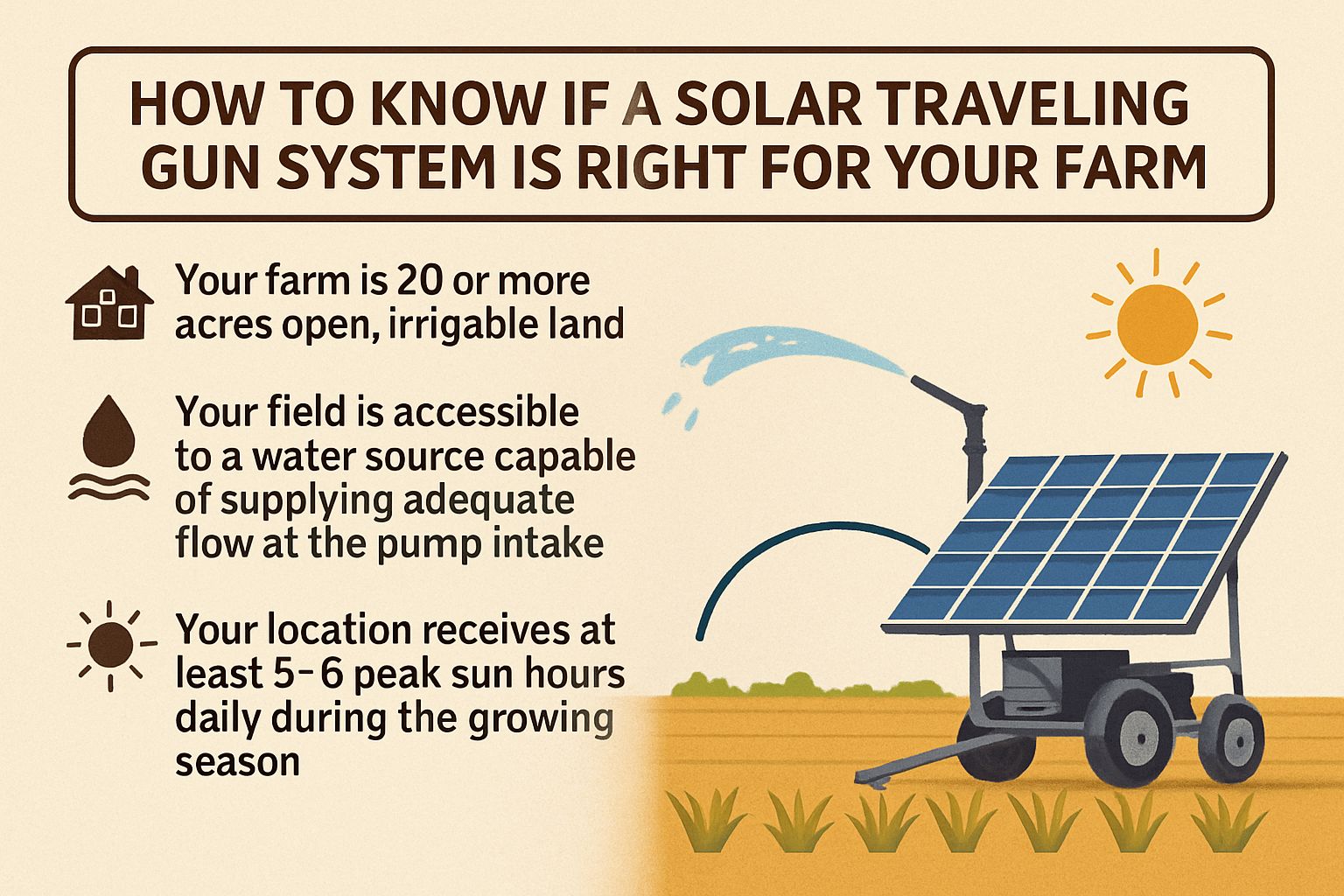
How to Know If a Solar Traveling Gun System Is Right for Your Farm
The clearest signal that a solar traveling gun system fits your operation is a combination of four factors aligning simultaneously: you have 20 or more acres of open, irrigable land; your field is accessible to a water source capable of supplying adequate flow at the pump intake; your location receives at least 5–6 peak sun hours daily during the growing season; and your current irrigation energy costs — whether diesel or grid — represent a meaningful recurring expense that you’re motivated to reduce. If all four conditions are true, the economics and operational fit are almost certainly there. If two or three apply, the system may still work with design adjustments. If only one applies, a different irrigation technology is likely a better match for your specific situation. For more on renewable energy solutions, check out how farm solar panels power equipment and tools.
Frequently Asked Questions
These are the questions farmers most commonly ask when evaluating solar traveling gun systems for the first time — answered directly with the specifics that actually matter for a farm purchase decision.
Can a solar traveling gun system work on a small farm under 50 acres?
Yes — a solar traveling gun system can work on a farm under 50 acres, and in many cases it works very well. The key variable isn’t just acreage; it’s whether the field size justifies the system’s capital cost relative to the alternatives. On a 15–30 acre farm without grid access, solar traveling gun systems frequently deliver a faster payback than any other powered irrigation option because they eliminate both grid extension costs and ongoing diesel expenses simultaneously.
For farms in the 10–20 acre range, a compact system built around a 3–5 HP pump and a 4–6 kW solar array — total installed cost in the $10,000–$16,000 range before tax incentives — can cover the entire field in daily or every-other-day irrigation cycles depending on crop water demand and travel speed settings. The system scales down effectively because pump power requirements drop significantly with acreage and flow volume reductions.
The honest caveat for smaller farms is that the cost-per-acre of the solar components is higher at small scale than at large scale. A 10-acre installation won’t achieve the same economies of scale as a 100-acre system using the same panel technology and pump infrastructure. If grid power is readily available and a standard electric pump is a viable alternative, that comparison deserves a serious look before committing to solar on a small acreage — particularly if the field doesn’t require the mobility and large-area coverage that makes traveling gun systems their most compelling case.
How many solar panels does a traveling gun irrigation system need?
Panel count depends on pump horsepower, daily operating hours, and the efficiency of the panels selected. As a practical starting point: every 1 HP of pump motor draw requires approximately 800–1,000 watts of solar panel capacity to run the pump directly during peak sunlight. A 10 HP pump therefore needs roughly 8–10 kW of panels for direct daytime operation — that’s 20–25 standard 400W monocrystalline panels. If battery storage is included and the system needs to operate during early morning or late afternoon hours beyond peak solar window, panel count increases by 30–50% to account for charging the battery bank during operating hours.
Climate and location matter significantly in this calculation. A farmer in Arizona or central California can extract more daily energy hours from the same panel array than one in the upper Midwest or Pacific Northwest. NREL’s PVWatts calculator — a free online tool — allows farmers to input their specific GPS coordinates and system specifications to generate location-accurate energy production estimates, which is a more reliable basis for panel sizing than generalized rules of thumb.
What happens to the system on cloudy or rainy days?
On overcast days, the system continues to generate power — just at reduced output. Light cloud cover typically reduces panel output to 50–70% of rated capacity; heavy overcast can bring it down to 10–25%. Whether that reduced output is sufficient to run the pump depends entirely on how the system was designed and whether battery storage is included.
A well-designed system handles cloudy days through one or more of three strategies. First, battery storage provides a power buffer that allows the pump to run at full capacity even when panel output is temporarily reduced. Second, variable frequency drives (VFDs) on the pump motor allow the system to run at reduced speed and flow rate on available power rather than shutting down entirely. Third, smart controllers can automatically reschedule irrigation runs to periods when solar forecasts show better generation potential, reducing wasted pump cycles on low-production days.
- Battery backup: Stores excess energy from sunny periods to bridge cloudy-day gaps
- Variable frequency drive (VFD): Allows pump to operate at partial capacity on reduced solar input
- Smart scheduling: Automated controllers shift irrigation windows to peak solar hours
- Hybrid backup: Some systems include a small grid or generator connection for multi-day cloud events
- Rainy days: Irrigation is typically unnecessary during active rainfall, aligning naturally with low solar generation
Rainy days are actually the least concerning scenario in this context — active rainfall eliminates the need for irrigation entirely, so low panel output on genuinely rainy days rarely causes a practical problem. The more challenging scenario is a string of heavily overcast but dry days during peak crop water demand, which is where battery storage capacity and system design quality make the most meaningful difference in operational continuity.
Are solar traveling gun systems eligible for agricultural energy grants or tax credits?
Yes, and the available incentives are substantial enough to meaningfully change the investment math for most farm operations. The two most significant programs in the United States are the federal Investment Tax Credit (ITC) and the USDA Rural Energy for America Program (REAP) grant.
The ITC currently provides a 30% tax credit on the installed cost of solar energy systems, including agricultural irrigation applications. This credit applies dollar-for-dollar against federal income tax liability — meaning a $40,000 solar irrigation system generates a $12,000 federal tax credit, reducing the effective system cost to $28,000. REAP grants, administered through USDA Rural Development, can cover up to 50% of the total project cost for eligible agricultural producers and rural small businesses. REAP applications are competitive and require documentation of energy use and project specifications, but approval rates for well-documented agricultural solar projects have been consistently strong in recent application cycles.
Key Incentive Programs for Solar Agricultural Irrigation (U.S.)
Federal ITC: 30% tax credit on total installed solar system cost — applies to irrigation pump systems
USDA REAP Grant: Up to 50% of project cost covered for eligible agricultural producers
USDA REAP Loan Guarantee: Up to 75% of project cost for projects not fully covered by grant funding
State-Level Programs: Many states offer additional rebates, property tax exemptions on solar equipment, and sales tax exemptions on solar hardware purchases — check DSIRE (Database of State Incentives for Renewables & Efficiency) for your state’s current offerings
MACRS Depreciation: Solar agricultural equipment qualifies for 5-year accelerated depreciation under the Modified Accelerated Cost Recovery System, providing additional tax benefit in early system years
Stacking the ITC with a REAP grant and state-level incentives can reduce the net out-of-pocket cost of a solar traveling gun system by 50–65% in some cases. Farmers who work with an agricultural tax advisor and a solar installer familiar with REAP application requirements consistently achieve better incentive outcomes than those who navigate the programs independently.
How long does it take to set up a solar-powered traveling gun system on a new field?
Setup time breaks into two distinct phases: the permanent infrastructure installation and the per-field operational setup before each irrigation run. Understanding the difference prevents unrealistic expectations about how quickly the system becomes operational after purchase.
The permanent installation phase — mounting solar panels, installing the pump station, running wiring, connecting the charge controller and battery bank, and commissioning the system — typically takes 2–5 days for a professional installation crew on a straightforward site. Complex sites with rocky terrain, significant distance between the water source and pump pad, or custom panel mounting structures can extend this to 7–10 days. Most farmers can expect their system to be generating power and running test pump cycles within one week of installation crew arrival, assuming equipment has been pre-staged on site. For more information on the key components of a farm solar panel system, you can visit this comprehensive guide.
The per-field operational setup — laying out the hose reel, positioning the traveling gun cart, connecting supply lines, and setting cart travel speed — takes 1–3 hours depending on field length and operator experience. First-time operators typically take longer as they develop a feel for hose lay tension, cart alignment, and pressure adjustment. By the third or fourth field setup, most operators can have a fully configured system ready to run in under 90 minutes.
The full first-season learning curve — optimizing travel speeds for your specific soils, dialing in the solar scheduling for your local weather patterns, and developing a reliable maintenance rhythm — generally takes one complete growing season. Farmers who commit to that learning process in year one consistently report high satisfaction with system performance from year two onward, when the operational patterns are established and the energy savings are fully realized.
Traveling gun sprinkler irrigation systems powered by solar panels are becoming increasingly popular among farmers. These systems offer a sustainable and efficient way to water crops without relying on traditional power sources. The solar panels provide the necessary energy to move the sprinkler across the fields, ensuring even distribution of water. This method is particularly beneficial for large farms where manual irrigation would be time-consuming and labor-intensive. For more information on how these systems can benefit farmers, check out this article on solar-powered traveling gun irrigation systems.

Leave a Reply