

Article-At-A-Glance: Farm Solar Panel Components
- A complete farm solar panel system includes six core components: solar panels, racking/mounting, inverters, charge controllers, battery storage, and wiring with safety equipment.
- Monocrystalline panels are the most efficient option for space-limited farms, while polycrystalline panels offer a budget-friendly alternative with slightly lower output.
- Bifacial solar panels can capture energy from both sides, making them a powerful upgrade for open farmland with reflective ground surfaces.
- GrowingSolarMist.com provides farmers with in-depth guidance on choosing the right solar components for agricultural operations of any size.
- Keep reading to find out how solar pumps, inverters, and battery banks work together — and which setup makes the most sense for your specific farm operation.
A farm solar panel system is not just a row of panels on a roof — it is a connected network of components that work together to capture, convert, store, and deliver energy where your operation needs it most.
Whether you are running irrigation pumps across hundreds of acres or simply trying to cut the electricity bill on a small family farm, understanding what goes into a solar system puts you in control of the decision. GrowingSolarMist.com covers exactly this kind of practical solar knowledge for farmers looking to make informed energy choices.
Farm Solar Systems Are Simpler Than You Think
Most farmers assume solar is complicated. In reality, every farm solar system — regardless of size — runs on the same fundamental components. Once you understand what each part does, the whole system clicks into place. The complexity only comes in when you start scaling up or integrating with the grid, and even then, the building blocks stay the same.

Rigid Silicon vs. Thin-Film Solar Panels for Farms
The panel itself is where energy production begins. Sunlight hits the photovoltaic cells inside the panel, and those cells convert that light into direct current (DC) electricity. For agricultural use, panels generally fall into two broad categories: rigid silicon and thin-film. Each has a distinct profile in terms of efficiency, durability, cost, and where it performs best on a working farm.
Choosing the wrong panel type for your farm’s conditions is one of the most common and costly mistakes in agricultural solar installations. A high-efficiency monocrystalline panel on a budget-tight small farm might drain resources, while a thin-film setup on a large, power-hungry operation will simply underperform. Matching the panel type to the farm’s actual needs is the first real decision in building a functional system. For more information on solar panel farm operations, check out this detailed guide.
Monocrystalline Silicon Panels: High Efficiency for Space-Limited Farms
Monocrystalline panels are cut from a single continuous crystal of silicon, which gives them a uniform dark appearance and the highest efficiency ratings available in standard commercial panels — typically between 17% and 22%. At approximately $1.00 to $1.50 per watt, they cost more upfront, but their efficiency means fewer panels are needed to hit your target power output. For farms with limited roof space or restricted mounting areas, monocrystalline is the practical high-performance choice.
Polycrystalline Silicon Panels: A Cost-Effective Middle Ground
Polycrystalline panels are made by melting multiple silicon fragments together, which creates that recognizable blue, speckled look. Their efficiency typically lands between 15% and 17%, slightly below monocrystalline, but they come in at a lower cost per watt — making them a smart option for farms with more available mounting space and a tighter installation budget. Large farms powering pumps, grain dryers, and other machinery often find polycrystalline panels deliver excellent value when deployed at scale.
Thin-Film Panels: Flexible but Lower Output
Thin-film panels are made by depositing photovoltaic material onto a substrate like glass, plastic, or metal. They are lightweight, flexible in some configurations, and perform better than crystalline panels in high-heat or low-light diffuse conditions. The tradeoff is efficiency — thin-film panels generally operate between 10% and 13%, which means you need significantly more surface area to match the output of rigid silicon panels. They work well for large, open land installations where space is not a constraint and cost-per-watt is the priority.
Bifacial Panels: Double-Sided Energy Capture
Bifacial panels are a newer innovation that captures sunlight from both the front and rear surfaces of the panel. When mounted above reflective surfaces — such as light-colored soil, gravel, or even snow — the rear side picks up reflected light and adds to the total energy output. For open farmland with the right ground conditions, bifacial panels can meaningfully outperform standard single-face panels without requiring a larger footprint. To learn more about energy solutions for farms, explore the importance of solar panel backup batteries.
Here is a comparison table of the four best solar panel types for agricultural use — focusing on features, efficiency, and suitability for farms.
|
Solar Panel Type |
Efficiency Range |
Cost per Watt (Approx.) |
Key Advantages for Agriculture |
Limitations |
Best Farm Applications |
|---|---|---|---|---|---|
|
Monocrystalline Panels |
17–22% 1 |
$0.90–$1.50 2 |
High efficiency, compact design, long lifespan, performs well in all climates |
Higher upfront cost |
Space-limited farms, rooftops, and irrigation systems 1 |
|
Polycrystalline Panels |
13–17% 3 |
$0.70–$1.00 3 |
Lower cost, durable, long lifespan, strong in direct sunlight |
Requires more space, less efficient in cloudy conditions | |
|
Thin-Film Panels |
10–13% 5 |
$0.50–$0.90 2 |
Lightweight, flexible, better low-light/shaded performance |
Lower efficiency, shorter lifespan |
Greenhouses, barns, shaded or irregular terrain 5 |
|
Bifacial Panels |
18–22% 6 |
$1.00–$1.60 6 |
Captures light from both sides, high energy yield, great for reflective surfaces like grass or soil |
Higher cost, more complex installation |
Agrivoltaics (dual-use with crops), open-field installations 6 |
These four types of solar panels represent the most effective options for agricultural operations, allowing farmers to select between high efficiency (monocrystalline, bifacial) and lower-cost scalability (polycrystalline, thin-film) depending on land availability, sunlight exposure, and budget.
The Racking System: How Panels Are Mounted on a Farm
The racking system is what physically holds your panels in place — and it has a direct impact on how much energy those panels produce. Angle, orientation, and whether the panels move with the sun all factor into overall system performance. Getting the mounting right is not just about stability; it is about maximizing every hour of usable sunlight across the farming season.
Most farm installations use either fixed ground-mount systems or rooftop fixed mounts. Both are simple, durable, and low-maintenance. Tracking systems are available for operations that want to extract maximum output from every panel, but they come with higher installation costs and more moving parts to maintain — a real consideration on a working farm where downtime has consequences.
Fixed-Mount Systems: Low Cost, Low Maintenance
Fixed-mount racking holds panels at a set angle — typically between 20 and 35 degrees depending on the farm’s latitude — and pointed south in the northern hemisphere for maximum sun exposure. Once installed, there is nothing to adjust and very little that can go wrong mechanically. Aluminum and galvanized steel are the two most common frame materials, both rated to withstand wind loads, snow weight, and the general punishment of outdoor agricultural environments.
For the vast majority of farms, a fixed-mount system delivers reliable, cost-effective results with minimal ongoing attention. The energy output is predictable, the installation is straightforward, and maintenance typically comes down to periodic cleaning and visual inspections.
- Ground-mount fixed systems are ideal when rooftop space is limited or panel access for cleaning is a priority.
- Rooftop fixed mounts work well on barns, equipment sheds, and storage buildings with south-facing roof sections.
- Pole-mount fixed systems elevate panels above snow accumulation and allow for easier tilt adjustment seasonally.
- Ballasted fixed mounts are used on flat surfaces where ground penetration is not practical, held in place by weighted bases.
The right fixed-mount choice depends on what structures you already have, the layout of your land, and how much access you want to the panels after installation.
Single-Axis Tracking Systems: More Output, More Investment
A single-axis tracking system rotates panels along one axis — typically east to west — following the sun’s path throughout the day. Compared to a fixed-mount system, single-axis trackers can increase energy output by up to 25%, which on a large farm translates to a significant reduction in the number of panels needed to meet your power target. The tradeoff is mechanical complexity, higher upfront installation cost, and the need for periodic maintenance on the motors and drive systems that keep everything moving.
|
Mounting Type |
Best For |
Energy Gain vs. Fixed |
Maintenance Level |
Relative Cost |
|---|---|---|---|---|
|
Fixed Ground Mount |
Small to mid-sized farms |
Baseline |
Low |
Lowest |
|
Rooftop Fixed Mount |
Barn or shed installations |
Baseline |
Low |
Low |
|
Single-Axis Tracker |
Large open fields |
Up to 25% more |
Moderate |
Higher |
|
Dual-Axis Tracker |
Maximum output scenarios |
Up to 40% more |
High |
Highest |

Inverters, Charge Controllers, and Batteries Explained
Solar panels produce direct current (DC) electricity. Most farm equipment runs on alternating current (AC). The inverter, charge controller, and battery bank are the three components that bridge that gap — converting, regulating, and storing the energy your panels produce so it is available in the right form, at the right time, for the right equipment.
What a Solar Inverter Does on a Farm System
- String inverters connect a series of panels into one unit and are the most common and cost-effective option for straightforward farm installations.
- Microinverters attach to each individual panel, allowing panels to operate independently — useful when shading from trees or structures affects part of the array.
- Hybrid inverters manage both solar input and battery storage simultaneously, making them ideal for off-grid or backup-power farm setups.
- Three-phase inverters are used on larger farm operations where heavy machinery like grain augers or irrigation pump motors require three-phase AC power.
The inverter is the brain of the electrical conversion process. It takes the raw DC output from your panels and transforms it into the AC electricity that powers your farm infrastructure — lights, motors, refrigeration units, and anything else plugged into your system. For farms relying on solar power, understanding backup batteries benefits can further enhance energy efficiency and reliability.
Inverter sizing matters more than most farmers realize. An undersized inverter creates a bottleneck — your panels may produce 20 kilowatts at peak sun, but if your inverter is only rated for 15 kilowatts, you are losing 5 kilowatts of usable energy every clear afternoon. Proper sizing starts with calculating your peak load demand and then matching the inverter capacity to that figure with a reasonable buffer built in. For more insights on energy storage solutions, explore the benefits of backup batteries for solar panels on farms.
For grid-tied farm systems, the inverter also handles the critical function of synchronizing your solar output with the utility grid’s frequency and voltage — a process that happens automatically but requires a grid-tie certified inverter to meet utility interconnection standards.
Charge Controllers: Protecting Your Battery Bank
A charge controller sits between the solar panels and the battery bank, regulating the voltage and current flowing into the batteries to prevent overcharging. Without it, panels would push unregulated current directly into batteries, causing heat buildup, reduced lifespan, and in worst cases, battery failure. There are two main types used in farm systems: PWM (Pulse Width Modulation) controllers for smaller, simpler setups, and MPPT (Maximum Power Point Tracking) controllers for larger systems where efficiency is a priority. For those looking to boost solar power efficiency, integrating smart controllers can be a beneficial step.
MPPT charge controllers are the standard choice for serious farm solar installations. They continuously adjust their input to harvest the maximum available power from the panels — even as sunlight intensity shifts throughout the day — and can be up to 30% more efficient than PWM controllers under variable conditions. For a farm running substantial battery storage, that efficiency gain adds up quickly across a full season of operation.
Battery Storage: Powering Operations After Sundown
Battery storage is what separates a solar system that only works in daylight from one that supports around-the-clock farm operations. The most widely used battery technologies in agricultural solar systems are lead-acid and lithium iron phosphate (LiFePO4). Lead-acid batteries are lower cost upfront but require regular maintenance and have a shorter cycle life. Lithium iron phosphate batteries cost more initially but offer a significantly longer lifespan, deeper discharge capability, and essentially zero maintenance — making them increasingly the preferred choice for farm applications where reliability is non-negotiable.
Battery bank sizing is determined by how many kilowatt-hours (kWh) of storage you need to cover your farm’s energy demand during non-production hours. A small farm running a water pump and basic lighting might get by with a 10–20 kWh bank, while a larger operation with refrigeration, automation systems, and heavy equipment standby power may require 100 kWh or more of usable storage capacity. For more information on battery options, explore the different solar panel backup battery types available for farmers.
Solar Pumps and Irrigation Integration
Irrigation is one of the highest energy costs on any farm, and it is also one of the most natural fits for solar power. Solar-powered water pumps can operate directly from panel output during daylight hours, reducing or eliminating the electricity costs associated with moving water across fields, filling storage tanks, or supplying livestock watering systems. For more information on components and setup, check out this solar irrigation system guide.
The beauty of solar irrigation is in its alignment with natural rhythms — the sun is typically at its strongest during the same hot, dry periods when water demand is at its peak. This overlap means a well-designed solar pump system can deliver water precisely when it is needed most, without drawing from battery storage or grid backup power.
DC Pumps vs. AC Pumps: Which Is Right for Your Farm Size
DC solar pumps connect directly to the panel output without needing an inverter, making them simple, efficient, and cost-effective for smaller farm water needs like livestock watering or small garden irrigation. AC pumps require an inverter to convert DC solar power to AC before the pump can operate, but they offer higher flow rates, greater head pressure, and broader compatibility with standard agricultural pump infrastructure — making them the right call for large-scale irrigation systems covering multiple fields or operating at significant depths. For enhancing efficiency, consider integrating smart controllers and sensors into your irrigation systems.
Water Storage as a Buffer for Non-Daylight Hours
Rather than relying entirely on battery storage to run pumps after dark, many farms use water storage tanks as a practical energy buffer. Pumping water into elevated tanks or large ground-level reservoirs during peak solar hours means the water is available for gravity-fed distribution at any time — day or night — without any additional electrical demand. This approach is especially effective for livestock operations, where water access must be continuous regardless of sunlight conditions.

Wiring, Safety Equipment, and System Monitoring
Every solar component in the system is connected by DC and AC wiring that must be properly sized, rated, and protected. UV-resistant, direct burial-rated solar cables are the standard for outdoor farm installations, where wiring is exposed to sunlight, moisture, temperature swings, and occasional physical contact from equipment or animals. Undersized wiring creates resistance losses that quietly reduce your system’s output and can create heat-related fire hazards over time — a risk that is especially serious in structures like barns or storage buildings where flammable materials are present. For more details on solar systems in agriculture, you can explore solar irrigation system components.
Safety equipment includes DC disconnect switches, AC breaker panels, surge protection devices, and grounding systems that protect both the equipment and anyone working near the installation. Monitoring systems — either built into the inverter or installed as separate data loggers — give farm operators real-time visibility into energy production, consumption, and battery state. Modern monitoring platforms allow remote access via smartphone apps, so you can check system performance from anywhere on the property or even off-site, catching faults or underperformance before they become costly problems.
How All Components Work Together as One System
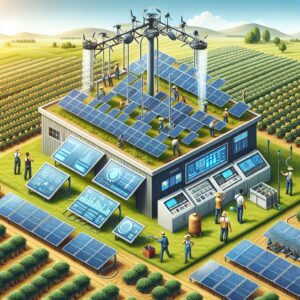
Every component described in this article does not operate in isolation — it is part of a carefully sequenced energy chain. Sunlight hits the panels, which generate DC electricity. That current flows through the charge controller into the battery bank for storage, or directly to the inverter for immediate conversion to AC power. The inverter then distributes usable electricity to pumps, motors, lights, and any other farm load connected to the system. Monitoring equipment watches over the entire chain in real time, flagging any drop in performance before it becomes a serious problem.
When the system is properly sized and each component is matched to the others, the whole thing runs quietly in the background — producing, storing, and delivering energy with very little daily input from the farmer. That reliability is what makes solar genuinely practical for agricultural operations, where energy downtime is not just inconvenient, it directly affects crops, livestock, and income.

Solar Is Now Within Reach for Most Farm Operations
Between federal tax incentives like the Investment Tax Credit (ITC), USDA REAP grants that cover up to 50% of project costs for agricultural producers, and the steady decline in panel and battery prices over the last decade, a farm solar installation that would have been financially out of reach ten years ago is now a realistic investment for operations of nearly any size. The components are proven, the installation process is well-established, and the return on investment continues to improve as grid electricity prices rise.
Frequently Asked Questions
Farmers new to solar typically have the same core questions before committing to an installation. The answers depend heavily on farm size, energy consumption, and what loads the system is expected to power — but the fundamentals are consistent across most agricultural solar projects. For those considering backup options, understanding solar panel backup battery types can be crucial for ensuring reliable energy supply.
Understanding how each component contributes to the overall system makes it much easier to have productive conversations with solar installers, compare quotes accurately, and avoid being oversold on equipment your operation does not actually need.
The following questions cover the most common points of confusion for farmers evaluating solar energy for the first time, or for those looking to expand an existing system to handle more of their operation’s energy demand.
Whether you are starting from scratch or upgrading an older setup, these answers will give you a solid foundation to move forward with confidence. For more information on solar systems, check out this guide on solar farm components.
- System sizing depends on your total energy consumption in kilowatt-hours per day
- Full-farm solar coverage is achievable but requires careful load analysis and adequate storage
- Component lifespan varies — panels last 25–30 years, batteries 10–15 years depending on type
- Off-grid vs. grid-tied is a fundamental design decision with major cost and reliability implications
- Maintenance requirements are minimal but consistent — cleaning and inspection are the core tasks
What size solar system does a farm typically need?
Farm solar system size is measured in kilowatts (kW) of panel capacity and kilowatt-hours (kWh) of battery storage. A small hobby farm with basic lighting and a single water pump might be adequately served by a 3–5 kW system, while a mid-sized row crop operation running irrigation pumps, grain handling equipment, and a farm office could need 30–100 kW or more of installed capacity.
The most reliable starting point is a 12-month energy audit — reviewing your electricity bills and cataloging every piece of equipment that draws power, along with how many hours per day it runs. That data gives a solar installer the inputs needed to size every component in the system accurately, from panel count to inverter capacity to battery bank size.
Can solar panels power an entire farm operation?
Yes — but it requires a system designed specifically for full-farm coverage, which means accounting for peak demand periods like harvest season, heat events that drive irrigation demand, and any three-phase equipment that requires specialized inverter configurations. Many farms start with solar covering a portion of their energy needs and expand the system incrementally as their confidence in the technology grows and their budget allows. Full off-grid operation is achievable for most farm types with adequate battery storage and a properly sized panel array.
How long do farm solar panel systems last?
Quality solar panels from established manufacturers carry 25 to 30-year performance warranties, typically guaranteeing that the panels will still produce at least 80% of their original rated output at the end of that period. In practice, many well-maintained panels continue producing beyond 30 years at reduced but still useful output levels.
The components with shorter service lives are the inverters — typically rated for 10 to 15 years — and batteries, which range from 5 to 10 years for lead-acid and 10 to 15 years for lithium iron phosphate depending on depth of discharge and operating temperatures. Budget for inverter and battery replacement as part of the system’s long-term cost model from the beginning.
What is the difference between an off-grid and grid-tied farm solar system?
- Grid-tied systems connect directly to the utility grid, allowing excess solar production to be exported for credit while drawing from the grid when solar output falls short
- Off-grid systems operate completely independently of the utility, relying entirely on battery storage to cover demand when panels are not producing
- Hybrid systems combine battery storage with a grid connection, providing backup power during outages while still benefiting from net metering
Grid-tied systems are generally less expensive to install because they do not require a full battery bank to cover nighttime or cloudy-day demand — the grid acts as the backup. For farms located close to utility infrastructure with reliable grid access, a grid-tied or hybrid system usually offers the best combination of cost and reliability.
Off-grid systems make the most sense for farms in remote locations where grid connection costs are prohibitively high, or for farmers who want complete energy independence. The battery bank in an off-grid system must be sized to cover multiple days of farm energy demand without panel input — a significant cost driver that requires careful engineering to get right.
The decision between off-grid and grid-tied ultimately comes down to your location, your utility’s net metering policies, your tolerance for grid dependency, and your budget for upfront battery storage investment.
How much maintenance does a farm solar panel system require?
- Panel cleaning: Remove dust, bird droppings, and debris every 1–3 months depending on local conditions — dirty panels can lose 5–25% of their output
- Visual inspections: Check mounting hardware, wiring connections, and panel surfaces for physical damage after major weather events
- Inverter checks: Review inverter display or monitoring app monthly to confirm normal operation and catch fault codes early
- Battery maintenance: Lead-acid batteries require periodic water top-ups and terminal cleaning; lithium batteries are essentially maintenance-free
- Annual professional inspection: A certified solar technician should inspect electrical connections, grounding systems, and overall system performance once per year
One of the most underappreciated aspects of solar ownership is how little it actually demands from the farmer day-to-day. There are no fuel deliveries, no oil changes, and no moving parts in the panels themselves — the system simply runs.
The most important maintenance habit is staying connected to your monitoring system. Whether it is a wall-mounted display in the barn or a smartphone app that shows real-time production data, regular monitoring catches underperformance early — often before the cause becomes a costly repair. For a comprehensive understanding of system coordination, you can explore the basic components of solar systems on farms.
Panel cleaning frequency depends heavily on your farm’s environment. Operations near dusty gravel roads, fields being tilled, or high bird-traffic areas will need more frequent cleaning than farms in cleaner environments. A simple rinse with a garden hose during low-production morning hours is usually sufficient for routine maintenance.
Snow accumulation in winter climates can temporarily reduce output to near zero, but most panel installations are angled steeply enough that snow slides off naturally within a day or two of a storm. Manually clearing snow is generally not recommended unless the array is easily accessible and the energy loss is significant enough to justify the effort and safety risk. To further improve efficiency, consider using smart controllers and sensors for your solar panel system.
With consistent attention to the basic maintenance tasks outlined above, a well-installed farm solar system should deliver decades of reliable, low-cost energy — making it one of the most durable infrastructure investments a modern farming operation can make. For additional energy storage solutions, consider exploring solar panel backup batteries for nighttime and weather power solutions.
If you are ready to explore what a solar system could look like for your specific farm operation, GrowingSolarMist.com offers detailed resources and guidance to help agricultural producers at every stage of the solar adoption journey.

Leave a Reply