

Key Takeaways: Solar Irrigation System Costs at a Glance
- Solar irrigation systems cost between $5,000 and $50,000+ depending on farm size, pump type, and whether battery storage is included.
- Most farmers see energy bill reductions of 50–80% after switching from diesel or grid power to solar irrigation.
- Federal tax credits, USDA REAP grants, and state rebates can significantly slash your upfront investment — sometimes by more than half.
- The average payback period for a solar irrigation system is 5 to 10 years, with panels lasting up to 30 years — meaning decades of nearly free water pumping.
- There are hidden costs most farmers don’t account for upfront — keep reading to make sure your budget is airtight before you invest.
Switching to solar irrigation is one of the most financially impactful decisions a farmer can make — but only if you go in with the right numbers.
Energy costs are one of the biggest operating expenses on any farm, and traditional irrigation systems running on diesel or grid electricity can quietly drain thousands of dollars every single season. Growing Solar Mist breaks down the real economics of solar-powered water systems and is a strong resource for farmers evaluating the switch. The sun, on the other hand, doesn’t send you a monthly invoice.
This guide is built for farmers who want straight answers — real cost ranges, what drives prices up or down, what incentives are available, and how quickly you can expect your investment to pay off.
What Does a Solar Irrigation System Actually Cost?
The honest answer is: it depends on your farm’s size, water needs, and system complexity. But the ranges below give you a reliable starting framework based on real-world installations.
Small Farm Systems: $5,000 – $10,000
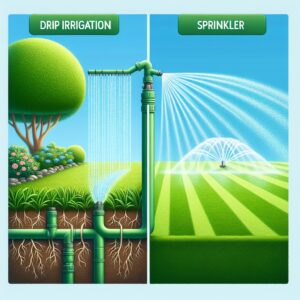
For small farms — typically under 10 acres — a basic solar irrigation setup running a surface pump with direct solar power (no battery storage) usually lands between $5,000 and $10,000. This typically covers 2–4 solar panels generating 1–3 kW of power, a compatible surface pump, basic piping and fittings, and straightforward installation on flat or accessible terrain. These systems work well for drip irrigation setups on vegetable plots, orchards, or small livestock operations with moderate daily water demand. To explore more about the benefits of solar energy for farmers, visit Paradise Solar Energy.
Medium Farm Systems: $10,000 – $20,000
Medium-sized farms ranging from 10 to 50 acres require more pumping capacity, more solar panel surface area, and often a more complex distribution network. Costs in this range reflect a system capable of delivering higher water volumes consistently across larger fields, and may start to include battery backup components for irrigation scheduling flexibility.
At this scale, submersible pumps become more common, especially where water is sourced from deeper wells rather than surface ponds or streams. The pump itself can cost $1,000 to $5,000, and solar panels for this capacity typically run $3,000 to $15,000 depending on output requirements.
Large Farm Systems: $20,000 – $50,000+
Large-scale commercial farming operations — 50 acres and beyond — are looking at systems that can run $20,000 to well over $50,000. Farm-scale solar arrays at this level can range from $60,000 to $500,000+ before incentives are applied, depending on total acreage and crop water demand. These installations typically involve high-capacity submersible or turbine pumps, multi-array solar panel configurations, battery storage systems, automated controllers, and professional site preparation. The upfront cost is significant, but so is the return — and at this scale, government incentives become especially critical to the financial equation.
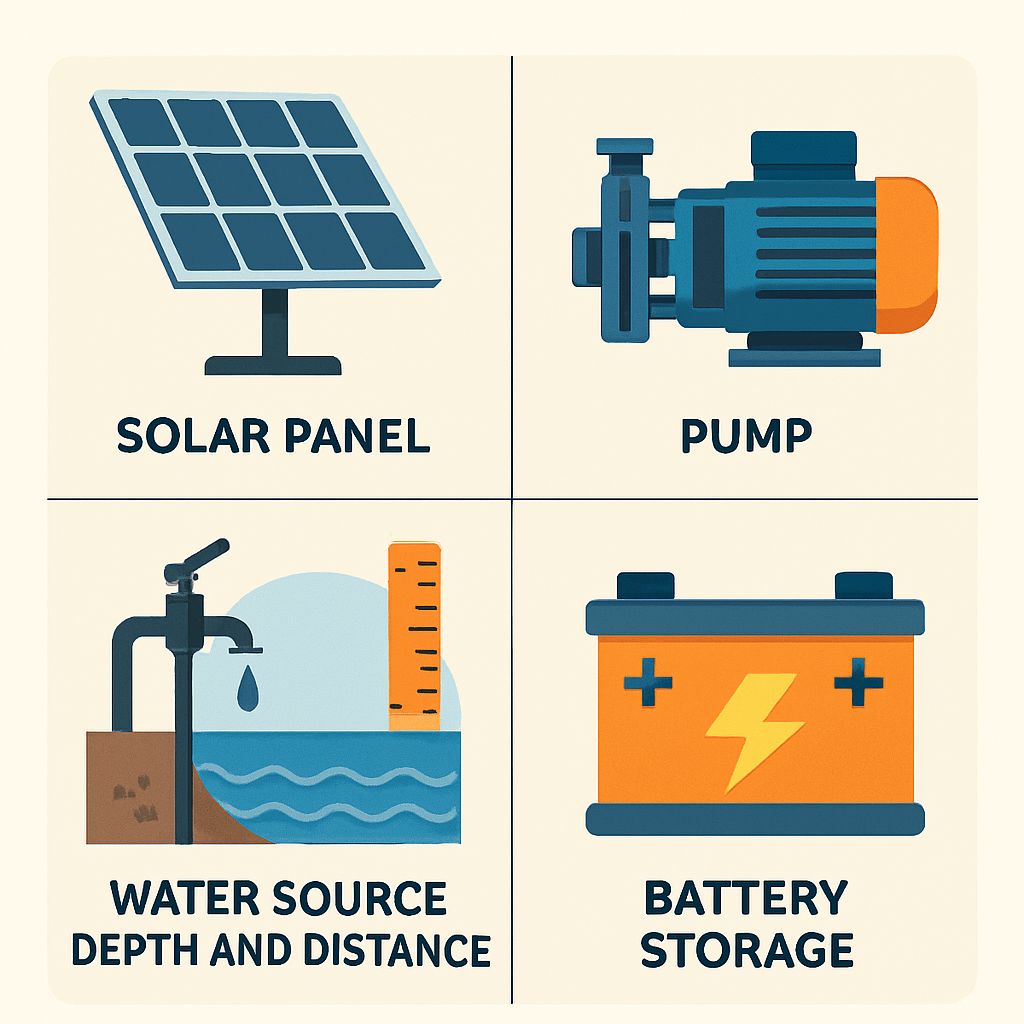
What Drives the Price of a Solar Irrigation System
Understanding what pushes costs up or down puts you in control of your budget. Here are the four biggest variables that determine what your system will actually cost. For more insights, explore the economics of solar irrigation systems.
Solar Panel Capacity and Output Requirements
Solar panels are usually the single largest line item in any solar irrigation budget. The more water you need to move — and the faster you need to move it — the more panel capacity your system requires.
- Panel cost range: $3,000 – $15,000 depending on wattage and brand
- Output needs are determined by your pump’s horsepower, daily water volume, and peak sun hours in your region
- Higher efficiency panels cost more upfront but require fewer panels to achieve the same output
- Monocrystalline panels tend to outperform polycrystalline in limited roof or land space scenarios
- Shading, panel angle, and orientation all affect real-world output and must be accounted for in system design
Getting an accurate load calculation before purchasing panels is non-negotiable. Undersizing your array is one of the most common and costly mistakes farmers make — you end up with a system that can’t meet irrigation demand during peak growing season.
Pump Type: Surface vs. Submersible
Surface pumps are less expensive and easier to maintain since they sit above ground, but they’re limited to water sources within about 25 feet of vertical lift. Submersible pumps are installed directly in a well or borehole and can handle much greater depths — but they cost more to purchase and require professional installation. For most farms pulling from deep wells, submersible is the only viable option, and that decision alone can add $1,000 to $5,000 to your system cost.
Water Source Depth and Distance
The deeper your water source and the farther it sits from your fields, the more energy your pump needs to do its job — and the more solar capacity you’ll need to support it. A well depth of 100 feet demands significantly more pump power than a surface pond 10 feet below your field level. Every additional foot of depth and every additional meter of horizontal pipe run adds to both equipment cost and energy demand. For more on how renewable energy can power farm operations, consider exploring solar panels for farms.
Battery Storage vs. Direct Solar Pumping
Direct solar pumping — where the pump only runs when the sun is shining — is the most affordable setup. No batteries means lower upfront cost and fewer components to maintain. Battery storage systems, however, allow you to pump and store water at any time, giving you flexibility to irrigate at dawn, dusk, or on cloudy days. Battery banks typically add $2,000 to $10,000 or more to total system cost, but for farms with strict irrigation timing requirements or inconsistent sunlight, the operational control they provide is often worth the investment.
Solar vs. Diesel vs. Grid-Powered Irrigation: Real Cost Comparison
When you stack solar against diesel and grid power over time, the numbers tell a clear story — and it’s not even close. Discover how solar panels for farms can revolutionize your irrigation system.
Diesel-powered irrigation systems carry a deceptively low upfront cost, often $500 to $5,000 for the pump and engine setup. But that affordability evaporates fast once you start fueling it season after season. Grid-powered electric pumps are more efficient than diesel but still leave you exposed to rising utility rates that you have zero control over. Solar flips that equation entirely — higher upfront, but the fuel is free for the next 25 to 30 years.
20-Year Total Cost Breakdown by System Type
Looking at total cost of ownership over 20 years is the only honest way to compare these systems. A diesel system that costs $3,000 to set up might seem like a bargain until you account for fuel, maintenance, and repairs compounding year over year. A solar system costing $15,000 upfront, by contrast, has minimal ongoing expenses once installed.
Research consistently shows that solar irrigation systems can deliver 20-year total costs that are 50 to 60% lower than diesel equivalents, largely because the operating costs after installation are negligible compared to continuously buying fuel or paying utility bills.
|
System Type |
Upfront Cost |
Annual Operating Cost |
Est. 20-Year Total Cost |
|---|---|---|---|
|
Diesel Pump |
$500 – $5,000 |
$2,000 – $6,000+ |
$40,000 – $125,000+ |
|
Grid Electric Pump |
$500 – $5,000 |
$1,200 – $4,000+ |
$25,000 – $85,000+ |
|
Solar Irrigation System |
$5,000 – $50,000+ |
$100 – $500 |
$7,000 – $60,000 |
|
Estimates based on small to large farm system ranges. Actual costs vary by region, farm size, and energy usage. |
Why Diesel Costs Keep Climbing While Solar Stays Flat
Diesel prices are tied directly to global oil markets — markets that are volatile, unpredictable, and have trended sharply upward over the past two decades. Every time fuel prices spike, your irrigation costs spike with them. There’s no hedging against it when you’re dependent on diesel.
Solar has no fuel cost variability. Once your panels are installed, the energy input — sunlight — costs exactly the same in year 20 as it did in year one: nothing. The only real ongoing costs are occasional maintenance and eventual component replacement, which pale in comparison to years of diesel purchases. That cost stability is worth a great deal to any farm operating on tight seasonal margins, especially when using solar panels to power farm equipment.
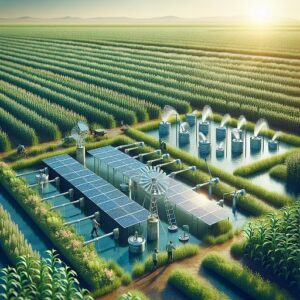
“Center Pivot Irrigation & Solar Panel …” from growingsolarmist.com and used with no modifications.
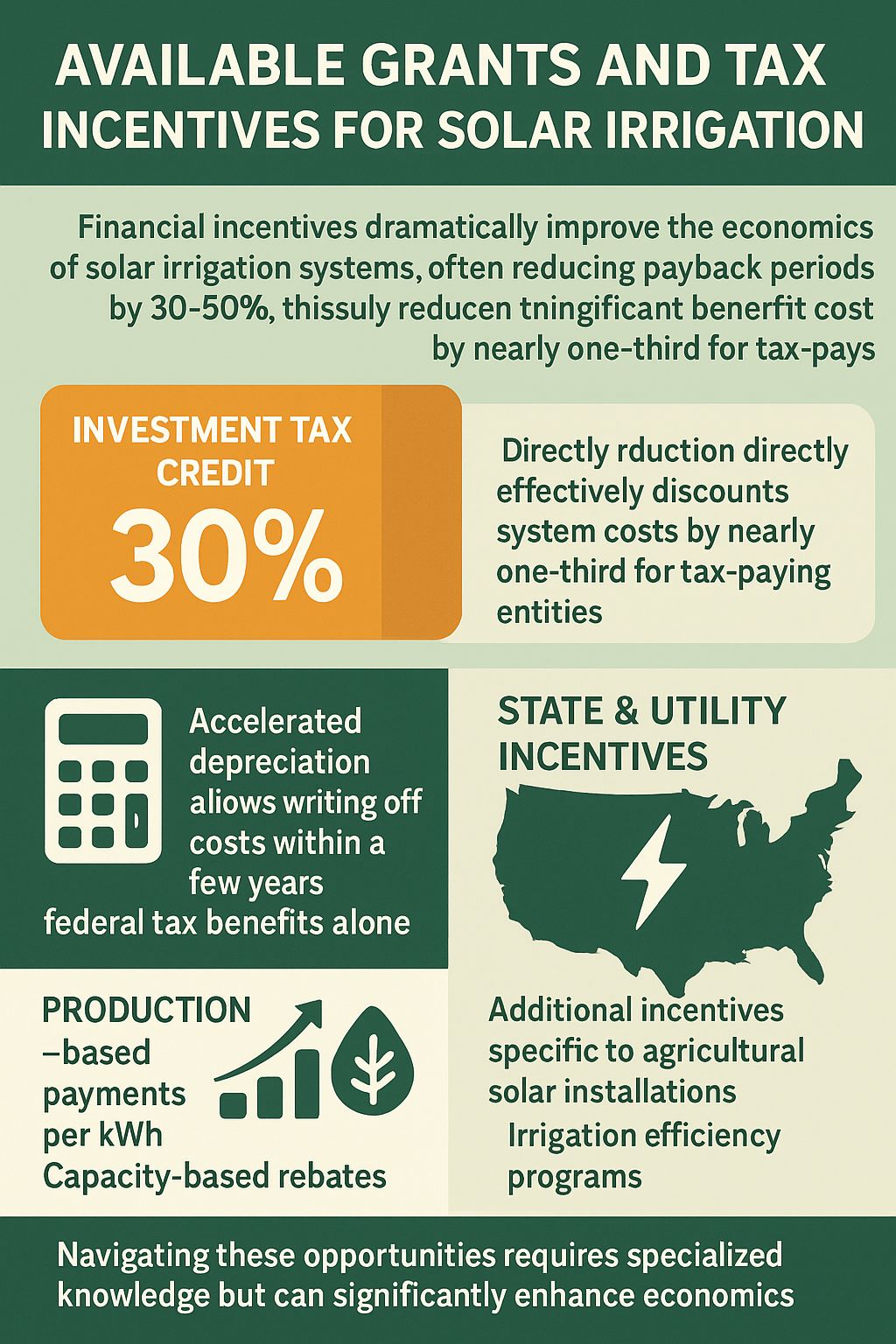
Government Incentives That Reduce Your Upfront Cost
The sticker price on a solar irrigation system is rarely what farmers actually pay. Federal programs, USDA grants, and state-level rebates can dramatically reduce what comes out of your pocket — in some cases cutting your net cost by more than half.
Knowing which programs you qualify for before you purchase is critical. Too many farmers invest first and research incentives second, missing application windows or purchasing equipment that doesn’t qualify for specific programs. Work through the list below before you sign any contracts.
Federal Tax Credits Available to Farmers
The federal Investment Tax Credit (ITC) allows farmers to deduct a significant percentage of their solar installation costs directly from their federal tax liability. Under current legislation, this credit applies to solar energy systems including those used for agricultural water pumping. Combined with accelerated depreciation through the Modified Accelerated Cost Recovery System (MACRS), farmers operating as a business entity can recover a substantial portion of their solar investment in the first few years alone. Consult a tax professional familiar with agricultural operations to maximize these benefits for your specific situation.
USDA REAP Grants for Renewable Energy
The USDA Rural Energy for America Program — better known as REAP — is one of the most valuable funding sources available to American farmers investing in renewable energy. REAP provides grants covering up to 50% of eligible project costs for agricultural producers installing solar energy systems, including solar-powered irrigation pumps.
To qualify, your operation must be an agricultural producer located in a rural area, and you must demonstrate that the project will result in measurable energy savings or renewable energy generation. The application process requires documentation of your current energy costs, a project description, and supporting quotes from installers.
REAP funding is competitive and awarded in cycles, so timing your application matters. The USDA announces funding rounds periodically — check the USDA REAP program page directly and work with your local USDA Service Center to ensure your application is complete and competitive before the window closes.
State-Level Rebates and Incentive Programs
On top of federal programs, many states offer their own rebates, low-interest loan programs, and property tax exemptions for agricultural solar installations. California, Texas, Colorado, and several Midwest farming states have historically offered strong incentive packages. The Database of State Incentives for Renewables & Efficiency (DSIRE) at dsireusa.org is the most comprehensive and up-to-date resource for finding exactly what’s available in your state.
How Long Before a Solar Irrigation System Pays for Itself
The payback period is what most farmers want to know first — and the answer depends on three things: what you paid for the system, what you were spending on energy before, and what incentives reduced your net cost. For most farms, that window falls somewhere between 5 and 10 years.
Average Payback Period by Farm Size
Smaller systems with lower upfront costs tend to pay back faster when the farm had high diesel or electricity costs before the switch. A small farm spending $4,000 per year on diesel irrigation that installs a $7,000 solar system (after incentives) could realistically see payback in under two years in a high-sun region. Larger systems take longer to recover simply due to higher capital outlay, but the absolute dollar savings are also much greater.
The key variable that accelerates payback for every farm size is the incentive stack. A farmer who layers federal tax credits with a USDA REAP grant and a state rebate could cut their net system cost dramatically, bringing a 10-year payback timeline down to 4 or 5 years without changing anything else about their operation.
A farmer in California who switched to solar irrigation reported a 75% reduction in energy costs for irrigation — a real-world example of how dramatically these systems can shift the financial picture when conditions align: high prior energy costs, strong sun hours, and a favorable incentive environment. For those looking to explore further, solar panels for farms can be a sustainable solution.
Estimated Payback Period by Farm Size (After Incentives)
🌱 Small Farm (under 10 acres) — System cost: $5,000–$10,000 | Est. payback: 3–6 years
🌽 Medium Farm (10–50 acres) — System cost: $10,000–$20,000 | Est. payback: 5–8 years
🛜 Large Farm (50+ acres) — System cost: $20,000–$50,000+ | Est. payback: 7–12 yearsPayback estimates assume average sun hours of 4–6 per day and prior annual energy costs of $2,000–$10,000+ depending on farm size.
Energy Bill Savings Farmers Can Realistically Expect
Switching to solar irrigation typically cuts energy costs for water pumping by 50 to 80%, with farmers in high-sun states often reaching the top end of that range. The actual dollar savings vary based on how much you were spending before, but for operations running grid-powered or diesel pumps heavily through growing season, annual savings of several thousand dollars are common — and those savings compound every year for the life of the system. For more information on how solar panels benefit farm operations, check out this guide on solar panels for farms.
Hidden Costs Farmers Often Overlook
The quoted price from an installer covers the equipment — but it rarely tells the full story. There are several additional costs that catch farmers off guard after they’ve already committed to a system, and knowing about them upfront can save you thousands in budget surprises.
These aren’t reasons to avoid solar irrigation. They’re reasons to plan carefully. A realistic total budget accounts for every line item below before the first panel goes in the ground.
Installation and Site Preparation Fees
Installation labor is a significant cost that varies widely based on terrain, soil conditions, distance from water source to field, and local labor rates. Rocky or uneven terrain that requires trenching for underground pipe runs, concrete footings for panel mounts, or electrical conduit installation will add meaningfully to your total cost. Budget installation separately from equipment — it can easily represent 20 to 30% of total project cost on complex sites.
Common Site Preparation Costs to Budget For:
⛏ Trenching for underground pipe or wiring: $5 – $20 per linear foot depending on soil conditions
📍 Panel mounting structure and concrete footings: $500 – $3,000+ depending on array size
⚡ Electrical wiring and disconnect installation: $300 – $1,500
📋 Permits and inspections: $100 – $1,000+ depending on local municipality requirements
🛠 Well modification or casing upgrade (if installing submersible pump in older well): $500 – $3,000These costs are in addition to equipment pricing and installer labor. Always request a fully itemized quote that includes site prep before signing a contract.
One of the most overlooked permit costs is interconnection fees if your system ties into the grid in any way. Even battery-backed solar systems in some jurisdictions require utility notification and inspection, which adds both cost and timeline to your project.
Always get at least three itemized quotes from installers who specialize in agricultural solar — not residential. Agricultural systems have different load profiles, different code requirements in many states, and require installers who understand pump sizing for irrigation applications specifically.
Ongoing Maintenance and Part Replacement Costs
Solar panels themselves are remarkably low-maintenance — no moving parts means very little that can go wrong. The primary task is keeping panels clean and free of dust, bird droppings, and debris that reduce output efficiency. In most farming environments, a seasonal inspection and occasional cleaning with water and a soft brush is all panels need. That said, pumps, controllers, wiring connections, and battery banks (if included) do require periodic attention.
Pumps are the component most likely to need replacement over the system’s life. Surface pumps may last 5 to 10 years with proper maintenance, while quality submersible pumps can run 10 to 15 years before needing service or replacement. Budget $500 to $2,000 for pump replacement at some point in your system’s life, along with $100 to $300 per year for routine inspections, minor part replacements, and any professional servicing. Battery banks, if your system includes them, typically need replacement every 5 to 10 years at a cost of $1,000 to $5,000+ depending on storage capacity. Factor these costs into your long-term return on investment calculation — even with them included, solar irrigation remains far cheaper than diesel or grid power over a 20-year horizon.
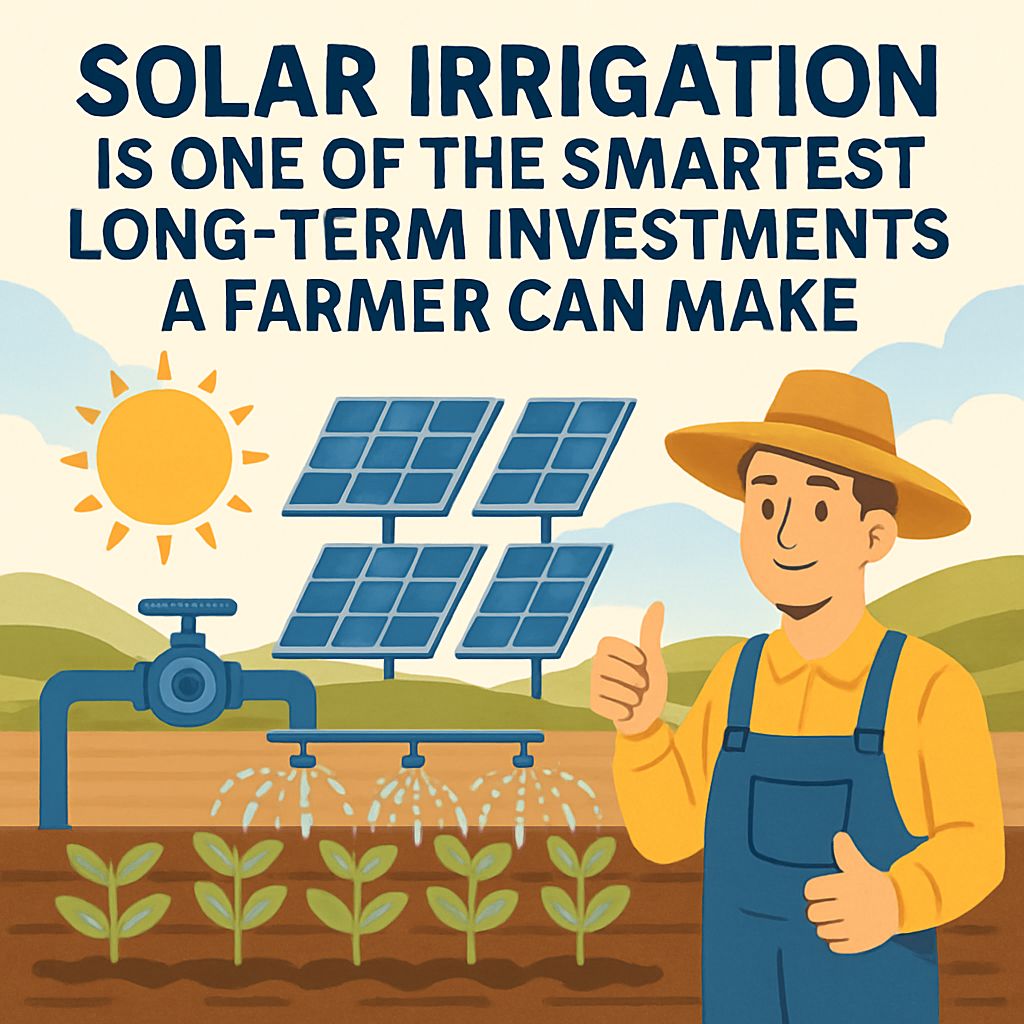
Solar Irrigation Is One of the Smartest Long-Term Investments a Farmer Can Make
When you run the numbers honestly — full upfront costs, incentives applied, operating expenses over 20 years, and realistic energy savings — solar irrigation outperforms diesel and grid-powered systems in nearly every scenario. Panels last up to 30 years. The fuel is free. And every dollar you’re not spending on diesel or electricity is a dollar that stays in your operation.
The farmers who benefit most are the ones who plan before they purchase — stacking available incentives, getting accurate load calculations, and budgeting for the full scope of installation. Go in with complete information, and solar irrigation doesn’t just pay for itself. It becomes one of the most reliable financial assets on your farm.
Frequently Asked Questions
Farmers evaluating solar irrigation for the first time tend to have the same core questions. The answers below are based on real system specs and verified cost data — not estimates pulled from thin air.
Understanding these fundamentals helps you ask better questions when talking to installers, write stronger REAP grant applications, and make a purchasing decision you won’t second-guess three seasons from now.
Here’s what farmers most commonly want to know before committing to a solar irrigation investment:
- How much does a solar water pump actually cost?
- Do you need batteries for solar irrigation to work?
- How long will the system realistically last?
- Is it worth it for a smaller operation?
- What does ongoing maintenance actually look like?
How Much Does a Solar Water Pump Cost for Irrigation?
Solar Water Pump Cost by Type:
💧 Small surface pump (up to 1 HP): $200 – $800
💧 Mid-range surface pump (1–3 HP): $800 – $2,500
💧 Submersible pump (shallow well, under 100 ft): $500 – $2,000
💧 Submersible pump (deep well, 100–400 ft): $1,500 – $5,000
💧 High-capacity turbine pump (large farm use): $3,000 – $10,000+Pump cost does not include solar panels, controller, wiring, piping, or installation labor.
The pump is just one piece of the system cost — and often not the most expensive piece. Solar panels, the charge controller, and installation frequently represent the larger share of total project budget. That’s why evaluating total system cost rather than individual component prices gives you a much more accurate picture of what you’re actually spending.
Pump sizing is driven by two key variables: the total dynamic head (the combined vertical lift plus friction losses in your pipe runs) and the daily water volume your crops require. Getting either of these wrong means a pump that either can’t meet demand or burns through more energy than necessary — both of which undermine your ROI. Have a qualified agricultural irrigation specialist calculate your system requirements before selecting any pump.
Also worth noting: solar-specific pump controllers — which regulate power delivery from panels to pump and protect against dry-run damage — add $150 to $600 to your budget but are non-negotiable for system longevity. Don’t skip them to save money upfront.
Can Solar Irrigation Systems Work Without Batteries?
Yes — and the majority of small to medium farm solar irrigation setups run exactly this way. In a direct-coupled system, the solar panels power the pump only when sunlight is available, typically between mid-morning and late afternoon. Water gets pumped into a storage tank or reservoir during daylight hours, and that stored water is then distributed by gravity or a secondary pump as needed throughout the day and night. This approach eliminates the cost and maintenance burden of battery banks entirely.
Battery storage makes sense when you need precise irrigation timing that doesn’t align with peak sun hours, when your crop or livestock water demand is consistent around the clock, or when your region experiences frequent cloudy periods that disrupt direct solar pumping. For most drip or flood irrigation applications where timing flexibility exists, a direct solar system paired with a well-sized storage tank is the most cost-effective and mechanically simple solution available.
What Is the Lifespan of a Solar Irrigation System?
Component Lifespan Reference Guide:
☀️ Solar panels: 25 – 30 years (with gradual efficiency decline after year 20)
🔄 Solar pump controller: 10 – 15 years
💧 Surface pump: 5 – 10 years with regular maintenance
💧 Submersible pump: 10 – 15 years with proper installation and water quality
🔋 Battery bank (if included): 5 – 10 years depending on chemistry and cycling
🔧 Piping and fittings: 20 – 40 years (UV-resistant HDPE or PVC)Lifespans assume routine seasonal maintenance and appropriate system sizing for the application.
Solar panels are the longest-lived component in the system by a significant margin. Most quality panels carry a 25-year performance warranty guaranteeing they’ll still produce at least 80% of rated output after two decades of use. That’s an extraordinary lifespan for any piece of farm equipment.
The practical implication is that even after your pump has been replaced once or twice and your battery bank has cycled through a replacement, your panels are still generating free energy and your total cost of ownership is still dramatically lower than what you would have spent on diesel fuel over the same period. The math gets better with every passing year.
Maximizing system lifespan comes down to proper installation from the start and a simple maintenance routine: annual panel inspection and cleaning, pump performance checks each season, monitoring controller readings for anomalies, and keeping all wiring connections corrosion-free. These small habits protect a large investment.
Are Solar Irrigation Systems Worth It for Small Farms?
For small farms that were previously spending $1,500 or more annually on diesel or electricity for irrigation, a solar system in the $5,000 to $7,000 range — reduced further by available incentives — can realistically pay back in 3 to 5 years and then deliver free irrigation for another 20 years beyond that. The smaller the prior energy spend, the longer the payback period, but even in those cases the operational simplicity, fuel independence, and reduced mechanical complexity make solar a strong choice for farms of any size.
What Maintenance Does a Solar Irrigation System Require?
Solar irrigation systems are among the lowest-maintenance water delivery solutions available to farmers. The panels have no moving parts and primarily need to be kept clean — dust accumulation alone can reduce panel output by 5 to 25% over a season in dry climates, so a rinse with clean water a few times a year makes a measurable difference in system performance and energy yield.
On the mechanical side, pump bearings and seals should be inspected annually, and submersible pumps should be pulled and inspected every 3 to 5 years to check for wear, mineral buildup, and seal integrity. Controller settings should be verified at the start of each irrigation season, and all wiring connections — particularly ground-level junction boxes exposed to moisture — should be checked for corrosion or damage.
The total annual time investment for routine solar irrigation maintenance on a small to medium farm is typically just a few hours per year. Compared to the time and cost involved in maintaining a diesel engine — oil changes, fuel filters, injector cleaning, belt replacements — solar is dramatically simpler to keep running at full performance year after year.

Leave a Reply