
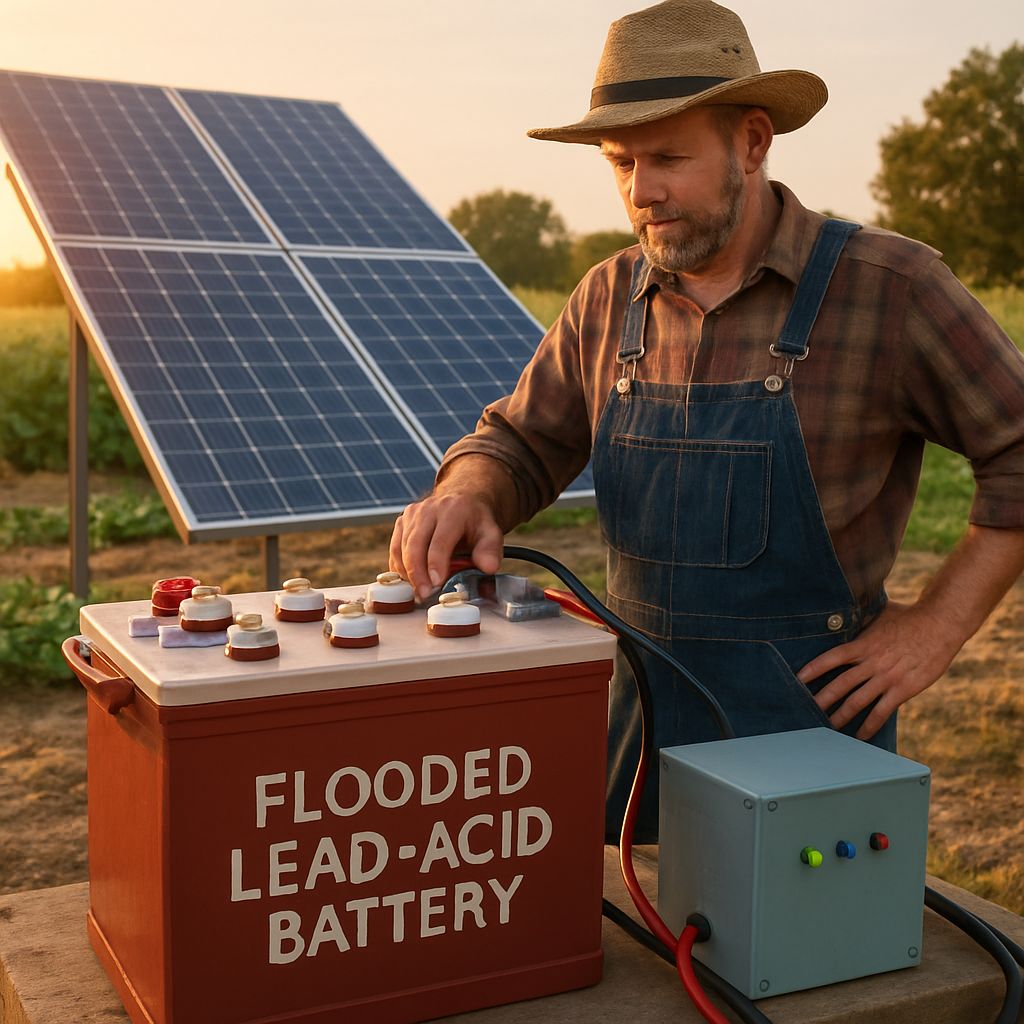
Article At-A-Glance
- Flooded lead-acid batteries cost 40-60% less upfront than lithium alternatives, making them the most accessible entry point for farm solar storage.
- These batteries deliver 1,200-1,500 cycles at 50% depth of discharge in real-world farm conditions — translating to 3-7 years of reliable service depending on cycling frequency.
- From overnight irrigation to cold storage, flooded lead-acid batteries can power virtually every critical farm operation when the sun goes down.
- Growing Solar Mist provides farmers with expert guidance on building cost-effective solar storage systems using proven battery technology.
- There’s one maintenance mistake most farmers make that quietly cuts battery lifespan in half — keep reading to find out what it is.
Storing solar energy on a farm doesn’t have to mean spending a fortune — flooded lead-acid batteries have been doing the job reliably for decades at a fraction of the cost of modern alternatives.
When farm operations depend on consistent power — overnight irrigation, livestock ventilation, cold storage — the battery bank behind your solar panels is just as important as the panels themselves. Most farmers don’t realize that the choice of battery chemistry directly determines how many years of service they’ll get and how much they’ll spend maintaining the system. Flooded lead-acid batteries remain the dominant choice in agricultural solar setups for reasons that go well beyond simple upfront savings.
Flooded Lead-Acid Batteries Are the Backbone of Farm Solar Backup
Solar panels generate power only when sunlight is available. On a working farm, energy demand doesn’t pause at sunset. Irrigation timers run through the night, barn ventilation keeps livestock comfortable during summer heat, and cold storage refrigeration cycles continuously regardless of cloud cover. A battery bank bridges that gap — absorbing excess solar energy during the day and releasing it precisely when operations demand it.
Flooded lead-acid batteries have powered off-grid and agricultural solar systems since renewable energy first became practical for rural properties. Their chemistry is well understood, their failure modes are predictable, and their cost structure makes large-capacity storage achievable for farms operating on tight margins. They’re not the newest technology, but they remain one of the most practical for the specific demands of farm environments.
What Is a Flooded Lead-Acid Battery?
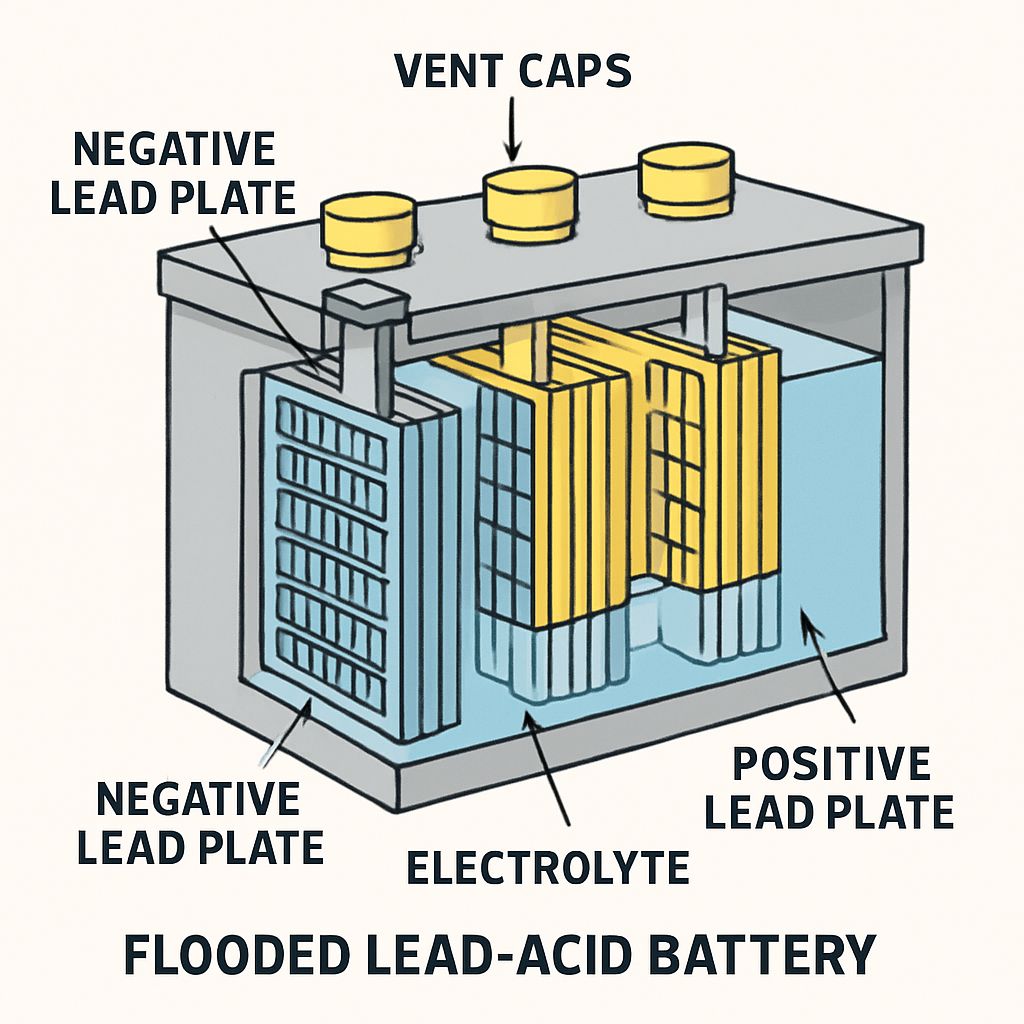
A flooded lead-acid battery is a rechargeable battery that uses lead plates submerged in a liquid electrolyte solution of sulfuric acid and distilled water. During charging and discharging, chemical reactions between the lead plates and electrolyte convert electrical energy to chemical energy and back again. The “flooded” designation refers specifically to the fact that the electrolyte is in free liquid form — as opposed to absorbed glass mat (AGM) or gel configurations where the electrolyte is immobilized.
How the Liquid Electrolyte Design Works
Inside each cell, alternating positive and negative lead plates sit fully submerged in the sulfuric acid electrolyte. When the battery discharges, lead dioxide on the positive plate and sponge lead on the negative plate both react with the electrolyte, producing lead sulfate and releasing electrons that flow as electrical current. Charging reverses this process, restoring the plates and electrolyte to their original chemical state.
During charging — particularly during the final stage — the electrolyte undergoes electrolysis, producing hydrogen and oxygen gas. This is why flooded batteries require venting and why water levels drop over time and must be replenished with distilled water. It’s also what distinguishes them from sealed battery types, which recombine those gases internally.
Deep-Cycle vs. Standard Automotive Batteries
Standard automotive batteries are engineered to deliver a large burst of current for a few seconds to start an engine, then immediately recharge from the alternator. They’re not designed for repeated deep discharges. Deep-cycle flooded lead-acid batteries, by contrast, have thicker, denser lead plates specifically constructed to withstand being discharged down to 50% or lower and recharged hundreds to over a thousand times. For solar applications — where the battery charges slowly from panels during daylight and discharges gradually through the night — deep-cycle chemistry is essential.
Why “Flooded” Matters for Energy Density and Cost
The flooded design offers a meaningful cost advantage over AGM and gel variants because the manufacturing process is simpler and the materials less specialized. For farm-scale systems requiring significant storage capacity — often measured in tens of kilowatt-hours — this cost difference becomes substantial. A flooded lead-acid battery bank capable of storing 20 kWh can cost 40-60% less than an equivalent lithium iron phosphate system, and significantly less than comparable AGM capacity at large scale.
How These Batteries Integrate With Farm Solar Panels
A farm solar storage system has four core components working together: solar panels generating DC electricity, a charge controller regulating how that electricity enters the battery bank, the battery bank itself storing energy, and an inverter converting stored DC power to the AC electricity most farm equipment requires. Flooded lead-acid batteries sit at the center of this system, absorbing energy during daylight hours and releasing it on demand.
How Solar Panels Charge a Flooded Lead-Acid Battery Bank
Solar panels connected to a battery-based system feed DC electricity through a charge controller and into the battery bank whenever panels are producing more power than the farm is currently consuming. The charging process happens in three stages: bulk charging, where maximum current flows to rapidly restore capacity; absorption charging, where voltage holds steady while current tapers off to complete the charge; and float charging, where a reduced maintenance voltage keeps the battery fully charged without overcharging it.
For flooded lead-acid batteries specifically, a fourth periodic stage called equalization charging is also required. During equalization, the charge controller intentionally slightly overcharges the battery at a controlled rate to break down sulfate buildup on the plates and ensure all cells reach full charge uniformly. Skipping equalization charges is one of the most common mistakes that shortens battery lifespan on farm solar systems.
The Role of a Charge Controller in Protecting Battery Life
A quality MPPT (Maximum Power Point Tracking) charge controller — such as the Victron SmartSolar MPPT 150/70 — does far more than simply connect panels to batteries. It actively manages voltage and current to match what the battery chemistry requires at each stage of charging, preventing both undercharging (which causes sulfation) and overcharging (which destroys plates and accelerates water loss). For flooded lead-acid batteries in farm solar systems, the charge controller must be configured specifically for flooded chemistry, with the correct bulk, absorption, float, and equalization voltage setpoints for the specific battery bank in use.
Critical Farm Operations These Batteries Power
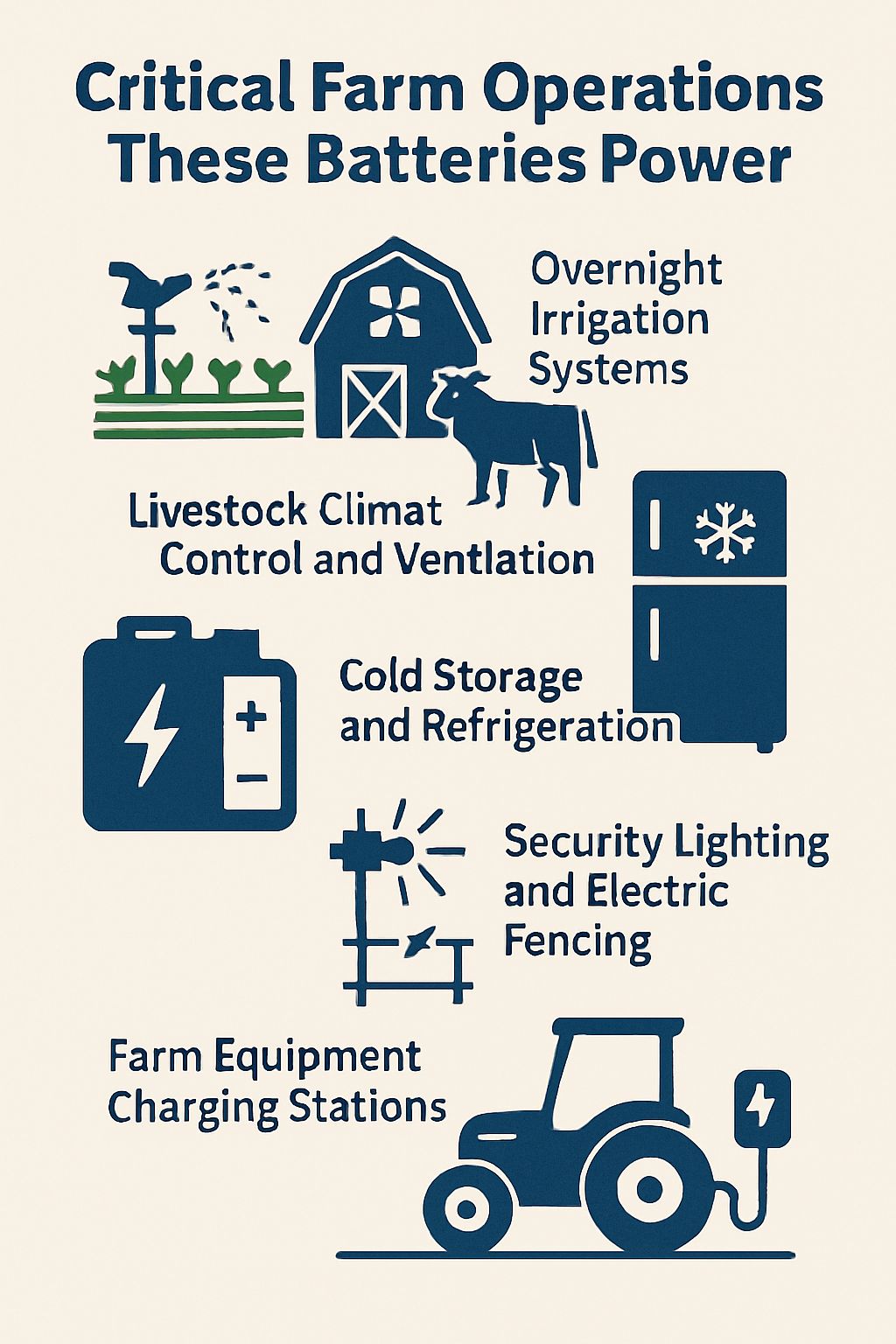
The practical value of a flooded lead-acid battery bank on a farm shows up in the specific operations it keeps running when solar panels aren’t producing. Each load type has different characteristics — some draw steady current over many hours, others cycle on and off, and some demand brief high-current surges — and the battery bank must be sized to handle the farm’s specific combination of loads.
Common Farm Solar Loads and Their Battery Impact
Farm Operation
Typical Power Draw
Daily Runtime
Battery Impact
Drip Irrigation Pump (1 HP)
750W
6-8 hours
High — overnight draw
Barn Ventilation Fans
200-400W per fan
12-16 hours
High — continuous seasonal load
Cold Storage Refrigeration
500-1,500W
Cycles 24 hrs
High — continuous critical load
Security Lighting (LED)
50-150W total
8-10 hours
Low — manageable overnight draw
Electric Fence Energizer
5-15W
24 hours
Very low — minimal drain
Equipment Charging Station
500-2,000W
2-4 hours
Moderate — scheduled load
1. Overnight Irrigation Systems
Irrigation pumps running overnight represent one of the highest sustained loads a farm battery bank will face. A single 1 HP irrigation pump draws approximately 750 watts continuously — meaning an 8-hour overnight irrigation cycle consumes around 6 kWh from the battery bank before the sun rises to begin recharging it. For farms running multiple irrigation zones or larger pump motors, this demand scales quickly and directly determines the minimum battery bank capacity required.
2. Livestock Climate Control and Ventilation
Barn ventilation is a non-negotiable load in summer months. Heat stress in dairy cattle can reduce milk production significantly, and inadequate airflow in poultry houses creates life-threatening conditions within hours during peak summer temperatures. Multiple ventilation fans running 12-16 hours daily represent a sustained, predictable load that flooded lead-acid battery banks handle well — precisely because this type of steady, moderate discharge is exactly what deep-cycle chemistry is built for.
3. Cold Storage and Refrigeration
Cold storage is arguably the most critical load on a farm solar system because it cycles continuously, day and night, and a failure directly translates to lost product and revenue. Walk-in coolers and refrigeration units for produce, dairy, or meat products draw between 500W and 1,500W depending on size, and their compressors create brief high-current startup surges that the battery bank must absorb cleanly. Flooded lead-acid batteries sized correctly for this load provide the current delivery capacity these compressor starts require without the voltage sag that undersized battery banks produce.
4. Security Lighting and Electric Fencing
LED security lighting across a farm property is actually one of the most manageable overnight battery loads. A complete perimeter lighting setup drawing 100-150W total running 10 hours overnight consumes roughly 1-1.5 kWh — a minor fraction of a properly sized farm battery bank.
Electric fence energizers are even less demanding. A quality fence energizer like the Gallagher M800 draws as little as 5-15W continuously, meaning the entire fence system consumes less than 0.4 kWh over a 24-hour period. These loads are easily incorporated into any farm solar battery system without meaningfully impacting overall capacity planning.
5. Farm Equipment Charging Stations
Electric utility vehicles, ATV farm equipment, and battery-powered tools are increasingly common on modern farms. Charging these during daylight hours directly from solar production is the most efficient approach — but when overnight or early morning charging is required, the battery bank steps in.
A typical electric utility vehicle charging session draws 1-2 kWh, which is a manageable scheduled load when built into the overall battery bank sizing calculation. The key is treating equipment charging as a planned load rather than an ad hoc draw, which allows the solar and storage system to be sized appropriately from the start.
Cost Comparison: Flooded Lead-Acid vs. Lithium Batteries for Farms
Battery chemistry choice is ultimately a financial decision as much as a technical one. For farms where capital is limited and the priority is maximizing storage capacity per dollar spent, the numbers consistently favor flooded lead-acid — particularly at the scale agricultural operations require.
Upfront Cost Differences
Flooded lead-acid deep-cycle batteries typically cost between $150 and $300 per kilowatt-hour of usable storage capacity (at 50% depth of discharge). Lithium iron phosphate batteries — the most farm-appropriate lithium chemistry — currently run $400 to $700 per kilowatt-hour of usable capacity. For a farm system requiring 20 kWh of usable storage, that difference represents $5,000 to $8,000 in additional upfront cost for lithium.
Battery Type
Cost per kWh (Usable)
20 kWh System Cost
Cycle Life (50% DoD)
Maintenance Required
Flooded Lead-Acid
$150 – $300
$3,000 – $6,000
1,200 – 1,500 cycles
Yes — monthly water checks
AGM Lead-Acid
$250 – $400
$5,000 – $8,000
500 – 800 cycles
Minimal
Lithium Iron Phosphate
$400 – $700
$8,000 – $14,000
3,000 – 5,000 cycles
None
What this table also reveals is that AGM batteries — often considered the middle-ground option — actually deliver fewer cycles than flooded lead-acid at higher cost. For farm applications where maintenance can be routinely performed, flooded batteries consistently offer the best value proposition.
Long-Term Maintenance Costs to Factor In
Flooded lead-acid batteries do require ongoing maintenance — primarily distilled water replenishment and terminal cleaning — but the actual cost of this maintenance is modest. Distilled water costs pennies per liter, and the time investment for monthly water checks across a properly installed battery bank is typically under 15 minutes. Factoring in replacement costs over a 10-year horizon, a well-maintained flooded lead-acid system often still outperforms lithium on total cost of ownership at the capacity scales farms require. For more on solar power management in farming, explore how drones are transforming solar power management.
How Long Do Flooded Lead-Acid Batteries Last on a Farm?
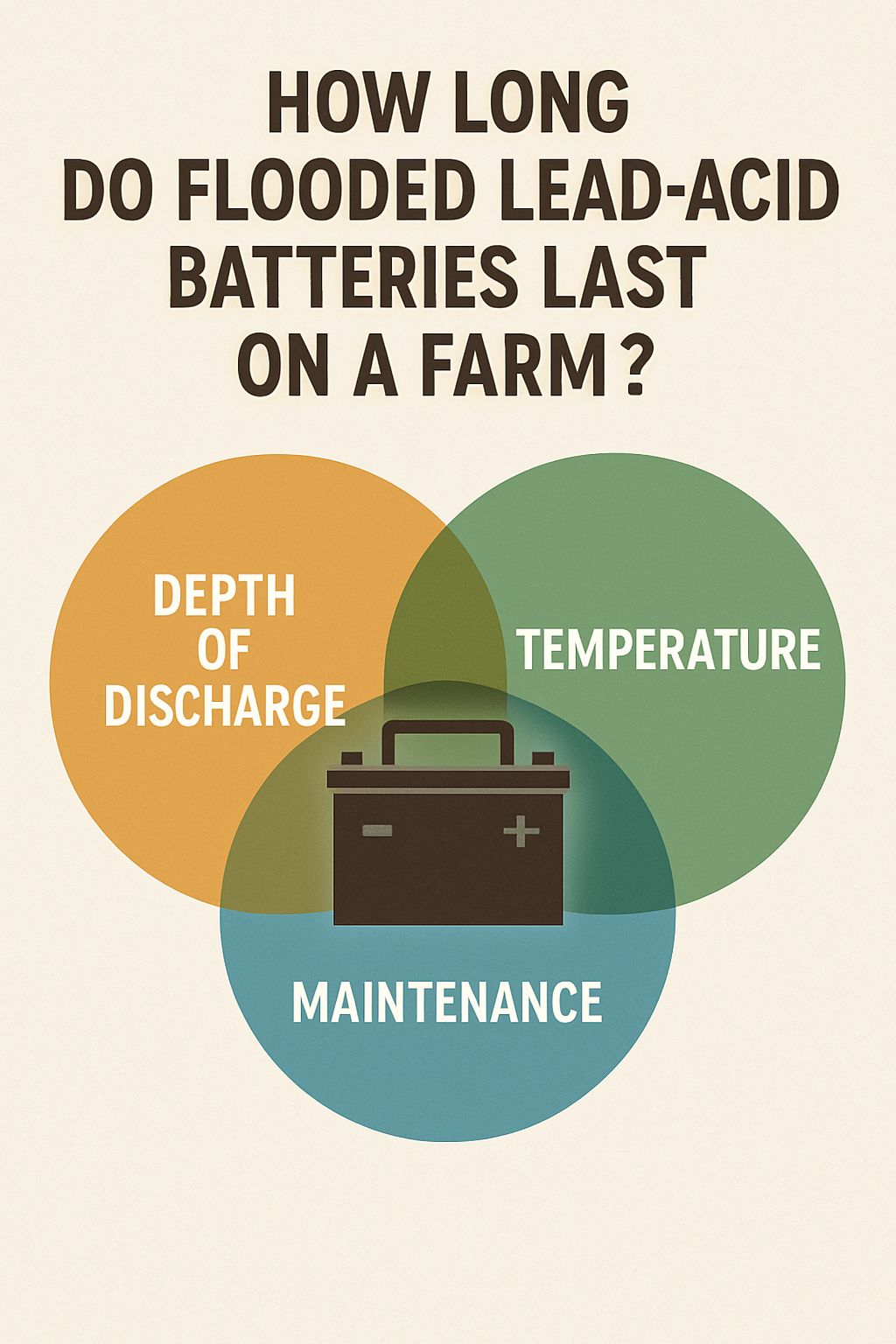
Battery lifespan in farm environments is determined by three intersecting factors: how deeply the batteries are discharged on each cycle, the temperature conditions they operate in, and the quality of the maintenance program keeping them healthy. Understanding all three gives farmers realistic expectations and actionable ways to extend service life.
In real-world farm applications, quality flooded lead-acid deep-cycle batteries — such as the Trojan T-105 or US Battery US 2200 XC — deliver 1,200 to 1,500 cycles at 50% depth of discharge. For a farm cycling the battery bank daily, that translates to roughly 3-4 years of service. For farms with less frequent full cycling — such as seasonal irrigation operations — the same battery bank can realistically last 5-7 years. Additionally, incorporating HPBC solar panels can further enhance energy efficiency and sustainability in agricultural operations.
Manufacturer cycle ratings are typically established under controlled laboratory conditions. Real farm environments introduce variables — temperature fluctuations, occasional deep discharges, inconsistent maintenance — that can push actual performance below laboratory figures if the system isn’t managed attentively. Conversely, farms that maintain their batteries carefully and keep discharge depth consistently at or below 50% often see performance that meets or exceeds rated specifications.
Depth of Discharge and Its Impact on Lifespan
Depth of discharge (DoD) is the single most controllable variable affecting flooded lead-acid battery lifespan. Discharging to 50% DoD rather than 80% DoD doesn’t just moderately extend cycle life — it dramatically extends it. A battery rated for 1,200 cycles at 50% DoD might deliver only 400-500 cycles if routinely discharged to 80%. This means that oversizing the battery bank — installing more capacity than the minimum required — directly translates to longer battery life by keeping routine discharge depth shallower.
The practical implication for farm system design is straightforward: calculate the farm’s actual daily energy requirement, then size the battery bank so that daily consumption represents no more than 50% of total bank capacity. A farm consuming 10 kWh overnight needs a battery bank with at least 20 kWh of total rated capacity to stay within that protective threshold consistently.
Temperature Extremes in Farm Environments
Flooded lead-acid batteries perform optimally at around 77°F (25°C). In cold barn environments during winter, battery capacity can drop noticeably — at 32°F (0°C), a flooded lead-acid battery may deliver only 70-80% of its rated capacity, and at 0°F (-18°C) that figure can fall to 50% or lower. This means farms in cold climates need to either insulate battery enclosures, install them in temperature-controlled spaces, or factor reduced winter capacity into system sizing.
Heat is equally damaging over the long term. For every 15°F (8°C) above the optimal operating temperature, flooded lead-acid battery life roughly halves. Batteries installed in un-ventilated metal outbuildings in hot climates can experience internal temperatures well above ambient air temperature, significantly accelerating degradation. Proper enclosure design with passive or active ventilation is not optional — it’s a direct investment in battery longevity.
Flooded Lead-Acid Battery Maintenance for Farmers
This is where most farmers either protect their investment or quietly destroy it. Flooded lead-acid batteries are forgiving of imperfect conditions, but they are not maintenance-free — and the single most common cause of premature failure in farm battery banks is neglected water levels. When electrolyte drops below the tops of the plates, the exposed lead oxidizes and that capacity is permanently lost. The good news is that proper maintenance is straightforward, inexpensive, and takes very little time once the routine is established. For more on maintaining solar power systems, explore how drones are transforming solar power management in farming.
1. Check and Top Off Water Levels Regularly
Water level maintenance is the most critical routine task for flooded lead-acid batteries — and the most commonly neglected one. As the battery charges and discharges, electrolysis causes water in the electrolyte to break down into hydrogen and oxygen gas, which vents out of the battery. Over time, this lowers the electrolyte level and can expose the lead plates if left unchecked.
- Check water levels at minimum once per month — more frequently during summer or heavy cycling periods
- Only use distilled water — tap water contains minerals that contaminate the electrolyte and accelerate plate degradation
- Fill to the manufacturer’s specified level, typically 1/8 inch below the bottom of the fill tube — never overfill
- Always check water levels after a full charge, not before — charging causes electrolyte expansion that can overflow if topped off beforehand
- Use a battery watering system like the Flow-Rite Pro-Fill for large battery banks — it speeds up the process dramatically and reduces spill risk
If you open a cell and find the plates exposed above the electrolyte surface, that capacity is already gone permanently. Add distilled water to cover the plates immediately, fully charge the battery, then assess whether the affected cells have lost significant capacity using a hydrometer reading.
For large farm battery banks with dozens of cells, a single-point watering system is one of the best investments a farmer can make. These systems connect all cells in a battery bank to a single fill port, allowing complete water replenishment in under two minutes compared to individually uncapping and filling each cell manually.
2. Clean Terminals to Prevent Corrosion
Battery terminal corrosion is more than an aesthetic issue — a heavily corroded terminal connection introduces resistance into the circuit that reduces charging efficiency, causes voltage drop under load, and can generate enough heat to damage cables and connectors. On farm battery banks that operate in humid, dusty environments, corrosion accumulates faster than in controlled indoor settings.
Inspect terminals quarterly as a minimum standard, or monthly if the battery enclosure is exposed to moisture or temperature swings. The white or blue-green crystalline buildup visible on corroded terminals is lead sulfate and copper sulfate — both electrically resistive and both easily addressed with basic cleaning supplies before they become serious problems.
- Disconnect cables before cleaning — always negative terminal first, reconnect positive first
- Mix baking soda with water to create a neutralizing paste and apply it directly to corroded terminals
- Scrub with a dedicated battery terminal brush — not a wire brush used for other purposes that may carry contaminating residue
- Rinse with clean water and dry thoroughly before reconnecting
- Apply a thin coat of battery terminal protector spray or petroleum jelly to slow future corrosion buildup
Loose terminal connections are equally problematic and often overlooked during visual inspections. Check that all cable connections are torqued to the manufacturer’s specification — a connection that looks secure can still have enough movement to arc under high-current loads, which rapidly damages both the terminal post and the cable lug.
For farm systems with multiple batteries wired in series or parallel, also inspect the inter-cell connectors and bus bars that link batteries together. These connections carry the full system current and develop corrosion at the same rate as terminal posts — but are often not cleaned as part of routine maintenance because they’re less visible. To enhance maintenance efficiency, consider integrating drone inspections into your routine.
3. Perform Equalization Charges to Balance Cells
Over time, individual cells within a flooded lead-acid battery develop slightly different states of charge due to manufacturing variations, differences in temperature exposure across the battery bank, and normal use patterns. This imbalance compounds over charging cycles, with weaker cells becoming progressively weaker while stronger cells carry more of the load. Equalization charging is the corrective process that brings all cells back to the same state of charge simultaneously.
During equalization, the charge controller deliberately raises the charging voltage above the normal absorption setpoint — typically to 15.5-16.0V for a 12V battery — and holds it there for a controlled period. This controlled overcharge causes gassing in all cells, which physically stirs the electrolyte, breaks down sulfate crystal buildup on the plates, and forces weaker cells up to full charge. For farm solar systems, equalization should be performed monthly as a standard practice — or whenever a hydrometer reading shows more than 0.030 specific gravity difference between the highest and lowest cells in the bank. Never perform equalization on AGM or gel batteries — this process is specific to flooded lead-acid chemistry.
4. Ensure Proper Ventilation to Safely Release Hydrogen Gas
During charging — particularly during the absorption and equalization stages — flooded lead-acid batteries produce hydrogen gas as a natural byproduct of electrolysis. Hydrogen is highly flammable and can accumulate to explosive concentrations in enclosed spaces with insufficient airflow. A battery enclosure inside a barn or outbuilding must have passive ventilation at minimum, with vents positioned low for fresh air intake and high for hydrogen exhaust, since hydrogen is lighter than air and rises. Never install flooded lead-acid batteries in a completely sealed enclosure, never use open flames or sparking tools near a charging battery bank, and ensure that any lighting or electrical equipment inside the battery enclosure is rated for use in potentially explosive atmospheres.
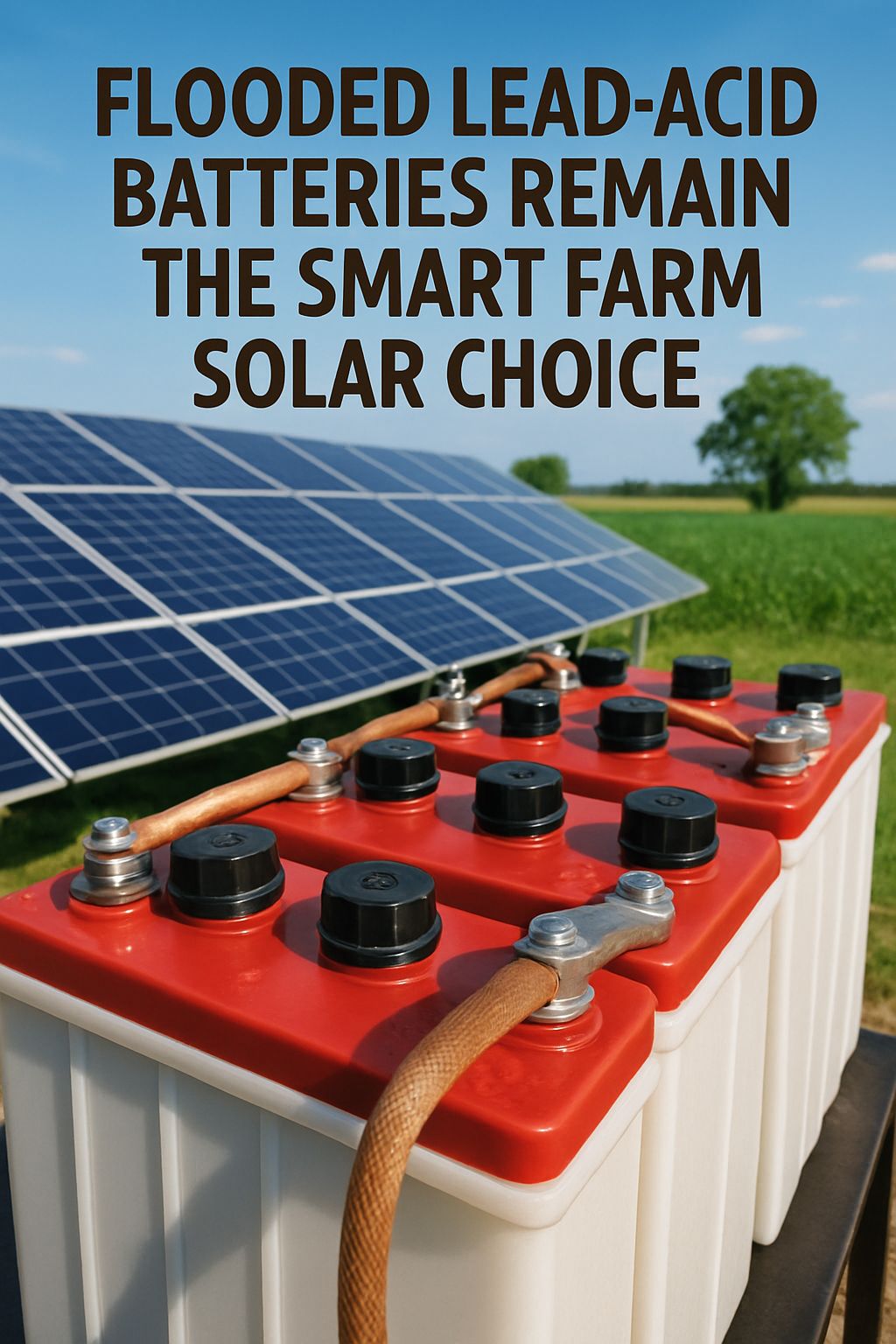
Flooded Lead-Acid Batteries Remain the Smart Farm Solar Choice
For the majority of farm operations — particularly those where capital efficiency matters more than eliminating every maintenance task — flooded lead-acid batteries continue to deliver a combination of cost, capacity, and proven reliability that newer chemistries haven’t displaced at agricultural scale. The 40-60% upfront cost advantage over lithium, combined with a well-understood maintenance protocol and predictable failure behavior, makes them the rational default for farm solar storage systems where the battery bank needs to be measured in tens of kilowatt-hours rather than single digits.
The farmers who get the most from flooded lead-acid battery banks are the ones who treat maintenance as a scheduled farm task rather than an afterthought — checking water monthly, cleaning terminals quarterly, running equalization charges consistently, and sizing their bank with enough headroom to keep daily discharge depth at or below 50%. Do those things, and a quality flooded lead-acid battery bank will serve a farm reliably for years before requiring replacement.
Frequently Asked Questions
Farmers new to solar storage consistently ask the same practical questions before committing to a flooded lead-acid battery bank. For those interested in how technology can further enhance solar efficiency, check out how drones boost solar panel efficiency for farmers. Here are the most important ones answered directly:
- How many batteries do I actually need for my farm’s load?
- Will they handle cold barn temperatures in winter?
- How often does the water really need checking?
- What happens if I regularly run them too low?
- Is hydrogen gas from charging actually dangerous in a farm building?
Each of these questions touches on a real design or operational decision. Getting them right before installation saves both money and frustration over the life of the system.
How many flooded lead-acid batteries do I need to power a farm?
The answer starts with your farm’s daily energy consumption in kilowatt-hours. Add up all overnight and cloudy-day loads — irrigation pumps, ventilation fans, cold storage, lighting — and calculate total daily kWh demand. That figure represents 50% of the battery bank capacity you need, since keeping discharge depth at or below 50% is the primary strategy for maximizing battery lifespan. For more detailed information, you can explore the benefits of using a lead-acid battery for renewable energy.
For example, a farm consuming 15 kWh overnight needs a battery bank with at least 30 kWh of total rated capacity. Using 6V Trojan T-105 batteries rated at approximately 225Ah each, a 48V system bank would require 16 batteries wired in series-parallel configuration to deliver roughly 28-30 kWh of usable capacity. A licensed solar installer or energy consultant can perform a precise load analysis and design the correct bank configuration for your specific operation. For more insights, explore the comparison of solar technologies that can benefit your farm.
Can flooded lead-acid batteries handle the temperature swings in a barn?
They can — but temperature management directly affects both performance and lifespan. At freezing temperatures, capacity drops to 70-80% of rated capacity, which needs to be factored into winter system performance. At sustained high temperatures above 90°F (32°C), plate degradation accelerates and water consumption increases significantly. The practical solution for most farms is installing the battery bank in an insulated, ventilated enclosure that buffers against the most extreme temperature swings, keeps the batteries above freezing in winter, and prevents heat buildup in summer. A temperature-controlled battery room in an existing farm structure is the ideal setup for cold-climate operations.
How often should I add water to my flooded lead-acid batteries?
Under normal operating conditions with daily solar cycling, plan on checking water levels monthly and adding distilled water every one to three months depending on climate and cycling intensity. In hot summer months or during periods of heavy equalization charging, water consumption increases and monthly additions may be required. In cooler months with lighter cycling, the interval can extend to two or three months between top-offs.
The critical rule is never letting water levels drop to the point where plates are exposed — even briefly. Set a recurring calendar reminder for monthly checks and treat it with the same priority as any other essential farm maintenance task. A battery watering gun with a built-in level indicator makes the process faster and removes the guesswork about when the correct fill level has been reached. For additional insights on optimizing farm operations, consider exploring HPBC solar panels and how they can power agricultural operations.
What happens if I discharge flooded lead-acid batteries too deeply too often?
Chronic deep discharge — regularly taking flooded lead-acid batteries below 50% depth of discharge, and especially below 20% — causes accelerated sulfation. During deep discharge, lead sulfate crystals form on the battery plates as part of the normal chemical reaction. When batteries are recharged promptly and correctly, this sulfate dissolves back into the electrolyte. But when batteries sit in a deeply discharged state or are repeatedly over-discharged, sulfate crystals harden and become permanent, physically blocking the active plate material and reducing capacity in a way that cannot be reversed.
The practical result is a battery bank that delivers progressively less usable capacity with each passing month until it can no longer meet the farm’s overnight load requirements — well before the theoretical end of its service life. Avoiding this outcome is straightforward: size the bank correctly from the start, set low-voltage disconnect thresholds on the inverter or charge controller to prevent automatic loads from discharging the bank below 50%, and monitor state of charge during the first few months of operation to confirm real-world performance matches the design assumptions.
Are flooded lead-acid batteries safe to use in enclosed farm buildings?
Yes — when properly installed with adequate ventilation. The hydrogen gas produced during charging is the primary safety concern, and it’s manageable with straightforward ventilation design. The lower explosive limit for hydrogen in air is 4% by volume, which requires significant accumulation to reach in a ventilated space. Passive ventilation with properly positioned intake and exhaust vents is sufficient for most farm battery installations, allowing hydrogen to disperse safely before it can accumulate to dangerous concentrations. For a comprehensive understanding of how solar technologies can be integrated into farming, check out this solar technologies comparison for farmers.
The installations to avoid are those that place flooded batteries in completely sealed rooms, airtight metal enclosures, or spaces where sparking equipment or open flames are routinely present. Keep the battery area clear of fuel storage, welding equipment, and any ignition sources. Install a hydrogen gas detector in enclosed battery rooms as an additional safety layer — these devices are inexpensive and provide an early warning well before gas concentrations approach any dangerous threshold. For more information on how technology is enhancing safety and efficiency, explore how drones detect solar panel problems faster than manual checks.





Leave a Reply