
Key Takeaways
- Solar panels do more than generate electricity on farms — they create cooler microclimates that directly reduce heat stress in livestock, improving animal health and productivity.
- Agrivoltaic systems allow farmers to run livestock operations and generate solar energy on the same land simultaneously, maximizing every acre.
- Solar-powered water pumps, ventilation systems, and electric fencing can transform daily livestock management while dramatically cutting energy costs.
- The USDA REAP grant program covers up to 50% of solar installation costs for eligible farmers — a critical financial tool most livestock producers don’t know about.
- Panel placement is everything — poor positioning can disrupt grazing patterns or limit natural light, but the right design unlocks benefits for both your animals and your energy output.
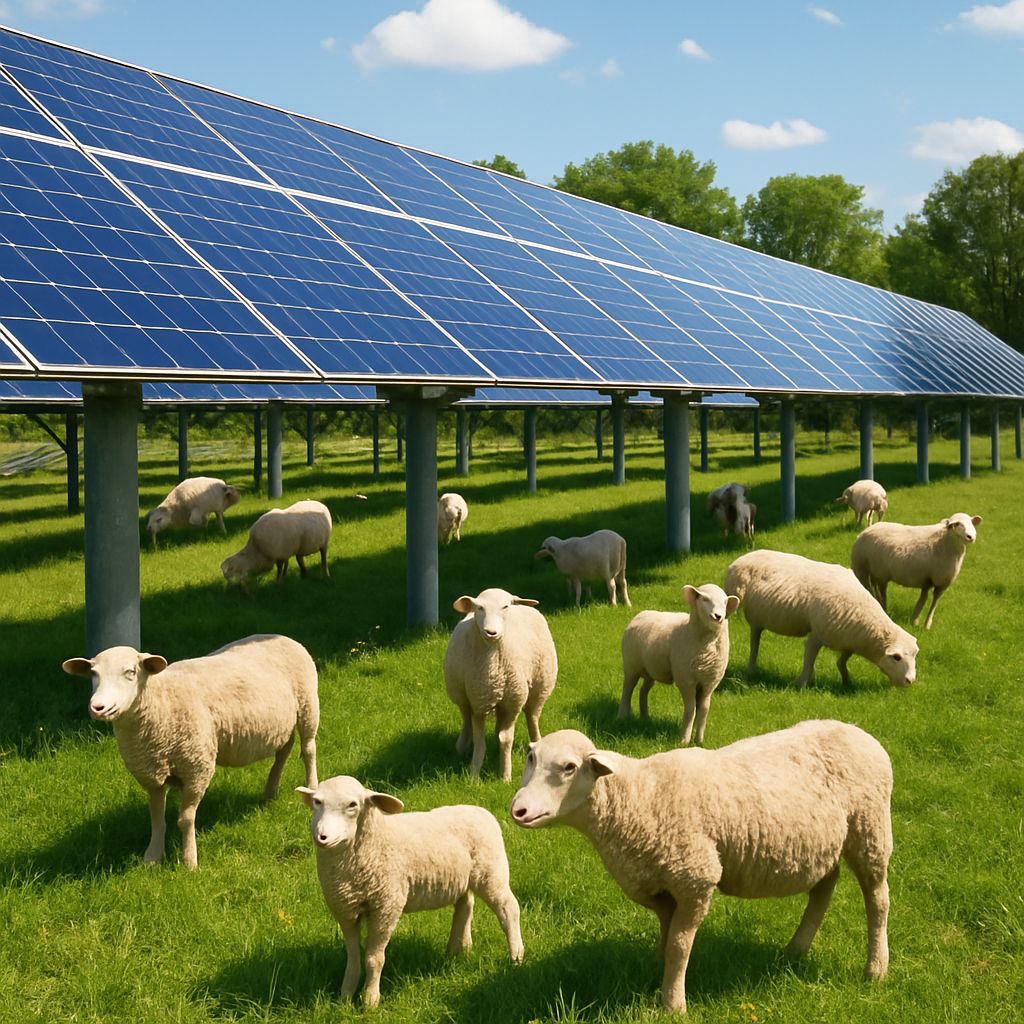
Solar panels on livestock farms are quietly becoming one of the smartest decisions in modern agriculture — and the animals are the first to benefit.
Growing Solar Mist has been at the forefront of documenting how solar integration reshapes livestock farming — from shade-driven animal welfare improvements to full agrivoltaic system designs built around how animals actually graze and move. The evidence is clear: farms that combine solar energy with livestock management consistently outperform those that don’t on multiple health, productivity, and financial metrics.
Solar Panels Are Changing How Livestock Farms Operate
Traditional livestock farming has always battled two unavoidable costs: energy and animal health. Heat stress alone costs the U.S. livestock industry billions annually in lost productivity, increased veterinary bills, and animal mortality. Solar panels address both problems at once — generating clean, low-cost electricity while physically reshaping the farm environment in ways that protect animals from temperature extremes.
What’s changed in recent years is the scale of adoption. Farmers who once saw solar as a niche technology are now integrating panel arrays directly into grazing fields, barns, and water systems. The dual-purpose model — energy production alongside active livestock use of the same land — has proven financially viable across cattle, sheep, poultry, and swine operations of nearly every size.
How Solar Panels Directly Benefit Farm Livestock
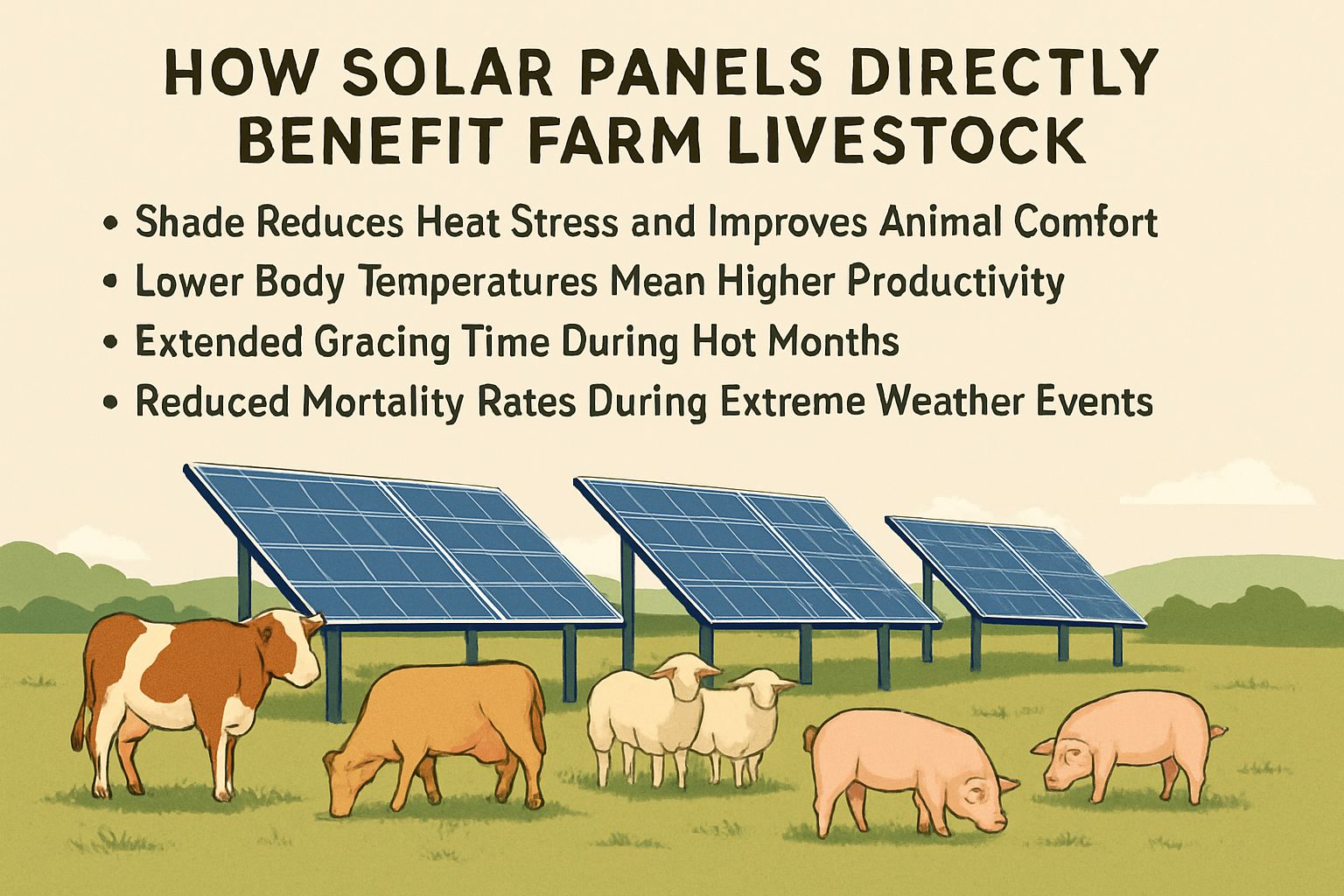
The benefits of solar panels for livestock go well beyond cutting the electricity bill. When panels are positioned correctly over or near grazing areas, they create a measurable shift in the immediate environment that animals respond to quickly and consistently. Heat, hydration, grazing behavior, and even reproductive performance are all affected by the presence of well-placed solar infrastructure.
Shade Reduces Heat Stress and Improves Animal Comfort
Heat stress is one of the most damaging and underestimated threats to livestock productivity. When core body temperatures rise above optimal thresholds, animals reduce feed intake, seek shelter, and divert energy away from growth and reproduction. Solar panels installed over grazing areas create shade zones that can run 10 to 15°F cooler than the surrounding open pasture — a difference that fundamentally changes how animals experience a summer afternoon.
This isn’t passive comfort. Cooler rest zones mean animals spend less metabolic energy managing heat and more energy on feed conversion, weight gain, and milk production. For dairy operations especially, the return on shading infrastructure is measurable within a single season.
Lower Body Temperatures Mean Higher Productivity
When livestock aren’t fighting heat, they perform better across every measurable output. Cattle in shaded environments show improved average daily weight gain. Dairy cows under consistent shade maintain more stable milk production volumes through summer months. Poultry operations using solar-shaded runs report better feed-to-weight conversion ratios. The physiology is straightforward — a comfortable animal is a productive animal.
Solar panels stabilize the microclimate beneath them by absorbing direct solar radiation before it reaches the ground. This creates more consistent temperatures throughout the day rather than the sharp midday spikes that trigger heat stress responses in livestock. That temperature stability compounds the shade benefit, giving animals a more predictable and manageable environment.
Extended Grazing Time During Hot Months
Without shade, livestock in hot climates naturally retreat during peak afternoon heat — typically between 11 a.m. and 4 p.m. That’s a significant chunk of prime grazing time lost every single day throughout summer. Solar panel arrays positioned across pasture areas give animals a reason to stay out and keep grazing, because the environment under the panels remains tolerable even when ambient temperatures peak.
Farmers using agrivoltaic grazing setups consistently report that their herds use more of the available pasture area and graze for longer daily windows during the hottest months. That translates directly into better pasture utilization and reduced supplemental feed costs.
Reduced Mortality Rates During Extreme Weather Events
Extreme heat events are becoming more frequent and more severe. For livestock operations without adequate shelter infrastructure, these events carry real mortality risk — particularly for young animals, pregnant females, and high-production dairy cows already operating near their physiological limits. Strategically placed solar panels provide emergency shade coverage during these critical periods, functioning as permanent, low-maintenance shelter that requires no additional labor to deploy when temperatures spike.
Beyond heat, panel structures can provide partial wind and precipitation protection during cold weather events, reducing the energy burden on animals trying to maintain core temperature during winter storms. The structural presence of solar arrays across a pasture essentially adds a layer of passive climate resilience to the entire grazing system.
Agrivoltaic Systems: Growing Energy and Raising Livestock Together
Agrivoltaics is the practice of running agricultural production and solar energy generation simultaneously on the same piece of land. For livestock farmers, this means panel arrays installed at heights and spacings that allow animals to graze freely beneath them while the panels above generate electricity — no land sacrificed, no production compromised, two income streams from one acre. To explore the potential of enhancing solar panel efficiency on farms, consider the benefits of solar trackers.
The financial case for agrivoltaic systems has strengthened considerably as panel costs have dropped and energy prices have risen. What was once an experimental approach used by early adopters is now a viable primary infrastructure strategy for livestock operations looking to reduce operating costs while improving animal welfare outcomes at the same time. Learn more about the benefits of solar trackers for optimizing solar panel efficiency on farms.
What Agrivoltaic Farming Actually Means
Agrivoltaic farming is not simply installing solar panels near a barn. It is a deliberate design approach where panel height, row spacing, orientation, and density are all calibrated around the specific needs of the livestock using the land beneath. Panels in a true agrivoltaic grazing system are typically mounted on elevated racking — often 8 to 12 feet above ground — leaving full clearance for animals to move, graze, and behave naturally. Row spacing is wide enough to allow sufficient sunlight penetration for grass growth while still providing meaningful shade coverage across the pasture floor. For more insights on how solar technology is integrated into agriculture, explore the benefits of solar trackers for farmers.
Which Livestock Benefit Most From Agrivoltaic Systems
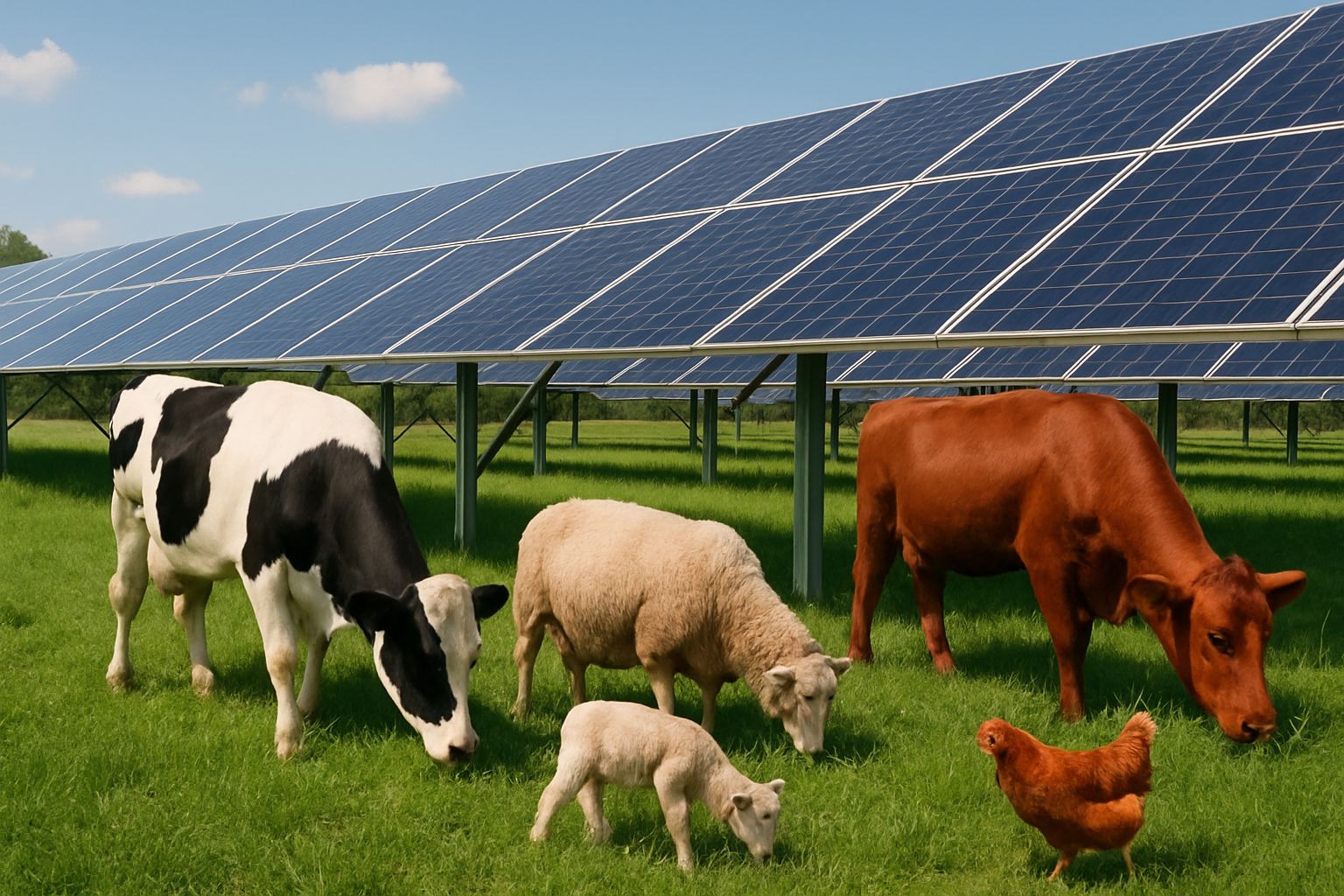
Sheep are consistently identified as the most compatible livestock for agrivoltaic systems. Their grazing height, body size, and foraging behavior make them ideal for maintaining vegetation under and between panel rows without damaging panel infrastructure. Cattle work well in higher-mounted systems where clearance accommodates their size. Poultry operations have also demonstrated strong results using solar-covered runs, with birds benefiting from both shade and the insect activity that increases in the more humid microclimate beneath the panels.
How Panel Placement Affects Grazing Patterns
Animals learn quickly. Within days of a new solar installation, livestock begin incorporating the shaded zones into their daily movement patterns — resting under panels during peak heat and grazing the open areas during cooler morning and evening hours. This self-directed behavior actually improves pasture utilization by distributing grazing pressure more evenly across the paddock. Panels placed thoughtfully across a pasture essentially guide livestock movement without fencing, reducing overgrazing in preferred areas and giving recovering pasture sections more recovery time.
Solar-Powered Systems That Improve Daily Livestock Care
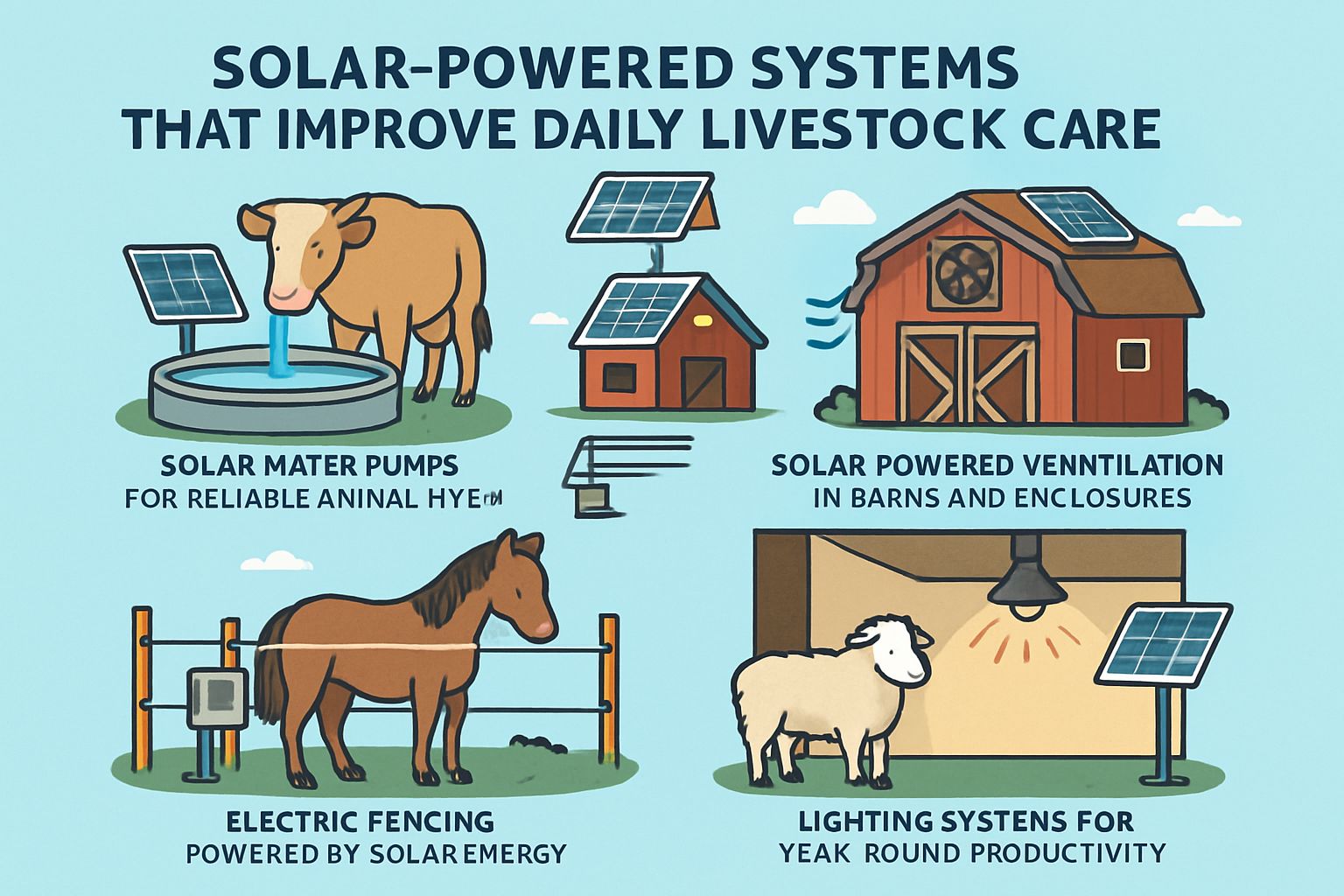
The physical shade benefit of solar panels is only part of the picture. The electricity those panels generate can power a range of livestock management systems that directly improve animal welfare, reduce manual labor, and cut operational costs across the entire farm. From water delivery to ventilation to perimeter security, solar energy makes each of these systems more reliable and significantly cheaper to run.
Solar Water Pumps for Reliable Animal Hydration
Water is non-negotiable for livestock health, and reliable delivery is one of the most labor-intensive parts of daily farm management. Solar-powered water pumps eliminate grid dependency for this critical function, drawing water from wells, ponds, or storage tanks using nothing but sunlight — and doing it consistently even in remote paddocks where running electrical infrastructure would be prohibitively expensive.
Real-World Example: A cattle operation running a 200-head herd across multiple paddocks can replace a grid-tied electric pump system with a solar-powered setup like the Grundfos SQFlex Solar Water Pump, which operates directly from panel input without battery storage during daylight hours. With a properly sized panel array — typically 1,000 to 3,000 watts depending on well depth and daily water demand — the system delivers continuous flow during peak sun hours, with a storage tank buffer covering overnight and cloudy-day needs. The result is a self-sufficient watering system that runs without a monthly electricity bill and requires minimal maintenance beyond annual inspections.
The hydration benefit compounds with the shade benefit significantly. Animals grazing under solar panels experience lower heat loads, which reduces their water consumption requirements slightly — but more importantly, it means they stay closer to the grazing area rather than trekking to distant water points during peak heat. Positioning solar-powered water stations within or adjacent to shaded panel zones creates a complete comfort hub that keeps animals calm, hydrated, and on pasture longer.
Solar water systems also shine in off-grid or remote grazing situations. Pumping water to a distant paddock traditionally meant either running long electric lines or hauling water manually — both expensive and time-consuming. A small dedicated solar panel array powering a pump directly at the water source removes both problems entirely. Systems like the Lorentz PS2 Solar Pump are specifically engineered for agricultural use, with variable-speed motors that adjust output based on available sunlight, maintaining consistent water delivery even on partly cloudy days. For more information on optimizing solar panel efficiency, consider exploring the benefits of solar trackers for farmers.
Maintenance on solar water systems is straightforward. Panels require periodic cleaning to maintain output efficiency, pump impellers need annual inspection, and storage tanks should be checked for algae growth seasonally. Compared to the mechanical complexity of generator-driven or grid-tied pump systems, the solar alternative has significantly fewer failure points and lower lifetime service costs.
Solar-Powered Ventilation in Barns and Enclosures
Barn ventilation is a constant energy cost for enclosed livestock operations. Fans running continuously through summer months drive up electricity bills while performing a function that solar power can handle directly and efficiently. Solar-powered ventilation fans can be wired directly to a dedicated panel array, meaning they run hardest precisely when ventilation demand is highest — on hot, sunny days when both solar output and barn temperatures peak simultaneously. That natural synchronization between energy production and cooling need makes solar ventilation one of the most elegantly matched agricultural solar applications available.
For poultry houses and swine confinement buildings especially, ventilation isn’t optional — it’s a life-safety system. Heat buildup in enclosed animal housing can reach dangerous levels within hours on a hot day. Solar-powered exhaust fans with battery backup provide reliable airflow even during grid outages, which often coincide with the severe weather events that put livestock at greatest risk. Installing a system like the iSolar Controls Solar Ventilation Controller allows farmers to automate fan speed based on temperature sensors inside the barn, maximizing both animal comfort and energy efficiency without manual adjustment.
Electric Fencing Powered by Solar Energy
Solar-powered electric fence energizers are one of the most widely adopted agricultural solar technologies, and for good reason. They eliminate the need for grid connections or frequent battery replacements across large perimeter systems, making rotational grazing management significantly more practical. A unit like the Gallagher S200 Solar Fence Energizer powers up to 25 miles of fence from a single integrated solar panel, providing consistent charge through seasonal light variation with its built-in battery storage system.
For rotational grazing systems specifically, solar fence energizers make the logistics of moving temporary fencing between paddocks much simpler. Each portable fence section operates as a self-contained unit — no extension cords, no generator, no grid connection required. This flexibility encourages more farmers to implement proper rotational grazing, which improves pasture health, reduces erosion, and ultimately supports better long-term carrying capacity across the entire operation.
Lighting Systems for Year-Round Productivity
Controlled lighting has documented effects on livestock productivity — particularly in poultry, where light cycle management directly regulates egg production, and in sheep and goat operations where breeding season timing can be manipulated through artificial photoperiod control. Solar-powered LED lighting systems make these productivity tools available without adding to the monthly electricity bill, providing consistent, programmable light cycles in barns and enclosures powered entirely by daytime solar generation stored in battery banks for nighttime delivery.
The Real Cost Savings Solar Delivers for Livestock Farmers
The productivity and welfare benefits of solar integration are compelling on their own — but the financial case is what typically drives adoption decisions. Between direct energy cost reduction, animal productivity improvements, and available government incentive programs, the economic argument for solar on livestock farms has never been stronger than it is right now.
How Much Farmers Save on Energy Bills
- Livestock operations typically spend 15 to 30% of total operating costs on energy — solar directly attacks that expense from day one of system operation.
- Average farm solar installations reduce electricity bills by 50 to 90% depending on system size, local utility rates, and net metering availability in the state.
- Solar water pumping systems eliminate pump electricity costs entirely during daylight hours, which for a continuously running stock water system can represent hundreds of dollars monthly.
- Ventilation fan arrays in poultry and swine operations are among the highest electricity consumers on the farm — solar can offset the majority of this load during the peak summer months when both demand and solar output are highest.
- Solar fence energizers replace battery replacement costs and eliminate the need for grid-tied fence lines, saving both materials and labor across large perimeter systems.
The payback period for a farm solar installation varies based on system size, local electricity rates, and available incentives — but most well-designed agricultural solar systems in the United States achieve full payback within 5 to 9 years. After payback, the energy generated is essentially free for the remaining 15 to 20 years of panel life, representing a substantial long-term reduction in operating costs that compounds in value as utility rates continue to rise.
It’s also worth accounting for the indirect financial benefits that come from improved animal welfare. Reduced heat stress translates directly into better feed conversion ratios, meaning farmers spend less on feed per pound of gain or per gallon of milk produced. Lower mortality rates during heat events reduce replacement animal costs. Improved reproductive performance in breeding herds increases calf or lamb crop percentages. These indirect savings don’t appear on the electricity bill, but they show up clearly in end-of-year production numbers.
When the full picture is considered — direct energy savings plus productivity improvements plus reduced veterinary and mortality costs — the true return on a well-integrated livestock solar system substantially exceeds what the electricity savings alone would suggest. Farmers who approach solar as a livestock management investment rather than purely an energy investment consistently report stronger overall financial outcomes from their installations.
Federal Tax Credits and USDA REAP Grants Available Now
The financial case for farm solar is made significantly stronger by two major federal support mechanisms currently available to U.S. livestock producers. The Investment Tax Credit (ITC) under the Inflation Reduction Act currently allows agricultural businesses to deduct 30% of solar installation costs directly from their federal tax liability. For a $150,000 solar installation on a mid-sized livestock operation, that’s $45,000 back at tax time — a substantial reduction in the net system cost that dramatically shortens payback timelines. Learn more about the benefits of different solar systems for agricultural use.
The USDA Rural Energy for America Program (REAP) goes even further, providing grants that cover up to 50% of eligible solar project costs for agricultural producers and rural small businesses. REAP grants can be combined with the ITC in many cases, meaning a livestock farmer could potentially offset 60 to 75% of total system costs through combined federal support before the system generates a single kilowatt-hour. Applications are accepted on a rolling basis, and the USDA prioritizes projects that demonstrate clear agricultural use cases — which livestock solar installations do by definition.
How to Set Up Solar Panels for Your Livestock Operation
Getting solar right on a livestock farm requires more planning than a typical residential installation. The system needs to serve both energy generation goals and animal welfare objectives simultaneously, which means panel placement, system sizing, and integration with existing infrastructure all need to be thought through carefully before a single post goes in the ground. Here’s how to approach it systematically.
1. Assess Your Farm’s Energy Needs First
Start by pulling 12 months of electricity bills and identifying your peak monthly consumption in kilowatt-hours. Layer in the specific loads you intend to power — water pumps, ventilation fans, lighting, fencing — and calculate their daily runtime and wattage requirements. This baseline energy audit determines the minimum system size needed to meet your goals. A licensed agricultural solar consultant can help translate this audit into a precise panel count and inverter specification, but having your own consumption numbers ready makes that conversation significantly more productive and protects you from systems that are sized to maximize sales rather than match your actual needs.
2. Choose the Right Panel Type for Agricultural Use
For most livestock applications, monocrystalline silicon panels deliver the best combination of efficiency and durability in an outdoor agricultural setting. They perform better than polycrystalline alternatives in high-temperature conditions — which is exactly when your livestock need the shade and energy output most. For agrivoltaic grazing systems specifically, bifacial monocrystalline panels like the LONGi Hi-MO 6 series capture reflected light from the ground surface beneath them, adding 5 to 15% additional energy yield without increasing the panel footprint. In barn or enclosure mounting situations where structural load is a concern, lightweight thin-film panels can be appropriate, but they sacrifice efficiency per square foot compared to crystalline options. Consider using solar trackers to maximize energy efficiency in these setups.
3. Position Panels to Maximize Both Energy and Shade
Panel orientation for energy production and panel orientation for livestock shade are not always the same thing — and the design challenge is finding configurations that serve both objectives well. South-facing panels at optimal tilt angles maximize annual energy output, but east-west oriented horizontal mounting at higher elevations can distribute shade more evenly across a pasture throughout the day. Working with a solar designer who understands livestock behavior allows you to find the configuration that balances energy yield with the shade patterns your specific animals need. As a general starting point, aim for panel mounting heights of at least 8 feet for sheep and 10 to 12 feet for cattle, with row spacing that allows 50 to 70% light transmission to the pasture floor to maintain adequate grass growth beneath the array.
4. Integrate Solar with Existing Livestock Infrastructure
The most cost-effective solar installations on livestock farms are those designed around existing water lines, fence lines, barn structures, and animal movement patterns rather than imposed on top of them. Before finalizing any layout, walk your farm with the solar designer and map where animals naturally congregate, where water infrastructure already exists, and which structures could support roof-mounted panels without modification. Barn roof installations eliminate the need for dedicated ground-mount racking costs and provide immediate dual benefit as both energy generators and weather protection for the animals below. Wherever possible, route solar wiring alongside existing electrical or water infrastructure to minimize trenching and installation labor costs.
5. Monitor System Performance and Animal Behavior Together
Once your system is live, tracking both energy output and animal response gives you the data needed to optimize the installation over time. Install a monitoring platform like SolarEdge Farm Monitor or Enphase Enlighten that logs daily energy production at the panel level — this lets you catch underperforming panels before they become a significant efficiency loss. Simultaneously, spend time observing how your livestock interact with the new infrastructure during the first 30 to 60 days. Note where animals congregate, which shade zones see the heaviest use, and whether any panels or mounting structures are causing animals to avoid areas they previously grazed freely.
If animals are avoiding certain zones, it’s usually a solvable problem — either a structural element is creating a fear response, or shade distribution isn’t landing where animals want it at the times of day they’re most active. Minor adjustments to panel tilt, the addition of visual barriers to break up reflective glare, or simply giving animals more time to acclimate can resolve most behavioral concerns. The farms that get the best long-term results from agrivoltaic systems are those that treat the first season as a calibration period rather than a finished product.
Common Mistakes Farmers Make with Livestock Solar Installations
Most solar installation failures on livestock farms aren’t technical — they’re design failures that stem from treating an agricultural solar project like a standard commercial rooftop installation. The animals, the pasture, and the farm’s specific operational rhythms all need to be factored into the design from the beginning, not accommodated as afterthoughts once the panels are in the ground.
Placing Panels Where They Block Too Much Natural Light
Dense panel arrays with tight row spacing can reduce light transmission to the pasture floor below the threshold needed to maintain productive grass growth. When less than 30 to 40% of natural light reaches the ground beneath a panel array, forage production drops significantly — defeating the purpose of integrating solar with a grazing system. The fix is straightforward at the design stage: specify wider row spacing, higher mounting heights, or bifacial panels that allow some light diffusion through the array. The mistake becomes expensive after installation, when re-racking or repositioning panels is the only remedy for a pasture that’s slowly losing its productive capacity.
Ignoring Animal Interaction with Panel Structures
Livestock are curious and physically powerful. Cattle will rub against mounting posts, sheep will investigate wiring conduits, and pigs will root beneath panel footings if they can reach them. None of this is unpredictable — but many solar installations on farms are designed without any accommodation for animal contact with structural components. Steel mounting posts should be smooth and rounded at animal contact heights. Wiring should be fully enclosed in rigid conduit buried below or mounted well above animal reach. Panel undersides, if accessible, should be at heights that prevent direct contact from larger animals.
The good news is that purpose-built agrivoltaic racking systems like those offered by GameChange Solar’s Genius Tracker or Array Technologies’ DuraTrack are increasingly designed with agricultural use in mind, incorporating features that reduce the risk of animal damage to the system and system components causing harm to animals. Specifying agricultural-grade racking from the outset is far more cost-effective than retrofitting protective measures after the first season reveals problems.
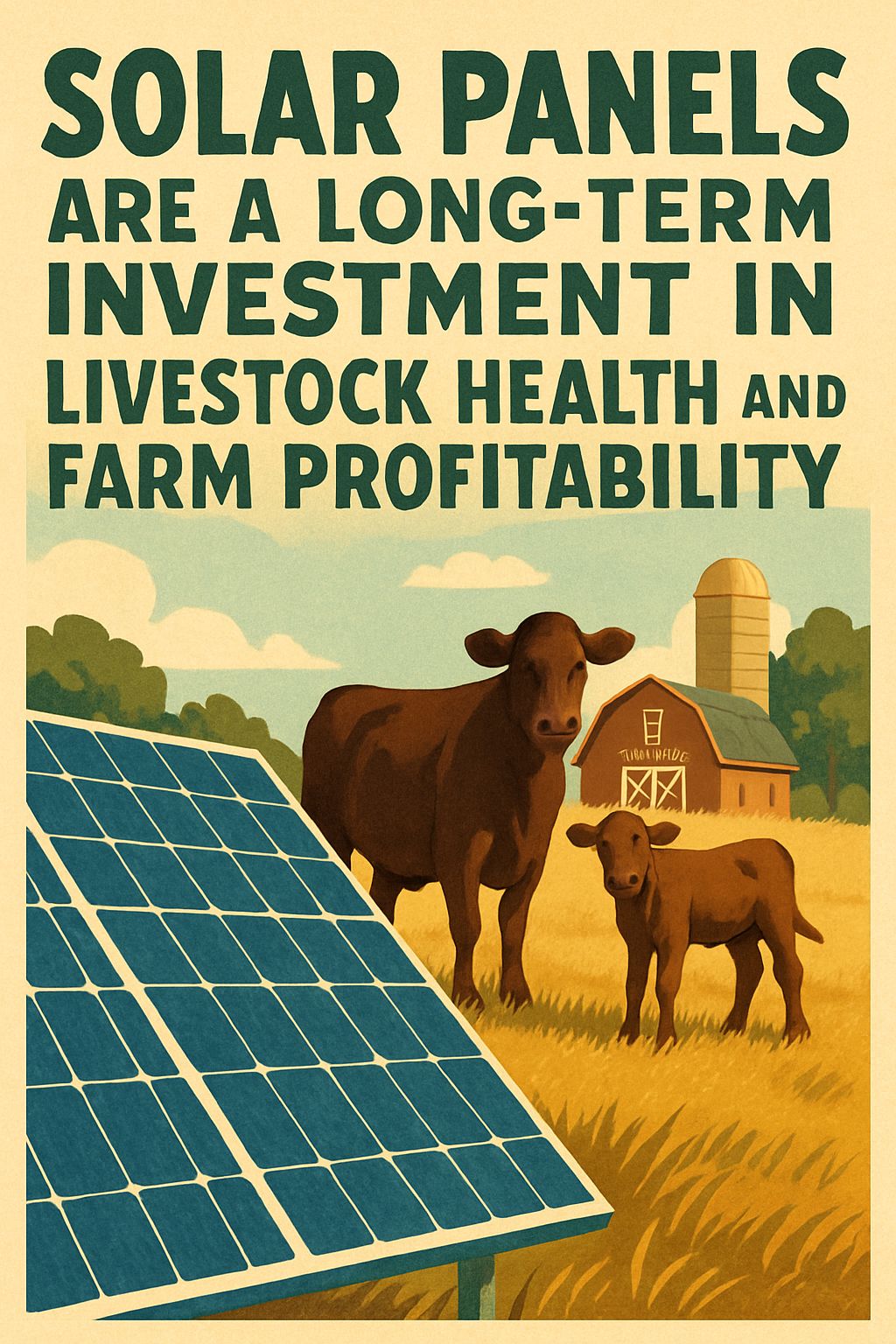
Solar Panels Are a Long-Term Investment in Livestock Health and Farm Profitability
Every element of a well-designed livestock solar system compounds in value over time. The panels producing energy today will still be generating at 80 to 85% of their original output in 25 years, while the shade they provide will protect every generation of animals that grazes beneath them for the entire life of the installation. The water pump running on solar power today eliminates electricity costs from that system permanently. The fence energizer charged by sunlight today removes battery replacement from the maintenance calendar indefinitely. When you add the trajectory of rising utility rates to the picture — energy costs that were manageable five years ago will be substantially higher five years from now — the financial case for locking in solar energy today only gets stronger with time. Livestock farmers who integrate solar now aren’t just solving today’s energy cost problem; they’re insulating their operations against the cost pressures that will define profitability in the next decade of agricultural production.
Frequently Asked Questions
Below are the most common questions livestock farmers ask when evaluating solar integration for their operations.
Can solar panels harm livestock if animals get too close to them?
Solar panels themselves are not inherently dangerous to livestock. The panels carry DC electrical current internally, but the exterior surfaces are non-conductive tempered glass and aluminum framing that poses no shock risk to animals that touch or rub against them. The risk points in an agricultural solar installation are the wiring connections, inverter equipment, and mounting hardware — all of which should be properly enclosed, elevated, or buried to prevent animal contact. A properly designed and installed system with agricultural-use considerations built into the specification poses minimal risk to livestock of any species.
What size solar system does a typical livestock farm need?
System size depends entirely on the specific energy loads being addressed. A small sheep operation primarily using solar for water pumping and fence energizing might be fully served by a 5 to 10 kilowatt system. A mid-sized cattle operation looking to offset barn lighting, ventilation, and water pumping while also providing agrivoltaic grazing shade would typically require a 25 to 75 kilowatt array. Large commercial poultry or swine operations with high ventilation and climate control loads regularly install systems in the 100 to 500 kilowatt range.
The most reliable approach is to complete a full energy audit before engaging with any solar installer. Document every electrical load on the farm, its wattage, and its average daily runtime. This gives you an independent baseline to evaluate installer proposals against, rather than relying solely on the installer’s assessment of what you need.
As a practical reference point, the table below outlines typical system size ranges by livestock operation type:
|
Operation Type |
Typical System Size |
Primary Solar Applications |
|---|---|---|
|
Small sheep or goat farm |
5 – 15 kW |
Water pumping, fencing, lighting |
|
Mid-size cattle operation |
25 – 75 kW |
Agrivoltaic grazing, barn ventilation, water systems |
|
Dairy farm (100+ cows) |
50 – 150 kW |
Milking equipment, cooling, lighting, water heating |
|
Commercial poultry house |
75 – 300 kW |
Ventilation fans, heating, lighting, feed systems |
|
Large swine confinement |
100 – 500 kW |
Climate control, ventilation, feed delivery, lighting |
Do solar panels work well in areas with frequent cloud cover?
Yes — modern monocrystalline solar panels continue generating electricity under cloud cover, typically producing 10 to 25% of their rated output on fully overcast days and 50 to 70% on partly cloudy days. For livestock operations in regions with significant seasonal cloud cover, the solution is straightforward: size the system slightly larger than your calculated minimum need, and include battery storage to buffer daily generation variation. This ensures that water pumps, ventilation systems, and other critical livestock infrastructure maintain reliable operation regardless of daily weather patterns.
Germany — one of the world’s largest solar energy producers — receives less annual sunlight than most of the continental United States, demonstrating clearly that solar viability is not limited to high-sunshine climates. Even farms in the Pacific Northwest, Great Lakes region, or New England can build economically viable solar systems by accounting for regional irradiance data in the system design from the outset. Tools like the NREL PVWatts Calculator allow farmers to input their specific location and get accurate energy production estimates for any proposed system size. To further enhance solar efficiency, farmers can explore the benefits of solar trackers in optimizing their systems.
How long does it take for a farm solar installation to pay for itself?
The payback period for most agricultural solar installations in the United States currently ranges from 4 to 9 years, depending on system size, local electricity rates, net metering policy, and the incentives applied at installation. Farms that successfully combine the 30% federal Investment Tax Credit with a USDA REAP grant covering 40 to 50% of project costs can see effective payback periods as short as 3 to 5 years on well-sized systems. For more information on optimizing solar systems, you might consider exploring smart controllers and sensors for your farm.
After payback, the remaining panel life — typically 15 to 20 additional years of strong production — represents essentially free electricity for the operation. At current agricultural energy cost trajectories, that post-payback generation window delivers substantial financial value that grows each year as utility rates continue to increase. The long-term financial model for farm solar is not speculative — it is grounded in panel performance warranties, documented degradation rates, and utility rate trend data that all point in the same direction.
It is important to note that payback calculations should include both direct energy savings and the indirect productivity gains from improved livestock welfare. A dairy operation that increases average milk production by reducing heat stress events adds real financial value that shortens the effective payback period beyond what energy savings alone would calculate. Building a comprehensive return-on-investment model that captures both energy and animal productivity dimensions gives a more accurate picture of the true financial timeline.
Payback Example: A 50 kW agrivoltaic grazing system installed on a 200-head cattle operation at a total cost of $120,000 receives a 30% ITC ($36,000) and a 40% REAP grant ($48,000), reducing the net cost to $36,000. At an average annual energy savings of $9,000 plus estimated productivity improvement value of $3,500 annually, the effective payback period is approximately 2.9 years — with 22+ years of remaining system life generating ongoing returns.
Can existing farms retrofit solar panels without major structural changes?
Most existing livestock farms can integrate solar with minimal structural disruption, provided the right system type is matched to the existing infrastructure. Barn and equipment shed roof installations are typically the lowest-disruption entry point — a structural engineer assesses roof load capacity, and if adequate, panels are mounted directly to existing rafters using standard agricultural roof-mount hardware. Most modern steel and timber agricultural buildings built in the last 30 years can accommodate roof-mounted solar without structural reinforcement. For more information on enhancing solar power efficiency, check out this guide on smart controllers and sensors.
Ground-mounted agrivoltaic systems in existing pastures require more planning but still integrate cleanly into working farms. Post installation involves driving or boring steel posts into the ground — a process that can be completed section by section without taking entire paddocks out of production simultaneously. A phased installation approach, where one paddock section is developed at a time while animals continue grazing adjacent areas, is standard practice for minimizing operational disruption during the build-out period.

Leave a Reply