
Key Takeaways
- Off-grid solar systems can reduce farm operating costs by 60-80% compared to diesel generators while providing energy independence and sustainability
- Battery storage systems are essential for off-grid farms, with lithium-ion offering the best combination of lifespan and efficiency for most agricultural applications
- Strategic solar panel placement and proper system sizing based on your specific farm operations is critical for maximum energy production
- USDA REAP grants can cover up to 25% of solar project costs for qualifying agricultural businesses
- Big Dog Solar helps farmers design customized solar solutions that address unique agricultural power needs while maximizing available incentives
Why Your Farm Needs Solar Power: The Hard Truth About Rural Energy
Remote farms face unique energy challenges that urban properties simply don’t encounter. If you’re operating off the grid, you’ve likely experienced the frustration of unreliable power and skyrocketing energy costs. Big Dog Solar understands these agricultural realities because we’ve helped countless farmers achieve energy independence through properly designed solar systems that deliver consistent power regardless of your farm’s location.
Traditional energy solutions for rural farms come with significant drawbacks. Diesel generators require constant refueling, ongoing maintenance, and create noise pollution that can disturb livestock. Meanwhile, extending grid connections to remote locations can cost tens of thousands of dollars in installation fees alone, with no guarantee of reliable service. The economic reality is stark: continuing with conventional power means accepting perpetually rising costs and operational vulnerabilities.
Solar power provides the perfect solution for off-grid agricultural operations. With sunlight as your fuel source, you gain energy security while drastically reducing operating costs. Modern solar technology has evolved specifically to meet farm demands with robust, weatherproof systems designed to withstand agricultural environments. The initial investment in solar infrastructure typically pays for itself within 5-7 years, after which your farm benefits from essentially free electricity for decades.
The Hidden Costs of Traditional Farm Power Sources
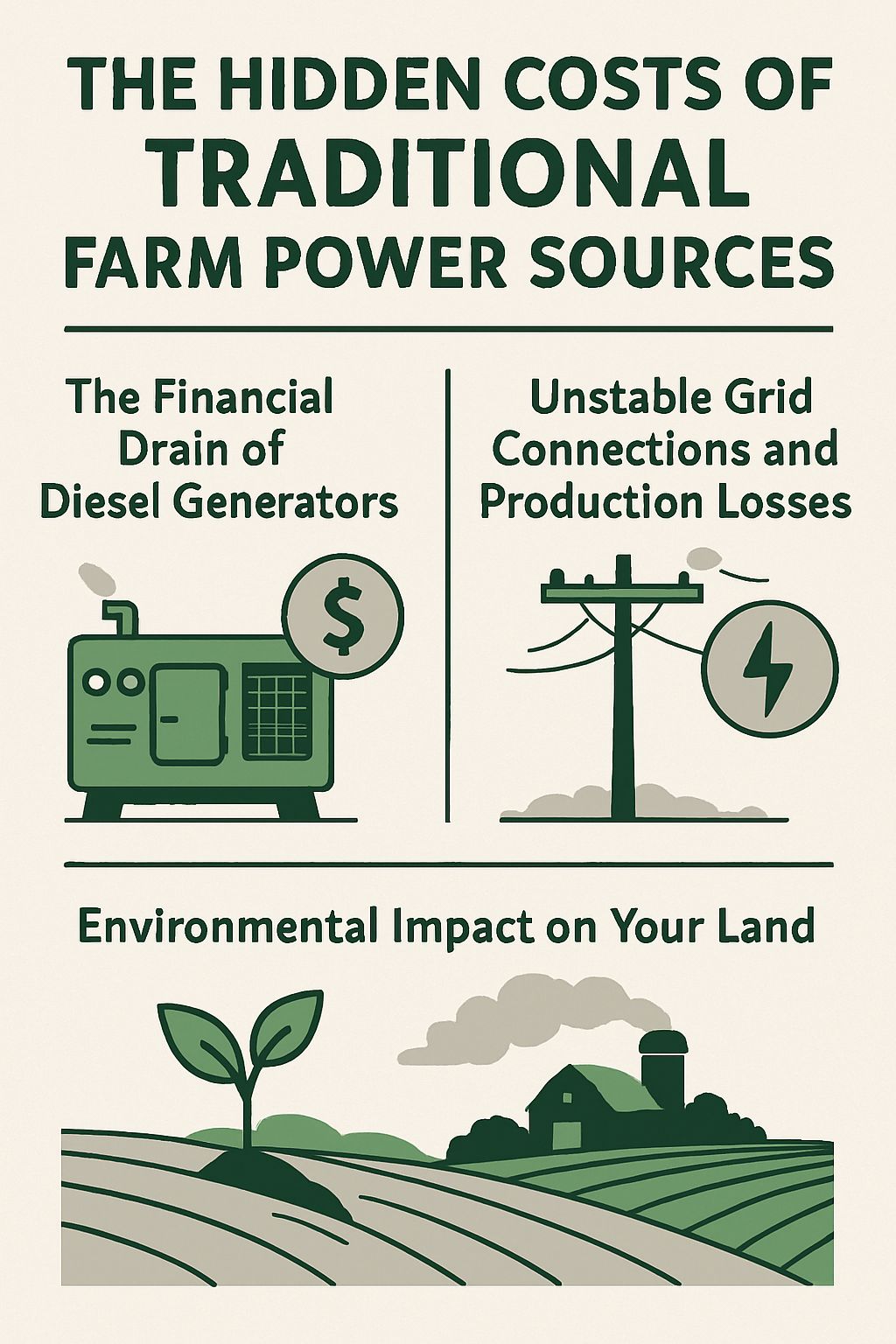
- Diesel generators require constant fuel purchases, regular maintenance, and eventual replacement
- Grid extensions to remote properties can cost $15,000-$50,000+ with ongoing monthly bills
- Unreliable power causes equipment damage and production losses during outages
- Fossil fuel power creates environmental contamination risks on agricultural land
- Traditional energy prices continually increase, while solar costs remain fixed after installation
The Financial Drain of Diesel Generators
Diesel generators have long been the default power solution for remote farms, but their true cost extends far beyond the initial purchase price. A typical agricultural generator consumes 1-3 gallons of fuel per hour depending on load requirements. At current diesel prices, this translates to $7-21 per hour in operating costs alone. Add in regular maintenance (oil changes, filters, repairs) at approximately $500-1,500 annually, plus the inevitable replacement cost every 10,000-30,000 operating hours, and the financial burden becomes substantial.
What many farmers don’t fully calculate is the labor cost associated with generator management. Each refueling, maintenance check, and troubleshooting session pulls you away from productive farm work. These hidden labor expenses, when properly accounted for, often add thousands to the annual cost of generator power. Meanwhile, solar panels work silently in the background, requiring minimal oversight and freeing you to focus on what matters most – your agricultural operations.
Unstable Grid Connections and Production Losses
Rural grid connections notoriously suffer from reliability issues that urban areas don’t experience. Weather events, equipment failures, and maintenance outages disproportionately affect remote lines, with power restoration typically prioritized for population centers. These outages create cascading problems for farm operations, from spoiled refrigerated products to disrupted watering systems and climate control failures in animal housing. To mitigate these issues, farmers are increasingly turning to solar panels to reduce farm energy bills and ensure a more reliable power source.
The financial impact of even brief power interruptions can be devastating. Livestock stress during ventilation system failures, crop losses from irrigation disruptions, and equipment damage from sudden shutdowns all represent significant costs. Off-grid solar systems with proper battery storage eliminate these vulnerabilities by providing consistent, independent power regardless of external conditions. Learn more about the financial benefits of solar panels for farmers.
Environmental Impact on Your Land
Traditional power sources create environmental liabilities that can affect farm productivity and sustainability. Diesel spills from generators or storage tanks can contaminate soil and water sources, potentially compromising organic certification or creating regulatory compliance issues. Fossil fuel emissions contribute to air quality concerns for both workers and livestock, while noise pollution from generators can stress animals and reduce production.
Solar Panel Basics for Farm Applications
Agricultural solar installations differ significantly from residential systems in both scale and application requirements. Farm solar arrays must withstand harsh conditions including dust, temperature extremes, and potential impacts from equipment or livestock. The good news is that modern solar technology has evolved to meet these demanding requirements with robust components designed specifically for agricultural settings.
An effective farm solar system starts with selecting the right panel type for your specific needs. Panel efficiency, durability, and cost must be balanced against your farm’s energy requirements, available installation space, and budget constraints. Unlike urban installations, rural farms often have ample space for ground-mounted systems, opening possibilities for larger arrays that can power even the most energy-intensive agricultural operations.
Monocrystalline vs. Polycrystalline vs. Thin-Film vs. Bifacial Solar Panels: Which Works Best for Farms
Each solar panel type offers distinct advantages for agricultural applications. Monocrystalline panels, with efficiency ratings of 18-22%, provide maximum power output per square foot – ideal for farms with limited installation space or high energy demands. Their excellent performance in high temperatures makes them particularly suitable for hot, sunny regions. Though more expensive initially, their longer lifespan (25+ years) and superior performance often justify the investment for permanent farm installations. To understand if this investment is worth it, explore the financial benefits of solar panels for farmers.
Panel Efficiency in Different Weather Conditions
Solar panels don’t stop working when clouds roll in, contrary to common misconceptions. Modern agricultural solar systems typically operate at 10-25% efficiency during overcast conditions, providing crucial power even during less-than-ideal weather. This resilience becomes especially important on farms where consistent power is needed regardless of weather patterns. High-quality monocrystalline panels maintain better efficiency during cloudy periods than their polycrystalline counterparts, making them worth considering for regions with variable weather.
Temperature also plays a significant role in panel performance, with most solar panels actually operating more efficiently in cooler conditions. For every degree above the standard test temperature (25°C/77°F), panels lose approximately 0.3-0.5% efficiency. This means spring and fall often deliver better solar production than the height of summer, despite receiving fewer daylight hours. Installing panels with adequate airflow beneath them helps mitigate heat-related efficiency losses during hot summer days when farm power demands often peak.
Mounting Options for Agricultural Settings
Fixed ground mounts represent the most straightforward and cost-effective option for most farm solar installations. These sturdy structures elevate panels 2-4 feet above ground level, providing clearance for snow accumulation, flood protection, and adequate airflow. For operations with grazing livestock, panels can be mounted higher (5-8 feet) to allow animals to move freely underneath without risk of damage – a practice increasingly common on sheep and poultry farms.
Tracking systems that follow the sun’s daily movement can increase energy production by 25-45% compared to fixed mounts, though they require more maintenance and come at a higher initial cost. Single-axis trackers, which rotate east to west, offer the best balance of increased production versus added complexity for most agricultural applications. Dual-axis systems that also adjust for seasonal sun angles provide maximum possible energy capture but generally prove cost-effective only in specialized high-value applications like intensive greenhouse operations.
Complete Components for an Off-Grid Farm Solar System
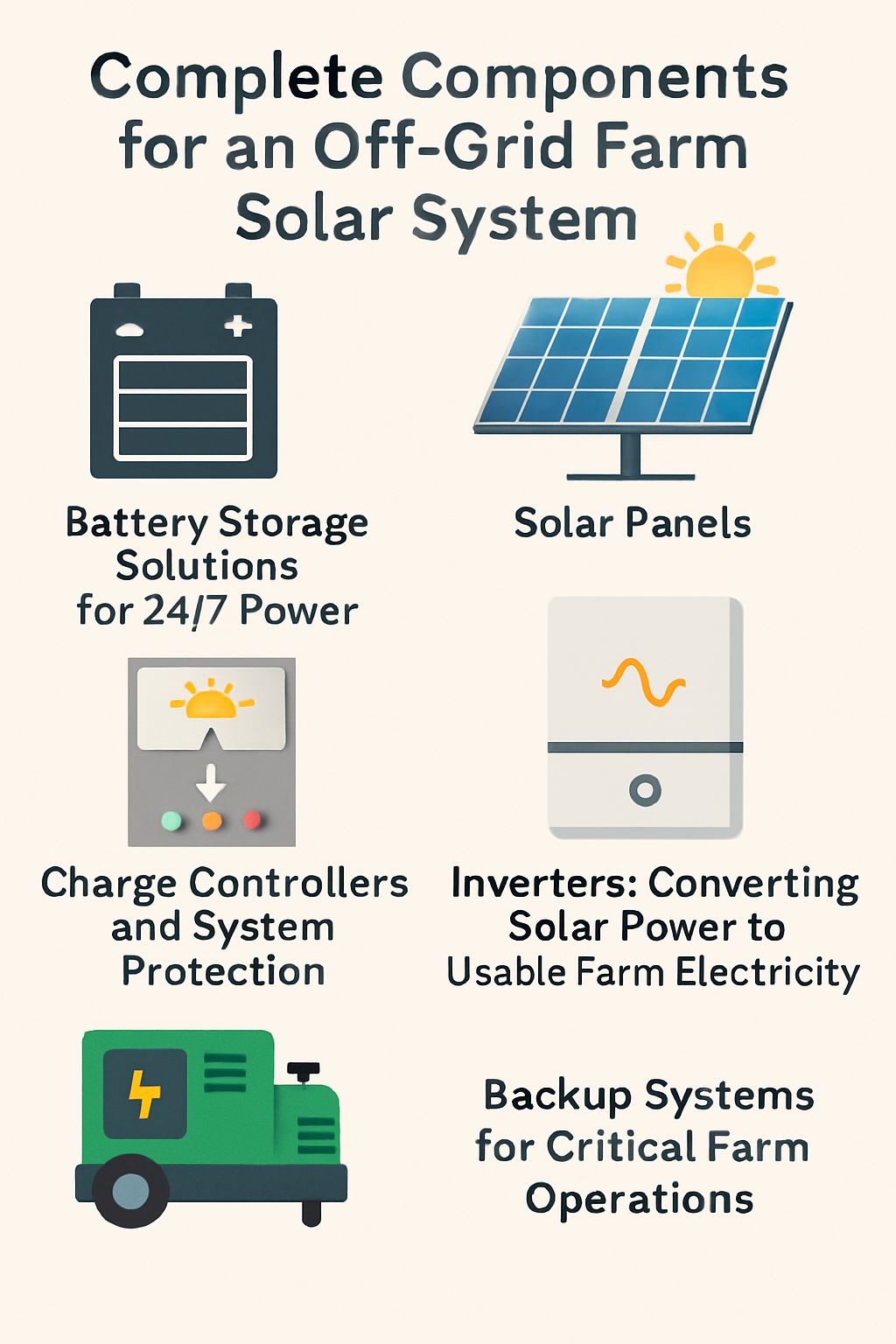
A functional off-grid farm solar system requires more than just panels – it’s an integrated ecosystem of components working together to capture, store, and deliver usable power. Unlike grid-tied systems that can rely on utility connections during production gaps, off-grid setups must be completely self-sufficient. This means incorporating robust storage solutions, power conditioning equipment, and often backup generation capacity to ensure continuous operation regardless of weather or time of day. For more information on how solar panels can transform sunlight efficiently, visit this resource.
Battery Storage Solutions for 24/7 Power
Battery storage forms the backbone of any off-grid farm solar system, providing critical power during nighttime hours and cloudy periods. Lithium iron phosphate (LiFePO4) batteries have emerged as the preferred choice for agricultural applications, offering 3,000-7,000 charge cycles, minimal maintenance requirements, and excellent safety profiles. While their upfront cost exceeds that of lead-acid alternatives, their 10-15 year lifespan and superior depth of discharge capabilities (80-100% versus 50% for lead-acid) deliver better long-term value for farm operations. For more insights on how solar technology is transforming agriculture, explore how solar panels are revolutionizing farm operations.
Charge Controllers and System Protection
Maximum Power Point Tracking (MPPT) charge controllers optimize energy harvest by continually adjusting the electrical operating point of your solar array. This advanced technology typically increases system efficiency by 20-30% compared to simpler controllers, making them essential for farm applications where maximizing every watt matters. Quality controllers also incorporate crucial protection features including overcharge prevention, temperature compensation, and reverse current protection – all vital for preserving your battery investment.
Inverters: Converting Solar Power to Usable Farm Electricity
For agricultural operations, pure sine wave inverters represent the only practical option, as they produce the clean, stable power required by sensitive farm equipment. These devices convert the DC electricity from your panels and batteries into standard AC power that runs everything from water pumps to refrigeration units. Size your inverter system based on your largest simultaneous load plus 20% headroom to prevent overloading during peak farm activities like irrigation cycles or milking operations.
Backup Systems for Critical Farm Operations
- Automatic generator integration systems that activate during extended low-sun periods
- Redundant battery banks that can be rotated into service during maintenance
- Prioritized load management systems that maintain power to critical operations during energy constraints
- Microgrids that can connect multiple on-farm renewable sources (solar, wind, micro-hydro)
- Remote monitoring systems that alert you to potential issues before they become emergencies
Even the most robust solar systems benefit from thoughtful backup solutions, particularly for operations where power interruptions could threaten animal welfare or crop viability. Modern hybrid inverters can automatically manage the transition between solar, battery, and generator power sources without disruption to farm operations. For critical systems like ventilation in confined animal operations, redundancy isn’t just convenient – it’s essential protection against catastrophic losses.
When designing backup systems, focus first on identifying truly critical loads that cannot tolerate interruption. Water systems for livestock, temperature control for young animals, and refrigeration for perishable products typically top this list. By segregating these essential circuits, you can design backup solutions scaled appropriately to your farm’s specific vulnerabilities rather than attempting to back up your entire operation.
Many farmers find that properly sized solar systems with adequate battery storage rarely require generator backup except during unusual weather patterns. When generators are included, propane models often prove more practical for agricultural backup than diesel alternatives, as propane stores indefinitely without degradation and starts reliably even after prolonged idle periods.
Remote monitoring capabilities provide crucial peace of mind for off-grid farm operations. Modern systems deliver real-time performance data and alert notifications directly to your smartphone, allowing you to address potential issues before they impact farm productivity. This connectivity transforms solar from a passive energy source to an actively managed farm asset that integrates seamlessly into your overall operation management.
Sizing Your Farm’s Solar System Correctly
The most common mistake in agricultural solar installations is improper system sizing, leading either to insufficient power or unnecessary expenditure. Unlike residential systems where usage patterns remain relatively consistent, farm operations often have dramatic seasonal variations and specific peak demands that must be accommodated. Careful analysis of both your current and anticipated future needs forms the foundation of a successful farm solar project. For more insights, explore how solar panels are revolutionizing farm operations.
Start by gathering at least 12 months of energy consumption data to capture seasonal patterns. If transitioning from generator power, calculate equivalent electrical load by converting fuel consumption to kilowatt-hours. Remember that solar production also varies seasonally, with winter months typically generating 30-60% less energy than summer peaks, depending on your latitude. This seasonal mismatch between production and farm needs often becomes the determining factor in overall system sizing.
Calculating Your Farm’s Energy Needs
Begin your farm energy assessment by creating a comprehensive inventory of all electrical equipment, noting both wattage and daily operation hours. Pay particular attention to high-consumption devices like irrigation pumps, refrigeration units, and heating systems that form the backbone of your energy demands. For accuracy, use clamp meters to measure actual operating loads rather than relying solely on nameplate ratings, as many farm implements draw significantly different power under real-world conditions.
Converting this equipment inventory into daily kilowatt-hour requirements provides your baseline energy target. Most farms benefit from adding a 20-30% capacity buffer to accommodate unexpected needs and system degradation over time. For operations with critical power requirements, like dairy farms or poultry operations, this buffer might reasonably extend to 50% to ensure absolute reliability regardless of weather conditions.
Seasonal Energy Variations in Agricultural Operations
Farm energy demands rarely remain constant throughout the year. Irrigation typically peaks during summer months, heating requirements surge in winter, and processing equipment usage often concentrates around harvest periods. Understanding these seasonal patterns is crucial for proper system sizing. When analyzing your energy needs, create separate calculations for each season rather than relying on annual averages that may mask critical peak demands. For more information on how to manage energy costs effectively, consider exploring solar panels to reduce farm energy bills.
Solar production follows its own seasonal curve, typically reaching maximum output during summer months when days are longest. This fortunate alignment often matches well with irrigation demands, but creates challenges for winter-heavy loads like livestock heating or greenhouse operations. For farms with significant winter energy requirements, increasing your system size by 40-50% beyond summer needs generally provides adequate year-round coverage.
Future-Proofing: Planning for Farm Expansion
Thoughtful solar system design anticipates your farm’s growth trajectory. Most agricultural operations expand incrementally over time, adding equipment, structures, or production capacity that increases energy demands. Installing a solar array that can accommodate reasonably anticipated expansion over the next 5-7 years typically proves more economical than undertaking multiple smaller installations.
Modular system architecture provides the most flexible approach to future expansion. By selecting components that allow straightforward integration of additional panels, batteries, and inverter capacity, you create a scalable energy platform that grows alongside your farm. This approach might include oversizing initial wiring, mounting structures, and charge controllers to accommodate future panels, even if you don’t install them immediately.
Strategic Panel Placement on Your Off-Grid Farm
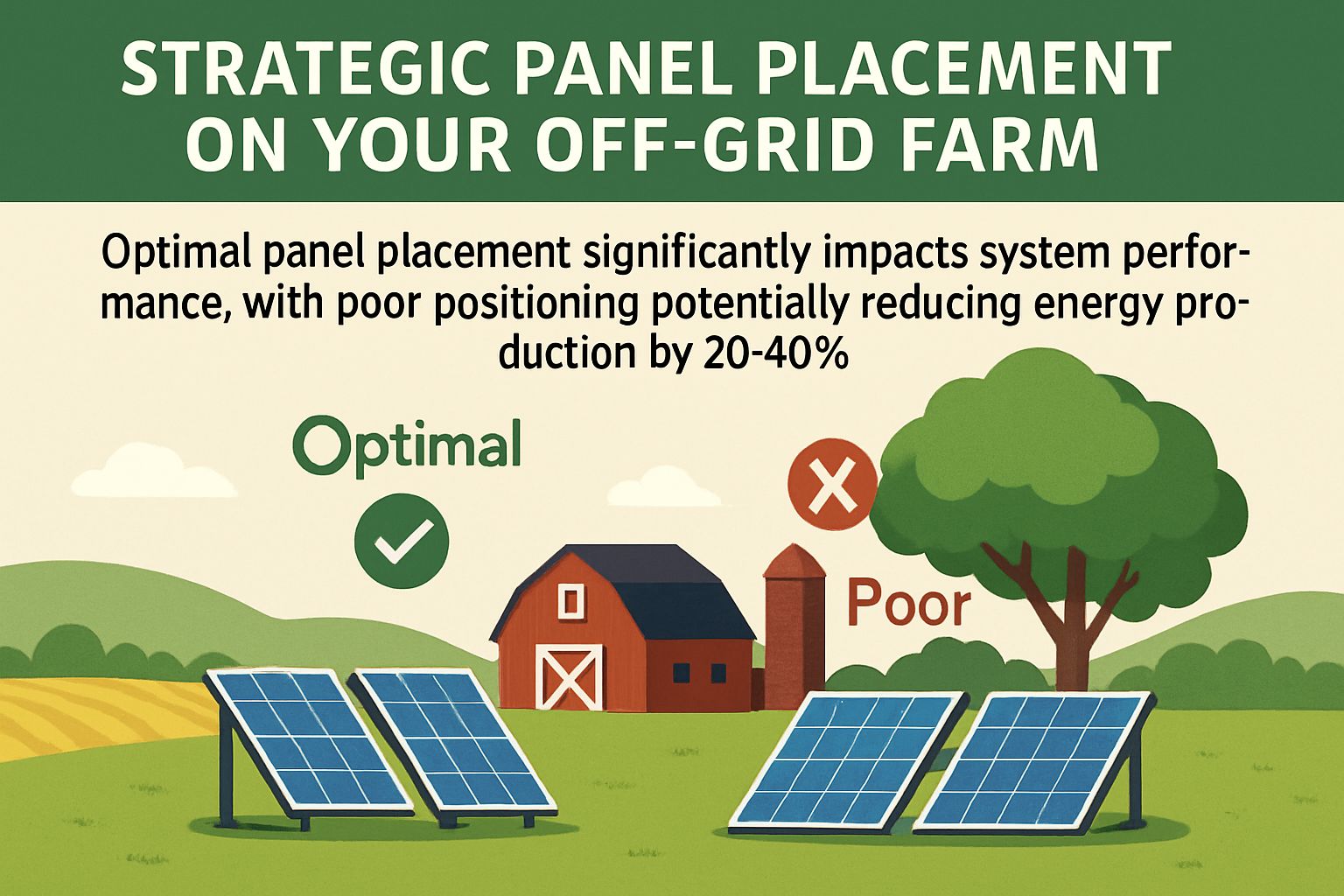
Optimal panel placement significantly impacts system performance, with poor positioning potentially reducing energy production by 20-40%. While southern exposure at a tilt equal to your latitude remains the general rule, agricultural properties often present unique opportunities and constraints. Careful site assessment identifies not only ideal locations but also potential integration with existing farm structures or dual-use applications that maximize return on investment.
Maximizing Sun Exposure in Rural Settings
Rural farm properties generally offer abundant unshaded space for solar arrays – a significant advantage over urban installations. However, proper site selection still requires careful analysis of potential obstructions including trees, silos, barns, and seasonal sun angles. Professional solar mapping tools can precisely calculate shading impacts throughout the year, helping identify optimal array locations that maximize production during your farm’s peak demand periods.
When analyzing potential sites, remember that even partial shading substantially impacts panel performance, as most standard solar strings operate at the level of their lowest-producing panel. Modern power optimizers and microinverters mitigate this issue by allowing each panel to operate independently, making them valuable additions for installations where some shading is unavoidable due to farm layout constraints.
Ground vs. Roof Mounting: What’s Right for Your Farm
Agricultural properties typically offer excellent options for ground-mounted systems, which provide easier installation, better airflow for cooling, and simplified maintenance compared to roof-mounted alternatives. These installations can be positioned for optimal sun exposure regardless of existing building orientations, and their height can be adjusted to accommodate farm activities underneath. For operations with grazing animals, elevated ground mounts with 6-8 foot clearance allow livestock to utilize the shaded area beneath panels, effectively doubling land use efficiency.
Roof mounting on existing farm structures remains viable where land conservation is prioritized or where buildings already offer ideal orientation. Barn roofs typically provide excellent structural support for solar arrays, though age and construction quality require thorough assessment before installation. When considering roof mounts on agricultural buildings, ensure that roof lifespans match or exceed expected solar system lifetimes (25+ years) to avoid premature dismantling for roof repairs.
Dual-Use Solar: Combining Energy Production with Crop Growing
Agrivoltaics – the integration of solar panels with active agricultural production – represents an emerging opportunity for maximizing farm productivity. Properly designed dual-use systems allow crop cultivation or grazing beneath appropriately spaced and elevated panels. Research demonstrates that certain crops actually benefit from the partial shade these systems provide, particularly in hot regions where reduced evaporation and heat stress can increase yields for shade-tolerant varieties.
Elevated solar arrays typically maintain 8-12 foot clearance with wider spacing between panel rows, allowing farm equipment access underneath while creating beneficial microclimate effects. The partial shading reduces water requirements by 15-30% for many crops while protecting plants from extreme temperature fluctuations. This approach is particularly successful with high-value crops like certain berries, greens, and herbs that thrive in dappled light conditions. For more information on optimizing solar energy for farms, explore off-grid solar power solutions.
Powering Specific Off-Grid Farm Operations with Solar
Different agricultural operations present unique energy challenges that require tailored solar solutions. Understanding the specific power requirements, usage patterns, and critical nature of each farm system allows for proper integration with your off-grid solar array. By prioritizing essential operations and designing appropriate power delivery for each, you create a resilient energy ecosystem that supports your entire farm without overbuilding capacity where it’s not needed.
Water Pumping Systems
Water access represents the most critical solar application on most farms, directly impacting livestock health and crop viability. Direct DC pumping systems that connect solar panels directly to specialized pumps (without batteries) offer exceptional efficiency for daytime irrigation and livestock watering. These systems operate whenever sufficient sunlight is available, typically pumping water to elevated storage tanks that provide gravity-fed distribution even when the sun isn’t shining.
For wells exceeding 100 feet depth, submersible pumps with specialized controllers automatically adjust pumping rates based on available sunlight, maximizing water extraction even during partially cloudy periods. These intelligent systems prevent the rapid cycling that damages standard pumps, extending equipment life while optimizing solar energy utilization. For critical water needs, incorporating battery storage ensures continuous water availability regardless of weather conditions or time of day.
Electric Fencing and Security
Solar-powered electric fencing provides reliable perimeter security with minimal energy requirements. Modern solar fence energizers incorporate built-in battery storage that maintains consistent fence operation through multiple cloudy days, offering peace of mind for livestock containment and predator exclusion. These self-contained units typically require just 15-30 watts of solar capacity, making them among the most economical and straightforward solar applications for farms of any size.
Cold Storage and Refrigeration
Refrigeration represents one of the more challenging off-grid solar applications due to its continuous power requirements and high startup loads. Energy-efficient DC refrigerators and freezers specifically designed for solar applications consume 30-60% less power than standard AC models, making them strongly preferred for off-grid farms. These specialized units typically incorporate super-insulation and variable-speed compressors that adapt to available power, maintaining critical cooling even during limited energy periods.
Processing Equipment
Farm processing equipment often creates substantial power demands through high-amperage motors and heating elements. When integrating these operations with off-grid solar, focus first on energy efficiency upgrades that reduce overall requirements. Variable frequency drives can reduce motor startup surges by 60-80%, while modern insulation and heat recovery systems dramatically lower energy needs for thermal processes like pasteurization or dehydration.
For operations with heavy processing loads, consider scheduling energy-intensive activities during peak solar production periods rather than designing your entire system around occasional heavy usage. This load-shifting approach allows you to maintain a more reasonably sized solar system while still accommodating all farm operations. Many successful solar farms effectively implement this strategy by processing harvested crops during daylight hours when direct solar production can handle the increased load without depleting battery reserves.
When equipment absolutely must operate regardless of solar conditions, hybrid systems that incorporate automatic generator backup provide practical insurance. Modern inverter-chargers seamlessly transition between power sources, allowing critical processing to continue uninterrupted while maintaining battery health. This approach provides operational reliability while still capturing the economic and environmental benefits of solar for the vast majority of your energy needs.
Farm-Specific Solar Incentives and Funding
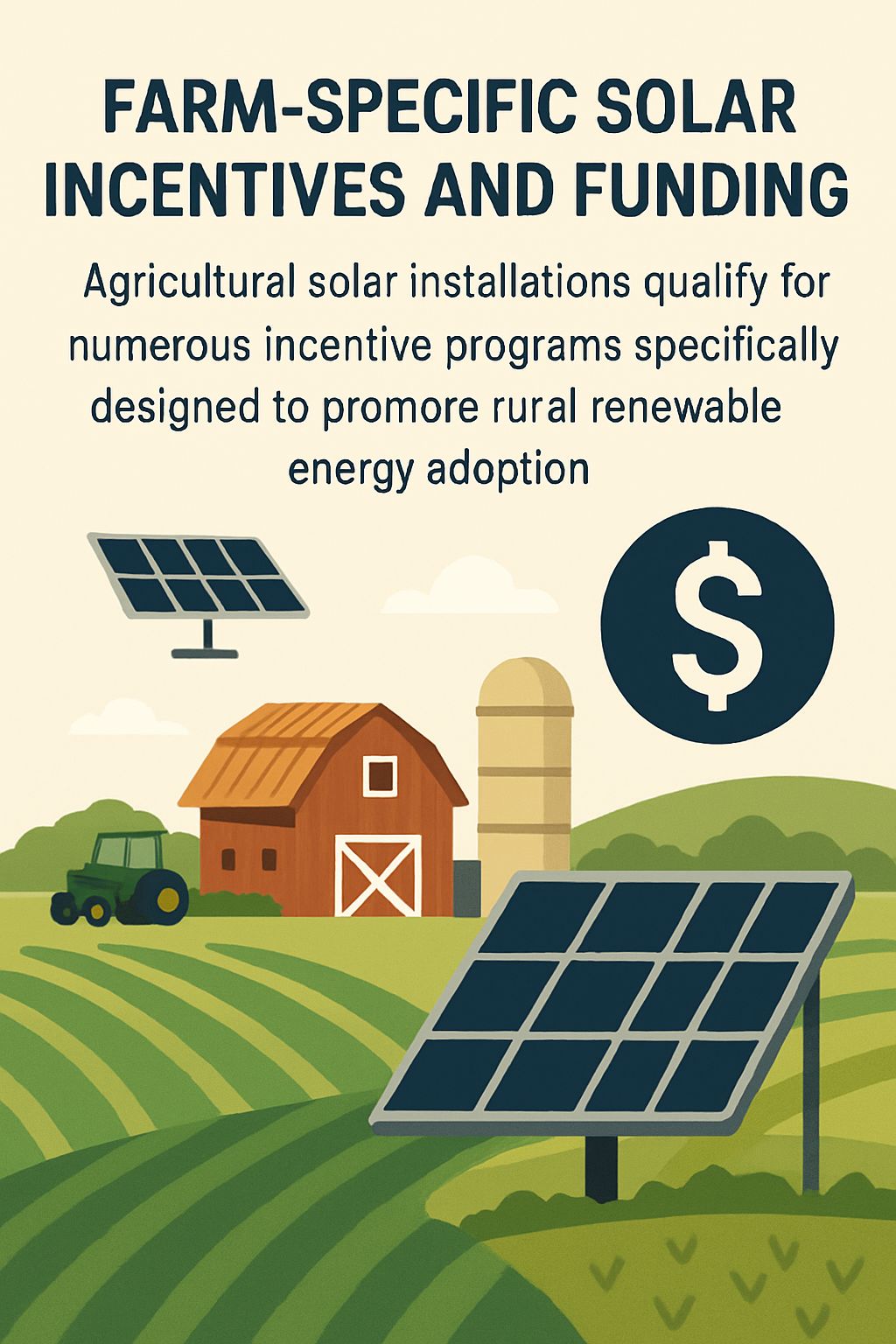
Agricultural solar installations qualify for numerous incentive programs specifically designed to promote rural renewable energy adoption. These financial supports often make solar systems significantly more affordable than most farmers initially assume. Navigating the complex landscape of grants, tax incentives, and low-interest financing options requires careful planning, but the potential benefits justify the effort, frequently reducing project costs by 50-75% after all incentives are applied.
USDA REAP Grants and Loans
The USDA Rural Energy for America Program (REAP) represents the single most valuable incentive for most farm solar projects. This program provides grants covering up to 25% of eligible project costs and loan guarantees for an additional 75%, potentially funding your entire system. REAP specifically targets agricultural producers and rural small businesses, with simplified application processes for projects under $80,000 making it accessible even for smaller farm operations. To learn more about how solar panels can revolutionize farm operations, check out this article on their impact and benefits.
Successful REAP applications require thorough documentation of your current energy usage, projected savings, and system specifications. Applications typically open twice yearly with submission deadlines in March and October, though funding can exhaust quickly in popular regions. Working with a solar provider experienced in agricultural REAP applications significantly increases approval chances, as they understand exactly what documentation reviewers seek and how to properly structure your project for maximum eligibility.
Beyond the headline 25% grant, REAP offers guaranteed loans with favorable terms specifically for agricultural renewable energy. These loans typically feature lower interest rates, extended repayment periods (up to 30 years for real property improvements), and reduced collateral requirements compared to conventional farm financing. Combining grant and loan guarantee components creates a comprehensive funding package that dramatically improves project economics.
REAP Success Story: Hillside Dairy in Wisconsin installed a 76kW solar system powering their milking parlor and refrigeration equipment. The project received a $42,500 REAP grant (25% of costs) plus secured guaranteed financing for the remainder through their local agricultural lender at 3.5% fixed for 15 years. The system generates approximately $12,000 in annual electricity savings, creating positive cash flow from the first year of operation.
Federal Tax Credits for Agricultural Solar
The federal Investment Tax Credit (ITC) provides a substantial 30% credit against tax liability for qualified solar installations on farm properties. Unlike deductions that merely reduce taxable income, this credit directly reduces dollar-for-dollar what you owe in taxes. Most agricultural businesses can carry forward unused portions of this credit for up to 20 years, ensuring you capture the full benefit even if your tax liability varies year to year. Additionally, the Inflation Reduction Act of 2022 stabilized this incentive at 30% through 2032, providing valuable certainty for farm planning purposes.
For projects beginning construction before 2025, bonus depreciation allows 100% first-year depreciation on the remaining system value after the ITC is applied. This accelerated depreciation creates substantial additional tax benefits, particularly for farms with significant tax liability from other operations. Starting in 2025, bonus depreciation gradually phases down by 20% annually, making earlier implementation financially advantageous for operations that can utilize these tax benefits.
- 30% federal tax credit applies to total system cost including panels, mounting, batteries, inverters, and installation
- Credit can be carried forward for up to 20 years if you can’t use it all immediately
- Accelerated depreciation provides additional tax benefits beyond the direct credit
- Property tax exemptions in many states prevent increases due to solar improvements
- Some agricultural operations may qualify for additional production-based incentives
When evaluating these tax benefits, consult with an accountant familiar with both agricultural businesses and renewable energy incentives. The interaction between various credits, depreciation schedules, and your specific farm tax situation creates opportunities for strategic planning that can significantly enhance project economics. Many farmers find that proper tax planning makes solar installations cash-flow positive from the first year of operation.
State-Level Incentives for Farm Energy Independence
Beyond federal programs, many states offer additional incentives specifically targeting agricultural solar adoption. These range from direct rebates that reduce upfront costs to performance-based incentives that provide ongoing payments for energy produced. The most valuable state programs often include sales tax exemptions on solar equipment, property tax exclusions that prevent assessment increases after solar installation, and specialized agricultural grant programs administered through state departments of agriculture. For more information on how these tax incentives make solar panels more affordable than ever for farmers, visit our detailed guide.
Several states have implemented specialized “Ag Energy” programs that provide funding specifically for on-farm renewable projects. These programs typically offer higher funding percentages than general renewable incentives, recognizing the unique challenges and opportunities of agricultural applications. Application requirements generally emphasize farm viability enhancement and sustainable agricultural practices, making them particularly valuable for operations focused on regenerative or organic farming methods that align with broader program goals.
Real Farm Solar Success Stories
Nothing demonstrates the transformative potential of off-grid solar like the experiences of farmers who have successfully implemented these systems. Across diverse agricultural sectors, from livestock operations to specialty crop production, solar power is revolutionizing how farms operate in remote locations. These case studies highlight not just energy savings, but also production improvements, resilience benefits, and unexpected operational advantages that emerged after solar implementation.
The most successful farm solar projects share common elements: thorough energy assessment before installation, appropriate system sizing based on actual measured needs, quality components designed for agricultural conditions, and integration with farm operations that maximizes both energy and agricultural productivity. By learning from these pioneering operations, you can avoid common pitfalls while implementing proven strategies that enhance your farm’s long-term viability. For more insights, consider exploring off-grid solar power solutions.
Livestock Operations Powered by the Sun
Davidson Family Ranch in Colorado transitioned their remote cattle operation to solar power after facing reliability issues with their diesel generator system. Their 15kW array with 48kWh battery storage powers water pumping, security lighting, and a small processing facility where they prepare direct-marketed beef. The most significant benefit came during winter operations – the elimination of generator noise reduced stress on cattle during feeding and handling, noticeably improving weight gain during finishing periods.
For poultry operations, temperature control represents the most critical energy need. Riverbed Poultry installed a 32kW solar system with 85kWh of lithium iron phosphate battery storage to power ventilation and cooling systems for their pastured poultry operation. The system includes automated controls that prioritize critical ventilation loads during extended cloudy periods, ensuring bird health while allowing less essential systems to temporarily reduce consumption when necessary. After three years of operation, they report zero bird losses due to power-related ventilation failures – a dramatic improvement over their previous experience with grid power.
The most sophisticated livestock solar applications incorporate precision agriculture monitoring alongside power generation. Westfield Dairy’s 56kW system powers not just basic operations but also their comprehensive monitoring systems that track individual cow health, milk quality parameters, and feed efficiency metrics. This integrated approach allows them to maintain critical data collection even during grid outages, preserving the information-driven management that modern dairy production requires.
Farmer Testimony: “After three major grid outages last year that each lasted over 48 hours, we realized our generator backup wasn’t sustainable. The solar system has eliminated that vulnerability completely. During the most recent winter storm that knocked out power for five days across the county, our operation continued without interruption – no production losses, no emergency fuel deliveries in dangerous conditions, just business as usual while our neighbors struggled. The peace of mind alone is worth the investment.” — James Westfield, Westfield Dairy
Crop Production with Zero Grid Dependency
Irrigation represents the largest energy demand for many crop operations, making it an ideal candidate for solar power integration. Heritage Orchards converted their 30-acre apple and pear operation to solar-powered drip irrigation, using a 22kW direct-drive system that pumps water whenever sufficient sunlight is available. By incorporating elevated water storage tanks that fill during peak sun hours, they maintain consistent water pressure for irrigation throughout the 24-hour cycle, eliminating the need for battery storage while still providing continuous water availability.
Actual Cost Savings from Real Farms
Financial outcomes from farm solar projects consistently demonstrate compelling returns on investment. Crossroads Vegetable Farm replaced their diesel irrigation pumps with a solar-powered system, reducing annual energy costs from $14,800 to approximately $1,200 for minimal maintenance and occasional backup generator operation. Their 48kW system, installed for $112,000 after incentives, achieved complete payback in just 8.2 years. More importantly, they’ve eliminated the constant maintenance requirements and fuel delivery challenges that previously disrupted farm operations during critical growing periods.
Beyond direct energy savings, many farms report significant operational benefits that impact overall profitability. Freedom Acres, a diversified livestock operation, eliminated twice-daily generator servicing after installing their solar system, freeing approximately 730 hours of labor annually. This time reallocation allowed them to expand their direct marketing program, increasing farm revenue by 22% without additional hired labor. Such operational improvements often exceed the direct energy savings in their impact on farm profitability, though they’re frequently overlooked in standard return-on-investment calculations.
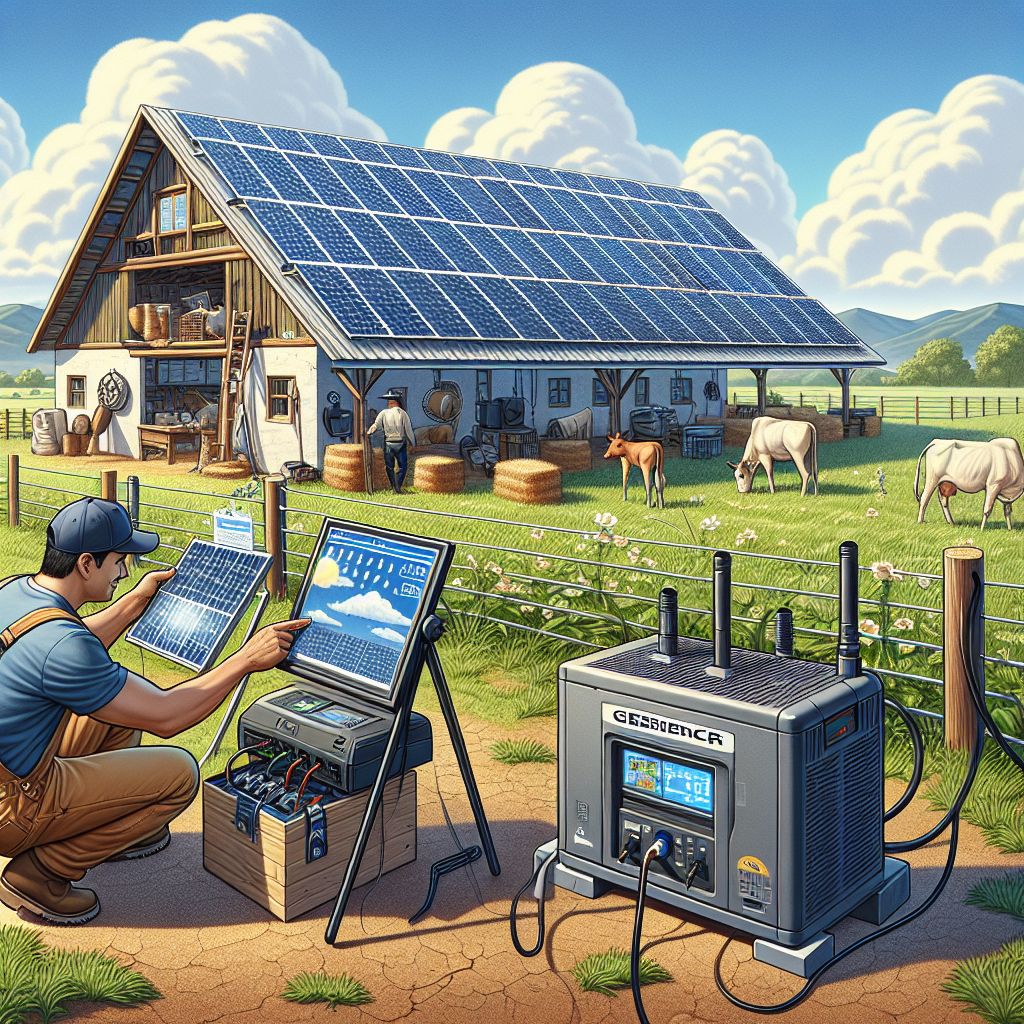
“Off-Grid Farming with Solar Power: Can …” from growingsolarmist.com and used with no modifications.
Take Control of Your Off-Grid Farm’s Energy Future
Energy independence represents one of the most significant opportunities for enhancing farm resilience and profitability in remote locations. By harnessing solar power, you eliminate the vulnerability inherent in relying on external energy sources with their unpredictable costs and reliability issues. This transition doesn’t just reduce operating expenses – it fundamentally transforms your relationship with energy from an ongoing liability to a fixed asset that delivers predictable performance for decades.
The time for agricultural solar adoption has never been better, with component costs continuing to decrease while incentive programs remain historically favorable. Today’s solar technologies specifically designed for farm applications offer durability, performance, and reliability that earlier generations simply couldn’t match. Big Dog Solar specializes in designing and installing these agricultural systems, with deep experience in the unique requirements of farm operations and maximizing available funding opportunities.
Frequently Asked Questions
After helping hundreds of farms transition to solar power, we’ve encountered common questions that arise during the planning process. Understanding these aspects of solar implementation helps you make informed decisions about your own project. The answers below reflect real-world agricultural applications rather than theoretical ideals, focusing on practical solutions that have proven successful across diverse farm operations.
Each farm presents unique challenges and opportunities for solar integration. While these general answers provide valuable guidance, your specific situation may benefit from individualized assessment. Big Dog Solar offers free consultations for agricultural operations considering solar power, helping you evaluate options specifically tailored to your farm’s needs, location, and energy requirements. To understand how solar panels can significantly reduce farm energy bills, exploring available resources can be beneficial.
Many farmers find that starting with a smaller system focused on their most critical operations provides a practical entry point to solar adoption. This approach allows you to gain experience with the technology while demonstrating its reliability for your specific needs. Most systems can be designed for straightforward expansion as your comfort and requirements grow, providing a scalable pathway to complete energy independence. For more insights on solar power solutions, you can explore off-grid solar power options for farms.
How many solar panels do I need to power a small farm?
Small farm operations (10-50 acres) with basic equipment typically require between 10-30kW of solar capacity, depending on specific operations. This translates to approximately 25-75 standard 400-watt panels. Livestock operations generally need more power than equivalent-sized crop farms due to ventilation, heating, and water pumping requirements. For example, a 30-acre vegetable operation with drip irrigation might function well with 15kW of solar capacity, while a similar-sized poultry operation could require 25kW or more to handle climate control systems.
Battery storage requirements vary significantly based on your farm’s operational pattern and critical loads. As a general guideline, most off-grid farm systems incorporate battery storage equal to 1.5-2.5 times their daily energy consumption to provide adequate reserve capacity during limited solar production periods. For a farm using 25kWh daily, this suggests a battery bank of 40-60kWh capacity. Critical operations that absolutely cannot tolerate interruption might justify higher storage ratios of 3-4 times daily usage. For more on how solar technology is revolutionizing farm operations, explore this resource.
The most accurate way to determine your specific requirements is conducting a comprehensive energy audit that measures actual consumption patterns across different seasons. Professional solar designers use this data to model system performance under various weather scenarios, ensuring adequate capacity for your farm’s particular needs. This process often identifies optimization opportunities that can reduce your required system size through strategic load management and efficiency improvements.
Sizing Example: A 40-acre diversified farm with irrigation, basic barn equipment, and cold storage typically requires approximately 20kW of solar capacity paired with 50kWh of lithium battery storage. This configuration provides reliable power for most operations year-round, with occasional generator backup during extended winter cloudy periods. Estimated total system cost ranges from $50,000-$70,000 before incentives, or $25,000-$35,000 after typical agricultural solar incentives are applied.
Remember that proper system sizing balances initial investment against energy security. While oversizing provides additional peace of mind, it increases upfront costs. Most successful farm installations aim for 95-98% energy self-sufficiency rather than 100%, using minimal generator backup for those rare extended low-production periods. This approach typically reduces initial system costs by 15-25% compared to systems designed for absolute worst-case scenarios. For more insights on cost reduction, explore how solar panels reduce farm energy bills.
What happens to my farm solar system during extended cloudy periods?
Well-designed off-grid farm solar systems incorporate sufficient battery storage to maintain critical operations through 3-5 days of minimal solar production. During extended cloudy periods beyond this buffer, systems typically implement tiered load management that preserves power for essential functions while temporarily reducing consumption for non-critical operations. Advanced battery monitoring systems provide clear visibility into remaining capacity, allowing informed decisions about conservation measures or backup generation activation before critical thresholds are reached.
Can solar panels withstand extreme weather common in farming regions?
Modern agricultural solar installations are engineered to withstand harsh farm environments including high winds, hail, heavy snow loads, and temperature extremes. Quality panels are tested to resist 1-inch hailstones at terminal velocity and withstand wind loads exceeding 140 mph when properly mounted. Most agricultural installations employ reinforced mounting systems with deeper foundations than residential equivalents, specifically designed to handle the exposed conditions common on farm properties. For regions with severe weather risks, additional protective features like enhanced frame reinforcement or specialized hail-resistant panel coatings provide extra durability without significantly impacting energy production.
How long does a farm solar system typically last before needing replacement?
Agricultural solar systems typically deliver 25-30+ years of productive operation with minimal degradation. Quality solar panels maintain at least 80% of their original output after 25 years, with many modern panels significantly exceeding this standard. The most maintenance-intensive component – battery storage – varies by chemistry, with lithium iron phosphate systems typically providing 10-15 years of service before requiring replacement. Other system components like inverters and charge controllers generally operate reliably for 10-15 years, making them routine replacement items within the overall system lifespan. With proper component selection and professional installation, most farm solar systems require only basic annual maintenance consisting primarily of panel cleaning and connection inspections.
Will installing solar panels affect my ability to use farm equipment nearby?
Properly designed agricultural solar installations have no impact on farm equipment operation or electronic systems. Unlike electric fencing that generates intentional pulses, solar arrays produce no electromagnetic interference that would affect equipment electronics, GPS systems, or radio communications. Ground-mounted systems can be positioned to maintain clear equipment paths while maximizing solar exposure, and elevated mounting options allow for continued land use beneath panels. For operations concerned about potential equipment impacts, panel arrays can be located away from high-traffic areas while still maintaining efficient connections to your electrical systems through properly sized underground conduit runs. Learn more about strategic solar panel placement to optimize your farm operations.
From powering irrigation systems to ensuring livestock have access to water and climate control, off-grid solar provides the energy independence that modern farms need to thrive regardless of location. By eliminating the vulnerability of diesel generators and unreliable grid connections, you gain both economic and operational advantages that strengthen your agricultural enterprise for decades to come. Learn more about how solar panels are revolutionizing farm operations.

Leave a Reply