
Key Takeaways
- Solar center pivot irrigation systems can cut energy costs by up to 70% compared to diesel or grid-powered setups — making them one of the highest-ROI upgrades available to modern farmers.
- There are four main system types to choose from: fully solar, hybrid grid-tied, solar with battery storage, and diesel retrofits — each suited to different farm sizes and power needs.
- Federal programs like USDA REAP grants and the Investment Tax Credit (ITC) can dramatically reduce upfront installation costs, but most farmers don’t know how to access them — we break it down inside.
- Automation and remote monitoring built into modern solar pivot systems reduce labor demands and allow precise, weather-responsive watering schedules from your smartphone.
Solar Center Pivot Irrigation Is Changing How Farms Run
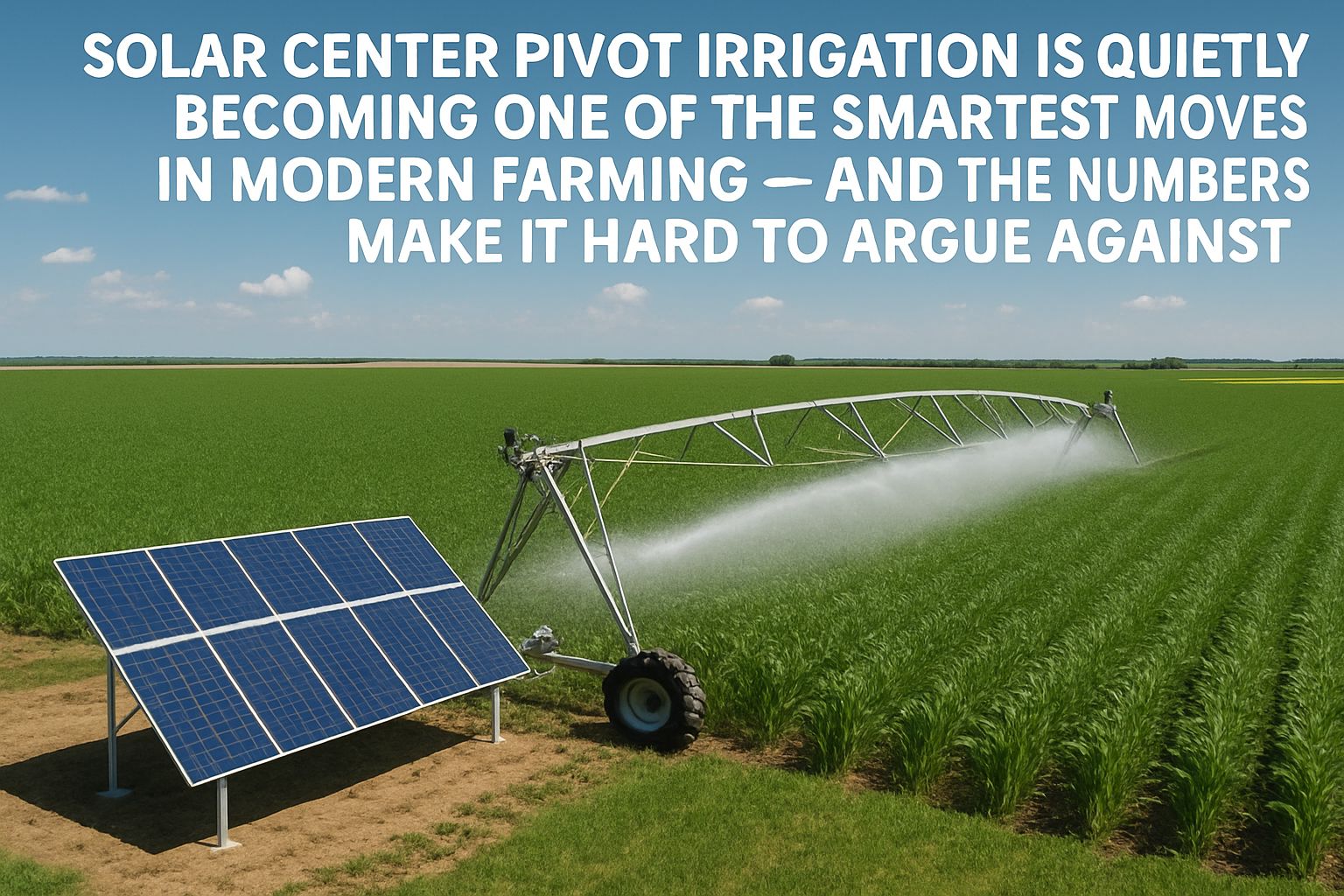
Solar center pivot irrigation is quietly becoming one of the smartest moves in modern farming — and the numbers make it hard to argue against.
Energy costs are one of the largest operating expenses on any irrigated farm. Running a traditional center pivot system on grid electricity or diesel fuel adds up fast, especially during peak growing seasons when the system runs daily. Solar changes that equation entirely. By generating free electricity from the sun, farmers can power the same high-output irrigation equipment at a fraction of the ongoing cost.
Growing Solar Mist has been at the forefront of helping farmers understand how solar energy and irrigation technology intersect, providing practical resources for farmers ready to make the switch. The shift toward solar-powered irrigation isn’t just about saving money — it’s about building a more resilient, efficient farm operation that isn’t vulnerable to fuel price spikes or utility rate hikes.
What Is a Center Pivot Irrigation System?
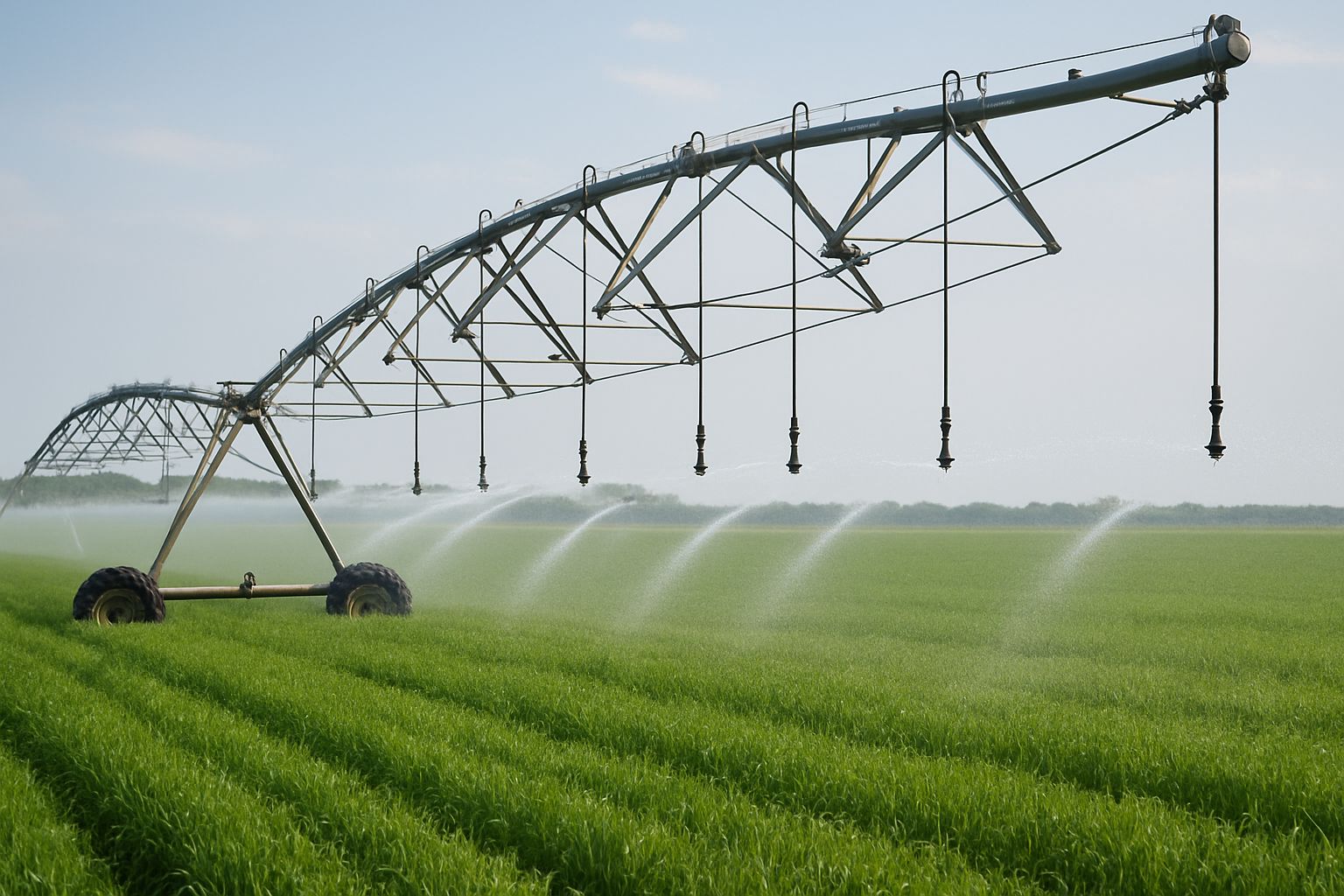
A center pivot irrigation system is a mechanized watering system that rotates around a central fixed point, covering a circular area of cropland with consistent, even water distribution. First introduced in the late 1940s by Frank Zybach, these systems transformed large-scale agriculture by replacing labor-intensive flood or furrow irrigation with automated, efficient water delivery. Today, center pivot systems irrigate millions of acres across the United States and worldwide, utilizing advanced solar panel power solutions for enhanced efficiency.
How the Rotating Arm Works
The system consists of a series of metal spans supported by wheeled towers that move in a slow circular path around the central pivot point. Water is pumped from a well or water source through the pivot point and travels along the span pipeline, spraying down onto crops through sprinkler heads or drop nozzles positioned along the arm.
Each wheeled tower is driven by its own electric motor, keeping the entire span moving in a coordinated arc. The speed of rotation can be adjusted to control how much water is applied per pass — slower rotation means more water per cycle, faster rotation means lighter application. A typical center pivot arm spans anywhere from 1,300 to over 2,600 feet, covering a circular field of 125 acres or more in a single system.
The control panel at the pivot point manages direction, speed, start and stop functions, and increasingly, integration with remote monitoring systems. Modern panels from manufacturers like Valley Irrigation and Reinke Manufacturing include digital interfaces that connect to smartphone apps and precision agriculture platforms.
What Types of Crops and Fields It Works Best For
Center pivot systems are highly versatile and work across a wide range of crops and terrain types. They perform best on relatively flat to gently rolling fields where consistent water pressure across the span can be maintained.
- Row crops: Corn, soybeans, cotton, and sorghum are among the most common crops irrigated by center pivot systems in the U.S.
- Specialty crops: Potatoes, sugar beets, onions, and dry beans respond well to the precise water application center pivots provide.
- Forage crops: Alfalfa and other hay crops benefit from the frequent, consistent irrigation cycles center pivot systems allow.
- Wheat and small grains: Particularly in arid western states, winter and spring wheat production relies heavily on pivot irrigation.
Fields that are square or irregularly shaped can still use center pivot systems with corner arm attachments that extend coverage into field corners. The key limiting factor is terrain — steep slopes create pressure management challenges, though modern variable rate irrigation (VRI) technology helps address uneven topography by adjusting output at individual nozzles.
How Solar Power Connects to the System
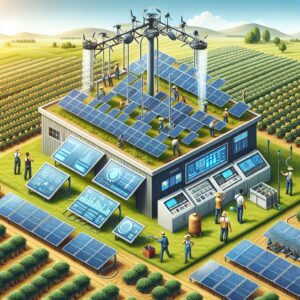
Connecting solar power to a center pivot irrigation system involves generating DC electricity from solar panels, converting it to AC power through an inverter, and routing that power to the pivot’s electric motors, control panel, and pump system. The connection point depends on the system design — some setups feed directly into the existing electrical infrastructure, while others operate as standalone off-grid systems.
- Solar array: Ground-mounted panels installed near the pivot point or along field edges capture sunlight and generate DC electricity.
- Inverter: Converts DC power from the panels to AC power compatible with the pivot motors and pump.
- Charge controller (battery systems): Regulates power flow to and from battery storage to prevent overcharging or deep discharge.
- Battery bank (optional): Stores excess solar energy for use during nighttime or low-sunlight periods.
- Grid connection (hybrid systems): Provides backup power when solar output is insufficient to meet demand.
The pump is typically the highest energy consumer in the entire system, often requiring 25 to 75 horsepower depending on well depth, water volume, and operating pressure. Sizing the solar array correctly to meet that pump demand — while also powering the pivot drive motors and controls — is the critical engineering step that determines system performance.
Types of Solar Center Pivot Irrigation Systems
Not every farm has the same power needs, water source, or budget — and solar irrigation system designs reflect that reality. There are four primary configurations farmers use when integrating solar with center pivot irrigation, each with distinct advantages depending on the operation.
1. Fully Solar-Powered Center Pivot Systems
A fully solar-powered system operates entirely on energy generated by the solar array, with no grid connection or diesel backup. These are best suited for farms in high-sunlight regions where irrigation is primarily a daytime activity and consistent solar output can be counted on throughout the growing season.
- Zero ongoing fuel or electricity costs once installed
- Complete energy independence from utility companies
- Best for remote farms where grid connection is expensive or unavailable
- Requires careful load matching between solar array size and pivot power demand
- Irrigation scheduling must align with peak sunlight hours
The main trade-off is operational flexibility. Without battery storage or grid backup, irrigation must happen when the sun is shining. For most summer crop irrigation schedules, this is a manageable constraint, and many farmers find daytime-only operation aligns naturally with their field management routines.
2. Hybrid Solar and Grid-Tied Systems
Hybrid systems connect both a solar array and the utility grid to the pivot’s power supply. Solar handles the majority of the electrical load during peak sunlight hours, while the grid automatically supplements power during early morning, evening, or overcast conditions. This is the most flexible configuration and the most popular choice for farms that already have grid access, as it maximizes solar savings without sacrificing operational flexibility.
3. Solar with Battery Storage Systems
Adding battery storage to a solar center pivot setup allows farms to store excess daytime solar energy and deploy it after sunset or during cloudy periods. Lithium iron phosphate (LiFePO4) battery banks are the current industry standard for agricultural solar storage due to their long cycle life, thermal stability, and high discharge rates. While battery storage adds upfront cost, it effectively extends the irrigation window beyond daylight hours and provides a reliable backup when grid outages occur.
4. Diesel Retrofit Solar Systems
Many farms already run diesel-powered pumps and pivots, and a full replacement isn’t always practical. Diesel retrofit systems add a solar array that offsets a significant portion of the diesel engine’s fuel consumption — typically running the pivot’s control systems, lighting, and auxiliary loads on solar while the main pump engine continues on diesel. This hybrid approach can cut diesel fuel use by 30–50%, reducing both operating costs and maintenance wear on the engine, while serving as a stepping stone toward a fully solar operation.
Solar Panels Used with Center Pivot Irrigation
Choosing the right solar panels for a center pivot application comes down to efficiency, durability, and the physical constraints of the installation site. Agricultural solar installations face harsher conditions than rooftop residential systems — dust, wind, temperature swings, and potential equipment vibration all factor into panel selection.
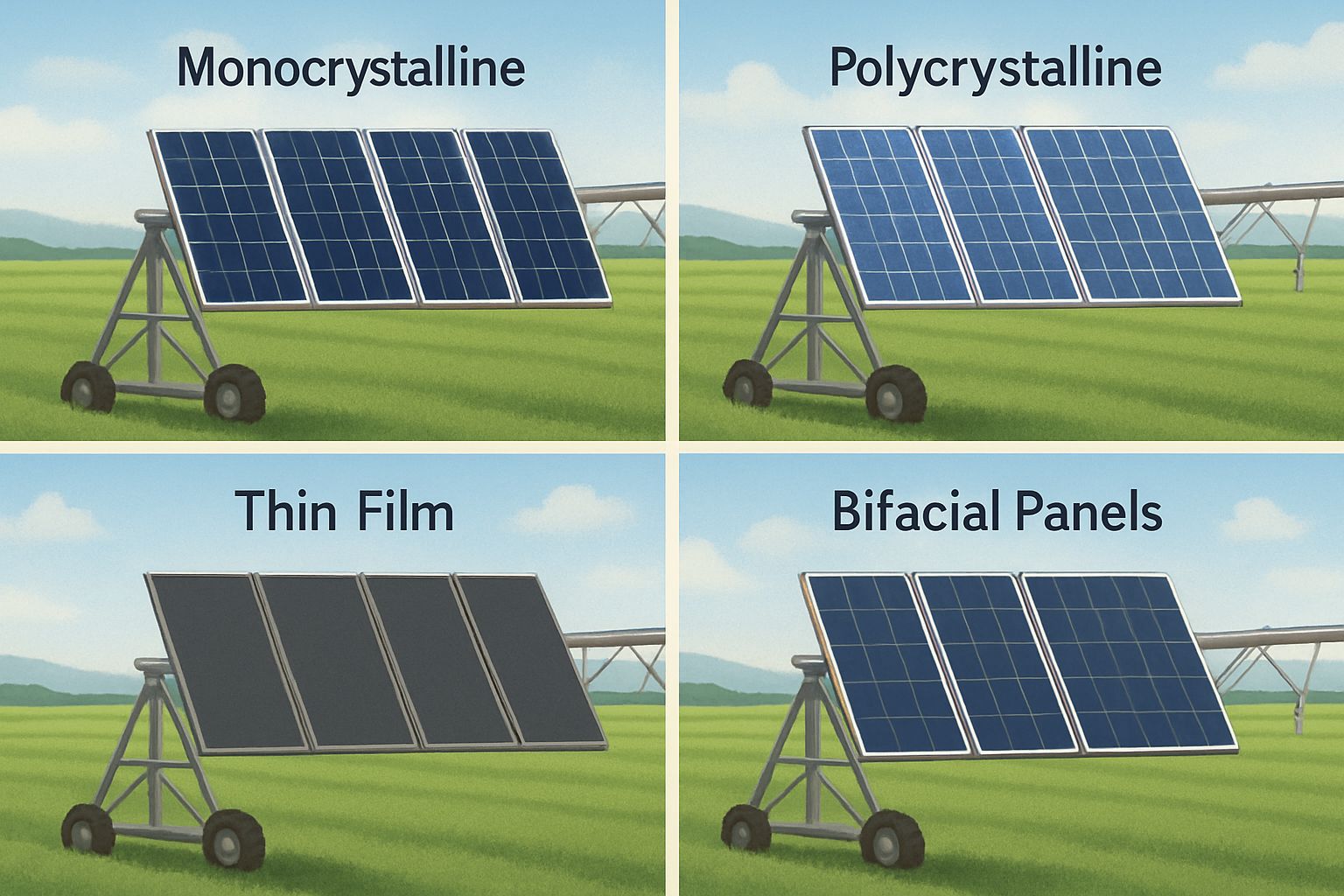
Monocrystalline vs. Polycrystalline vs. Thin Film vs. Bifacial Panels
Monocrystalline panels are the top choice for most agricultural solar installations due to their high efficiency ratings — typically 17–22% — and strong performance in high-temperature conditions. They produce more power per square foot than any other panel type, which matters when ground space near the pivot is limited. Polycrystalline panels cost slightly less but operate at lower efficiency (13–17%), making them better suited for installations where land space for a larger array isn’t a concern. Thin film panels are lightweight and flexible but fall well below the efficiency of crystalline options, making them a poor fit for high-demand pivot applications.
Bifacial panels are gaining traction in agricultural settings because they capture sunlight on both the front and rear surfaces, boosting energy yield by 10–20% compared to standard monocrystalline panels when installed over reflective ground surfaces like dry soil or light-colored gravel. For center pivot applications where panels are ground-mounted at an angle, bifacial technology offers a meaningful output increase without requiring additional panel count.
How Many Panels a Center Pivot System Needs
The number of panels required depends directly on the total power demand of the system — primarily the pump motor. A center pivot pump running a 50-horsepower motor requires approximately 37 kilowatts of continuous power. At that demand level, using 400-watt monocrystalline panels, you’d need roughly 93 panels to meet that load under peak sunlight conditions. Add the pivot drive motors (typically 1–2 HP per tower) and control systems, and a complete system for a 125-acre pivot field commonly requires between 80 and 150 panels depending on pump size, local solar irradiance, and whether battery storage is included in the design.
Here is a comparison table of the four best solar panel types for agricultural use — focusing on features, efficiency, and suitability for farms:
|
Solar Panel Type |
Efficiency Range |
Cost per Watt (Approx.) |
Key Advantages for Agriculture |
Limitations |
Best Farm Applications |
|---|---|---|---|---|---|
|
Monocrystalline Panels |
17–22% 1 |
$0.90–$1.50 2 |
High efficiency, compact design, long lifespan, performs well in all climates |
Higher upfront cost |
Space-limited farms, rooftops, and irrigation systems 1 |
|
Polycrystalline Panels |
13–17% 3 |
$0.70–$1.00 3 |
Lower cost, durable, long lifespan, strong in direct sunlight |
Requires more space, less efficient in cloudy conditions | |
|
Thin-Film Panels |
10–13% 5 |
$0.50–$0.90 2 |
Lightweight, flexible, better low-light/shaded performance |
Lower efficiency, shorter lifespan |
Greenhouses, barns, shaded or irregular terrain 5 |
|
Bifacial Panels |
18–22% 6 |
$1.00–$1.60 6 |
Captures light from both sides, high energy yield, great for reflective surfaces like grass or soil |
Higher cost, more complex installation |
Agrivoltaics (dual-use with crops), open-field installations 6 |
These four types of solar panels represent the most effective options for agricultural operations, allowing farmers to select between high efficiency (monocrystalline, bifacial) and lower-cost scalability (polycrystalline, thin-film) depending on land availability, sunlight exposure, and budget.
Key Benefits of Solar Center Pivot Irrigation
The case for switching to solar-powered center pivot irrigation isn’t built on theory — it’s built on real operational savings that compound year after year. Farmers who make the switch consistently report lower input costs, more predictable operating budgets, and improved crop outcomes driven by more consistent water delivery.
Energy is the single largest controllable cost in irrigated agriculture, and solar directly attacks that expense. Unlike diesel or grid electricity — both subject to price volatility — solar energy production costs nothing once the system is installed. That financial certainty alone makes long-term farm planning significantly easier.
Beyond cost savings, solar-powered pivots often integrate more smoothly with precision agriculture technology than older diesel or basic grid systems. The same electrical infrastructure that powers the pivot can support soil sensors, weather stations, and automated control systems that make the entire irrigation operation smarter and more responsive.
Here’s a quick summary of the core advantages farmers gain when moving to solar center pivot irrigation:
- Energy cost reductions of up to 70% compared to diesel or grid-powered systems
- Protection from fuel price spikes and utility rate increases
- Precise water delivery that reduces waste and improves crop uniformity
- Lower maintenance requirements compared to diesel engine-driven systems
- Remote monitoring and automation capabilities that reduce labor demands
- Eligibility for federal and state incentives that significantly offset installation costs
- Reduced carbon footprint, supporting sustainability goals and potential carbon credit programs
Energy Cost Savings of Up to 70%
Solar-powered center pivot systems can reduce energy costs by up to 70% compared to conventional diesel or grid-electricity setups. A farmer running a 50-HP pump on diesel at current fuel prices could spend $15,000 to $25,000 per irrigation season in fuel alone. A properly sized solar array eliminates or drastically reduces that recurring expense, with most systems reaching full payback within 5 to 8 years — after which the energy is effectively free for the remaining 20-plus-year lifespan of the panels.
Precise Water Delivery Reduces Waste
Center pivot systems already deliver water more efficiently than flood or furrow irrigation, but pairing them with solar and variable rate irrigation (VRI) technology takes precision to another level. VRI systems adjust water output at individual nozzles in real time based on GPS-mapped prescription zones, soil type variations, and crop water demand data. The result is that water goes exactly where it’s needed — no more, no less.
This precision matters enormously in regions facing water scarcity or operating under strict water rights allocations. Farms using VRI-equipped solar pivots have reported water savings of 15–30% compared to conventional uniform-rate pivot operation, which translates directly into lower pumping costs and extended aquifer sustainability for future seasons.
Protection Against Rising Utility Prices
Electricity and diesel prices have both trended upward over the past decade, and agricultural energy users are particularly exposed to that volatility. A solar array locks in a fixed, predictable energy cost at installation — effectively hedging against future utility rate increases for 25 years or more. For farm operations building long-term financial models, that price certainty is a significant strategic advantage that goes well beyond the simple year-one savings calculation.
Lower Maintenance Demands Than Diesel Systems
Diesel engines require regular oil changes, fuel filter replacements, injector maintenance, and periodic overhauls — all of which add up in both direct cost and operational downtime. A solar array with an inverter has no moving parts, requires no lubrication, and typically needs nothing more than occasional panel cleaning and an annual inverter inspection to maintain peak performance.
The pivot drive motors themselves have the same maintenance needs regardless of the power source, but eliminating the diesel engine from the equation removes the most maintenance-intensive component in the entire system. Most solar inverter manufacturers, including SMA Solar Technology and Fronius, rate their agricultural inverters for 10–15 years of continuous operation with minimal servicing.
Over a 20-year system lifespan, the maintenance cost difference between a diesel-powered pivot and a solar-powered one can easily exceed $30,000 — and that’s before accounting for unplanned breakdown repairs that can halt irrigation at the worst possible moments during the growing season.

Remote Monitoring and Automation Capabilities
One of the most underappreciated benefits of modern solar center pivot irrigation is what it enables beyond simply powering the pump. When solar infrastructure is in place, connecting advanced automation and remote monitoring technology becomes practical and cost-effective, transforming a simple irrigation system into a fully managed precision agriculture tool.
Smartphone and Computer Control Features
Modern center pivot control systems from Valley Irrigation (BaseStation3), Lindsay Corporation (FieldNET), and Reinke Manufacturing (RC10 Control Panel) all offer cloud-connected remote operation through smartphone apps and web dashboards. Farmers can start, stop, adjust speed, change direction, and monitor system status from anywhere with a cell signal. Real-time alerts notify operators of motor faults, low pressure events, or unexpected stops — catching problems before they become costly crop damage situations. For farms managing multiple pivots across large acreages, centralized remote control is no longer a luxury; it’s a practical necessity.
Soil Moisture Sensors and Weather-Based Scheduling
Integrating soil moisture sensors with a solar-powered pivot creates a closed-loop irrigation system that responds to actual field conditions rather than fixed schedules. Sensors placed at multiple depths and locations across the field feed real-time data to the control system, which automatically triggers irrigation when soil moisture drops below crop-specific thresholds and stops watering when optimal levels are restored.
Weather-based scheduling layers on additional intelligence by pulling local forecast data to avoid irrigating immediately before a rain event — a common waste in conventional timer-based systems. Companies like CropX and Sentek offer sensor platforms that integrate directly with major pivot control systems, allowing the entire irrigation decision process to run automatically with minimal farmer input.
How Automation Cuts Labor Costs on the Farm
Before remote monitoring and automation became standard, managing a multi-pivot operation meant constant physical checks — driving out to the field to verify the system was running, manually adjusting settings, and responding in person to every fault alarm. Automated solar pivot systems handle the majority of that workload independently, freeing up operator time for higher-value farm tasks. Farms managing four or more pivot systems have reported labor savings equivalent to one full-time seasonal employee after implementing fully automated solar-powered irrigation control — a saving that compounds significantly over the course of a growing season.
Federal and State Incentives for Solar Irrigation
The upfront cost of a solar center pivot system is the most common reason farmers hesitate — but federal and state incentive programs exist specifically to close that gap. When stacked correctly, these programs can reduce total installation costs by 40–60%, dramatically shortening the payback period and improving the long-term return on investment. The key is knowing which programs apply to your operation and how to apply for them before your project breaks ground.
USDA REAP Grants for Farm Solar Projects
The USDA Rural Energy for America Program (REAP) is the single most valuable incentive available to farmers installing solar irrigation systems. REAP provides grants covering up to 50% of eligible project costs for agricultural producers and rural small businesses installing renewable energy systems. As of the most recent funding cycle, individual REAP grants range from $2,500 to $1 million for renewable energy projects, with priority given to projects that demonstrate clear energy cost savings and operational impact. Applications are accepted on a rolling basis through local USDA Rural Development state offices, and working with an energy consultant familiar with the application process significantly improves approval odds. Farmers who have successfully used REAP funding report that the grant alone, combined with other incentives, can bring a $150,000 solar irrigation project down to an effective out-of-pocket cost below $75,000.
Federal Investment Tax Credit (ITC) for Solar
The federal Investment Tax Credit (ITC), extended and expanded under the Inflation Reduction Act of 2022, currently allows agricultural solar system owners to deduct 30% of the total installed system cost directly from their federal tax liability. For a $120,000 solar center pivot installation, that translates to a $36,000 tax credit — not a deduction, but a dollar-for-dollar reduction in taxes owed. Farmers who cannot fully utilize the credit in the installation year can carry the remaining balance forward to future tax years. When combined with USDA REAP grants, the ITC can make solar irrigation one of the most financially incentivized capital investments available in agriculture today.
How to Find State-Level Incentives in Your Area
Beyond federal programs, most states offer additional incentives including property tax exemptions on solar equipment, sales tax exemptions on panel and inverter purchases, and state-level rebate programs through utility companies. The most comprehensive database for finding state-specific solar incentives is the Database of State Incentives for Renewables & Efficiency (DSIRE), available at dsireusa.org. Entering your state and selecting “agriculture” or “solar” filters will surface every applicable program, including current funding availability and application deadlines. Many state land-grant university extension services also publish annual guides to agricultural energy incentives tailored specifically for farmers in that state — a resource worth checking before finalizing any solar irrigation budget.
Solar Center Pivot Irrigation Is the Future of Efficient Farming
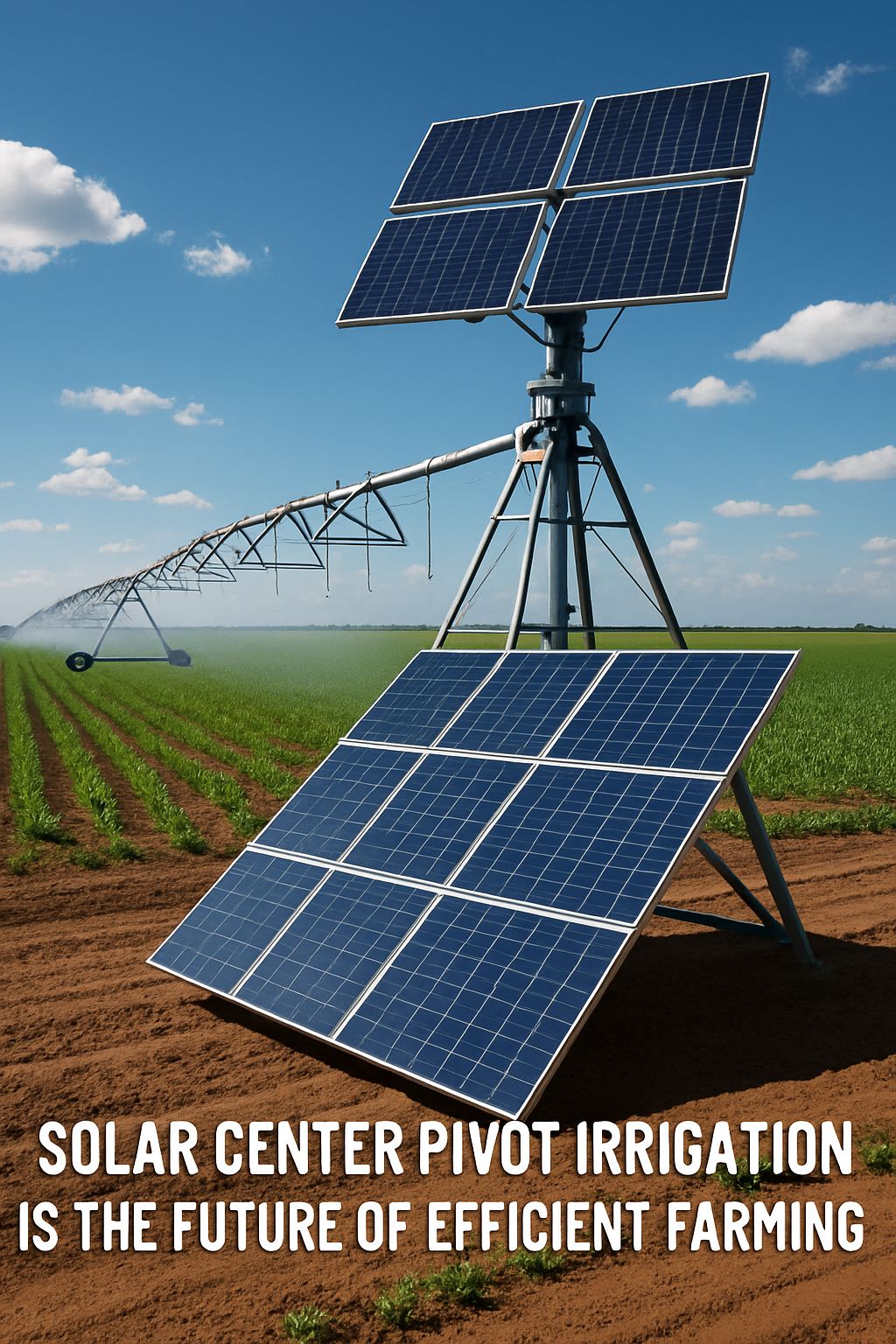
The combination of falling solar panel costs, rising energy prices, and increasingly sophisticated irrigation automation has created a window where solar center pivot irrigation delivers returns that simply weren’t possible a decade ago. Farms that make this investment now lock in lower operating costs, gain energy independence, and build a more resilient operation for the decades ahead. The technology is proven, the incentives are substantial, and the farmers already running solar-powered pivots are seeing exactly the results the numbers promise.
Frequently Asked Questions
Farmers considering solar center pivot irrigation consistently run into the same core questions — around cost, performance, scale, and maintenance. The answers below cut through the noise and give you the practical information needed to make a confident decision.
Every farm situation is different, so treat these figures as solid starting-point benchmarks rather than fixed rules. Your actual system design, local solar resource, water source depth, and pivot size will all influence the final numbers for your specific operation.
How Much Does a Solar Center Pivot Irrigation System Cost?
A complete solar center pivot irrigation system — including solar array, inverter, mounting hardware, wiring, and integration with an existing pivot — typically costs between $80,000 and $250,000 depending on pump size, array capacity, and whether battery storage is included. A straightforward 50-HP pump system with a ground-mounted solar array and a hybrid grid-tied inverter commonly lands in the $100,000 to $150,000 range before incentives. After applying a 30% federal ITC and a USDA REAP grant covering 25–50% of eligible costs, the effective out-of-pocket cost on that same system can fall to $40,000–$75,000.
Most solar-powered pivot installations reach full financial payback within 5 to 8 years under normal operating conditions, after which the system generates effectively free irrigation energy for the remaining 15–20 years of panel life. When you factor in rising diesel and electricity costs over that period, the long-term savings figure continues to grow well beyond the initial payback milestone.
Can a Solar Center Pivot System Run at Night or on Cloudy Days?
Solar Center Pivot Operation by Power Configuration
System Type
Daytime (Full Sun)
Cloudy / Overcast
Nighttime
Fully Solar (No Battery)
✓ Full Operation
△ Reduced Output
✗ No Operation
Hybrid Solar + Grid
✓ Solar Primary
✓ Grid Supplement
✓ Grid Backup
Solar + Battery Storage
✓ Solar + Charging
✓ Solar + Battery
✓ Battery Power
Diesel Retrofit Solar
✓ Solar Offset
✓ Diesel Primary
✓ Diesel Primary
Whether a solar center pivot can run at night or during cloudy weather depends entirely on the system configuration. A fully solar system with no battery or grid backup will slow down or stop when sunlight drops below the threshold needed to power the pump motor — typically around 30–40% of peak irradiance. For most summer irrigation schedules in high-sunlight agricultural regions, this limitation has minimal real-world impact since peak water demand aligns naturally with peak daylight hours.
Hybrid grid-tied systems handle low-light and nighttime operation seamlessly by drawing supplemental power from the utility grid whenever solar output is insufficient. The transition between solar and grid power is automatic and instantaneous, requiring no operator input. From the pivot’s perspective, power delivery is uninterrupted regardless of weather conditions.
Battery storage systems provide the most complete solution for farms that need true 24-hour irrigation capability without grid dependence. A properly sized lithium iron phosphate battery bank can store enough energy during peak daylight hours to run the pivot through the night, though battery capacity sufficient for a 50-HP pump system adds $30,000–$60,000 to the total project cost.
For the vast majority of farms, a hybrid solar and grid-tied configuration delivers the best balance of solar savings, operational flexibility, and installation cost — making full nighttime and cloudy-day operation available without the premium cost of large-scale battery storage.
How Large of a Farm Can a Center Pivot System Cover?
A single center pivot system can cover a circular field ranging from under 40 acres for shorter span configurations to over 500 acres for the largest commercial systems with corner arm attachments. Standard commercial pivots typically cover 125–160 acres per unit, which is the most common configuration for grain and row crop farms across the U.S. Great Plains and Midwest.
- Short span systems (quarter-mile radius): Cover approximately 125 acres per pivot unit
- Standard commercial systems: Cover 130–160 acres with spans up to 1,320 feet
- Extended span systems: Can reach 200+ acres with longer arm configurations
- Corner arm attachments: Add 30–60 additional acres of coverage in square fields
- Multiple pivot setups: Large farms commonly run 4–10+ pivot units to cover full acreage
For farms larger than what a single pivot can efficiently cover, multiple systems operating independently are the standard approach. Each pivot gets its own solar array sized to its specific power demand, and remote monitoring systems allow a single operator to manage multiple units simultaneously from one central dashboard.
There is no hard upper limit on how much total acreage solar center pivot irrigation can serve — the practical boundary is determined by water supply availability, budget, and how many pivot units the farm’s infrastructure can support. Operations in Nebraska, Kansas, and the Texas Panhandle routinely run solar-assisted pivot networks covering 2,000 acres or more across a single farm.
Are Solar Center Pivot Systems Hard to Maintain?
Solar center pivot systems are among the lowest-maintenance irrigation configurations available. The solar array itself requires periodic panel cleaning — typically two to four times per growing season in dusty agricultural environments — and an annual inspection of inverter connections and mounting hardware. The pivot structure, drive motors, and sprinkler heads follow the same maintenance schedule as any conventional pivot regardless of power source. Replacing a diesel engine with solar power actually reduces total system maintenance burden significantly, eliminating oil changes, fuel system servicing, and engine overhauls from the annual maintenance calendar entirely. For more information on how solar panels can power farm equipment, check out this guide on renewable energy for farms.
What Crops Benefit Most from Center Pivot Irrigation?
Center pivot irrigation delivers the greatest agronomic benefit to crops with high water demand, sensitivity to moisture stress, or high market value that justifies the infrastructure investment. The consistent, uniform water delivery that center pivots provide is particularly valuable during critical crop development stages — pollination in corn, pod fill in soybeans, tuber development in potatoes — where moisture stress causes disproportionate yield losses. For more information on powering farm equipment, explore solar panel solutions for farms.
Corn is the single largest beneficiary of center pivot irrigation in the United States. A corn crop experiencing moisture stress during the silking and pollination window can lose 3–8 bushels per acre per day of stress — a yield hit that a properly managed center pivot system prevents entirely. With corn markets regularly pricing above $4.50–$5.50 per bushel, the yield protection value of reliable pivot irrigation is straightforward to quantify.
Specialty crops including potatoes, onions, dry beans, and sugar beets show some of the strongest return-on-investment figures for solar center pivot investment due to their high per-acre revenue and acute sensitivity to irregular watering. Potato crops, in particular, require precise soil moisture management throughout the growing season to produce consistent tuber sizing and minimize quality defects — a requirement that center pivot VRI systems meet better than any other irrigation method.
Forage crops like alfalfa also benefit significantly from center pivot irrigation, particularly in arid western states where dryland alfalfa production is marginal. Solar-powered pivots allow alfalfa growers to irrigate cost-effectively across multiple cuttings per season without the fuel expense that makes diesel-powered irrigation economically marginal at alfalfa price levels.
Solar center pivot irrigation systems are becoming increasingly popular among farmers for their efficiency and sustainability. These systems harness the power of the sun to provide energy for irrigation, reducing reliance on traditional power sources. By utilizing solar panel systems, farmers can optimize their operations and ensure a consistent water supply to their crops. This not only helps in conserving energy but also contributes to reducing the carbon footprint of agricultural activities.



Leave a Reply