

Key Takeaways
- Solar irrigation systems can reduce operational costs by up to 70% compared to diesel-powered alternatives while eliminating fuel dependencies.
- These systems require minimal maintenance and have an average lifespan of 25+ years, providing long-term reliability for farm operations.
- Smart irrigation controllers powered by solar energy can reduce water consumption by 30-50% through precision application.
- Government incentives including tax credits, grants, and subsidies can offset 30-50% of initial installation costs.
- Solar-powered systems enable reliable irrigation in remote locations without access to the electrical grid, expanding farming possibilities.
Solar Irrigation: The Future of Sustainable Farming
The agricultural landscape is changing rapidly as farmers face rising energy costs, water scarcity, and pressure to reduce environmental impact. Solar irrigation systems address these challenges head-on by harnessing abundant sunlight to power farm water delivery. Unlike conventional methods that rely on grid electricity or diesel fuel, solar irrigation offers a clean, renewable alternative that’s becoming increasingly affordable. Smart Commercial Energy research shows that farmers who switch to solar irrigation typically see dramatic reductions in operating expenses while improving their environmental footprint. As climate patterns become more unpredictable, these systems provide the reliability and sustainability modern agriculture demands.
The technology has matured significantly in recent years, moving from experimental setups to robust, field-proven solutions. Modern solar irrigation systems can match or exceed the performance of traditional pumping methods while eliminating fuel costs and reducing carbon emissions. What once required massive investment is now within reach for farms of all sizes, thanks to falling solar panel prices, improved efficiency, and attractive financial incentives. For many farmers, the question is no longer whether to adopt solar irrigation but when and how to implement it effectively.
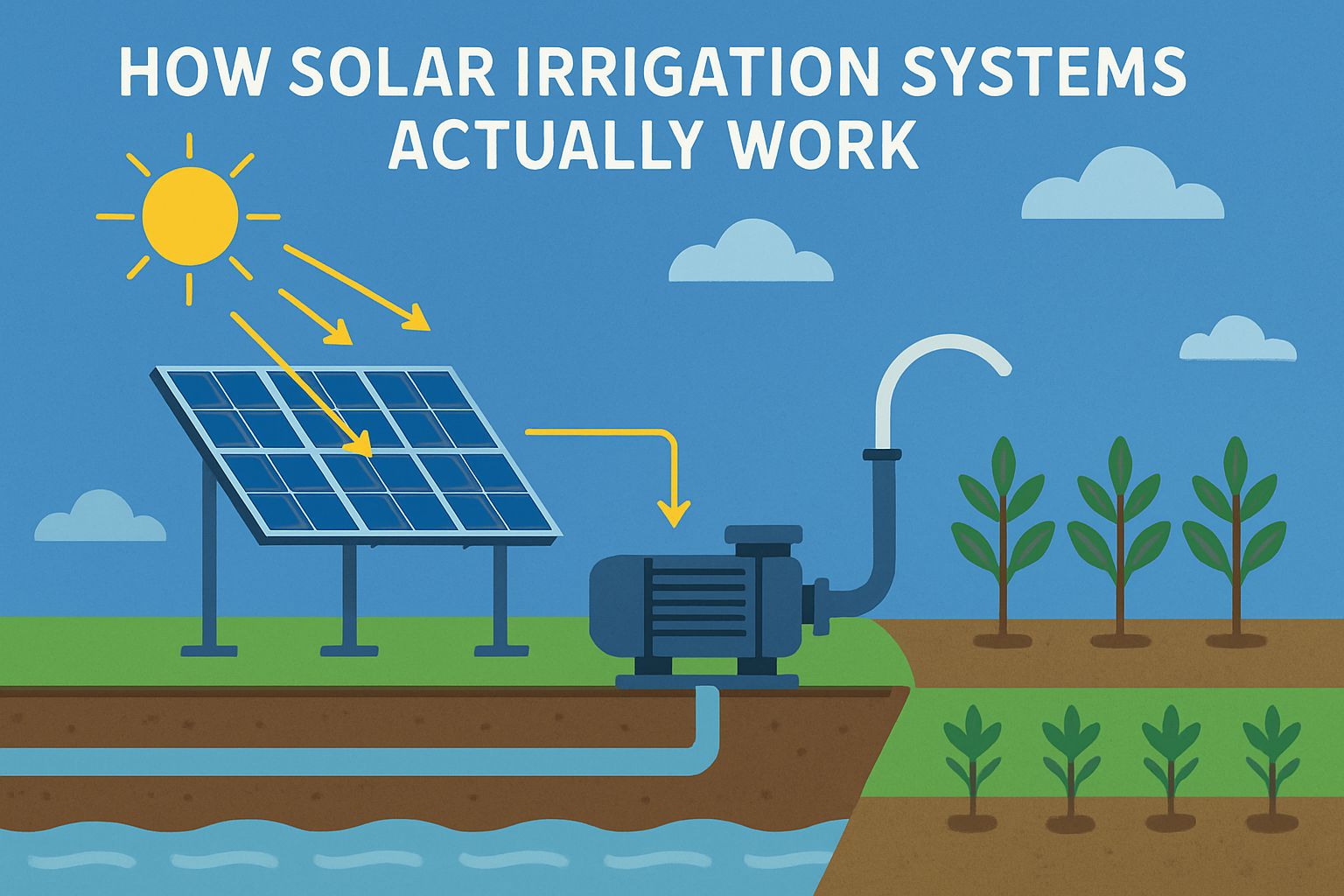
How Solar Irrigation Systems Actually Work
Solar irrigation harnesses photovoltaic technology to convert sunlight directly into electricity that powers water pumps and distribution systems. Unlike complicated renewable energy solutions, these systems operate on straightforward principles that any farmer can understand. The generated electricity drives pumps that move water from sources like wells, rivers, or reservoirs to fields where crops need hydration. Modern systems incorporate monitoring and automation to optimize water delivery based on crop requirements and environmental conditions.
The Four Essential Components
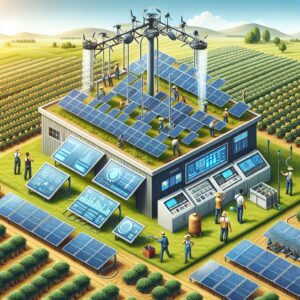
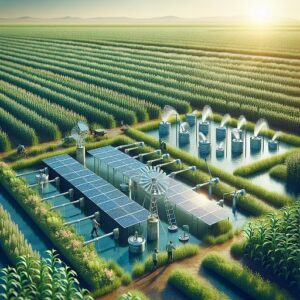
Every solar irrigation system consists of four fundamental components working in harmony. Solar panels, mounted on trackers or fixed racks, capture sunlight and convert it to DC electricity. The pump controller or inverter transforms this DC power to AC current (if needed) and regulates electrical flow to match pump requirements. The water pump itself draws water from the source and creates pressure for distribution. Finally, the irrigation distribution system—whether drip lines, sprinklers, or center pivots—delivers water precisely where crops need it. These components are modular, allowing systems to scale from small market gardens to extensive commercial operations.
The size and configuration of these components vary based on water requirements, pumping depth, pressure needs, and geographical factors. A small vegetable farm might use a 2kW system with surface pumps, while larger operations often implement 10kW+ setups with submersible pumps capable of drawing water from deep wells. What’s remarkable is how these systems adapt to virtually any agricultural setting, from flat riverside plots to hilly terrain with varying water access challenges.
From Sunlight to Water Flow: The Energy Conversion Process
The energy journey begins when photons (light particles) strike the silicon cells in solar panels, creating an electric current through the photovoltaic effect. This direct current flows to the controller, which optimizes the voltage and current to match pump specifications. For AC pumps, an inverter converts the power to alternating current at the required frequency. The electrical energy then powers the pump motor, which converts electrical energy to mechanical energy, driving the impeller or piston that creates water pressure. This pressure forces water through pipes to the distribution system, which delivers precisely controlled amounts to growing zones. Learn more about how solar panels work and help farmers.
Smart Controllers and Automation Features
Modern solar irrigation systems incorporate intelligent controllers that maximize efficiency and crop yields. These controllers monitor soil moisture levels, weather conditions, and crop growth stages to deliver water only when and where it’s needed. Some advanced systems integrate with weather forecasting data to adjust irrigation schedules based on predicted rainfall or temperature changes. Remote monitoring capabilities allow farmers to check system performance and make adjustments via smartphone apps, even when miles from their fields.
Automation features extend beyond simple timers to include flow sensors that detect leaks, pressure regulators that optimize water distribution, and sun-tracking mechanisms that increase energy capture by up to 25%. The most sophisticated systems can independently section off irrigation zones, sequentially watering different areas to maximize the available solar power throughout the day. This intelligence transforms solar irrigation from a simple pumping mechanism to a comprehensive water management solution that optimizes both energy and water resources. For more insights, explore how solar panels are revolutionizing farm operations.
6 Major Benefits That Make Farmers Switch to Solar
The transition to solar irrigation isn’t just about adopting new technology—it’s about fundamentally transforming farm operations for greater resilience and profitability. Across diverse agricultural regions, farmers are discovering that solar irrigation delivers advantages that conventional systems simply cannot match. These benefits extend beyond simple cost savings to impact overall farm sustainability, crop quality, and long-term business viability.
1. Slash Operating Costs by Up to 70%
One of the most immediate and compelling benefits of solar irrigation is the dramatic reduction in operating expenses. Traditional diesel pumps require constant fuel purchases, with costs that fluctuate unpredictably with global oil markets. Grid electricity, while somewhat more stable, still represents a significant monthly expense that increases during peak growing seasons. Solar irrigation eliminates these recurring costs entirely, with sunshine providing free energy throughout the system’s lifetime.
The math speaks for itself: a medium-sized farm spending $800-1,200 monthly on irrigation energy can save $9,600-14,400 annually after switching to solar. Over the 25+ year lifespan of a solar system, this represents savings of $240,000-360,000—far exceeding the initial investment. For many farmers, this cost reduction transforms marginally profitable operations into solidly successful enterprises with improved cash flow and enhanced ability to weather market fluctuations.
2. Zero Fuel Needs and Minimal Maintenance
Solar irrigation systems operate with remarkable simplicity compared to their conventional counterparts. With no fuel to purchase, transport, store, or handle, farmers eliminate a significant logistical burden along with the associated environmental risks of spills and contamination. The absence of internal combustion engines also means no oil changes, fuel filters, or exhaust systems to maintain—eliminating most routine maintenance tasks entirely. For more insights on how solar technology is revolutionizing farm operations, explore our detailed article.
The primary components of solar systems have few or no moving parts, dramatically reducing wear and breakdown potential. Solar panels typically require only occasional cleaning to remove dust or debris, while modern pumps are engineered for extended service intervals. This minimal maintenance profile translates to fewer unexpected breakdowns during critical irrigation periods, reducing crop stress and yield losses. Many farmers report maintenance requirements dropping by 80-90% after switching to solar, freeing up valuable time and resources for other farm activities.
3. Water Conservation Through Precision Irrigation
Solar irrigation systems excel at water conservation—a critical advantage as freshwater resources face increasing pressure worldwide. Because these systems operate at their maximum capacity during the sunniest parts of the day (which typically coincide with peak evaporation periods), they naturally encourage watering during optimal times. Many solar systems also incorporate precision application technologies like drip irrigation or micro-sprinklers that minimize waste through targeted delivery.
The integration of soil moisture sensors and weather-responsive controllers further enhances efficiency by delivering water only when crops actually need it. Studies show that well-designed solar irrigation systems can reduce water consumption by 30-50% compared to conventional flooding or uncontrolled sprinkler methods. This conservation benefit not only preserves precious water resources but also reduces soil erosion, nutrient leaching, and disease pressure from excessive moisture—all contributing to healthier crops and improved yields.
4. Government Incentives and Tax Benefits
Governments worldwide recognize the environmental and economic benefits of solar irrigation, offering substantial financial incentives to accelerate adoption. In the United States, federal tax credits can offset 30% of system costs, while many states offer additional rebates, grants, or property tax exemptions. Agricultural extension programs frequently provide technical assistance and subsidized assessments to help farmers implement optimal systems.
These incentives dramatically improve project economics, often reducing payback periods from 7-10 years to just 3-5 years. Beyond direct financial support, many regions offer expedited permitting for solar projects, reducing administrative burdens. Forward-thinking utilities may provide net metering arrangements that credit farmers for excess electricity generated during non-irrigation periods. Smart farmers combine multiple incentive programs to reduce initial investment by 40-60%, making solar irrigation financially compelling even for operations with tight capital constraints.
5. Reliable Operation in Remote Locations
For farms in remote areas, solar irrigation offers independence from unreliable or nonexistent grid infrastructure. Traditional options for these locations—primarily diesel generators—require constant fuel deliveries over poor roads, increasing costs and environmental impact. Solar systems eliminate this dependency, producing power wherever sunlight reaches. This capability opens new agricultural possibilities in regions previously considered too isolated for efficient irrigation.
The reliability advantage extends beyond remote locations to any area with unstable electricity supply. In regions with frequent outages or voltage fluctuations, solar systems with battery backup ensure continuous operation regardless of grid conditions. This independence provides peace of mind during critical growing periods when irrigation interruptions could devastate crops. Many farmers report that this reliability factor alone justifies the investment, as it removes a major source of operational stress and potential crop failure.
6. Increase in crop efficiencies
Solar irrigation systems enable farmers to optimize watering schedules based on actual crop needs rather than electricity rates or fuel availability. This precision timing leads to healthier plant development, better nutrient utilization, and ultimately higher yields. Research indicates that well-managed solar irrigation can increase production by 15-30% compared to inconsistent manual irrigation methods, particularly for water-sensitive high-value crops.
The environmental benefits extend to soil health as well. By eliminating diesel engines near fields, solar irrigation reduces soil contamination from fuel spills and exhaust particulates. The more precise water application prevents waterlogging and salinization issues that plague many conventionally irrigated farms. Progressive farmers leverage these advantages to produce premium crops with documented sustainability credentials, often commanding price premiums in environmentally conscious markets.
“After installing our solar irrigation system, our vegetable operation saw water usage drop by 42% while yields increased nearly 20%. The system paid for itself in just over four years, and we’ve been operating essentially cost-free for the six years since. It’s transformed how we think about farm economics.” — Maria Gonzalez, Sunshine Organics Farm
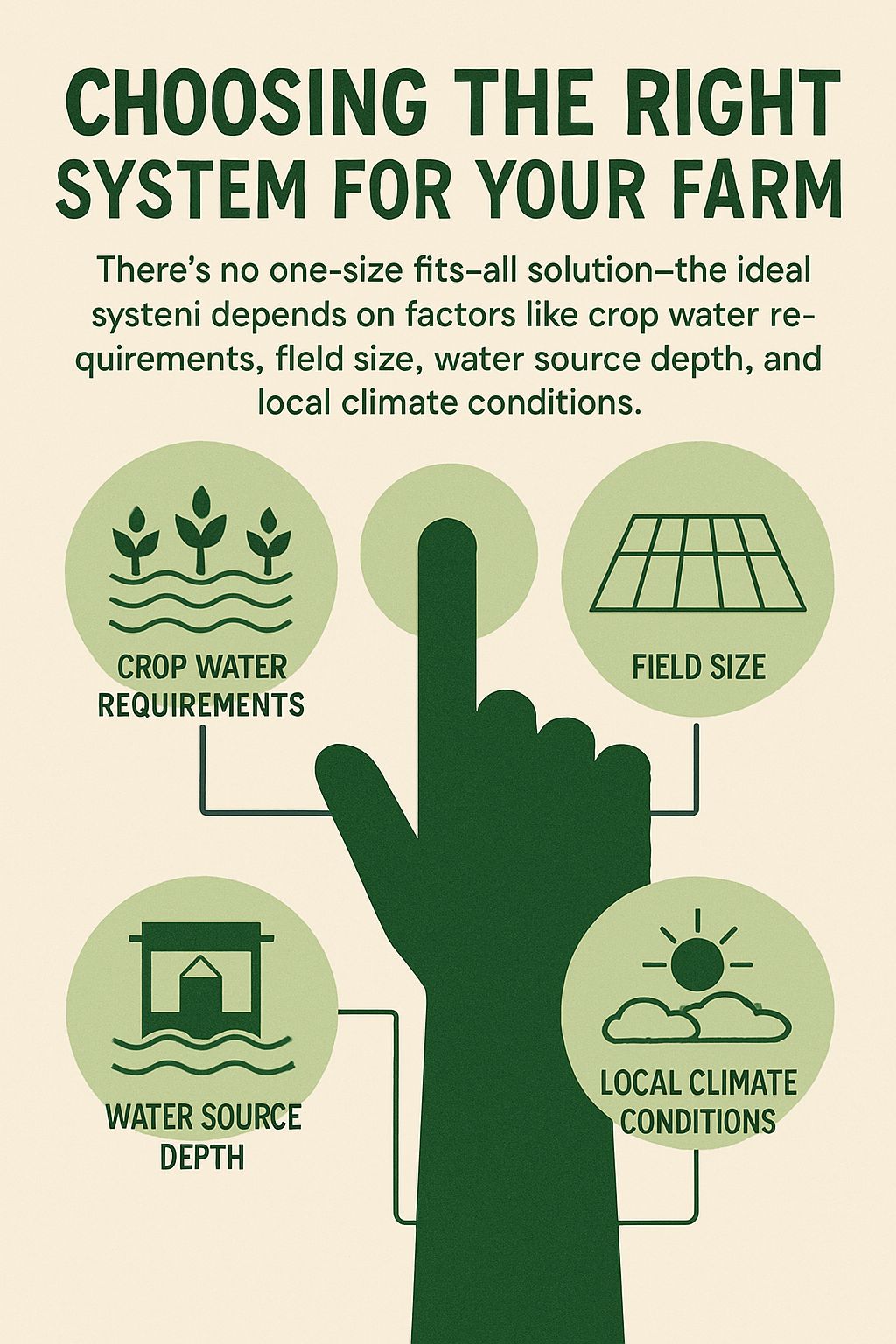
Choosing the Right System for Your Farm
Selecting the appropriate solar irrigation system requires careful evaluation of your specific agricultural needs. There’s no one-size-fits-all solution—the ideal system depends on factors like crop water requirements, field size, water source depth, and local climate conditions. Taking the time to properly assess these factors before purchase leads to better performance, lower costs, and fewer headaches down the road.
The most successful implementations start with clear goals. Are you primarily looking to reduce operating costs, improve reliability, or expand irrigation to new areas? Your priorities will guide system design decisions and help determine which features deserve additional investment. Remember that a well-designed system should serve your farm for decades, making thorough planning essential to long-term satisfaction.
Match System Size to Your Water Requirements
Accurately calculating your water needs is the foundation of proper system sizing. Consider your peak daily water requirements during the hottest, driest part of your growing season—this represents your maximum demand. For row crops like corn or soybeans, this typically ranges from 6-8 gallons per minute per acre, while vegetable crops often require 8-12 gallons per minute per acre. Factor in your irrigation method’s efficiency—drip systems may be 90% efficient, while some sprinkler systems might be only 60-70% efficient.
Once you’ve established water requirements, determine the total dynamic head (TDH)—the combination of vertical lift from water source to field plus pressure needed for proper distribution. These two factors—flow rate and TDH—determine pump size and, consequently, the required solar array capacity. Undersizing leads to insufficient irrigation during critical periods, while oversizing unnecessarily increases costs. Working with experienced designers helps strike the right balance for your specific situation.
Decide what Irrigation System Will be Used
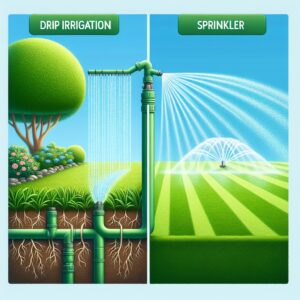
The distribution system significantly impacts overall efficiency and required solar capacity. Drip irrigation typically requires lower pressure (10-25 PSI) and delivers water directly to plant roots with minimal loss, making it highly compatible with solar power. Sprinkler systems demand higher pressure (30-60 PSI) and lose more water to evaporation but cover larger areas quickly. Center pivot systems fall between these options in terms of efficiency but offer excellent automation for large-scale operations.
The best choice depends on your crops, soil type, and management practices. Vegetables, berries, and tree crops often benefit most from drip systems, while broad-acre field crops may be better suited to pivot or sprinkler approaches. Many farms successfully implement hybrid solutions, using different techniques for different fields or crops. The irrigation method should be decided before sizing solar components, as it fundamentally determines energy requirements.
Choosing the Correct Solar Panel for Your Farms Irrigation System
Solar panel selection involves balancing efficiency, durability, and cost. Monocrystalline panels offer higher efficiency (17-22%) and take up less space but come at a premium price. Polycrystalline panels provide slightly lower efficiency (13-17%) but often deliver better value for agricultural applications. For farms with limited installation space, higher-efficiency panels may justify their additional cost, while operations with abundant mounting areas might prioritize lower cost per watt. Thin-film panels have lower efficiency ratings (typically 10-13%) than crystalline options, they perform better in high-temperature environments, maintain more consistent output during extremely hot days, and they also show superior performance in low-light and diffuse light conditions. Bifacial solar panels represent cutting-edge technology for agricultural applications, featuring photovoltaic cells on both the front and back surfaces. The innovative design can increase energy production by 10-30% compared to traditional monofacial panels.
Here is a comparison table of the four best solar panel types for agricultural use — focusing on features, efficiency, and suitability for farms.
|
Solar Panel Type |
Efficiency Range |
Cost per Watt (Approx.) |
Key Advantages for Agriculture |
Limitations |
Best Farm Applications |
|---|---|---|---|---|---|
|
Monocrystalline Panels |
17–22% 1 |
$0.90–$1.50 2 |
High efficiency, compact design, long lifespan, performs well in all climates |
Higher upfront cost |
Space-limited farms, rooftops, and irrigation systems 1 |
|
Polycrystalline Panels |
13–17% 3 |
$0.70–$1.00 3 |
Lower cost, durable, long lifespan, strong in direct sunlight |
Requires more space, less efficient in cloudy conditions | |
|
Thin-Film Panels |
10–13% 5 |
$0.50–$0.90 2 |
Lightweight, flexible, better low-light/shaded performance |
Lower efficiency, shorter lifespan |
Greenhouses, barns, shaded or irregular terrain 5 |
|
Bifacial Panels |
18–22% 6 |
$1.00–$1.60 6 |
Captures light from both sides, high energy yield, great for reflective surfaces like grass or soil |
Higher cost, more complex installation |
Agrivoltaics (dual-use with crops), open-field installations 6 |
These four types of solar panels represent the most effective options for agricultural operations, allowing farmers to select between high efficiency (monocrystalline, bifacial) and lower-cost scalability (polycrystalline, thin-film) depending on land availability, sunlight exposure, and budget.
Panel mounting systems also deserve careful consideration. Fixed ground mounts offer simplicity and lower maintenance but capture less energy throughout the day. Single-axis tracking systems follow the sun’s east-to-west movement, increasing energy harvest by 25-35% but adding moving parts and maintenance requirements. Dual-axis trackers adjust for both daily and seasonal sun positions, maximizing energy capture but at significantly higher cost and complexity. Most agricultural applications find single-axis trackers provide the optimal balance of increased production versus added complexity.
Battery Storage Options for Nighttime Operation
Battery storage extends irrigation capability beyond daylight hours but adds substantial cost to system implementation. For many farms, scheduling irrigation during daylight is preferable to investing in battery storage. However, certain scenarios—like operations with limited water rights that must maximize pumping during specific time windows, or crops that benefit from nighttime watering to reduce evaporation—may justify the additional investment.
When batteries make sense, lithium iron phosphate (LiFePO4) technology typically offers the best combination of cycle life, safety, and performance for agricultural applications. These batteries withstand the deep cycling common in irrigation systems while providing 3000+ cycles before significant capacity loss. Proper battery sizing requires calculating both power demands (kW) and energy requirements (kWh) to ensure sufficient capacity without unnecessary expense. Most battery systems add 30-50% to project costs but can significantly enhance system versatility.
Cost Breakdown and Return on Investment
Understanding the financial implications of solar irrigation helps farmers make informed investment decisions. The economics typically include substantial upfront costs offset by dramatic reductions in operating expenses over the system’s life. A complete financial analysis must consider initial investment, ongoing maintenance, energy savings, production benefits, available incentives, and financing options.
While costs vary significantly based on size, complexity, and location, most agricultural solar irrigation systems range from $2,500-$4,000 per kilowatt of capacity installed. A typical 10kW system sufficient for irrigating 15-25 acres might cost $25,000-$40,000 before incentives. This initial investment represents the primary financial hurdle, but a well-designed system quickly begins generating returns through eliminated energy expenses.
Initial Installation Expenses
Installation costs break down into several categories, with solar panels typically representing 30-40% of system cost. Pumps account for 15-25%, mounting structures 10-15%, controllers and electronics 10-15%, and labor/installation 15-25%. Additional costs may include storage tanks, batteries (if included), filtration systems, and distribution infrastructure. Site-specific factors like distance from water source to fields, terrain challenges, or poor road access can significantly impact costs.
Comparing quotes from multiple providers often reveals surprising price variations for seemingly similar systems. These differences typically stem from component quality differences, warranty terms, service agreements, and design approaches. The lowest bid rarely represents the best value—focus instead on system quality, installer experience with agricultural applications, and comprehensive warranty coverage. Many farmers find working with agricultural solar specialists rather than general solar installers results in better-optimized systems.
Long-Term Savings Calculator
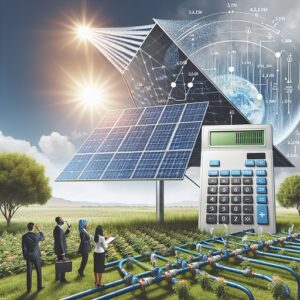
A proper savings analysis compares the total cost of ownership between solar and conventional alternatives over a 20-25 year period. For diesel comparison, calculate current annual fuel consumption (gallons) × local diesel price × expected annual price increase (typically 3-5%). Add maintenance costs (typically $500-1,500 annually for diesel systems) and eventual replacement costs, as diesel pumps typically require replacement every 7-10 years. Discover how solar panels can reduce farm energy bills and contribute to long-term savings.
For grid electricity comparisons, calculate current kWh usage × electricity rate × expected annual increase (typically 2-4%). Include demand charges, which often add significantly to irrigation electricity costs during peak summer months. Against these ongoing expenses, compare the solar system’s one-time investment (minus incentives) plus minimal maintenance costs (typically $100-300 annually). The difference represents your lifetime savings—often $100,000-$300,000 for medium-sized operations.
Payback Period: What to Expect
Payback periods for solar irrigation typically range from 3-7 years depending on local solar resources, energy costs, available incentives, and system design. Regions with high electricity rates or diesel prices often see faster payback, sometimes as short as 3-4 years with available incentives. Areas with lower energy costs might extend to 6-7 years, still representing an excellent long-term investment for infrastructure with a 25+ year lifespan.
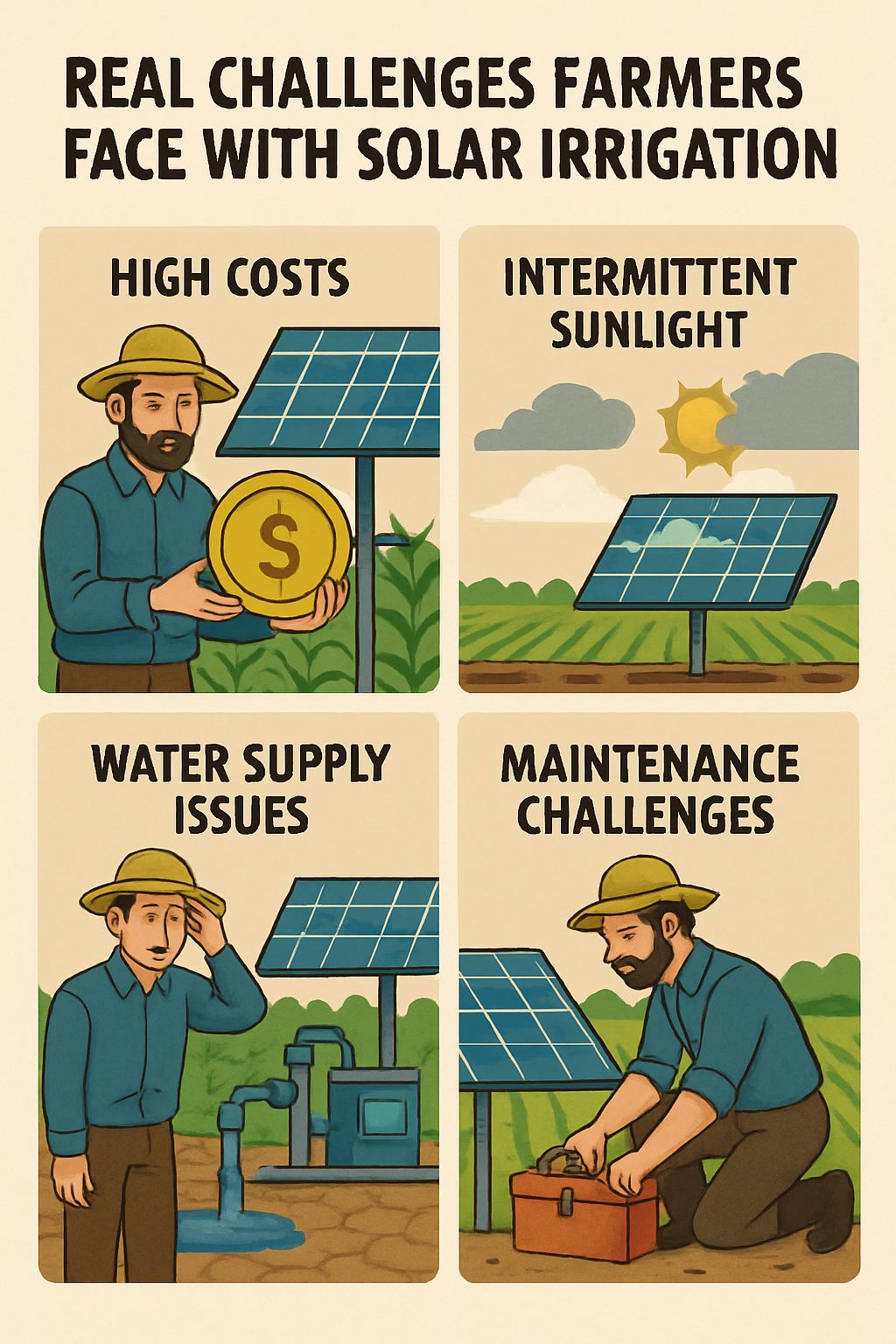
Real Challenges Farmers Face with Solar Irrigation
While the benefits are compelling, solar irrigation isn’t without challenges. Acknowledging these potential hurdles helps farmers develop mitigation strategies and set realistic expectations. The most common concerns include intermittent operation during cloudy periods, seasonal variations in solar production, initial capital requirements, and scaling limitations for very large operations.
These challenges aren’t deal-breakers but require thoughtful system design and management strategies. Most can be addressed through proper planning, appropriate component selection, and realistic performance expectations. Working with experienced agricultural solar specialists who understand both irrigation requirements and solar technology helps navigate these potential complications.
Weather Dependency Solutions
Solar irrigation’s dependence on sunlight presents obvious challenges during extended cloudy periods or short winter days. Practical solutions include incorporating water storage tanks that fill during sunny periods for use during cloudy weather. This approach allows systems to “bank” solar energy in the form of elevated water ready for distribution. For operations requiring absolute reliability, hybrid systems that incorporate grid connection as backup or small backup generators provide insurance against extended poor weather.
Scaling Systems for Larger Acreage
Large-scale operations face unique challenges when implementing solar irrigation across hundreds or thousands of acres. The substantial upfront capital requirements can strain even well-capitalized operations, while the physical footprint of larger solar arrays sometimes removes significant land from production. Progressive farms overcome these hurdles through phased implementation, starting with the most critical irrigation zones and expanding as initial investments begin generating returns. Some operations also explore creative approaches like elevated panel mounting that permits continued cultivation beneath the array or integrating grazing livestock under panels.
Step-by-Step Implementation Guide
Successful solar irrigation implementation follows a systematic process from initial concept to fully operational system. This methodical approach helps avoid costly mistakes, ensures appropriate system design, and sets realistic timelines and expectations. Most projects require 3-6 months from initial consultation to completed installation, with larger or more complex systems taking longer.
The process typically includes assessment, design, equipment selection, permitting, installation, commissioning, and training phases. Each stage builds upon the previous, with opportunities to refine the approach based on new information or changing requirements. Taking the time to properly execute each step results in systems that perform better, last longer, and deliver greater overall value.
Site Assessment and System Design
The process begins with comprehensive site assessment, examining water sources, pumping requirements, field layouts, solar exposure, and existing infrastructure. Professional assessors evaluate potential mounting locations, measure water table depths or surface water availability, and identify any potential shading issues from trees or structures. This information feeds into system modeling software that simulates performance across seasonal variations and weather patterns specific to your location. For more insights, explore strategic solar panel placement to maximize farm yields.
Finding Qualified Installers
Selecting the right installation partner significantly impacts system performance and reliability. Look for contractors with specific experience in agricultural applications, not just residential or commercial solar. Request agricultural references and visit existing installations to evaluate quality and performance. Verify that potential installers maintain proper licensing, insurance, and certification from manufacturers whose equipment they install. The North American Board of Certified Energy Practitioners (NABCEP) certification provides additional assurance of technical competence for solar aspects, while irrigation specialists should demonstrate expertise in agricultural water management.
Permitting and Regulatory Requirements
Permitting requirements vary significantly by location but typically include electrical permits, water rights verification, and possibly land use or environmental reviews. Some jurisdictions require engineering stamps on larger systems or those connected to buildings. Local utilities may require interconnection applications even for off-grid systems if backup grid connection exists. Agricultural exemptions often streamline the process for farm applications, but requirements should be verified early in the planning process to avoid delays.
Installation Timeline and Expectations
Most agricultural solar irrigation installations require 3-10 days of active on-site work, depending on system size and complexity. The process typically begins with ground work and foundation preparation for mounting systems, followed by mechanical installation of racks and panels. Pump installation, electrical work, and control system setup usually come next, with final testing and commissioning completing the process. Weather delays, equipment availability, and seasonal farm activities can extend timelines, so planning installation during less busy farming periods minimizes disruption.
Make the Smart Switch to Solar Today
The evidence is clear: solar irrigation represents one of the smartest investments available to modern farmers. With dramatic operational savings, enhanced reliability, and substantial environmental benefits, these systems deliver value across multiple dimensions. The technology has matured beyond early adoption to become a mainstream, proven solution for agricultural water management across diverse growing regions and crop types.
As energy costs continue rising while solar equipment prices stabilize or decline, the economic case grows even stronger each year. Farmers who implement these systems gain not just immediate benefits but position their operations for long-term sustainability in an increasingly resource-constrained agricultural landscape. The question isn’t whether solar irrigation makes sense, but rather how quickly you can implement a system tailored to your specific needs. Learn more about the financial benefits of solar panels for farmers.
Is a Solar Irrigation Systems Worth a Farmers Investment
When properly designed for your specific agricultural requirements, solar irrigation systems deliver exceptional return on investment while enhancing operational resilience. The combination of eliminated energy costs, minimal maintenance, incentive availability, and system longevity creates compelling economics that few agricultural investments can match. Beyond the straightforward financial returns, these systems provide protection against energy price volatility, reduce environmental impact, and often improve crop quality through more consistent irrigation—benefits that continue delivering value for decades.
Frequently Asked Questions
As farmers consider solar irrigation, certain questions consistently arise during the decision-making process. Addressing these common concerns helps clarify expectations and provides practical guidance for implementation planning. The answers below reflect real-world experience across diverse agricultural applications and regions.
Many farmers initially wonder whether solar can truly replace their existing systems, particularly for larger operations with substantial water requirements. Years of field experience now conclusively demonstrate that properly designed solar systems can indeed meet the irrigation demands of commercial agriculture, from small specialty crop operations to extensive broadacre farming.
Others question the reliability during less-than-ideal weather conditions or worry about maintenance requirements in dusty agricultural environments. These practical concerns deserve straightforward answers based on actual performance data rather than theoretical projections.
How many solar panels do I need to power my irrigation system?
The number of solar panels required depends on your pump size, daily runtime needs, and local solar conditions. As a general guideline, each horsepower of pump capacity requires approximately 1,000 watts (1kW) of solar panels when operating direct-drive systems without batteries. A typical 5HP pump would therefore need about 5kW of solar capacity, which translates to roughly 12-15 standard solar panels (assuming 350-400W panels).
This calculation changes significantly based on water source depth, required pressure, pumping efficiency, and local solar irradiance. Deep well applications may require 1,200-1,500 watts per horsepower due to the increased energy needed to lift water from greater depths. Systems incorporating batteries for extended operation typically require 20-30% additional panel capacity to charge batteries while simultaneously powering pumps.
- Surface water pumping: 800-1,000W per horsepower
- Shallow well (0-100ft): 1,000-1,200W per horsepower
- Medium depth well (100-200ft): 1,200-1,400W per horsepower
- Deep well (200ft+): 1,400-1,800W per horsepower
- Systems with battery storage: Add 20-30% additional capacity
Professional system designers use specialized software that incorporates these variables along with local solar data to calculate precise requirements for your specific situation. Most reputable providers offer free site assessments and system sizing recommendations tailored to your exact needs. For more information on how solar panels can reduce farm energy bills, explore our detailed guide.
Can solar irrigation systems work during cloudy days?
Solar irrigation systems continue functioning during cloudy conditions but with reduced output proportional to the available sunlight. During heavy overcast, systems typically operate at 10-30% of their clear-sky capacity—sufficient for maintenance watering but not peak irrigation demands. Light clouds or haze might reduce output to only 50-70% of maximum capacity, often still adequate for normal operation at slightly reduced flow rates.
Farmers address this variability through several practical strategies. Water storage tanks or reservoirs filled during sunny periods provide irrigation capacity during cloudy intervals. Variable frequency drive (VFD) controllers automatically adjust pump speed to match available power, ensuring continuous operation even with fluctuating sunlight. For operations requiring absolute reliability regardless of weather, hybrid systems incorporating grid connection as backup or battery storage provide insurance against extended cloudy periods.
What’s the typical lifespan of a solar irrigation system?
Modern solar irrigation systems deliver exceptional longevity compared to conventional alternatives. Solar panels carry manufacturer warranties of 25-30 years and typically maintain at least 80% of their original production capacity after 25 years of operation. In practice, many panels continue functioning effectively for 30-40 years, though with gradually decreasing efficiency in later years.
The pump components generally have shorter lifespans but still exceed conventional alternatives. Quality solar pumps typically operate 7-15 years before requiring significant service, compared to 5-7 years for standard electric pumps and 3-5 years for diesel pumps. Controllers and electronics usually last 10-15 years before updating becomes necessary, often due to technology advancements rather than failure.
This longevity translates to extraordinary lifetime value. While conventional systems require multiple complete replacements over a 25-year period, a well-maintained solar system might need only one pump replacement and minor electronic updates. The resulting lifetime ownership cost typically runs 60-80% lower than diesel alternatives and 40-60% below grid-powered systems, even before considering operating cost savings.
Are there specific crops that benefit most from solar irrigation?
High-value specialty crops generally realize the greatest benefit from solar irrigation due to their sensitivity to irrigation timing and quality. Fruits, vegetables, nuts, and herbs—particularly organic varieties—often see yield increases of 15-25% with optimized solar irrigation that delivers consistent moisture without the constraints of grid power availability or fuel delivery schedules. The premium nature of these crops means even modest yield improvements quickly offset system costs.
Water-sensitive crops like berries, leafy greens, and tree fruits particularly benefit from the ability to provide frequent, light irrigation exactly when needed rather than heavy, infrequent watering dictated by labor availability or off-peak electricity rates. Cannabis and hemp operations also report significant advantages from solar irrigation, both from optimized watering schedules and marketing benefits associated with sustainable production methods.
How do I protect my solar irrigation system from extreme weather?
Modern solar irrigation equipment is engineered to withstand agricultural environments, but additional precautions enhance long-term reliability in extreme conditions. For high-wind areas, specify mounting systems rated for local maximum wind speeds (typically 90-120mph for agricultural installations). Most reputable manufacturers offer reinforced mounting options for hurricane-prone regions or areas with extreme snow loading potential.
“We installed our solar irrigation system just before the category 3 hurricane hit our region last year. While we suffered crop damage, the solar array came through without a scratch thanks to the reinforced mounting system our installer recommended. We were pumping water again the day after the storm passed—something none of our neighbors with conventional systems could do with power out for nearly two weeks.” – Carlos Mendez, Florida vegetable grower
Lightning protection is essential for all systems, including proper grounding, surge protection devices on electrical components, and lightning rods for arrays in high-strike areas. Frost protection for pumps and pipes follows the same practices used for conventional irrigation, including drain-back capabilities, insulation, and heat tape for critical components in freezing climates. For those interested in maximizing farm efficiency, strategic solar panel placement can also play a crucial role in farm operations.
Hail protection presents a greater challenge, as solar panels are inherently exposed. Most modern panels withstand 1-inch hail impacts at terminal velocity, but extreme hail events can cause damage. Some farmers in hail-prone regions install protective mesh screens above arrays during peak hail season, removing them afterward to minimize production losses. Insurance specifically covering solar equipment provides additional protection against severe weather events. To explore how solar panels are revolutionizing farm operations, consider the broader impact and benefits they bring to agriculture.
For dust and debris concerns, panels with self-cleaning glass coatings reduce maintenance requirements in dry, dusty regions. Mounting panels at steeper angles (20-30 degrees rather than the typical 10-15 degrees) in dusty areas promotes natural cleaning during rainfall, significantly reducing cleaning frequency. For more insights on optimizing solar panel use, explore how strategic solar panel placement can enhance farm yields.
With proper design considerations and preventive measures, solar irrigation systems routinely withstand decades of agricultural use even in challenging climates. The elimination of fragile components like fuel lines, exhaust systems, and complex engines actually makes these systems inherently more weather-resistant than many conventional alternatives.
Smart Commercial Energy delivers custom-designed solar irrigation solutions for farms of all sizes, with specialists who understand both agricultural requirements and solar technology. Our systems are built specifically for agricultural durability, with components selected for long-term reliability in farm environments. Contact us today for a free site assessment and discover how solar irrigation can transform your operation’s profitability and sustainability.

Leave a Reply