
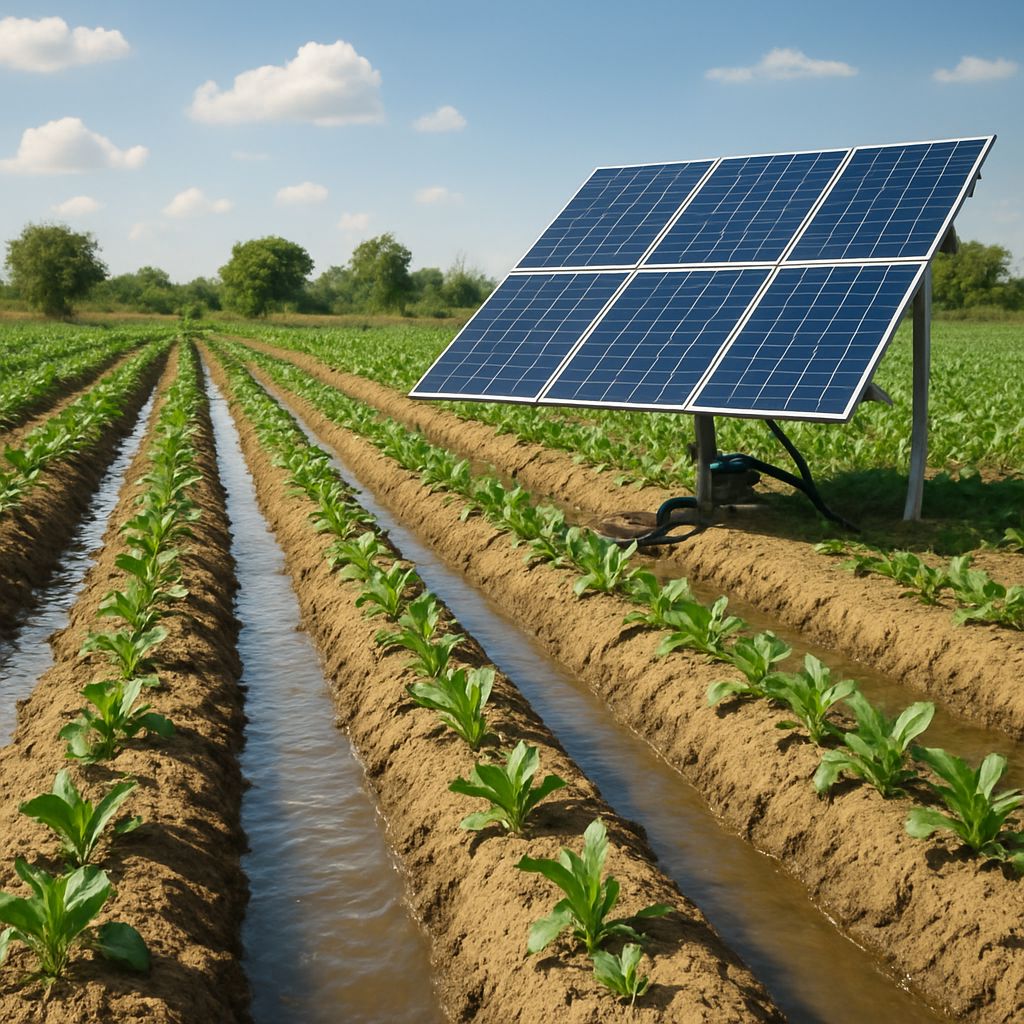
Key Takeaways
- Solar-powered furrow irrigation can cut farm energy costs by up to 90% compared to diesel or grid-powered systems, making it one of the most impactful cost-saving upgrades a farmer can make.
- The technology works on farms of nearly any size — from small 1-acre plots to large commercial operations — with system sizing tailored to match your specific water demand.
- Government incentives and tax credits can significantly offset upfront installation costs, improving your return on investment timeline.
- Remote farms with unreliable grid access benefit the most, but even grid-connected farms see substantial long-term savings by reducing dependence on external energy sources.
- Keep reading to discover how farmers in Arizona, Nebraska, and India are already achieving dramatic results — including a 22% yield increase — using this exact system.
Harnessing the sun to move water through your fields is one of the smartest agricultural decisions you can make right now. GrowingSolarMist.com has been at the forefront of helping farmers understand how renewable energy can be practically applied to everyday irrigation challenges, and solar-powered furrow irrigation is one of the clearest wins in sustainable agriculture today.
Solar Panels and Furrow Irrigation: Why This Combination Works
Furrow irrigation has been feeding civilizations for thousands of years. Solar panels have been commercially viable for decades. Putting them together creates something genuinely powerful — a low-cost, low-emission, self-sufficient irrigation system that works even in places the power grid has forgotten.
The combination succeeds because both technologies are fundamentally simple. Furrows move water by gravity once it’s delivered. Solar panels generate electricity without moving parts. Together, they eliminate the two biggest operational headaches in traditional irrigation: fuel costs and grid dependency.
What Furrow Irrigation Actually Is
Furrow irrigation is a surface irrigation method where shallow channels, called furrows, are cut between crop rows. Water flows down these channels from a supply point — typically a pump — and soaks into the soil laterally and downward to reach plant roots. It’s widely used for row crops like corn, cotton, sugarcane, and vegetables. The system is gravity-assisted, which means once water enters the furrow, it moves on its own. The pump’s only job is to lift and deliver water to the head of the field.
How Solar Panels Power the System
Solar panels convert sunlight into DC electricity, which powers a submersible or surface-mounted water pump. That pump draws water from a well, canal, reservoir, or river and delivers it to the top of the furrow channels. Here’s how the core energy flow works:
- Solar array captures sunlight and converts it to DC electricity
- Charge controller regulates voltage to protect batteries and pump equipment
- Inverter (if needed) converts DC to AC for standard pump motors
- Water pump lifts and delivers water to the irrigation inlet
- Furrow channels distribute water across the field by gravity flow
- Battery bank (optional) stores excess energy for pumping during low-light periods
The simplicity of this chain is exactly why it works so reliably. There are no combustion engines, no fuel deliveries, and no utility bills attached to the process. When the sun rises, the system works. Modern solar pump controllers also include maximum power point tracking (MPPT) technology, which continuously optimizes energy extraction from the panels — even during partial cloud cover.
System sizing is straightforward. A typical 1-horsepower solar pump requires approximately 1,000 watts of solar panel capacity under full sun conditions. For a 10-acre vegetable farm requiring a 5 HP pump, you’d be looking at roughly a 5kW solar array — about 15 to 17 standard 300-watt panels. Learn more about solar-powered irrigation systems and their benefits.
Why Traditional Power Sources Fall Short
Diesel pumps are the dominant alternative in areas without reliable grid access, and they come with a long list of problems. Fuel costs are volatile and recurring — there’s no price certainty from season to season. Diesel engines require regular maintenance including oil changes, filter replacements, and injector servicing. In remote locations, even getting fuel delivered adds logistical cost and complexity.
Grid-connected electric pumps solve the fuel problem but introduce a different vulnerability: dependence on utility infrastructure. Power outages during critical growing periods can devastate crops. In drought-prone regions, irrigation timing is everything, and a grid failure at the wrong moment has real consequences. Beyond reliability, grid electricity rates have been rising steadily, eroding farm margins year over year. For farmers looking to mitigate these issues, exploring solar panels for farms can be a viable alternative.
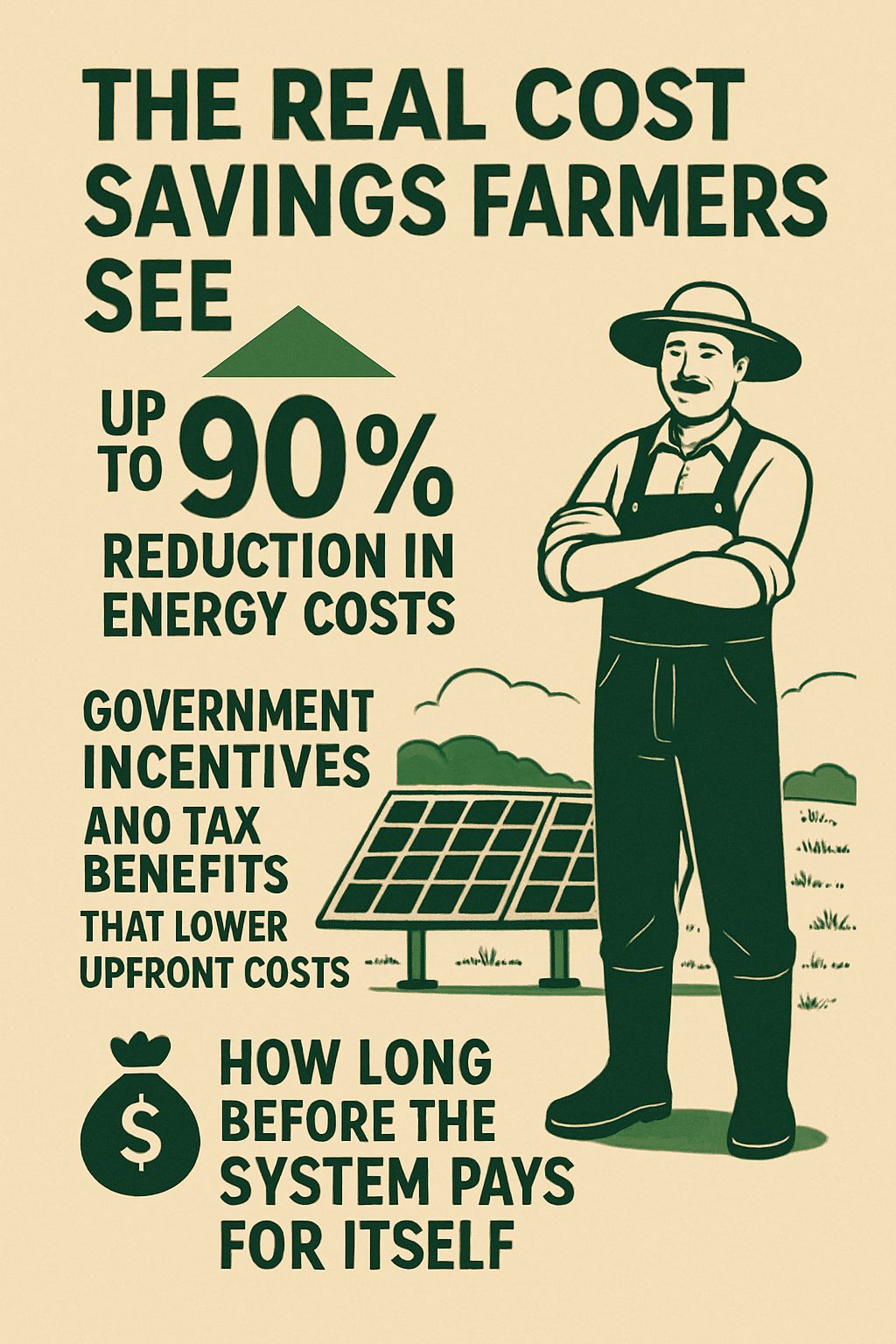
The Real Cost Savings Farmers See
The financial case for solar-powered furrow irrigation is compelling, and the numbers back it up consistently across farm types and geographies.
Up to 90% Reduction in Energy Costs
Solar-powered furrow irrigation systems have been shown to reduce farm energy costs by up to 90% compared to diesel or grid-powered alternatives. Once the panels are installed, the fuel cost is zero. Sunlight is free. The only ongoing costs are minimal maintenance and, if applicable, battery replacement every 7 to 10 years for lead-acid systems (lithium batteries last considerably longer).
To put that in real numbers: a farm spending $10,000 annually on diesel for irrigation could reduce that to $1,000 or less in maintenance-related costs. Over a 25-year panel lifespan, that’s potentially $200,000+ in cumulative energy savings — from a system that typically costs between $5,000 and $30,000 to install depending on scale. For more information on how solar panels can benefit farms, visit this usage guide.
Government Incentives and Tax Benefits That Lower Upfront Costs
In the United States, the federal Investment Tax Credit (ITC) allows farmers to deduct a significant percentage of solar installation costs from their federal taxes. Many states layer additional incentives on top — including grants, rebates, and property tax exemptions for solar equipment. The USDA’s Rural Energy for America Program (REAP) provides grants covering up to 25% of eligible project costs for agricultural solar installations, with loan guarantees available for the remaining investment. These programs exist specifically to make this transition financially accessible for working farms. For more information on how solar energy can benefit agriculture, explore solar-powered irrigation solutions.
How Long Before the System Pays for Itself
Payback periods for solar furrow irrigation systems typically range from 3 to 7 years, depending on system size, local energy costs, available incentives, and hours of daily operation. After payback, the system generates essentially free irrigation energy for the remaining 18 to 22 years of panel life. That’s two decades of dramatically reduced operating costs — a margin improvement that compounds every single growing season.
Water Efficiency Gains with Solar Furrow Irrigation
Cost savings are the headline, but water efficiency improvements are equally important — particularly as water scarcity intensifies across major agricultural regions worldwide.
How Consistent Solar Power Improves Irrigation Timing
One of the underappreciated advantages of solar-powered pumping is operational consistency. When power is free and reliable, farmers irrigate on the optimal agronomic schedule rather than the cheapest one. With diesel systems, high fuel costs often push farmers toward fewer, longer irrigation events — which is less efficient than the frequent, shorter cycles that many crops prefer.
Solar-powered systems remove that economic barrier entirely. Farmers can irrigate at dawn when evaporation rates are lowest, run shorter cycles more frequently, and respond immediately to soil moisture changes without worrying about fuel consumption. This behavioral shift alone improves water use efficiency at the field level.
Timing irrigation correctly also reduces soil crusting and runoff — two major efficiency losses in furrow systems. When water is applied at the right rate and interval, it infiltrates more uniformly along the furrow length, reducing tail-water waste at the end of rows. Additionally, using solar panels can enhance the efficiency of irrigation systems by providing sustainable energy solutions for powering the necessary equipment.
|
Irrigation Factor |
Diesel-Powered System |
Solar-Powered System |
|---|---|---|
|
Energy Cost Per Season |
$8,000 – $15,000+ |
Near $0 (maintenance only) |
|
Irrigation Scheduling Flexibility |
Limited by fuel cost |
Full flexibility |
|
Emissions Per Season |
High (CO₂ & particulates) |
Zero operational emissions |
|
Grid Dependency |
None (fuel-based) |
None (solar-based) |
|
Maintenance Frequency |
High (engine servicing) |
Low (panel cleaning, inspections) |
|
System Lifespan |
10 – 15 years (engine) |
25 – 30 years (panels) |
Reduced Water Waste Compared to Diesel-Powered Systems
Diesel pump operators often run systems at full capacity regardless of actual crop need — because starting and stopping a diesel engine repeatedly is mechanically hard on the equipment and operationally inconvenient. Solar-powered pumps, by contrast, can be modulated easily using variable frequency drives (VFDs), allowing precise flow control matched to current crop demand and soil conditions. Learn more about how solar panels power farm equipment effectively.
The result is measurable. Farms that switch to solar-powered furrow irrigation and implement proper flow management typically see a significant reduction in total water applied per acre — without any reduction in yield. In water-stressed regions, that conservation isn’t just environmentally responsible. It’s a competitive advantage that protects the farm’s long-term viability.
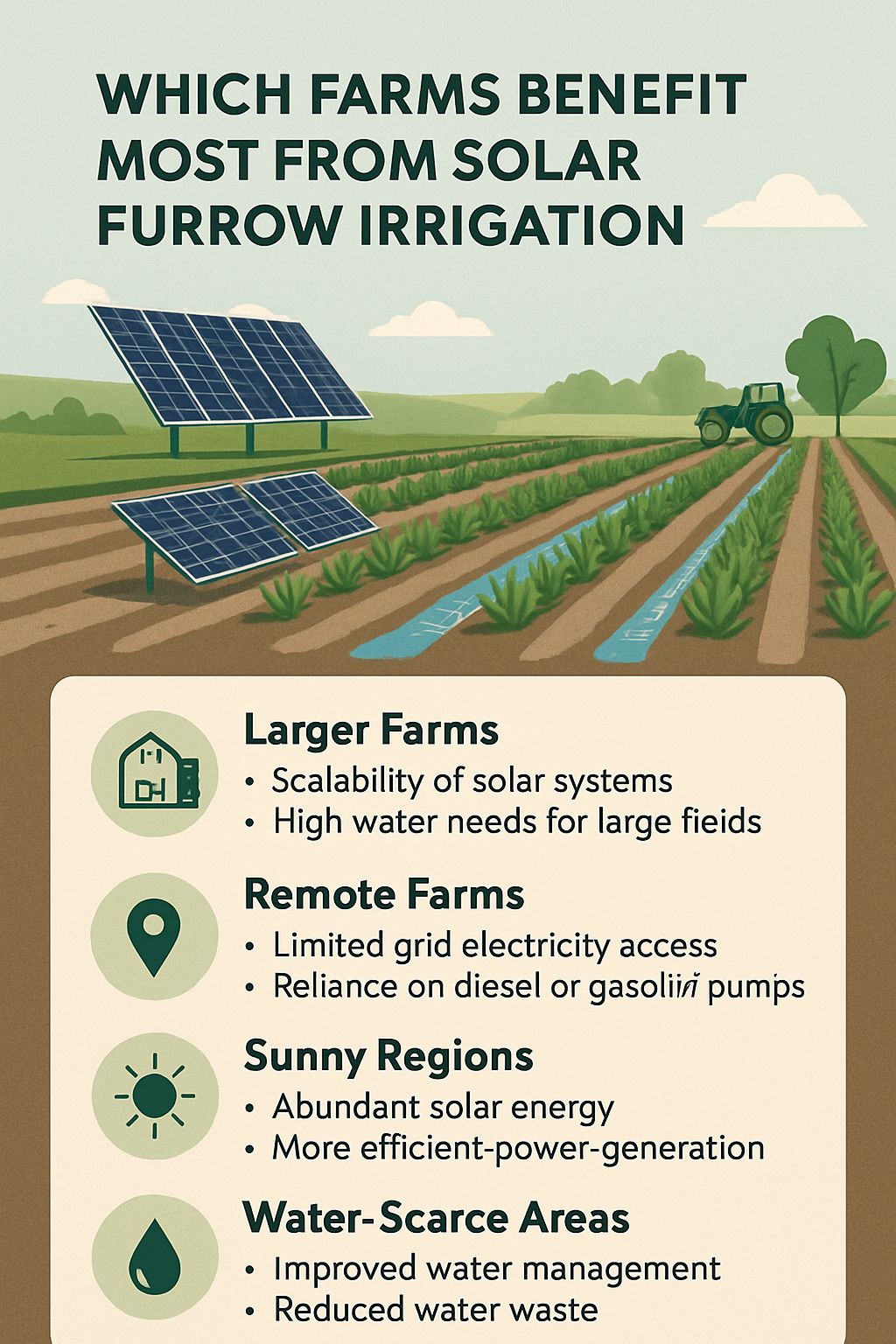
Which Farms Benefit Most from Solar Furrow Irrigation
Not every farm will see identical results from solar furrow irrigation, but the technology is flexible enough to deliver meaningful benefits across a remarkably wide range of agricultural contexts. The farms that benefit most share a few common characteristics: high current energy costs, limited grid reliability, and crops that are well-suited to surface irrigation methods.
Geography plays a significant role too. Farms located in high-solar-irradiance regions — the southwestern United States, sub-Saharan Africa, South Asia, and Australia’s agricultural belt — generate more energy per panel per day, which directly improves system economics. A farm in Arizona generates considerably more usable solar energy annually than the same system installed in a northern European climate.
That said, solar-powered furrow irrigation has demonstrated viability across a broad spectrum of climates and farm types. The key is proper system sizing and, where sunlight is inconsistent, incorporating battery storage or hybrid backup power to maintain operational continuity during low-light periods.
Quick Reference: Farm Profiles Most Suited to Solar Furrow Irrigation
✅ Remote farms with no grid connection or unreliable power supply
✅ Farms currently spending heavily on diesel fuel for irrigation pumping
✅ Row crop operations growing corn, cotton, vegetables, or sugarcane
✅ Operations in high-sunlight regions with long growing seasons
✅ Farms in drought-prone areas where water use efficiency is critical
✅ Smallholder farms in developing regions seeking energy independence
✔ Grid-connected farms looking to reduce utility costs long-term
Remote Farms with Unreliable Grid Access
For farms without reliable grid electricity, solar isn’t just a cost-saving measure — it’s the difference between having a functional irrigation system and not having one. Across large parts of Sub-Saharan Africa, South Asia, and rural South America, grid infrastructure either doesn’t reach agricultural land or delivers power so intermittently that it cannot be depended upon for critical irrigation schedules.
In these contexts, solar-powered pumping transforms farm productivity entirely. Farmers who previously relied on expensive diesel deliveries — or hand-carried water — can suddenly irrigate consistently, on schedule, and at scale. The energy independence that solar provides in these environments has direct food security implications, not just financial ones.
Drought-Prone Regions Where Water Conservation Is Critical
In drought-affected regions, every liter of water matters. Solar-powered furrow irrigation systems enable the kind of precise, responsive irrigation scheduling that minimizes waste. When energy is free, farmers can apply smaller, more frequent water applications that match actual crop uptake rather than compensating for infrequent diesel-powered pump runs. This approach reduces deep percolation losses, limits evaporation, and keeps soil moisture in the optimal range for crop growth — a combination that becomes critical when aquifer levels are dropping and surface water allocations are tightening.
Small-Scale vs. Large-Scale Farm Suitability
Solar-powered furrow irrigation systems can be designed for farms of virtually any size, though the economics shift with scale. Small operations between 1 and 10 acres typically face higher per-acre installation costs but can still achieve strong returns, particularly when government subsidies or community solar programs are available. Large commercial farms benefit from economies of scale in solar procurement and installation, often achieving shorter payback periods. Mid-sized operations — in the 20 to 100 acre range — frequently represent the sweet spot where system economics, available incentives, and operational simplicity align most favorably.
What a Solar Furrow Irrigation System Setup Looks Like
Understanding what you’re actually installing helps you plan effectively, communicate with suppliers, and avoid the costly mistakes that come from under-specifying your system. A solar furrow irrigation setup is not a single product — it’s an integrated system of components that must be matched to each other and to your specific farm’s water requirements.
The good news is that the core technology is mature, widely available, and increasingly affordable. Solar panel costs have dropped by more than 89% since 2010 according to the International Renewable Energy Agency (IRENA), and solar pump technology has advanced significantly in reliability and efficiency over the same period.
Core Components You Need
A complete solar-powered furrow irrigation system includes the following essential components working together: a solar panel array sized to your pump’s power requirements; a charge controller with MPPT technology to optimize energy harvest; a submersible or surface pump rated in horsepower to match your flow and head requirements; an inverter if your pump motor is AC-driven; a pressure tank or header pipe to deliver water to the furrow inlets; and optionally, a battery bank for after-hours or low-light pumping capability. Each component must be correctly specified — undersizing any one element creates a bottleneck that limits the entire system’s performance.
Sizing Your Solar Array to Match Water Demand
Sizing starts with understanding your peak water demand. Calculate the total volume of water your crops need per day during the peak growing season, then work backward to determine the pump flow rate required to deliver that volume within available daylight hours. From there, match the pump’s power draw to your solar array capacity.
A useful rule of thumb: plan for 1,000 watts of solar panel capacity per horsepower of pump motor under full sun conditions. If you’re in a region that averages 6 peak sun hours per day, a 3kW array can theoretically power a 3 HP pump for 6 hours — delivering substantial daily water volume without any fuel cost.
Always build in a 20 to 25% capacity buffer above your calculated minimum. Solar output varies with temperature, panel soiling, wiring losses, and seasonal sun angle changes. An undersized array that can’t meet peak demand on a hot July afternoon is a serious operational problem during the most critical irrigation period of the year. For more insights on sustainable agriculture, consider exploring solar-powered irrigation systems.
- Step 1: Calculate peak daily crop water requirement in gallons or liters per acre
- Step 2: Determine total dynamic head (vertical lift + friction losses in pipes)
- Step 3: Select pump HP rating based on required flow rate and head
- Step 4: Size solar array at 1kW per HP plus 20-25% buffer
- Step 5: Evaluate battery storage need based on irrigation schedule and sunlight hours
- Step 6: Select MPPT charge controller rated above your array’s maximum current output
Battery Storage vs. Direct Solar Pumping
Direct solar pumping — where the pump runs only when the sun is shining — is the simplest and most cost-effective configuration. It works well when your irrigation schedule is flexible and you can pump during daylight hours. Battery storage adds cost and complexity but enables pumping at dawn, dusk, or during brief cloud cover periods. For farms that need to irrigate at specific times regardless of sunlight, or those in regions with frequent cloud interruptions, a battery bank is worth the additional investment. Lithium iron phosphate (LiFePO4) batteries are the current best choice for agricultural solar storage, offering 2,000 to 4,000 charge cycles with minimal capacity degradation compared to traditional lead-acid alternatives.
Installation Considerations and Common Mistakes
Poor installation decisions are responsible for the majority of underperforming solar irrigation systems. The most common errors include panel shading from nearby trees or structures, incorrect pump-to-pipe sizing that causes excessive friction losses, inadequate wire gauge between panels and controller causing voltage drop, and panels installed at the wrong tilt angle for the farm’s latitude.
Installation Mistakes to Avoid:
✖ Installing panels where afternoon shadows from buildings or trees will cause shading losses
✖ Using undersized wiring between the solar array and charge controller
✖ Selecting a pump with higher head rating than needed — wasted power and cost
✖ Skipping a pressure-rated header pipe — inconsistent flow to furrow inlets
✖ Ignoring panel tilt optimization for your specific latitude
✖ Underestimating friction losses in long pipe runs from pump to field
Panel orientation and tilt are straightforward to optimize. In the northern hemisphere, panels should face true south (not magnetic south) and be tilted at an angle approximately equal to your farm’s latitude in degrees. A farm at 35°N latitude should have panels tilted at 35° from horizontal for optimal annual energy production. Adjusting tilt seasonally — steeper in winter, flatter in summer — can improve annual output by an additional 5 to 10%.
Pipe sizing deserves particular attention. Many first-time installers choose pipes that are technically capable of carrying the required flow but create excessive friction head, forcing the pump to work harder and consume more power. As a general guideline, keep flow velocity in main supply pipes below 1.5 meters per second to minimize friction losses. Upsizing your pipe diameter by one size is almost always worth the modest additional material cost when you consider the pump energy savings over a 25-year system lifespan.

“Furrow Irrigation Systems …” from growingsolarmist.com and used with no modifications.
Proven Results From Farmers Already Using This System
The strongest argument for solar-powered furrow irrigation isn’t found in technical specifications or financial projections — it’s found in the documented experiences of farmers who have already made the transition. Real-world results consistently validate the theoretical benefits, and in many cases, the outcomes exceed initial expectations.
92% Energy Cost Reduction on a 20-Acre Arizona Vegetable Farm
A vegetable farmer operating a 20-acre operation in Arizona transitioned from diesel-powered pumping to a solar array paired with a direct-drive submersible pump system. The farm, which grew a rotation of lettuce, peppers, and tomatoes using furrow irrigation, had been spending heavily on diesel fuel annually to maintain irrigation schedules through the long Arizona growing season. After installing a correctly sized solar system, the farm’s energy costs for irrigation dropped by 92% — reducing what had been one of the operation’s largest variable expenses to near zero.
Beyond the cost savings, the farmer reported a meaningful improvement in irrigation scheduling consistency. Free from the economic pressure to minimize pump run time, the operation shifted to more frequent, shorter irrigation events better matched to crop demand. Soil moisture levels became more stable across the growing season, reducing plant stress during the hottest summer months and improving produce quality grades at market.
22% Yield Increase on a Nebraska Corn Farm
A corn producer in Nebraska documented a 22% yield increase in the first full season following the transition to solar-powered furrow irrigation. The yield improvement was attributed primarily to improved irrigation timing consistency — the ability to irrigate at agronomically optimal intervals without being constrained by energy cost concerns. Previously, high electricity costs had led the operation to stretch intervals between irrigation events, particularly during early and mid-season when corn is establishing its root system and setting ears.
The Nebraska case is particularly instructive because it demonstrates that the benefits of solar-powered furrow irrigation extend well beyond energy cost reduction. When irrigation decisions are driven by crop science rather than energy economics, yield outcomes improve measurably. For a corn operation, a 22% yield improvement translates directly to significant additional revenue per acre — a return that compounds the already strong financial case built on energy savings alone.
Community Solar Irrigation Projects in Drought-Prone India
Perhaps the most compelling large-scale evidence for solar-powered furrow irrigation comes from community-based projects across drought-prone regions of India, particularly in states like Rajasthan, Maharashtra, and Gujarat. Smallholder farmers in these regions — many operating plots of just 2 to 5 acres — historically faced a brutal choice between expensive diesel pumping and unreliable grid electricity that often delivered power only during non-peak nighttime hours. Community solar irrigation projects changed that equation entirely by pooling resources across multiple farming households to install shared solar arrays that power centralized pumping stations serving entire farming communities.
The results across these projects have been transformative. Participating farmers reported dramatic reductions in irrigation costs, improved ability to plant second and third crops within a single year, and greater resilience during drought periods when reliable irrigation access became the difference between a viable harvest and crop failure. The community model also solved the individual capital barrier that prevents many smallholder farmers from accessing solar technology independently — by sharing both the installation cost and the energy output, solar-powered furrow irrigation became financially accessible to farming households that could never have funded a standalone system.
Challenges You Should Know Before You Commit
Solar-powered furrow irrigation is not without its challenges. Going in with a clear understanding of the real obstacles — rather than discovering them mid-installation — is the difference between a system that delivers on its promise and one that underperforms and frustrates. Two challenges stand out as the most significant: the upfront capital requirement and the variability of solar energy output across seasons and weather conditions.
Neither of these challenges is a dealbreaker. Both are manageable with proper planning, correct system design, and appropriate use of available financial tools. But they deserve honest acknowledgment before you commit to the investment.
Upfront Capital Requirements
A complete solar-powered furrow irrigation system for a mid-sized farm typically costs between $5,000 and $30,000 installed, depending on pump size, array capacity, battery storage inclusion, and local labor rates. For many farming operations — particularly smallholder farms already operating on thin margins — finding that capital upfront is genuinely difficult. The USDA REAP grant program, federal ITC tax credits, and state-level agricultural energy programs can collectively reduce net out-of-pocket costs by 40 to 60% in many U.S. jurisdictions. Agricultural lending programs specifically designed for renewable energy investments are also increasingly available through farm credit institutions, allowing the system to be financed against the energy savings it generates. The key is researching available programs in your specific state and county before finalizing your budget — the incentive landscape varies significantly by location and changes from year to year.
Seasonal Sunlight Variability and Its Impact on Output
Solar energy output is not constant across the year. In most agricultural regions, winter months deliver significantly fewer peak sun hours per day than summer months — which is generally acceptable since irrigation demand is also lower in winter. The challenge arises during shoulder seasons — spring planting and fall harvest periods — when irrigation demand is moderate but solar output may be transitioning. A system sized purely for peak summer operation may underdeliver during these critical early and late-season windows. To mitigate this, farmers can explore solar panel backup batteries as an essential solution for maintaining consistent power supply.
The solution is to size your system based on your most demanding irrigation period while incorporating battery storage or a hybrid backup — either a small grid connection or a compact diesel generator — to cover periods when solar output falls short of pump demand. A properly designed hybrid system captures the vast majority of energy from solar while maintaining operational reliability during low-light periods. This is not a compromise — it’s smart engineering that protects your crops while still delivering most of the cost and sustainability benefits of a pure solar system.
Cloud cover and dust accumulation on panels are additional factors that reduce real-world output below nameplate specifications. Panel soiling from agricultural dust, pollen, and bird droppings can reduce output by 5 to 25% if panels are not cleaned regularly. In high-dust farming environments, monthly panel cleaning is a minimum maintenance requirement — not an optional task. Scheduling panel cleaning as part of regular farm maintenance routines ensures the system consistently delivers the energy output your irrigation schedule depends on.

“Furrow Irrigation Systems …” from growingsolarmist.com and used with no modifications.
Solar Furrow Irrigation Is a Long-Term Investment Worth Making
When you look at the full picture — 90% energy cost reductions, 25-year panel lifespans, proven yield improvements, water conservation benefits, and the growing availability of financial incentives that reduce upfront barriers — solar-powered furrow irrigation stands out as one of the most financially sound and environmentally responsible investments available to farmers today. The technology is proven, the components are widely available, and the farmers who have already made the transition are reaping compounding returns season after season. The question for most farming operations is no longer whether solar-powered furrow irrigation makes sense — it’s how quickly you can get a properly designed system in the ground and start eliminating your energy costs for good.
Frequently Asked Questions
Solar-powered furrow irrigation raises practical questions from farmers at every stage of consideration — from initial curiosity to active system planning. The answers below address the most common and important questions directly, such as the benefits of solar panels powering farm operations.
Understanding these specifics will help you evaluate whether the technology is right for your operation and what a realistic implementation path looks like for your farm size, location, and crop type.
How Many Solar Panels Does It Take to Power a Furrow Irrigation Pump?
The number of panels required depends directly on your pump’s horsepower rating and the wattage of the panels you select. Using standard 400-watt panels as a reference point, a 1 HP pump requires approximately 3 panels, a 3 HP pump needs around 8 to 9 panels, and a 5 HP pump requires approximately 13 to 15 panels under full sun conditions.
Always add a 20 to 25% buffer above your calculated minimum to account for real-world efficiency losses from temperature, wiring resistance, panel soiling, and seasonal sun angle variation. A system that meets your exact calculated minimum will regularly fall short of delivering full pump power under anything less than ideal conditions.
Panel selection also matters. Higher-efficiency monocrystalline panels — such as those in the 400 to 550 watt range now commonly available — generate more power per square meter of roof or ground space, which is advantageous when installation area is limited. Polycrystalline panels cost less per watt but require more physical space to achieve the same output. For most agricultural solar installations, monocrystalline panels represent the better long-term value despite higher upfront cost per panel.
Can Solar Furrow Irrigation Work in Cloudy or Rainy Climates?
Yes — solar-powered furrow irrigation can work in cloudy or rainy climates, though system design must account for reduced average daily sunlight hours. Modern solar panels continue generating electricity during overcast conditions; output drops to roughly 10 to 25% of peak capacity under heavy cloud cover, but this is not zero. In consistently cloudy regions, the practical solution is to oversize the solar array relative to pump demand, incorporate battery storage to bank energy from clear periods, and — where irrigation continuity is critical — include a small hybrid backup power source.
It’s also worth noting that in genuinely rainy climates, irrigation demand is typically lower, which reduces the daily energy requirement for pumping. The two factors — lower solar output and lower irrigation demand — often partially offset each other in practice, making solar-powered systems viable in climates that initially seem unsuitable.
Farmers in the Pacific Northwest of the United States, parts of Western Europe, and monsoon-influenced regions of Asia have successfully deployed solar-powered irrigation systems by designing for their specific climate realities rather than treating solar as a technology only suited to desert environments. Battery storage sized for 2 to 3 days of pump operation is typically sufficient to bridge cloudy periods in most temperate agricultural regions.
What Crops Are Best Suited for Solar-Powered Furrow Irrigation?
Furrow irrigation itself is best suited to row crops with moderate to high water requirements planted in relatively flat terrain. The crops that benefit most from solar-powered furrow irrigation include corn, cotton, sugarcane, soybeans, potatoes, onions, garlic, and a wide range of field vegetables including tomatoes, peppers, and squash. Grain crops like wheat and sorghum are also commonly furrow-irrigated in water-limited regions. The solar power component adds benefit to any crop currently being irrigated with diesel or grid power — the crop suitability question is primarily about furrow irrigation as a delivery method rather than the energy source powering the pump.
Is Solar Furrow Irrigation Suitable for Hilly or Uneven Terrain?
Furrow irrigation itself requires relatively flat to gently sloping land — typically a slope of 0.5% to 3% — for water to flow evenly down furrows without causing excessive erosion on steeper sections or pooling on flat areas. Hilly or highly irregular terrain is genuinely challenging for furrow irrigation regardless of the energy source powering the pump. Land grading or precision leveling can extend the viable slope range in some cases, but steep terrain generally requires switching to a different irrigation method such as drip or sprinkler systems.
The solar power component, however, is entirely terrain-independent. Solar panels can be ground-mounted on racking systems that hold them at the optimal tilt angle regardless of the surrounding landscape. If your terrain is suitable for furrow irrigation, solar power is a viable energy source. If your terrain is too steep for furrow irrigation, solar power can equally well drive a drip or micro-sprinkler system — the energy and sustainability benefits of solar pumping apply across all surface and pressurized irrigation methods.
How Much Maintenance Does a Solar-Powered Irrigation System Require?
- Panel cleaning: Monthly in high-dust agricultural environments; every 2 to 3 months in lower-dust settings — use soft brushes or low-pressure water, never abrasive materials
- Electrical connection inspection: Annually check all terminal connections for corrosion, looseness, or UV degradation in wiring insulation
- Charge controller check: Review controller display readings monthly to confirm MPPT operation and battery state of charge within normal parameters
- Pump inspection: Annual check of pump impeller, seals, and inlet screen for wear or blockage — submersible pumps in clean water sources typically require minimal service
- Battery maintenance (if applicable): Lead-acid batteries require quarterly electrolyte level checks and terminal cleaning; lithium batteries are essentially maintenance-free between replacement cycles
- Panel structure and mounting: Annual inspection of racking hardware for corrosion, loose fasteners, and structural integrity — particularly important in high-wind agricultural environments
Overall, solar-powered irrigation systems require dramatically less maintenance than diesel-powered equivalents. A diesel engine demands regular oil changes, fuel filter replacements, air filter servicing, injector maintenance, and periodic overhauls. A solar array and electric pump system has no combustion components, no oil, and no fuel system — the maintenance checklist is genuinely simple by comparison.
The most maintenance-intensive component in a solar irrigation system is the battery bank, if one is included. Lead-acid batteries require the most attention and have the shortest service life — typically 3 to 5 years in daily cycling applications. Upgrading to lithium iron phosphate batteries at initial installation or at the next battery replacement cycle significantly reduces ongoing maintenance burden and extends replacement intervals to 10 or more years.
Pump longevity depends heavily on water quality. Submersible pumps operating in clean groundwater sources can run for 10 to 15 years with minimal service. Pumps drawing from surface water sources — rivers, canals, or open reservoirs — face higher sediment loads that accelerate impeller wear. Installing a properly rated intake screen and flushing the pump inlet periodically extends service life considerably in these applications. For farms looking to improve their operations, solar panels for farms can be a sustainable solution.
One practical maintenance advantage that often goes unmentioned is remote monitoring capability. Most modern solar pump controllers include data logging and — in current-generation products — wireless connectivity that allows system performance monitoring from a smartphone. Anomalies in energy production, pump current draw, or battery state of charge can be detected early and addressed before they become costly failures. For farmers managing multiple fields or splitting time between farm tasks, this remote visibility is a genuine operational advantage that reduces the time burden of system oversight.


Leave a Reply