
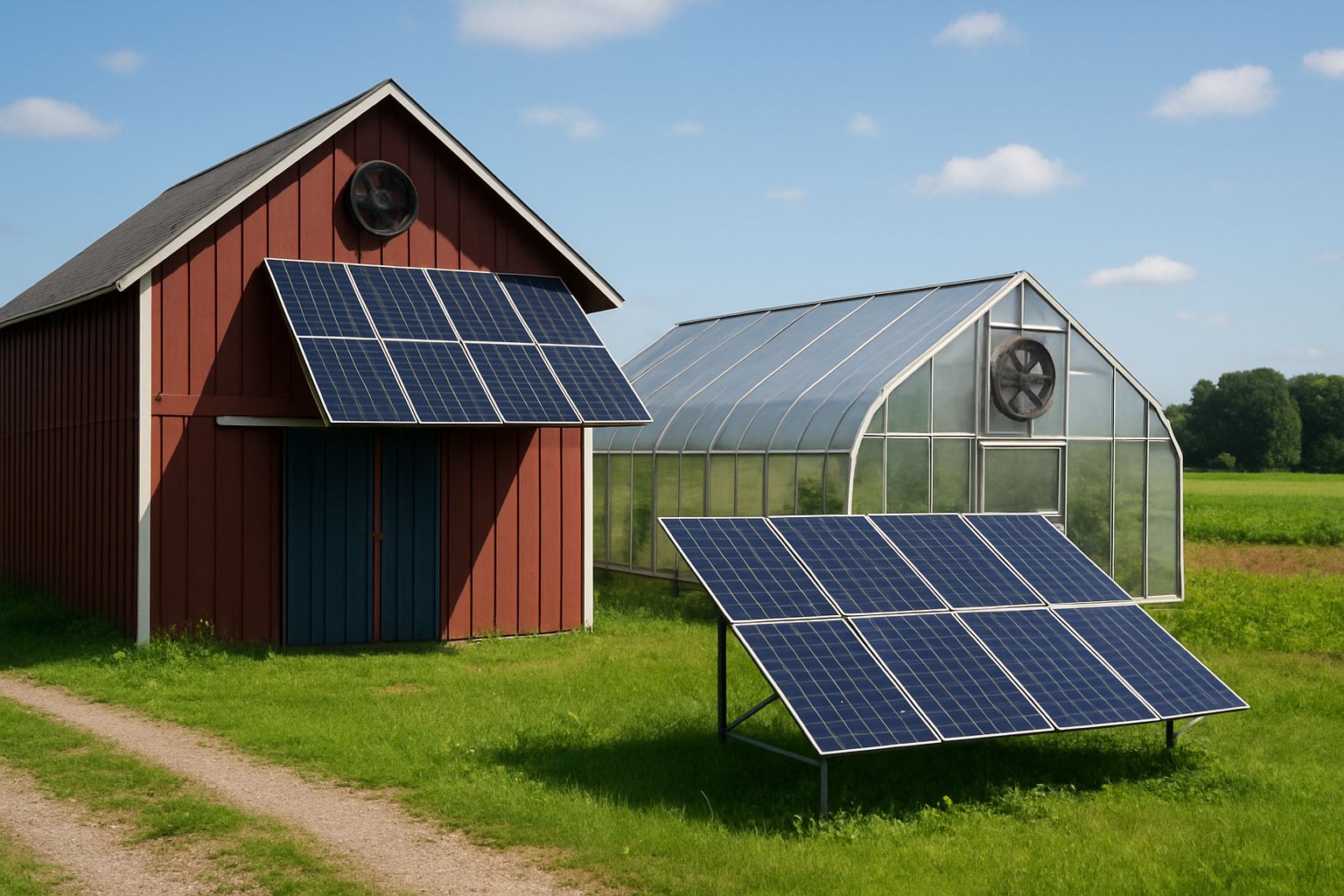
Article-At-A-Glance
- Solar-powered ventilation systems can reduce barn and greenhouse energy costs by up to 70%, with many farms seeing electricity bill reductions of 50% or more.
- Poor ventilation costs farmers far more than the price of a solar system — heat stress, disease, and crop loss add up fast.
- The Riverstone Solar Ventilation System delivers 800 CFM of off-grid cooling and can reduce internal temperatures by up to 20°F without a single grid connection.
- Federal tax credits, USDA REAP grants, and net metering programs make solar ventilation one of the highest-ROI investments available to modern farmers.
- Keep reading to find out exactly how many panels you need, what systems work best, and the real payback period farmers are experiencing.
Solar panels for barn ventilation aren’t just a green energy trend — they’re one of the most practical upgrades a farmer or grower can make to protect livestock, crops, and the bottom line.
Whether you’re managing a livestock barn, a hobby greenhouse, or a commercial growing operation, energy costs for fans, exhaust systems, and climate controls add up fast. Sustainable energy solutions built for agricultural use are making it easier than ever to cut that dependency on the grid while keeping your animals cool and your plants thriving. The technology has matured, the costs have dropped, and the financial incentives have never been stronger.
Solar Panels Cut Energy Costs for Barn & Greenhouse Ventilation by Up to 70%
Ventilation is one of the most energy-hungry functions on any farm or growing operation. Running exhaust fans, circulation fans, evaporative coolers, and automated vent systems around the clock pulls significant power from the grid — and that bill doesn’t take summers off. According to the U.S. Department of Energy, solar energy can lower those energy costs by up to 70%, depending on system size and consumption patterns.
For farms already operating on thin margins, that kind of reduction isn’t just attractive — it’s transformative. Solar-powered ventilation systems pay for themselves, reduce exposure to rising utility rates, and provide energy independence that no utility company can take away.
Why Ventilation Is the Biggest Energy Drain on Agricultural Buildings
Unlike lighting or irrigation, ventilation systems run continuously during warm months and often year-round in enclosed livestock facilities. A single commercial exhaust fan running 12 hours a day can consume 200–500 kWh per month depending on its size. Scale that across multiple fans in a large barn or greenhouse operation and you’re looking at a significant chunk of your monthly electricity spend. The problem compounds in summer when temperatures spike and fans run at maximum capacity precisely when grid electricity demand — and pricing — is also at its peak.
How Solar Panels Directly Power Fans, Exhaust Systems, and Climate Controls
Photovoltaic (PV) solar panels convert sunlight directly into DC electricity, which can power fans and exhaust systems either directly or through a charge controller and battery bank. In a direct-coupled setup, the fan runs whenever the sun shines — which is also when ventilation demand is highest. More sophisticated systems add a battery bank and inverter, allowing fans to run after dark or during overcast periods without any grid input.
Automated controls make the system even smarter. Temperature and humidity sensors can trigger fans to ramp up or slow down based on real-time conditions inside the barn or greenhouse, so you’re not wasting energy ventilating when it isn’t needed. This sensor-driven approach optimizes airflow and extends equipment life at the same time. For those interested in sustainable energy solutions, exploring the benefits of solar trackers can further enhance energy efficiency.
System Type
Power Source
Best Use Case
Approx. Cost
Direct PV-to-Fan
Solar panel only
Daytime ventilation, small barns
$150 – $300
PV + Battery Bank
Solar + stored energy
24/7 ventilation, livestock barns
$500 – $2,000+
Grid-Tied Solar
Solar + grid backup
Large commercial greenhouses
$3,000 – $15,000+
Hybrid Smart System
Solar + battery + sensors
Automated climate control
$1,500 – $8,000
The right system depends entirely on your building size, livestock count, crop sensitivity, and whether you need nighttime ventilation. For most small-to-mid-size barns, a direct PV setup or a PV-plus-battery system hits the sweet spot between cost and performance.
The Real Numbers: Energy Savings Farmers Are Seeing
Farms that have integrated solar ventilation consistently report electricity bill reductions of 50% or more. Solar-powered ventilation fans alone can save an additional $50–$150 per year in grid electricity costs for fans and evaporative cooling systems. For larger operations running multiple fans and climate control systems, those savings scale proportionally — and compound year after year against a fixed installation cost.
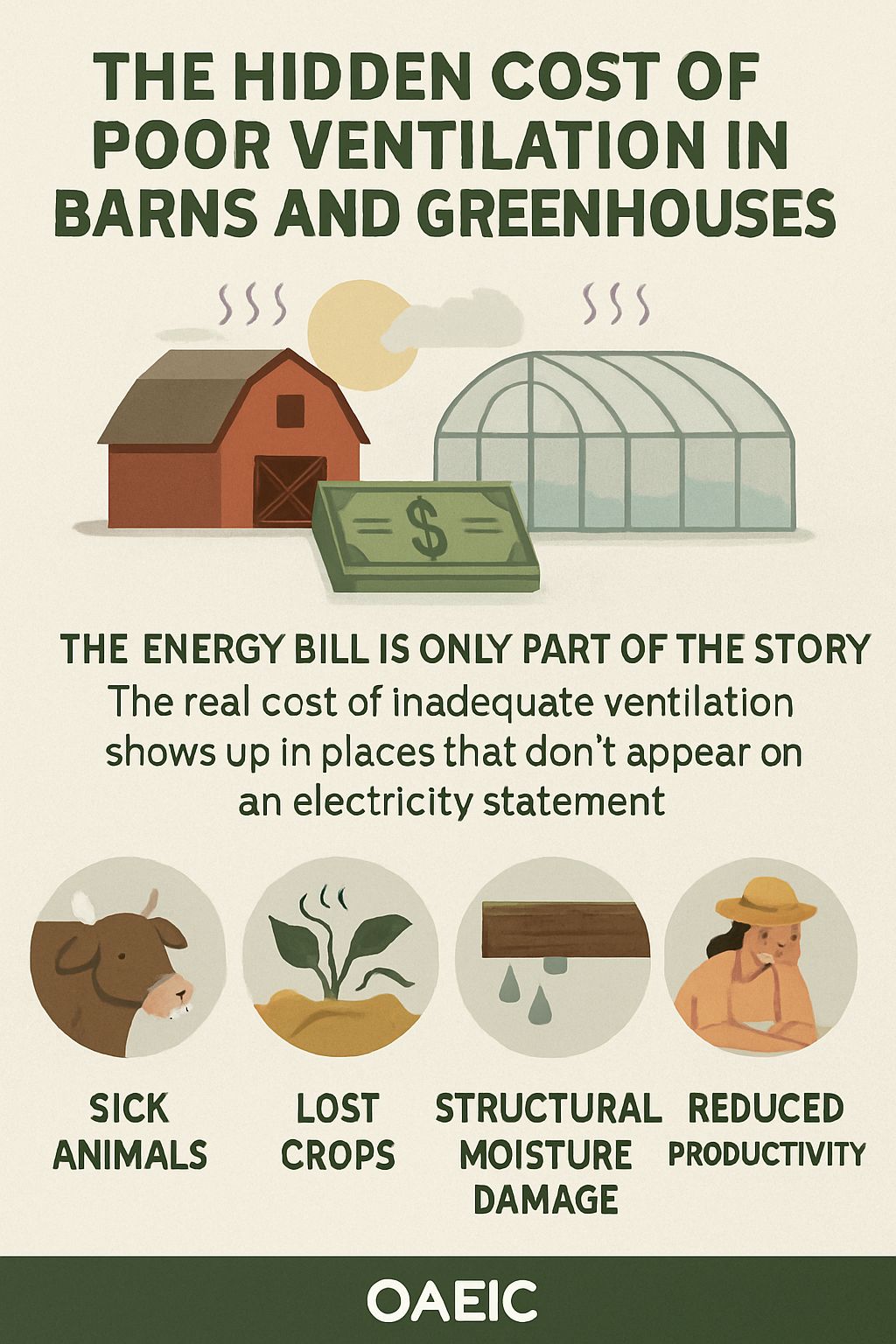
The Hidden Cost of Poor Ventilation in Barns and Greenhouses
The energy bill is only part of the story. The real cost of inadequate ventilation shows up in places that don’t appear on an electricity statement — sick animals, lost crops, structural moisture damage, and reduced productivity. Farmers who delay ventilation upgrades often find they’re paying far more in losses than they would have spent on a solar system.
Stagnant air traps heat, moisture, ammonia from animal waste, and airborne pathogens. In a barn without proper airflow, those conditions don’t just make animals uncomfortable — they create a breeding ground for respiratory illness, fungal disease, and the kind of chronic stress that quietly eats into livestock performance. To mitigate these issues, some farms are exploring solar trackers to improve ventilation systems and enhance air circulation.
- Ammonia buildup from manure in poorly ventilated barns irritates respiratory tracts in cattle, poultry, and swine, increasing veterinary costs and reducing feed conversion rates.
- Excess humidity in greenhouses promotes gray mold (Botrytis cinerea), powdery mildew, and root rot — diseases that can wipe out entire crop cycles.
- Heat accumulation in enclosed spaces causes heat stress in livestock, which directly suppresses milk production, egg-laying rates, and weight gain.
- Structural damage from condensation and moisture deteriorates wood framing, insulation, and equipment over time, adding costly repairs.
Heat Stress in Livestock: What Temperatures Above 80°F Actually Cost Farmers
Once barn temperatures climb above 80°F, livestock begin experiencing heat stress — and the economic consequences are immediate. Dairy cattle produce measurably less milk. Poultry reduce egg production. Pigs eat less and gain weight more slowly. The cumulative impact across a full summer season can represent thousands of dollars in lost output on even a modest-sized operation. Solar-powered ventilation that keeps temperatures in the optimal range isn’t an expense — it’s production insurance.
How Excess Humidity Destroys Greenhouse Crops and Spreads Disease
Greenhouses trap moisture by design, and without active ventilation, relative humidity can climb to levels where fungal pathogens thrive. Botrytis cinerea (gray mold) spreads aggressively above 85% relative humidity and can devastate tomatoes, strawberries, lettuce, and ornamental crops within days. Solar-powered exhaust fans that maintain humidity below the 70–80% threshold are one of the simplest, most cost-effective disease prevention tools available to greenhouse growers.
The math is straightforward: a solar ventilation system that prevents even one serious outbreak pays for itself many times over in a single growing season.
How Solar-Powered Ventilation Systems Actually Work
- Solar panels capture sunlight and convert it to DC electricity through the photovoltaic effect.
- Charge controllers regulate the flow of electricity to prevent battery overcharge and damage.
- Battery banks (optional) store excess energy for use during nights or cloudy periods.
- Inverters convert DC power to AC if your fans and equipment require it.
- Ventilation fans and exhaust systems receive the regulated power and move air based on demand.
- Sensors and smart controllers monitor temperature and humidity, automating fan speed and run time.
The beauty of a well-designed solar ventilation system is that it scales. A small hobby greenhouse might need nothing more than a 50W panel and a single 12V DC fan. A large commercial barn might require a full grid-tied solar array with battery backup, smart sensors, and multiple exhaust fans operating in zones.
Most systems are modular, meaning you can start small and expand as your energy needs grow or your budget allows. This flexibility is one of the key reasons solar ventilation is gaining traction across farm sizes — from backyard chicken coops to 10,000-square-foot commercial growing facilities.
Photovoltaic Panels vs. Thermal Solar: Which Powers Ventilation Better
For ventilation specifically, photovoltaic (PV) panels are the clear winner. PV systems generate electricity that can power any type of fan or control system, giving you complete flexibility in equipment choice and system design. Thermal solar collectors, by contrast, generate heat rather than electricity — useful for water heating and passive greenhouse warming, but not directly applicable to powering fans and exhaust systems. For barn and greenhouse ventilation, PV is the technology to invest in.
Battery Backup Systems for Nighttime and Cloudy Day Operation
Here’s the question most farmers ask first: what happens when the sun goes down? For daytime-only ventilation needs — which covers most heat management scenarios — a direct PV-to-fan setup without batteries works perfectly well. The sun is shining precisely when the barn or greenhouse is hottest. However, if your livestock require continuous overnight airflow, or if you’re running evaporative cooling systems that need to operate after dark, a battery backup system is worth the additional investment. Lithium iron phosphate (LiFePO4) batteries are increasingly the preferred choice for agricultural solar systems due to their long cycle life, thermal stability, and low maintenance requirements.
Automated Sensors and Smart Controls That Adjust Airflow Automatically
Modern solar ventilation systems don’t just move air — they think. Integrated temperature and humidity sensors continuously monitor internal barn or greenhouse conditions and communicate with a smart controller that adjusts fan speed, opens or closes vents, and activates supplemental cooling only when conditions demand it. This kind of precision means you’re never running fans at full power when a light breeze would do the job, and never under-ventilating during a heat spike because no one was there to flip a switch. Systems like these can reduce unnecessary fan runtime by 30–40%, stretching your solar energy further and reducing mechanical wear on equipment.
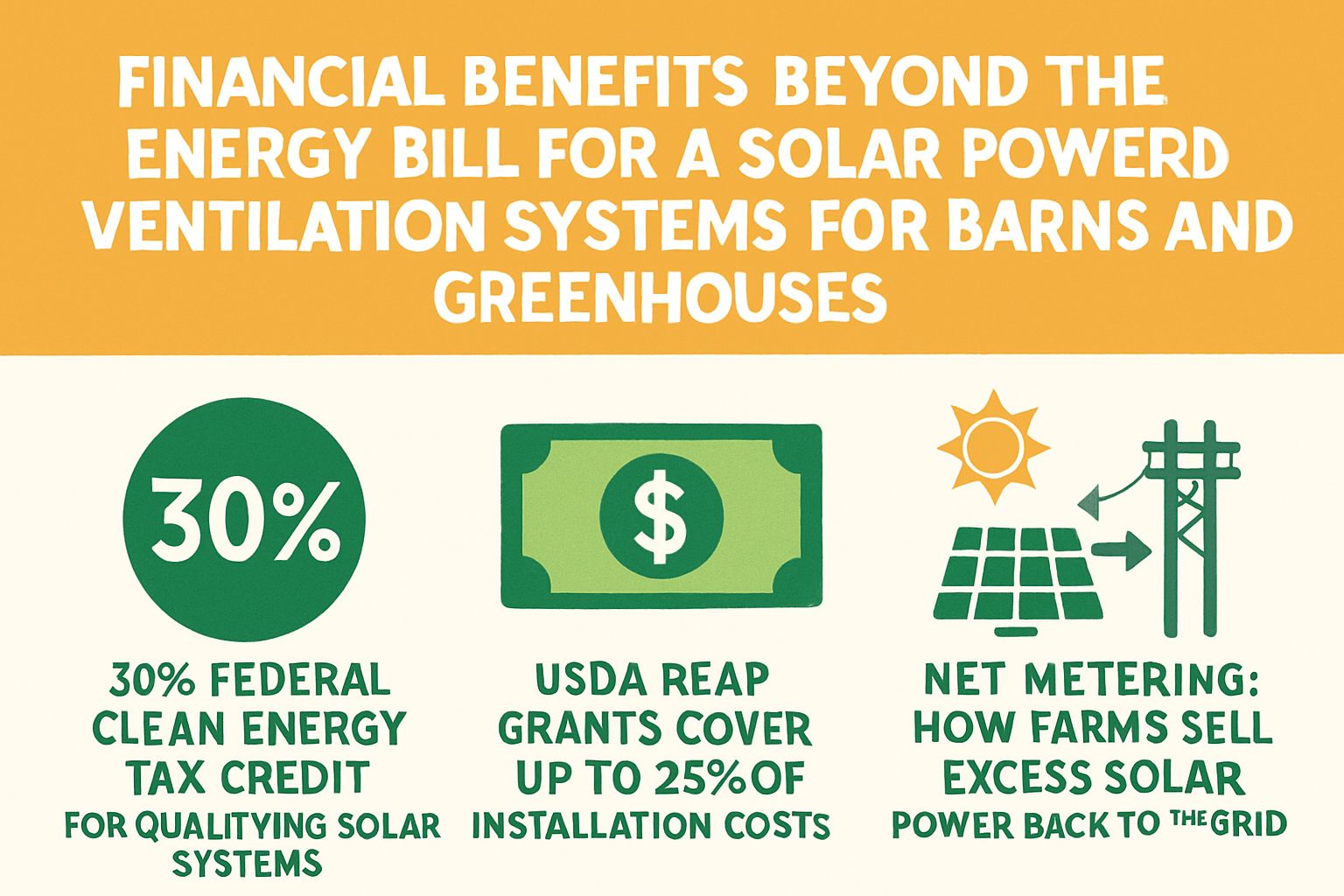
Financial Benefits Beyond the Energy Bill
The upfront cost of a solar ventilation system is the number most farmers focus on — but it’s only one part of the financial picture. Between federal tax incentives, USDA grant programs, and net metering opportunities, the actual out-of-pocket investment after incentives can be dramatically lower than the sticker price suggests.
The combination of reduced operating costs, available grants, and tax credits means that many solar ventilation systems reach payback in as little as 3–7 years — after which every year of operation is essentially free energy. For a system with a 25-year panel lifespan, that’s nearly two decades of zero-cost ventilation. Additionally, exploring options like single-axis solar trackers can further enhance the efficiency and effectiveness of solar panels in agricultural settings.
30% Federal Clean Energy Tax Credit for Qualifying Solar Systems
Under the Inflation Reduction Act, agricultural solar installations qualify for the Investment Tax Credit (ITC) at a rate of 30% of total system cost. This applies to PV panels, inverters, charge controllers, battery storage systems, and installation labor — meaning the credit covers the full system, not just the panels themselves. For a $5,000 solar ventilation installation, that’s a direct $1,500 reduction in your federal tax liability. Consult a tax professional to confirm eligibility for your specific system and farm structure.
USDA REAP Grants Cover Up to 25% of Installation Costs
The USDA Rural Energy for America Program (REAP) provides grants and loan guarantees to agricultural producers and rural small businesses investing in renewable energy systems. Grants can cover up to 25% of eligible project costs, and loan guarantees can finance up to 75% of total costs. REAP funding has been used to support solar ventilation systems, solar water heating, and grid-tied PV installations across farm operations of all sizes.
Applications are accepted on a rolling basis, and the program is competitive — so detailed project documentation and a strong energy audit backing your application significantly improve approval odds. Your local USDA Service Center is the right starting point for understanding current funding cycles and application requirements in your region.
Net Metering: How Farms Sell Excess Solar Power Back to the Grid
If your solar array generates more electricity than your ventilation and farm systems consume — which is common during mild spring and fall weather — net metering programs allow you to export that excess power to the utility grid in exchange for credits on your electricity bill. Some farms generate additional revenue by leasing land for larger solar installations, but even a modest rooftop array on a barn can generate meaningful bill credits through net metering that effectively reduce the cost of grid electricity you do use. Availability and compensation rates vary by state and utility provider.
Solar Heating for Greenhouses: Reducing Fossil Fuel Use by 50–80%
Ventilation is only half of the greenhouse climate equation. Heating — especially through cold nights and shoulder seasons — is where fossil fuel dependency in greenhouse operations runs deepest. Propane, natural gas, and electric resistance heating are expensive, carbon-intensive, and vulnerable to price volatility. Solar heating strategies, both passive and active, can reduce fossil fuel consumption in greenhouses by 50–80%, fundamentally changing the economics of year-round growing.
Passive Solar Design: Thermal Mass, Water Barrels, and Rock Beds
Passive solar heating requires no panels, no inverters, and no electricity — just smart design that captures and stores heat from sunlight during the day for slow release at night. The most effective passive thermal mass materials for greenhouses are large water-filled barrels painted black, which absorb solar radiation during daylight hours and radiate that stored heat as temperatures drop after sunset. Rock beds and concrete floors serve a similar function. A greenhouse with adequate thermal mass can maintain temperatures several degrees above outside ambient temperature through the night without any active heating input — which directly reduces how hard and how long your heating system needs to run.
Active Solar Collectors and SRCC-Certified Systems That Qualify for Tax Credits
Active solar thermal collectors go a step further than passive design by using dedicated collector panels — typically mounted on the greenhouse roof or south-facing wall — to actively capture solar heat and transfer it to air or water that circulates through the growing space. Systems certified by the Solar Rating and Certification Corporation (SRCC) meet established performance and safety standards and are generally required to qualify for the federal Investment Tax Credit. When evaluating active solar thermal systems, look specifically for the SRCC OG-100 rating for individual collectors or OG-300 for complete system certification — these designations confirm the system has been independently tested and meets federal incentive eligibility requirements.
Agrivoltaic Systems: Solar Panels That Do Double Duty on Farms
Agrivoltaics is one of the most exciting developments in agricultural solar — and it flips the traditional land-use conversation entirely. Instead of treating solar panels and farming as competing uses for the same land, agrivoltaic systems integrate solar arrays directly into crop production areas, with panels mounted high enough to allow farming beneath them. The panels generate electricity for ventilation, irrigation, and other farm loads while simultaneously providing partial shade that can actually improve yields for heat-sensitive crops in hot climates.
Research into agrivoltaic systems has shown measurable benefits for crops like lettuce, spinach, and certain herbs that perform better under filtered light than under intense direct sun. The shade reduces soil moisture evaporation, which cuts irrigation demand. Meanwhile, the cooler microclimate under the panels reduces heat stress on both crops and the farm workers tending them. For farmers with open field operations adjacent to barn or greenhouse structures, agrivoltaics represents a way to generate solar energy without sacrificing productive agricultural land — a genuine win on both sides of the equation.
Solar Is the Smartest Long-Term Investment for Farm Energy Independence
Energy independence isn’t just a philosophical goal for farmers — it’s a practical economic strategy. Grid electricity prices have risen steadily over the past two decades and show no signs of reversing. Every kilowatt-hour your solar system generates is a kilowatt-hour you don’t buy from a utility at an ever-increasing rate. Lock in your energy costs today with a fixed solar installation, and you’ve effectively hedged against decades of utility price increases. With solar panel lifespans routinely exceeding 25 years and most quality systems carrying 10–25 year performance warranties, the long-term math is compelling for virtually any farm operation with adequate sun exposure.
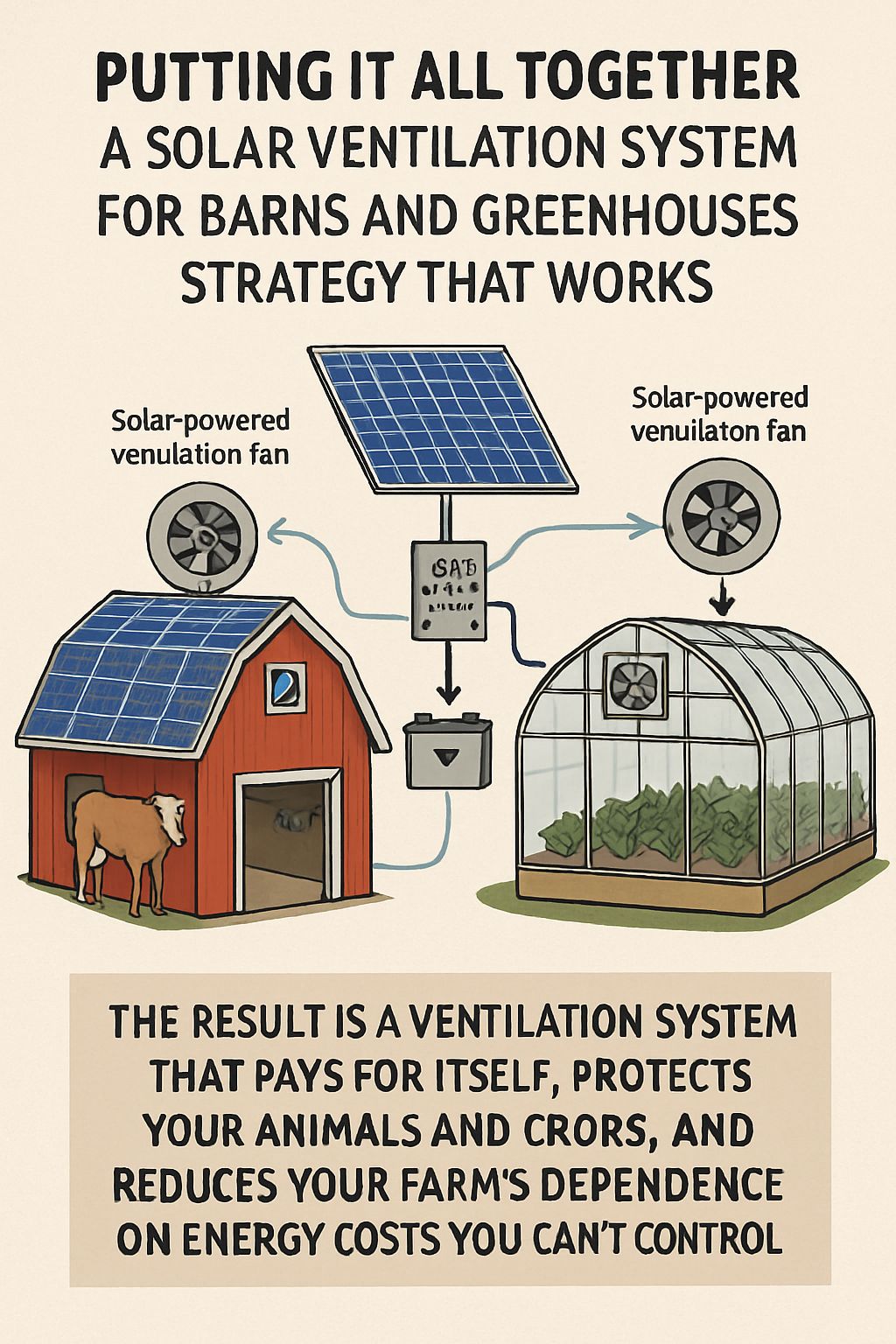
Putting It All Together: A Solar Ventilation Strategy That Works
The most effective approach combines the right system size for your specific building, the appropriate technology for your ventilation needs, and a financial plan that maximizes available incentives. Start with a proper CFM calculation for your barn or greenhouse — a general rule of thumb is one complete air exchange per minute for greenhouses, and 1 CFM per square foot of floor space as a minimum for livestock barns. Size your solar array to meet that load with a 20–25% surplus to account for panel degradation and seasonal variation. Apply for REAP funding before installation, claim the 30% ITC at tax time, and explore net metering with your utility provider to capture value from any excess generation. The result is a ventilation system that pays for itself, protects your animals and crops, and reduces your farm’s dependence on energy costs you can’t control.
Conclusion
Solar-powered ventilation is no longer a niche technology for early adopters — it’s a proven, financially sound infrastructure upgrade that farms of every size are implementing with measurable results. The combination of lower energy costs, healthier growing environments, reduced livestock stress, and strong federal and USDA incentives makes this one of the clearest return-on-investment decisions available to modern agricultural operations. Whether you start with a $200 DIY setup for a small greenhouse or invest in a full grid-tied system for a commercial barn, every step toward solar ventilation is a step toward a more resilient, profitable farm.
The farmers and growers who move on this now will spend the next 25 years paying virtually nothing for the ventilation energy that keeps their operations running — while everyone else keeps writing checks to the utility company every month.
Frequently Asked Questions
Still have questions about solar panels for barn ventilation? Here are the most common questions farmers and growers ask — answered directly.
Can solar panels power ventilation fans in a barn year-round, including winter?
Yes, solar panels can power barn ventilation year-round, though winter performance varies by location. PV panels generate electricity from daylight, not heat — so they continue producing power on cold, sunny winter days, often quite efficiently since cooler temperatures actually improve panel output. In northern latitudes where winter daylight hours are short and overcast days are frequent, a battery backup system ensures continuous fan operation even when solar generation is reduced. For most livestock barns, winter ventilation demands are lower than summer peaks, which means your solar system is typically well-matched to the reduced winter load.
How many solar panels do I need to run greenhouse ventilation systems?
The number of panels depends on your total fan wattage and daily run hours. A single 12V DC brushless fan drawing 30–50 watts can be powered by one 50W monocrystalline panel for daytime-only operation. A larger greenhouse running an 800 CFM commercial exhaust fan drawing 150–200 watts continuously will need two to four 100W panels plus a charge controller and battery bank for reliable operation. Calculate your total daily watt-hour consumption — fan wattage multiplied by daily run hours — then size your array to generate that amount with a 25% buffer for losses and degradation. A qualified solar installer can run this calculation precisely for your specific equipment and location.
What is the payback period for a solar-powered ventilation system on a farm?
Most solar ventilation systems reach payback within 3–7 years after accounting for energy savings, the 30% federal Investment Tax Credit, and any USDA REAP grant funding received. A basic DIY system costing $250 with $80–$150 in annual energy savings pays back in roughly 2–3 years with no incentives at all. Larger commercial systems that qualify for REAP grants and the ITC can see effective payback periods in the 4–6 year range despite higher upfront costs. After payback, 18–22 years of remaining panel lifespan translates to nearly free ventilation energy for the remainder of the system’s life.
Do solar ventilation systems work without a battery backup?
Yes — and for many barn and greenhouse applications, a battery-free direct PV-to-fan system is the most cost-effective choice. Solar ventilation fans operate whenever the sun is shining, which aligns naturally with peak heat buildup in agricultural structures. The hottest part of the day is also the sunniest, meaning your fan runs hardest exactly when it’s needed most. For those considering alternatives, exploring backup batteries benefits for solar panels on farms might be worthwhile.
Battery backup becomes worthwhile when you need ventilation after dark — for example, in livestock barns that require continuous overnight airflow, or for evaporative cooling systems that need to run through the evening hours. If your primary concern is daytime heat management and humidity control, a direct-coupled solar fan system without batteries is a simpler, lower-cost, lower-maintenance solution that works exceptionally well.
Are there specific solar panels designed for agricultural buildings like barns and greenhouses?
Standard monocrystalline PV panels work effectively on agricultural buildings, but several product lines are purpose-configured for farm environments. Panels used in agricultural settings should carry an IP65 or higher weatherproof rating to handle dust, moisture, and the harsher environmental exposure typical of farm structures. Flexible thin-film panels are increasingly used on curved or metal barn roofs where rigid panels can’t be easily mounted, while bifacial panels — which capture reflected light from below — can improve energy yield on reflective metal roofing common on agricultural buildings.
For dedicated ventilation kits, systems like the Riverstone Solar Ventilation System come pre-matched with a solar panel sized specifically for the included fan, taking the guesswork out of component pairing. These all-in-one agricultural ventilation kits are designed for straightforward installation by someone with basic DIY skills, without requiring a licensed electrician for the panel-to-fan connection in most jurisdictions — though always verify local electrical code requirements before installation.
When evaluating panels for a barn roof installation, also consider the structural load capacity of your roof. Standard 60-cell monocrystalline panels weigh approximately 40–50 pounds each, and a multi-panel array can add meaningful weight to an older agricultural structure. A structural assessment before installation is always a worthwhile precaution on legacy farm buildings. Additionally, exploring solar tracker benefits can optimize the efficiency of your solar panel installation.
Ultimately, the best solar panel for your barn or greenhouse is the one properly sized for your ventilation load, rated for outdoor agricultural exposure, and backed by a manufacturer warranty of at least 10–25 years on power output. Match those criteria, pair it with the right fan and controller, and you have a system built to outlast most of the equipment it’s powering.
Explore how sustainable energy solutions built for agricultural use can help you design and implement the right solar ventilation system for your barn, greenhouse, or farm operation — and start cutting those energy bills for good.



Leave a Reply