

Key Takeaways
- Solar panels can reduce farm electricity costs by up to 75%, offering significant long-term savings for agricultural operations of all sizes.
- Monocrystalline panels deliver the highest efficiency (20-22%) for farms with limited space, while polycrystalline options provide a more budget-friendly alternative at 15-17% efficiency.
- The USDA offers specific grants and loan programs designed to help farmers transition to renewable energy, covering up to 25% of system costs.
- Agrivoltaics—the practice of growing crops beneath solar panels—can increase land use efficiency by up to 70% while providing shade benefits for certain crops.
- Growing Solar Mist helps farmers determine the most suitable solar solution for their specific agricultural needs, maximizing both energy production and farm productivity.
The farming landscape is evolving rapidly as agricultural operations face rising energy costs, climate challenges, and sustainability demands. Solar energy offers a powerful solution to these pressing concerns, transforming how farms operate while significantly reducing overhead expenses. For today’s forward-thinking farmer, solar panels represent not just an environmental choice but a strategic business decision that can dramatically improve profitability and operational resilience. Growing Solar Mist specializes in helping farmers identify the optimal solar solutions for their unique agricultural needs.
Solar Power Revolution in Modern Farming
The integration of solar technology into agricultural operations marks one of the most significant shifts in farming practices in recent decades. Modern farms consume substantial amounts of electricity for irrigation systems, barn operations, cold storage, and equipment charging—often with punishing peak-demand charges from utility companies. Solar power systems offer farmers energy independence while aligning with sustainable farming initiatives that increasingly matter to consumers and agricultural policy.
Unlike traditional energy sources, solar panels provide predictable energy costs for 25+ years, insulating farm operations from volatile fuel and electricity markets. This predictability allows for more accurate long-term financial planning and stability. Additionally, solar installations require minimal maintenance, operate silently, and produce no emissions during operation—making them ideal for agricultural environments where minimal disruption to livestock and crops is essential.
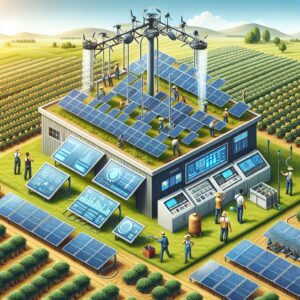
The modularity of solar systems also provides unique advantages for farms, allowing for strategic placement and scaling as operations grow. Installations can be placed on unused land, integrated with existing structures like barn roofs, or even designed to create dual-purpose spaces through innovative agrivoltaic approaches that combine crop production with energy generation.

“Best Solar Panels for Farm Power: Types …” from growingsolarmist.com and used with no modifications.
Types of Solar Panels Best Suited for Agricultural Use
Selecting the right solar panel technology for a farm requires consideration of available space, budget constraints, and specific energy needs. Different panel types offer varying benefits that may make them more suitable for particular agricultural applications. Understanding these differences helps farmers make informed decisions that maximize both energy production and return on investment.
Monocrystalline Panels: High Efficiency for Limited Farm Space
- Highest efficiency ratings (17-22%) allow for maximum power generation in limited space
- Superior performance in high temperatures makes them ideal for unshaded farm installations
- Longer lifespan (25-40 years) offers extended value despite higher initial investment
- Sleek black appearance may be preferred for installations visible to the public
- Better low-light performance extends daily production hours during crucial growing seasons
Monocrystalline panels represent the premium tier of solar technology, crafted from single-crystal silicon that allows electrons to flow more freely. This results in the highest efficiency ratings among commercially available panels, making them particularly valuable for farms with limited roof or ground space for installation. Their superior heat tolerance means they maintain better performance during hot summer months when farm energy demands often peak for irrigation and cooling systems. For more information on how solar technology can boost agribusiness, check out this article on boosting agribusiness and farming efficiency with solar energy.
While their upfront cost is typically 10-15% higher than alternatives, monocrystalline panels’ longer productive lifespan and higher energy production often result in better long-term economics. For dairy operations, vegetable processing facilities, or farms with high-value crops requiring reliable climate control, the dependable performance of monocrystalline panels frequently justifies the additional investment.
Polycrystalline Panels: Budget-Friendly Options for Larger Farms
Polycrystalline panels offer an excellent middle-ground solution for many agricultural operations, balancing reasonable efficiency (13-17%) with more affordable pricing. These panels, recognizable by their characteristic blue hue, are manufactured through a less intensive process where multiple silicon fragments are melted together. This manufacturing approach reduces production costs while still delivering solid performance for most farm applications. For operations with ample mounting space and modest budgets, polycrystalline panels often provide the best value proposition, allowing farmers to achieve energy independence without premium pricing.
The cost advantage of polycrystalline panels becomes particularly significant in large-scale installations where the 10-15% savings per panel translates to substantial overall project savings. Many row crop operations, livestock farms, and rural agricultural businesses find that polycrystalline systems hit the sweet spot between performance and affordability. Their slightly lower efficiency is easily overcome by simply adding a few additional panels when space permits—often still resulting in lower total system costs than monocrystalline alternatives.
Thin-Film Panels: Flexible Solutions for Specialized Agricultural Applications
Thin-film solar technology offers unique advantages for specific agricultural contexts where traditional rigid panels might not be suitable. These lightweight, flexible panels can be integrated into curved surfaces, temporary structures, or portable farm equipment. Their lower efficiency (10-13%) means they require approximately twice the installation area to produce the same energy as monocrystalline panels, but their adaptability opens up installation possibilities that conventional panels cannot address.
One notable advantage of thin-film technology is superior performance in partially shaded conditions and extreme high temperatures, making them valuable for areas with irregular shading patterns or exceptionally hot climates. Some innovative farms have successfully deployed thin-film panels on hoop houses, equipment sheds with lightweight roofing, or as part of mobile irrigation systems. Their lower profile and reduced weight also minimize wind resistance, potentially reducing structural requirements for mounting systems in exposed rural locations.
PERC Panels: Advanced Technology for Maximum Farm Production
Passivated Emitter and Rear Cell (PERC) technology represents the cutting edge in solar panel development, offering exceptional efficiency advantages for farm installations. These panels incorporate an additional reflective layer on the back surface that captures light which passes through the initial silicon layer, allowing it to be reflected back for a second chance at energy conversion. This innovation pushes efficiency ratings to 19-22% while using roughly the same production costs as standard polycrystalline panels, making them increasingly popular for agricultural applications.
PERC panels excel in the variable lighting conditions common on farms, maintaining better performance during early morning and late afternoon hours when traditional panels experience significant efficiency drops. This extended daily production window can be particularly valuable for irrigation systems that may need to operate throughout the day. Additionally, their improved performance in high-temperature environments makes them well-suited for installations in open farm fields where ambient temperatures frequently rise above optimal operating conditions for standard panels.
The primary limitation for PERC technology in farm settings relates to potential induced degradation (PID), which can occur in humid environments or when exposed to certain soil contaminants. Proper installation with quality components and appropriate system design can mitigate these concerns, making PERC panels an excellent option for farms looking to maximize energy production from limited installation space. For more insights on how solar power is transforming modern farming, explore our detailed guide.
Choosing the right type of solar panel for your farm is crucial. Consider the specific needs of your operations, the available space, and your budget. This below table will help you choose the right one:
|
Type of Solar Panel |
Advantages |
Disadvantages |
|---|---|---|
|
Monocrystalline Solar Panels | ||
|
– Performance drops slightly in extreme heat. 1 | ||
|
– Performs well in low-light conditions (cloudy days, mornings). 1, 2 | ||
|
Polycrystalline Solar Panels |
– Cost-effective option, suitable for large-scale installations. 1, 3 |
– Lower efficiency (13-17%) compared to monocrystalline panels. 1, 3 |
|
– Durable and handles heat well. 3 |
– Requires more space for the same energy output as monocrystalline panels. 3 | |
|
– Affordable initial investment, often offset by government incentives. 3 | ||
|
Thin-Film Solar Panels |
– Lightweight, flexible, and easy to install on unconventional surfaces (e.g., curved roofs)1, 5, 7 |
– Lowest efficiency (10-13%) among the options, requiring more space for equivalent output.5, 7 |
|
– Performs well in high temperatures and low-light conditions, ideal for diverse climates. 5, 7 |
– Shorter lifespan (10-20 years) compared to crystalline panels. 5, 7 | |
|
– Cost-effective with lower production and installation costs. 5, 7 |
– Bulkier installations needed for larger-scale energy production.5 | |
|
PERC Solar Panels |
– Enhanced efficiency (Up to 22% or higher) due to passivation layer, capturing more sunlight. 4 |
– Higher cost than traditional Monocrystalline panels, but prices are becoming comparable. 4 |
|
– Performs well in low-light and high-temperature conditions, ideal for varied climates. 2, 4 |
– Technology may be less familiar, requiring specialized installation expertise. 4 | |
|
– Maximizes energy output in limited space, suitable for farms with restricted installation areas. 4 |
This table provides a comparison of solar panel options for farmers, highlighting their suitability based on efficiency, cost, durability, and space requirements. Farmers should consider their specific energy needs, budget, and available installation area when making a decision.
Cost-Benefit Analysis of Solar Installations on Farms
The economics of solar power for agricultural operations has shifted dramatically in recent years, with installation costs dropping by more than 70% over the past decade while panel efficiency has steadily improved. Today’s farm solar installations typically deliver positive returns beginning in years 5-8, followed by decades of essentially free electricity. This fundamental shift in energy economics allows farmers to convert unpredictable, ever-increasing utility expenses into fixed, depreciable assets with predictable performance.
When evaluating the financial case for solar, farmers must consider both direct and indirect benefits. Beyond the obvious electricity savings, solar installations can increase property values, provide depreciation tax benefits, generate potential income through renewable energy credits, and create marketing advantages for sustainability-focused agricultural products. Comprehensive analysis should include potential production increases from more reliable power for critical systems and protection from grid outages that can devastate livestock operations or interrupt time-sensitive processing.
Initial Investment vs. Long-Term Energy Savings
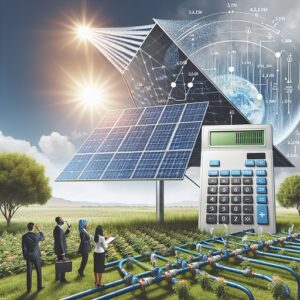
The upfront cost of agricultural solar installations typically ranges from $2.00-$3.50 per watt of capacity before incentives, with economies of scale favoring larger systems. A 25kW system—suitable for many small to medium farms—generally costs $50,000-$87,500 before applying tax credits, grants, and other incentives that can reduce this amount by 30-60%. This initial investment is offset by monthly energy savings that accumulate significantly over the system’s 25+ year lifespan, typically generating total returns 2-4 times the original investment.
Material selection significantly impacts both initial costs and long-term performance. Premium components with longer warranties may increase upfront expenses by 15-25% but can deliver superior reliability and efficiency that proves economical over decades of operation. For agricultural applications where harsh environmental conditions are common, investing in higher-quality panels, inverters, and mounting hardware often represents sound financial planning rather than unnecessary expense.
Sample ROI Calculation for 30kW Farm System
System Cost: $75,000
Federal Tax Credit (30%): -$22,500
USDA REAP Grant (25%): -$18,750
Net Investment: $33,750
Annual Electricity Savings: $5,400
Simple Payback Period: 6.25 years
25-Year Return: $135,000 (4x initial investment)
Additional Benefits: Depreciation tax advantages, increased property value
Payback Period Calculations for Different Farm Sizes
Farm size and operational focus dramatically impact solar payback periods, with dairy and poultry operations typically seeing the fastest returns due to their high, consistent energy demands. Small-scale specialty crop farms with significant cold storage or processing needs also achieve favorable payback periods, often 5-7 years. Row crop operations with seasonal irrigation requirements may experience longer payback periods of 7-10 years but still benefit substantially from the long-term fixed energy costs that solar provides.
Geographic location plays a crucial role in determining system performance and financial returns. Southern states with higher solar radiation offer roughly 25-30% more production than northern regions, shortening payback periods accordingly. However, northern farms often face higher utility rates that partially offset lower production, making solar viable across virtually all agricultural regions of the country. Local incentive programs, net metering policies, and agricultural-specific grants create additional regional variations that competent solar installers should incorporate into farm-specific financial projections.
Energy Independence: Protection Against Rising Utility Costs
Perhaps the most compelling economic argument for farm solar installations is protection against utility rate increases that have historically outpaced inflation. Over the past two decades, agricultural electricity rates have risen at an average of 2.5-3.5% annually, a trend expected to accelerate as utilities face infrastructure upgrades, climate regulations, and fuel cost volatility. Solar installations effectively lock in electricity costs at the equivalent of 8-12 cents per kilowatt-hour for 25+ years, creating predictable operating expenses that enhance long-term farm business planning.
This energy price stability represents a significant competitive advantage in agricultural sectors where margins are often tight and input cost management is critical to profitability. Farms with substantial electricity demands for irrigation, climate control, processing, or refrigeration can transform one of their largest variable expenses into a fixed cost. During periods of agricultural price volatility or market downturns, this energy cost certainty provides valuable financial stability that can make the difference between profitable operation and unsustainable losses.
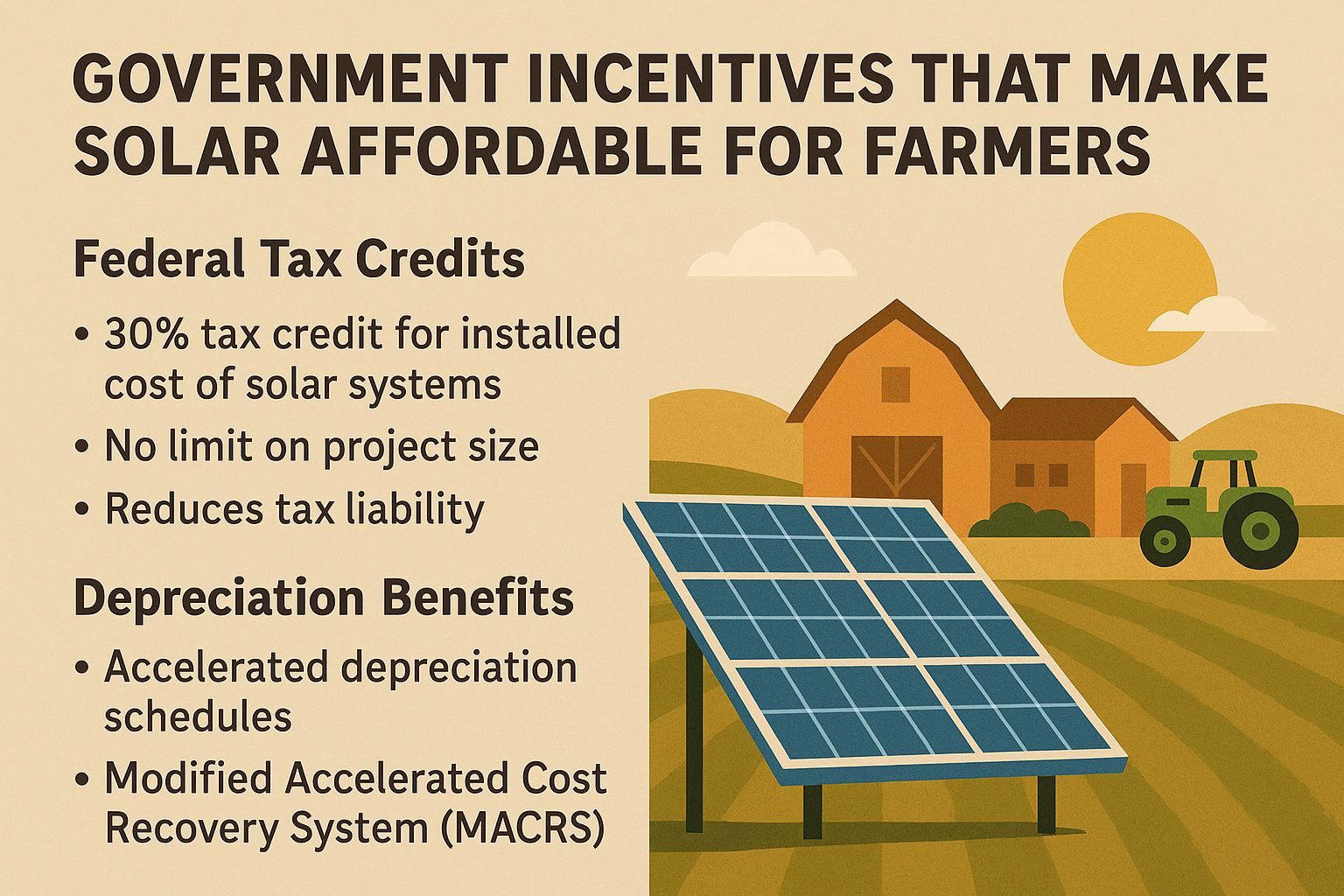
Government Incentives That Make Solar Affordable for Farmers
The financial case for agricultural solar installations is substantially strengthened by an array of government incentives specifically designed to accelerate renewable energy adoption in farming communities. These programs can reduce initial system costs by 50-75%, dramatically improving return on investment and shortening payback periods. Understanding and effectively leveraging these incentives is essential for maximizing the economic benefits of farm solar projects.
Federal Tax Credits and Depreciation Benefits
The federal Investment Tax Credit (ITC) currently provides a direct tax credit equal to 30% of the installed cost of qualifying solar energy systems with no upper limit on project size. This dollar-for-dollar reduction in tax liability significantly improves project economics and can be carried forward if the full credit cannot be used in the installation year. For farm businesses structured as pass-through entities like sole proprietorships, partnerships, or S-corporations, these credits flow directly to the owners’ personal tax returns, creating substantial tax savings.
Beyond the ITC, farms can utilize accelerated depreciation schedules including bonus depreciation or Modified Accelerated Cost Recovery System (MACRS) to deduct the remaining system value over just 5 years rather than the 25+ year actual lifespan. This accelerated depreciation creates significant additional tax benefits in the early years after installation, effectively reducing the net system cost by an additional 15-30% depending on the farm’s tax situation. When combined with the ITC, these tax benefits can reduce the effective cost of solar installations by nearly 60% for many agricultural operations.
State-Specific Agricultural Solar Programs
Many states have implemented additional incentives specifically targeting agricultural solar adoption, recognizing both the environmental benefits and the economic importance of strengthening farm businesses. These programs take various forms including production-based incentives, additional tax credits, property tax exemptions, sales tax exemptions, and specialized grant programs. California’s Net Energy Metering Aggregation (NEMA) program, for instance, allows farmers to offset electricity used across multiple meters with a single solar array, while Minnesota’s Rural Renewable Energy Alliance provides technical assistance and financing specifically for farm-based renewable energy.
The value of these state programs varies dramatically by location, creating significant regional differences in solar project economics. In states with strong agricultural solar incentives, payback periods under 4 years are increasingly common, while even in states with minimal additional support, the federal incentives typically enable payback periods under 10 years. Partnering with solar providers experienced in agricultural installations ensures these state-specific opportunities are fully leveraged to maximize financial returns.
USDA Rural Energy Grants and Financing Options
The U.S. Department of Agriculture’s Rural Energy for America Program (REAP) offers grants covering up to 25% of eligible project costs and loan guarantees up to 75% for agricultural producers implementing renewable energy systems. These grants, available for projects from $2,500 to $1 million, are specifically designed to help farmers adopt clean energy technologies. REAP applications are accepted year-round with competitive funding cycles that typically favor shovel-ready projects demonstrating significant energy savings and strong agricultural business cases.
Beyond REAP, the USDA also supports farm solar projects through the Environmental Quality Incentives Program (EQIP), Conservation Innovation Grants, and various rural development initiatives. Local USDA offices can provide guidance on navigating these programs, which often work in concert with state and federal tax incentives to make solar installations remarkably affordable for qualifying agricultural operations. Growing Solar Mist’s agricultural specialists can help farmers identify and apply for these agricultural-specific funding opportunities, substantially reducing out-of-pocket expenses.
Practical Applications of Solar Power in Agriculture
Solar energy systems have proven remarkably versatile across numerous agricultural applications, offering solutions that extend far beyond simple electricity generation. The adaptability of solar technology allows it to address specific farming challenges while creating new opportunities for operational efficiency. From powering essential equipment to enabling precision agriculture, solar installations can be tailored to support virtually every aspect of modern farming operations.
One particularly valuable aspect of solar power for farms is its modularity and scalability. Systems can start small, focusing on critical needs, and expand over time as budgets allow and benefits become evident. This phased approach minimizes initial financial risk while providing immediate relief for the most energy-intensive farm operations.
Irrigation Systems Powered by Solar Energy
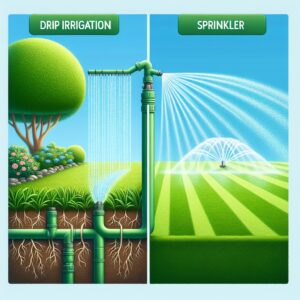
Irrigation represents one of the most promising applications for solar power in agriculture, with direct-coupled solar pumping systems eliminating fuel costs and extending water access to remote fields. These systems pair solar panels directly with DC water pumps, operating at maximum capacity during peak sunlight hours when evaporation concerns are highest. The natural alignment between solar energy production and irrigation needs creates perfect synergy, with systems producing most power precisely when watering is most beneficial.
Modern solar irrigation solutions incorporate smart controllers that adjust pumping rates based on available sunlight, soil moisture levels, and crop water requirements. This precision approach not only conserves water but also ensures optimal growing conditions that can increase yields by 20-30% compared to traditional fixed-schedule irrigation. For operations without reliable grid access, solar irrigation eliminates the expense and maintenance of diesel generators while providing completely autonomous operation.
Barn and Outbuilding Electricity Needs
Agricultural buildings typically have substantial energy requirements for lighting, ventilation, heating, cooling, and equipment operation. Solar installations can offset these demands through either grid-tied systems that reduce utility bills or off-grid solutions that provide power to remote structures. The large, unobstructed roof areas common on barns and equipment sheds make them ideal mounting locations, transforming these structures into power-generating assets rather than energy consumers.
Livestock operations particularly benefit from solar power, as animal welfare depends on consistent environmental control regardless of utility service reliability. Solar systems with battery backup can maintain critical ventilation and temperature control during grid outages that might otherwise result in catastrophic losses. This energy security represents significant risk mitigation for poultry, dairy, and swine operations where even brief power interruptions can have serious consequences.
Cold Storage and Product Processing Applications
Post-harvest handling represents a critical energy-intensive phase for many agricultural operations. Solar power can significantly reduce the operating costs of cooling, washing, sorting, and processing equipment that transforms raw harvests into marketable products. Cold storage facilities particularly benefit from solar installations, as their continuous refrigeration loads create substantial electricity demand that solar can offset during peak rate periods.
The timing advantage of solar production aligns perfectly with many processing needs, as maximum power generation occurs during daylight hours when most harvesting and processing takes place. For operations producing high-value perishable crops, solar-powered cold chains can extend market reach and product shelf life while reducing spoilage losses. These improvements in post-harvest handling directly impact the bottom line through both cost reduction and revenue enhancement from higher-quality marketed products.
Electric Farm Equipment Charging Stations
The rapidly evolving field of electric agricultural equipment offers exciting opportunities for solar integration. From small utility vehicles to emerging electric tractors, battery-powered farm equipment eliminates fuel costs and reduces maintenance requirements. Solar charging stations provide the perfect energy source for this equipment, creating truly sustainable operation free from fossil fuels. Early adopters have reported operational cost reductions of 70-85% compared to conventional equipment when pairing electric vehicles with solar charging infrastructure.
Forward-thinking farms are establishing solar-powered charging hubs strategically located to service daily equipment routes, ensuring vehicles can operate continuously through quick midday recharging. These distributed energy nodes also provide convenient power sources for portable tools, monitoring equipment, and worker needs throughout the property. As agricultural equipment manufacturers continue expanding electric options, solar charging infrastructure represents a future-proof investment that positions farms for the ongoing electrification of agricultural operations.
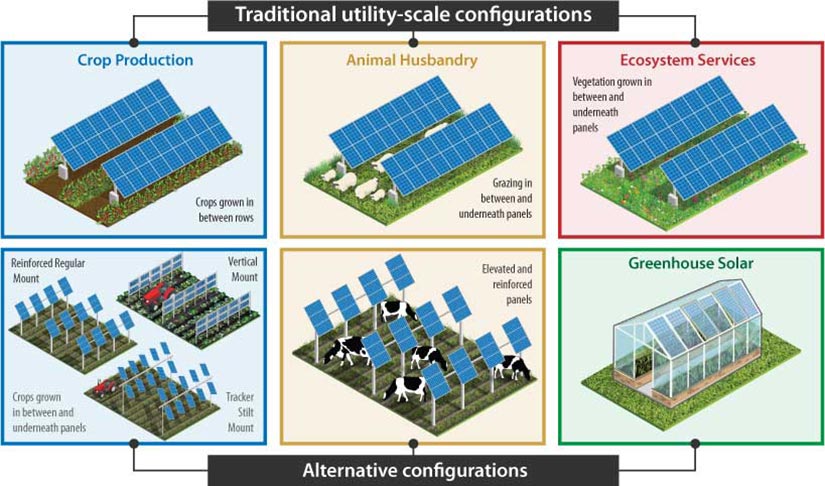
Agrivoltaics: Growing Crops and Generating Power Together
Agrivoltaics—the practice of co-locating solar panels and agricultural production on the same land—represents one of the most innovative approaches to farm solar integration. Rather than viewing solar installations as competing with crop production for land use, agrivoltaic systems create complementary relationships that can increase overall land productivity by 60-70%. This dual-use approach addresses one of the primary concerns farmers express about solar adoption: the potential loss of productive agricultural land.
Research from the University of Arizona and several agricultural extension services has demonstrated that certain crops actually perform better under the partial shade provided by elevated solar panels. The modified microclimate created beneath panel arrays reduces water stress, minimizes sun scalding, and can extend growing seasons for temperature-sensitive crops. This research has catalyzed rapid development of specialized mounting systems designed specifically for agricultural integration, with adjustable panel spacing and heights tailored to accommodate farming equipment and optimize both energy and crop production.
Shade-Tolerant Crops That Thrive Under Solar Panels
Certain crops demonstrate particularly strong performance in agrivoltaic systems, showing yield increases of 10-30% when grown beneath appropriately spaced solar arrays. Leafy greens including lettuce, spinach, and kale benefit from reduced heat stress and slower bolting, often allowing additional harvest cycles. Similarly, certain berries, herbs, and root vegetables that naturally prefer partial shade conditions show improved quality and extended production seasons when integrated with solar installations.
Beyond traditional crops, mushroom cultivation, certain nursery operations, and specialty crops like ginseng or wasabi that require shade cloth protection become natural fits for agrivoltaic approaches. The economic returns from these high-value specialty crops can sometimes exceed the value of the electricity generated, making the solar component almost a secondary benefit. Thoughtful crop selection based on local growing conditions and market opportunities allows farmers to maximize the synergistic potential of these integrated systems.
Water Conservation Benefits of Combined Systems
One of the most significant advantages of agrivoltaic systems is their impact on water efficiency, with studies showing 15-30% reductions in irrigation requirements for crops grown beneath solar arrays. This water conservation results from lower evaporation rates, reduced plant transpiration needs, and more efficient utilization of limited rainfall. In regions facing water scarcity or rising irrigation costs, this benefit alone can justify agrivoltaic approaches even before considering the value of energy production.
The shading pattern created by solar panels also modifies soil temperature profiles, reducing extreme temperature fluctuations that can stress plants and accelerate moisture loss. This more stable growing environment helps maintain optimal soil biology and nutrient cycling while reducing heat-related crop losses during extreme weather events. For operations in water-limited regions or those facing increasing climate variability, these resilience benefits provide valuable insurance against growing conditions that challenge conventional production systems.
Livestock Shelter Applications
Innovative farmers have discovered that raised solar arrays provide excellent shelter opportunities for certain livestock operations, particularly poultry, sheep, and some specialty livestock that benefit from protection against aerial predators and weather extremes. These animals naturally seek shade during peak daylight hours, making their behavior perfectly compatible with solar infrastructure. The animals benefit from the modified microclimate while providing vegetation management through grazing, reducing or eliminating mowing requirements around panels.
Rotational grazing systems using portable fencing allow livestock to maintain vegetation throughout solar installations without creating excessive wear patterns or damaging equipment. Sheep have proven particularly well-suited to solar grazing, with their height and grazing habits posing minimal risk to wiring while effectively managing vegetation. Several solar developers now specifically seek partnerships with sheep producers, creating additional revenue streams for livestock operators through vegetation management contracts.
Installation Considerations for Farm Solar Systems
Agricultural solar installations face unique considerations that differentiate them from residential or commercial projects. Farm operations typically have specific energy usage patterns, physical constraints, and business needs that must inform system design and implementation. Working with installers experienced in agricultural applications ensures these factors are properly addressed, maximizing both immediate benefits and long-term system performance.
Ground-Mounted vs. Roof-Mounted Systems
The decision between ground and roof mounting represents one of the most fundamental choices in agricultural solar design. Roof-mounted systems utilize existing structures, preserving land for production while potentially lowering installation costs. They work particularly well on newer buildings with appropriate structural capacity and favorable orientation. However, they can complicate future roof maintenance and limit system size based on available suitable roof area.
Ground-mounted systems offer greater design flexibility, optimal orientation regardless of existing structures, better airflow for cooling, and easier maintenance access. These advantages typically result in 10-15% higher energy production per installed watt compared to roof systems. The primary considerations for ground systems involve land use tradeoffs, potential for equipment interference, and slightly higher installation costs due to additional mounting infrastructure. Innovative approaches like elevated systems allowing continued land use underneath, pollinator-friendly ground cover, or integration with livestock grazing can mitigate land use concerns while creating additional environmental and operational benefits. Learn more about how solar power is transforming modern farming.
Solar Tracking Technology to Maximize Farm Energy Production
Tracking systems that allow panels to follow the sun’s path throughout the day can increase energy production by 25-45% compared to fixed installations. This significant output advantage makes tracking systems particularly valuable for farms with limited installation space or high energy demands. Single-axis trackers, which rotate panels east to west on a fixed north-south axis, offer the best balance of increased production, mechanical reliability, and cost-effectiveness for most agricultural applications. For more insights on how solar power is transforming modern farming, explore our detailed guide.
The economic case for tracking technology strengthens in locations with high electricity rates, valuable net metering programs, or significant morning and evening energy demands. However, tracking systems involve more moving parts, higher maintenance requirements, and 15-25% higher initial costs that must be justified through additional energy production. For many farm operations, the simplified reliability and lower maintenance of fixed-tilt ground mounts ultimately proves more suitable despite somewhat lower energy output.
Grid Connection vs. Off-Grid Solutions for Remote Farms
Farms with reliable grid access typically benefit most from grid-connected solar systems that use net metering to balance production variations against consumption needs. These systems avoid battery costs and complexity while still providing substantial utility savings. For remote agricultural operations or those with unreliable utility service, off-grid or hybrid systems incorporating battery storage can provide energy independence and operational reliability that may justify their additional cost.
Battery storage adds 30-100% to system costs depending on capacity but creates unique capabilities including backup power for critical systems, peak load management to reduce demand charges, and time-shifting energy use to maximize self-consumption. Emerging battery technologies and declining costs are rapidly improving the economics of storage, making it increasingly viable for more farm applications. Strategic battery sizing focused on supporting only essential functions during outages (rather than full property backup) can optimize the cost-benefit equation while still providing critical operational resilience. For more insights on how solar technology is transforming agriculture, check out how solar power is transforming modern farming.
“Farm Solar Panel Uses: Power Equipment …” from growingsolarmist.com and used with no modifications.
Maintenance Requirements and Best Practices
Solar installations for farms generally require minimal maintenance compared to other farm equipment, with no moving parts in the panels themselves and very limited routine service needs. However, the agricultural environment does present unique challenges including dust accumulation, potential wildlife interactions, and vegetation management requirements. Establishing appropriate maintenance protocols ensures maximum system performance and longevity in these demanding settings.
Seasonal Cleaning Protocol for Agricultural Environments
Farm environments typically expose solar panels to higher levels of dust, pollen, and organic material than residential settings, potentially reducing energy production by 5-15% if left unaddressed. Most agricultural solar installations benefit from quarterly cleaning, with additional attention during peak pollen seasons or following nearby field operations that generate significant dust. Simple cleaning using water, mild detergent, and soft brushes is typically sufficient, with pressure washing generally discouraged due to potential damage to panel seals and coatings.
Scheduling cleaning operations during early morning or evening hours not only avoids production losses during peak solar hours but also prevents thermal shock to hot panels from cold water application. For larger installations, specialized cleaning equipment including rotating brushes, purified water systems, or robotic cleaners can improve efficiency and reduce labor requirements. The investment in regular cleaning typically delivers returns of 4-8 times the maintenance cost through improved energy production, particularly in dusty agricultural environments.
Monitoring System Performance in Farming Applications
Modern solar installations incorporate sophisticated monitoring systems that track production metrics, identify potential problems, and quantify financial benefits. These monitoring platforms allow farmers to verify system performance without specialized knowledge, receiving alerts when production falls below expected levels. The most effective monitoring approaches integrate solar production data with farm energy consumption metrics, providing comprehensive visibility into overall energy dynamics and highlighting opportunities for operational adjustments that maximize solar utilization.
Protecting Solar Equipment from Farm Hazards
Agricultural environments present unique challenges for solar equipment including machinery traffic, livestock interaction, and accelerated wear from environmental factors. Thoughtful system design incorporating appropriate setbacks, protective barriers, and elevated mounting can mitigate these risks without compromising farm operations. Ground-mounted systems particularly benefit from clearly marked equipment zones, dedicated access paths, and strategic placement that minimizes conflict with regular farm activities.
Wildlife interactions represent another consideration for farm solar installations, with birds, rodents, and insects occasionally attempting to nest in or around equipment. Protective screens for inverter ventilation openings, appropriate wire management, and periodic inspection of junction boxes and conduit entry points prevent most wildlife-related issues. When properly addressed during system design, these preventive measures minimize maintenance requirements while ensuring reliable long-term operation.
Lightning protection deserves special attention for farm installations, particularly those in open rural environments where strikes are more common. Proper grounding systems, surge protection devices at multiple system points, and thoughtful routing of DC circuits minimize vulnerability to weather-related damage. These protective measures represent a small fraction of total system cost while providing essential protection for the substantial investment that solar installations represent.
Real Success Stories: Farms Transformed by Solar Power
The theoretical benefits of agricultural solar become tangible through the experiences of farmers who have successfully integrated this technology into their operations. These real-world implementations demonstrate both the immediate financial impacts and the strategic advantages that solar power brings to diverse farming operations. From small specialty crop producers to large commodity operations, solar adoption is delivering measurable results across the agricultural spectrum.
While each farm’s experience reflects its unique circumstances, certain patterns emerge consistently across successful solar implementations. These include significant reductions in operating costs, enhanced market resilience through fixed energy expenses, and new marketing opportunities built around sustainable production practices. Many farmers also report unexpected benefits including improved community relations, valuable learning experiences for the next generation, and personal satisfaction from environmental stewardship.
Small Family Farms Cutting Operational Costs
For small-scale farms operating on tight margins, energy costs often represent a disproportionate expense that directly impacts profitability. Solar installations have proven particularly transformative for these operations, converting unpredictable monthly expenses into fixed investments with predictable returns. Case studies consistently show small farms reducing operational electricity costs by 70-100% through appropriately sized solar systems, with payback periods of 4-7 years after incentives. These energy savings frequently make the difference between marginal profitability and sustainable business success, particularly for operations with significant refrigeration, processing, or climate control requirements.
Large Agricultural Operations Achieving Energy Independence
- A 1,200-acre California almond operation installed a 650kW system that eliminated $175,000 in annual irrigation pumping costs while qualifying for $450,000 in tax benefits
- A Midwest dairy with 800 cows reduced electricity expenses by 85% through a combination of solar production and energy efficiency upgrades prompted by their solar feasibility study
- A poultry operation spanning 12 houses installed a phased solar approach that maintained cash flow while eventually offsetting 95% of their substantial ventilation and climate control loads
- A diversified vegetable farm with significant processing facilities leveraged solar to qualify for premium-priced sustainability certification programs, increasing revenue while decreasing costs
- A wine producer integrated solar canopies over customer areas, creating marketing advantages while powering critical refrigeration equipment for temperature-sensitive production
Large-scale agricultural operations have demonstrated remarkable creativity in solar integration, often finding synergies between energy production and core business activities. Many have successfully negotiated power purchase agreements (PPAs) or lease arrangements that eliminate upfront capital requirements while still delivering immediate positive cash flow. These innovative financing approaches allow operations to focus investment capital on core agricultural activities while still capturing the benefits of solar energy.
The marketing advantages of solar adoption have proven particularly valuable for consumer-facing agricultural businesses. Farms selling directly to consumers through CSAs, farm stands, or agritourism activities report that visible solar installations create positive customer impressions and support premium pricing for sustainably-produced products. Similarly, wholesale producers increasingly find that documented sustainable practices including renewable energy create preferred supplier status with environmentally-conscious retail and distribution partners.
Perhaps most significantly, farm solar adopters consistently report that their installations have exceeded financial projections and performance expectations. The rapidly improving economics of solar technology, combined with the natural synergies between solar production and agricultural energy needs, creates a particularly favorable application that continues to strengthen with ongoing technological advancements and declining equipment costs.
“Solar Power Agriculture Benefits …” from growingsolarmist.com and used with no modifications.
Conclusion
The integration of solar energy into agricultural operations represents one of the most promising developments in modern farming, offering both immediate financial benefits and long-term strategic advantages. As energy costs continue rising and climate considerations become increasingly important, solar power provides farmers with a proven solution that enhances both economic and environmental sustainability. The technology has matured to the point where installations reliably deliver decades of low-maintenance, high-value operation across diverse agricultural settings.
The most successful farm solar implementations begin with thorough assessment of current energy usage patterns, future needs, and specific operational constraints. This foundation enables system designs that maximize relevant benefits while integrating seamlessly with existing farm activities. Whether through roof-mounted systems on existing structures, ground installations on marginal land, or innovative agrivoltaic approaches that combine energy and crop production, thoughtful solar integration creates lasting value for agricultural operations of all types and sizes.
Is Using Solar Panels in Agriculture a Great Idea for the Farmer
The evidence overwhelmingly supports solar adoption as a financially sound and operationally beneficial strategy for modern agricultural operations. Beyond the compelling economic returns that typically deliver 15-25% ROI over system lifespans, solar installations provide farms with energy security, environmental benefits, and positioning advantages in increasingly sustainability-focused markets. The technology has proven its reliability and value across diverse agricultural applications, with continuing improvements further enhancing already strong performance.
For today’s forward-thinking farmer, solar energy represents not merely an alternative power source but a strategic asset that transforms energy from an unpredictable expense into a controlled investment with predictable returns. The question has shifted from whether solar makes sense for agriculture to how best to implement systems that maximize the specific benefits for each unique farming operation. With proper planning, appropriate technology selection, and strategic implementation, solar power delivers substantial and lasting advantages that strengthen both immediate farm profitability and long-term operational resilience.
Frequently Asked Questions
- What size solar system do I need for my farm operations?
- How do agricultural solar incentives differ from residential programs?
- Can solar panels power irrigation systems effectively?
- What maintenance requirements should farmers expect for solar installations?
- How does weather affect farm solar production?
The growing adoption of solar technology across agricultural sectors has generated numerous questions from farmers considering their own installations. These frequently asked questions address the most common concerns and considerations that arise during the exploration and implementation process. Understanding these foundational issues helps farmers approach solar opportunities with realistic expectations and appropriate planning.
While general principles apply broadly, the most effective solar implementations always reflect the specific circumstances, needs, and goals of individual farm operations. Consulting with agricultural solar specialists who understand both energy systems and farming realities ensures solutions that deliver maximum value for your unique situation. Growing Solar Mist specializes in helping farmers navigate these decisions with farm-specific expertise rather than generic solar knowledge.
Additional questions beyond those addressed here can be directed to agricultural energy specialists who understand the unique considerations that differentiate farm installations from other solar applications. The best consultations begin with thorough understanding of your operation’s energy profile, production patterns, and long-term goals rather than focusing immediately on equipment specifications or system sizing.
How many solar panels do I need to power my farm operations?
System sizing for agricultural operations should begin with comprehensive energy analysis rather than arbitrary coverage targets. Review 12-24 months of utility bills to establish baseline consumption patterns, paying particular attention to seasonal variations that might affect optimal system design. Most grid-connected farm installations aim to offset 70-100% of annual electricity usage, typically requiring 25-35 square feet of panel area per 1,000 kWh of annual consumption. A medium-sized farm consuming 50,000 kWh annually would generally need a 30-40kW system occupying approximately 1,500-2,000 square feet of mounting area.
Beyond simple consumption matching, effective agricultural solar design considers load timing, peak demand patterns, and potential future expansion. Operations with primarily daytime power requirements (such as packing facilities or irrigation) can often utilize smaller systems than those with significant evening usage, as the direct production-to-consumption alignment improves financial performance. Similarly, farms with substantial summer energy demands generally benefit more from solar than those with primarily winter consumption, as production naturally aligns with seasonal patterns. Growing Solar Mist can provide farm-specific analysis that accounts for these operational nuances rather than one-size-fits-all recommendations.
Can solar panels withstand extreme weather conditions common on farms?
Modern solar equipment is engineered for exceptional durability, with quality panels rated to withstand one-inch hailstones, 120+ mph wind loads, and temperature extremes from -40°F to 185°F. This robust construction has been demonstrated through real-world performance during hurricanes, tornados, and severe weather events where properly installed solar arrays frequently remain intact even when surrounding structures sustain damage. The most critical factor in weather resilience is proper installation using engineered mounting systems appropriate for local conditions and adherence to building codes that incorporate regional weather considerations. For more insights, explore the benefits of solar power in agriculture.
Agricultural environments can present additional weather-related challenges including dust storms, heavy snow accumulation, and exposure to corrosive agricultural chemicals. These considerations should inform equipment selection, with higher-quality panels featuring stronger glass, reinforced frames, and superior sealing typically delivering better long-term performance in demanding farm settings. Similarly, inverter placement in protected locations and appropriate equipment enclosures significantly enhance system durability and reliability during extreme weather events.
While no outdoor equipment is completely impervious to severe weather, properly designed agricultural solar installations typically require minimal weather-related maintenance and demonstrate exceptional longevity. Most systems include monitoring that alerts owners to any performance issues resulting from weather impacts, allowing prompt attention to any damage that might occur during truly extreme events. Standard insurance policies generally cover solar equipment against weather damage, providing additional protection for this long-term investment.
Will installing solar panels affect my crop production or land use?
Traditional ground-mounted solar installations do require dedicated land that becomes unavailable for conventional crop production, typically using 5-10 acres per megawatt of capacity. However, innovative approaches including elevated mounting systems, agrivoltaic designs, and strategic placement on marginal lands minimize or eliminate production impacts. Many farms successfully locate solar arrays on less productive areas, along field borders, or integrated with existing infrastructure to avoid displacing valuable cropland. The emerging field of agrivoltaics specifically addresses land use concerns by designing systems that maintain agricultural production beneath and between panel installations.
What’s the typical return on investment for a farm solar system?
Agricultural solar installations typically deliver internal rates of return ranging from 10-25% depending on local utility rates, available incentives, and system design. After applying current federal tax credits, USDA grants, and accelerated depreciation benefits, many farm systems achieve simple payback periods of 4-8 years while providing 25+ years of productive operation. This represents significantly stronger financial performance than many traditional farm investments, with the added advantage of very low maintenance requirements and minimal operational attention once installed.
Beyond direct electricity savings, comprehensive ROI calculations should consider demand charge reductions, protection against future utility rate increases, potential revenue from renewable energy credits, and depreciation tax benefits. Many agricultural operations also find that solar investments support premium pricing or preferred market access for sustainably-produced products, creating additional revenue enhancements that further improve overall returns. Growing Solar Mist provides detailed financial analysis that incorporates these various value streams to present complete ROI projections rather than simplified payback calculations.
Can I sell excess solar energy back to the grid from my farm?
Net metering policies in most states allow farms to receive credits for excess solar production fed back to the grid, effectively using the utility system as free energy storage. These programs typically credit excess production at retail or near-retail rates, substantially improving project economics compared to systems that can only offset immediate consumption. However, specific net metering provisions vary significantly by state and utility, with important differences in credit rates, monthly versus annual settlement, capacity limitations, and treatment of persistent oversupply. Understanding these local regulations is essential for optimal system sizing and financial projections.
Some larger agricultural operations may qualify for more sophisticated arrangements including feed-in tariffs, virtual net metering across multiple properties, or direct power purchase agreements with specific consumers. These advanced structures sometimes enable farms to install larger systems than their own consumption would justify, creating additional revenue streams from otherwise underutilized land. However, such arrangements typically require more complex interconnection processes, specialized legal agreements, and sometimes additional equipment for production metering and grid interaction.
For most farm operations, systems sized to produce 90-110% of annual consumption provide optimal economic performance while remaining within standard net metering provisions. This approach maximizes the value of solar production while minimizing regulatory complexity and avoiding potential issues with utilities regarding oversized systems. Growing Solar Mist specializes in helping farmers navigate these regulatory considerations to design systems that capture maximum value within local utility frameworks.
Solar power has emerged as a transformative technology for modern agriculture, offering financial, operational, and sustainability benefits that strengthen farm businesses while supporting environmental stewardship. By harnessing free, abundant solar energy, farmers can convert unpredictable energy expenses into controlled investments that deliver decades of returns. Growing Solar Mist remains committed to helping agricultural operations of all types and sizes implement solar solutions optimized for their specific needs and circumstances.
Implementing solar panels in agriculture can significantly enhance energy efficiency and sustainability. By utilizing solar energy, farmers can reduce their reliance on traditional power sources and decrease operational costs. For more information on how solar energy can boost agribusiness, check out this article on boosting agribusiness and farming efficiency with solar energy.

Leave a Reply