
Key Takeaways
- Off-grid farm solar systems require batteries for energy storage, allowing for electricity use during nighttime and low-sunlight periods.
- The type of battery you choose significantly impacts system performance, with options ranging from affordable lead-acid to premium lithium-ion batteries.
- Proper sizing of your battery bank is crucial and depends on your farm’s specific energy needs, desired days of autonomy, and local climate conditions.
- While the initial investment in batteries can be substantial, they’re essential for energy independence and typically pay for themselves through reduced utility costs.
- Regular maintenance and understanding the complete system components will extend the life of your off-grid solar setup and maximize your return on investment.
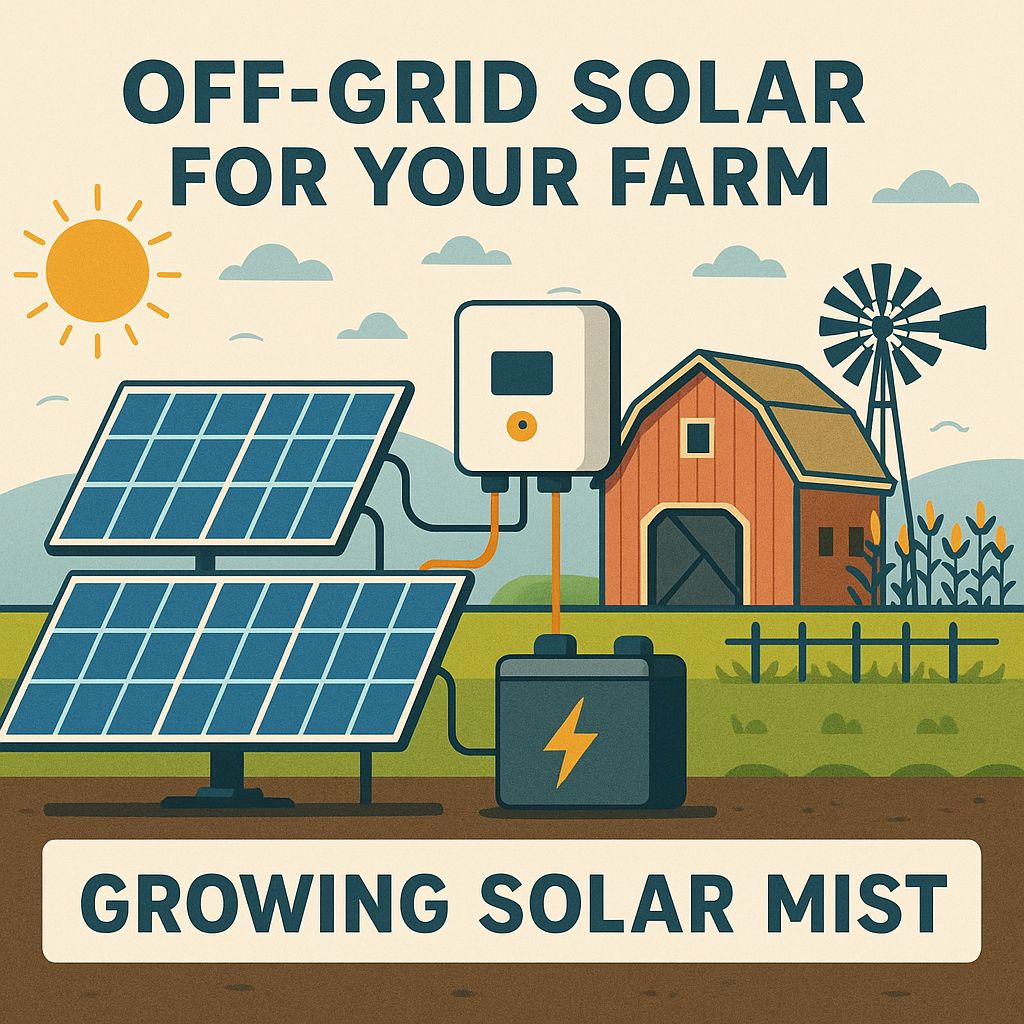
Going off-grid with solar power isn’t just about placing panels on your roof—it’s about creating a self-sustaining energy ecosystem for your farm. When the sun sets or clouds roll in, your solar panels stop generating electricity, but your farm’s operations don’t stop. This reality makes batteries not just useful but absolutely essential for any off-grid farm solar system. Growing Solar Mist has been helping farmers transition to sustainable energy solutions, providing both the equipment and knowledge needed for successful off-grid systems.
Unlike urban solar installations that can easily connect to the grid for backup power, remote farms often don’t have this luxury. Without batteries to store excess energy produced during sunny days, you’d be left in the dark when your panels aren’t actively generating power. This makes a properly sized battery bank the foundation of energy independence for your agricultural operation.

Why Your Off-Grid Farm Needs Solar Batteries
Imagine starting your day before sunrise, needing to milk cows or power irrigation systems. Without batteries, your solar-powered farm would be helpless until the sun climbs high enough to generate sufficient electricity. Batteries bridge this fundamental gap between energy production and consumption times, storing power when it’s abundant and releasing it when it’s needed.
Weather inconsistencies pose another challenge that only batteries can solve. During cloudy periods or winter months when solar production drops significantly, a robust battery bank ensures your critical farm operations continue uninterrupted. In many agricultural regions, these seasonal variations can last days or even weeks, making adequate storage capacity non-negotiable.
Beyond necessity, batteries provide valuable stability to your electrical system. They help manage voltage fluctuations that could damage sensitive farm equipment and offer surge capacity for starting motors with high inrush current requirements. This protection extends the life of expensive agricultural machinery while maintaining consistent power quality across your operation. For more information, check out batteries for off-grid solar.
Farm Energy Reality Check: A typical 100-acre farm may require 25-50 kWh of daily electricity for basic operations. Solar panels only produce power for approximately 5-6 hours at peak efficiency each day. Without batteries, you’d have no power for the remaining 18-19 hours.
Different Types of Solar Systems for Farms
Before diving deeper into battery requirements, it’s important to understand the three main types of solar power systems available for farms. Each configuration offers different benefits and requires different approaches to energy storage. Your specific location, budget, and energy needs will determine which system makes the most sense for your agricultural operation.
Grid-Tied Systems: When Batteries Aren’t Necessary
Grid-tied solar systems connect directly to the utility grid, allowing your farm to draw power when needed and send excess solar energy back when you’re producing more than you consume. These systems typically don’t require batteries because the grid acts as your backup power source. When your panels aren’t producing enough electricity, you simply pull from the grid. When you generate excess, you push it back, often receiving credits through net metering programs.
Hybrid Systems: Getting the Best of Both Worlds
Hybrid solar systems combine elements of both grid-tied and off-grid setups. They maintain a connection to the utility grid but also incorporate battery storage. This configuration offers significant advantages for farms in areas with unreliable grid service or frequent power outages. During normal operation, you can use the grid as backup or to supplement your solar production, while your batteries provide emergency power during outages.
The flexibility of hybrid systems makes them increasingly popular for farms that want energy independence without completely cutting ties to conventional power sources. They can be programmed to prioritize solar consumption, battery charging, or grid power based on electricity rates and production patterns, maximizing your financial benefits while maintaining reliable power.
Off-Grid Systems: Complete Energy Independence
- No connection to utility infrastructure
- Require comprehensive battery storage
- Often include backup generators for extended low-sun periods
- Provide complete energy autonomy for remote locations
- Require careful sizing and planning to ensure reliability
True off-grid systems operate entirely independently from utility power. These setups are essential for farms in remote locations where grid connections are unavailable or prohibitively expensive to install. Without access to grid power as a backup, properly sized battery banks become the foundation of reliable operation. Your batteries must be substantial enough to carry your farm through multiple days of minimal solar production.
While offering complete energy independence, off-grid systems demand more careful planning and typically represent a larger initial investment. You’ll need to precisely calculate your energy requirements and implement conservative usage practices to ensure your system remains reliable year-round, especially during seasonal periods of reduced solar production.

Essential Components of an Off-Grid Farm Solar System
Creating a functional off-grid solar system for your farm requires more than just batteries and panels. Each component plays a vital role in harvesting, storing, and delivering usable power to your agricultural operation. Understanding these elements helps you make informed decisions when designing or upgrading your system.
Solar Panels: Your Energy Generators
Solar panels serve as the primary energy collectors in your system, converting sunlight into direct current (DC) electricity. For farm applications, monocrystalline panels typically offer the best efficiency-to-space ratio, generating more power per square foot than polycrystalline alternatives. Most agricultural installations require between 25-100 panels depending on your energy demands, available space, and local solar conditions.
When selecting panels for farm use, durability becomes particularly important due to exposure to dust, debris, and potentially ammonia in livestock environments. Look for panels with robust framing, high impact resistance, and warranty coverage specifically including agricultural applications. Positioning is equally crucial – mounting structures should elevate panels above potential shading from buildings, equipment, or growing crops.
Choosing the right type of solar panel for your off-grid system is crucial. Consider the specific needs of your operations, the available space, and your budget. This below table will help you choose the right one:
|
Type of Solar Panel |
Advantages |
Disadvantages |
|---|---|---|
|
Monocrystalline Solar Panels | ||
|
– Performance drops slightly in extreme heat. 1 | ||
|
– Performs well in low-light conditions (cloudy days, mornings). 1, 2 | ||
|
Polycrystalline Solar Panels |
– Cost-effective option, suitable for large-scale installations. 1, 3 |
– Lower efficiency (13-17%) compared to monocrystalline panels. 1, 3 |
|
– Durable and handles heat well. 3 |
– Requires more space for the same energy output as monocrystalline panels. 3 | |
|
– Affordable initial investment, often offset by government incentives. 3 | ||
|
Thin-Film Solar Panels |
– Lightweight, flexible, and easy to install on unconventional surfaces (e.g., curved roofs)1, 5, 7 |
– Lowest efficiency (10-13%) among the options, requiring more space for equivalent output. 5, 7 |
|
– Performs well in high temperatures and low-light conditions, ideal for diverse climates. 5, 7 |
– Shorter lifespan (10-20 years) compared to crystalline panels. 5, 7 | |
|
– Cost-effective with lower production and installation costs. 5, 7 |
– Bulkier installations needed for larger-scale energy production. 5 | |
|
PERC Solar Panels |
– Enhanced efficiency (Up to 22% or higher) due to passivation layer, capturing more sunlight. 4 |
– Higher cost than traditional Monocrystalline panels, but prices are becoming comparable. 4 |
|
– Performs well in low-light and high-temperature conditions, ideal for varied climates. 2, 4 |
– Technology may be less familiar, requiring specialized installation expertise. 4 | |
|
– Maximizes energy output in limited space, suitable for farms with restricted installation areas. 4 |
Charge Controllers: Protecting Your Battery Investment
Charge controllers act as gatekeepers between your solar panels and battery bank, regulating the voltage and current flowing into your batteries. This protection prevents overcharging, which can significantly reduce battery lifespan or even cause dangerous conditions. Modern MPPT (Maximum Power Point Tracking) controllers offer 20-30% more charging efficiency than older PWM (Pulse Width Modulation) models, making them worth the additional investment for farm systems.
Properly sized charge controllers must handle the maximum current your array produces while incorporating safety margins for optimal performance. For large farm systems, multiple controllers may be configured in parallel to manage sections of your array independently, improving redundancy and system reliability.
Inverters: Converting DC to AC Power
Inverters transform the DC power stored in your batteries into the AC power required by most farm equipment. Pure sine wave inverters deliver clean, utility-grade electricity that won’t damage sensitive electronics or motors, making them essential for agricultural applications. Your inverter system must be robust enough to handle both continuous loads and the startup surge requirements of equipment like water pumps, refrigeration units, and machinery. For more on inverter efficiency, explore the benefits of solar pump inverters for farmers.
For larger farms, modular inverter systems allow for expandability and redundancy. If one unit fails, others continue operating while repairs are made. Some advanced systems incorporate synchronous operation, enabling multiple inverters to work together, sharing loads and improving overall system efficiency. When selecting inverters, always size for your peak loads plus a 20% safety margin to ensure reliable operation.
Battery Banks: The Heart of Your Off-Grid System
Your battery bank serves as the central energy reservoir, storing excess production for use when needed. This component represents both the most critical and typically most expensive part of your off-grid system. Farm applications generally require larger capacity than residential systems due to higher energy demands and the critical nature of agricultural operations.
Battery banks should be housed in temperature-controlled environments whenever possible, as extreme temperatures significantly impact performance and lifespan. Proper ventilation is essential, particularly for lead-acid batteries which release hydrogen gas during charging. Include monitoring systems that track battery state, providing alerts when maintenance is needed or when capacity drops below critical thresholds.
Backup Generators: When to Include Them
Even well-designed off-grid solar systems benefit from backup generation capability. Propane, diesel, or biofuel generators provide essential redundancy during extended periods of low solar production or unexpected system failures. Modern hybrid controllers can automatically start your generator when battery levels fall below predetermined thresholds, ensuring continuous power for critical farm operations.
When selecting a generator, consider fuel availability, maintenance requirements, and noise levels if located near livestock. Proper sizing should account for both powering essential equipment and simultaneously recharging your battery bank. This dual-purpose operation typically requires 25-50% more capacity than what’s needed for running equipment alone.
Best Battery Types for Off-Grid Farm Systems
Selecting the right battery technology for your farm involves balancing initial cost against longevity, maintenance requirements, and performance characteristics. Each battery type offers distinct advantages and limitations that should be evaluated against your specific agricultural needs and budget constraints.
1. Lead-Acid Batteries: Affordable but High Maintenance
Lead-acid batteries represent the most economical entry point for off-grid storage, with initial costs 50-70% lower than advanced alternatives. Traditional flooded lead-acid batteries require regular maintenance, including checking electrolyte levels, cleaning terminals, and performing equalization charges. This maintenance schedule typically demands attention every 1-3 months, making them best suited for farms with dedicated system operators.
While affordable upfront, these batteries generally offer shorter lifespans of 5-7 years when properly maintained. They also require careful installation in well-ventilated spaces due to hydrogen gas emissions during charging. Their depth of discharge is typically limited to 50% to prevent premature aging, effectively doubling the capacity needed compared to technologies that allow deeper cycling.
2. Lithium-Ion Batteries: Expensive but Long-Lasting
Lithium-ion batteries have revolutionized off-grid storage with their superior performance characteristics, though at premium prices typically 2-3 times higher than lead-acid alternatives. These batteries offer exceptional depth of discharge capabilities, allowing you to utilize 80-90% of their rated capacity without damage. With minimal voltage drop until nearly depleted, they maintain consistent power delivery to sensitive farm equipment throughout their discharge cycle.
The virtually maintenance-free operation makes lithium-ion ideal for busy farm environments where regular battery attention isn’t practical. Their expected lifespan of 10-15 years often justifies the higher initial investment through reduced replacement frequency and superior performance. Additionally, their compact footprint requires approximately half the space of lead-acid banks with equivalent usable capacity, an important consideration for farms with limited installation space.
3. Saltwater Batteries: Eco-Friendly Alternative
Saltwater (sodium-ion) batteries represent an emerging technology that uses non-toxic materials and offers impressive safety profiles for agricultural applications. These batteries eliminate fire risks associated with lithium-ion chemistry and avoid the toxic materials present in lead-acid options. Their environmentally friendly composition makes them particularly appealing for organic operations or farms with strong sustainability commitments.
While currently less energy-dense than competing technologies, requiring more space per kilowatt-hour of storage, saltwater batteries offer moderate cycle life (approximately 3,000 cycles) and moderate depth of discharge capabilities. Their performance sweet spot lies in applications with daily cycling needs and moderate power demands. For farms transitioning toward fully sustainable operations, these batteries align perfectly with ecological values despite their higher cost compared to traditional lead-acid options.
4. Flow Batteries: Ideal for Large-Scale Operations
Flow batteries store energy in liquid electrolyte solutions contained in separate tanks, offering unique advantages for large farm operations with substantial storage requirements. Unlike conventional batteries that degrade with each charge cycle, flow batteries can be cycled repeatedly with minimal capacity loss, potentially lasting 20+ years with proper maintenance. Their ability to completely separate power (kW) from energy (kWh) allows for independent scaling of each aspect, creating highly customizable systems.
These systems excel in applications requiring many hours or days of storage capacity, such as farms in regions with extended cloudy periods. While demanding significant initial investment and installation space, their extremely long lifecycle and minimal capacity degradation create compelling economics for large-scale, long-term agricultural installations. The ability to deeply discharge without damage further enhances their effective capacity compared to technologies with more limited cycling parameters.
Sizing Your Battery Bank Correctly for an Off-Grid Farm
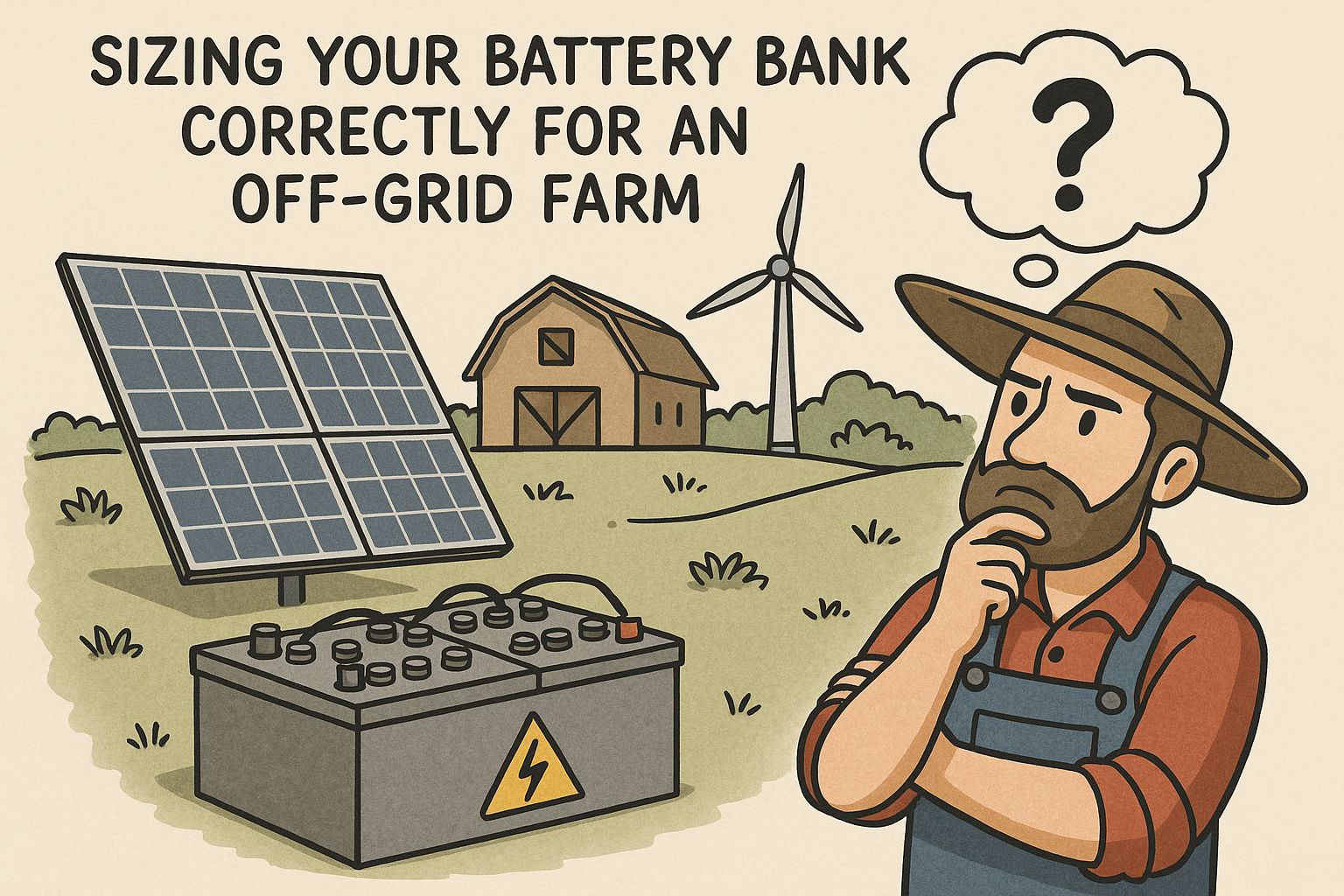
Properly sizing your battery bank is perhaps the most critical decision you’ll make when designing an off-grid solar system for your farm. Under sizing leads to power shortages during crucial operations, while oversizing unnecessarily increases your investment costs. The right balance requires careful analysis of your specific farm’s energy needs and operational patterns.
Start by conducting a comprehensive energy audit of your farm operations. Track electricity usage throughout different seasons to capture the full range of your power requirements. Remember that many agricultural activities follow seasonal patterns, with irrigation, heating, cooling, and harvest equipment creating variable demands throughout the year.
Listing Essential Equipment and Their Power Requirements
Create a detailed inventory of all electrical equipment used on your farm, noting both the wattage rating and typical hours of daily operation. Pay special attention to equipment with high starting surges, such as water pumps, compressors, and motors, which may require 3-5 times their running wattage during startup. Include everything from lighting and refrigeration to specialized equipment like milking machines or grain processing systems.
Sort your equipment into critical and non-critical categories. Critical systems like livestock water pumps, refrigeration for perishable products, or climate control for sensitive crops must run without interruption. Non-critical loads can be managed through energy-efficient scheduling or even automated load-shedding during low battery conditions.
|
Farm Equipment |
Typical Wattage |
Daily Run Time |
Daily Energy (Wh) |
Criticality |
|---|---|---|---|---|
|
Water Pump (1HP) |
750W (1500W surge) |
3 hours |
2,250 Wh |
Critical |
|
Refrigeration |
500W |
10 hours (cycling) |
5,000 Wh |
Critical |
|
Lighting |
200W |
6 hours |
1,200 Wh |
Semi-critical |
|
Milking Machine |
1,100W |
2 hours |
2,200 Wh |
Critical |
|
Small Tools |
1,500W |
1 hour |
1,500 Wh |
Non-critical |
Days of Autonomy: Planning for No-Sun Periods
Days of autonomy refers to how long your battery bank can power essential operations without any solar input or recharging. This factor varies significantly based on your local climate and seasonal conditions. Farms in cloudy, northern regions may need 5-7 days of autonomy during winter months, while operations in sunny southern locations might function reliably with just 2-3 days of storage capacity. For those interested in optimizing their energy systems, consider ways to increase solar panel efficiency.
Weather data for your specific location provides the foundation for this calculation. Analyze historical weather patterns to determine the typical duration of cloudy periods. Then add a safety margin to account for unusual weather events. Remember that battery systems sized for extended autonomy require significantly larger investments, so balance reliability against cost constraints.
Depth of Discharge: Extending Battery Life
Battery life is directly related to how deeply you discharge them in daily operation. While it might seem efficient to use 100% of your battery capacity, this approach dramatically shortens battery lifespan. Lead-acid batteries typically should not be discharged below 50% to maintain reasonable longevity, effectively doubling the capacity needed. Lithium batteries can handle deeper discharges of 80-90% without significant degradation.
When calculating your required capacity, incorporate the appropriate depth of discharge limitation for your chosen battery type. For example, if your daily energy requirement is 15kWh and you’re using lead-acid batteries with a 50% maximum discharge, you’ll need a 30kWh battery bank. The same system with lithium batteries might only require 17-19kWh of capacity.
Temperature Considerations for Battery Performance
Battery performance varies significantly with temperature, a crucial factor for farm installations that may experience seasonal extremes. Cold temperatures reduce available capacity – a battery bank might deliver only 60-70% of its rated capacity when operating near freezing. Conversely, high temperatures accelerate chemical reactions and battery degradation, potentially halving battery lifespan for each 10°C (18°F) above optimal operating temperature. For farmers looking to enhance their systems, exploring solar panel efficiency for farm irrigation can be beneficial.
Climate-controlled battery rooms represent a worthwhile investment for serious off-grid installations. If temperature control isn’t feasible, you’ll need to increase your battery capacity to compensate for reduced cold-weather performance. Some advanced battery technologies, particularly certain lithium chemistries, maintain better performance across temperature extremes compared to traditional lead-acid batteries.
Real Costs of Off-Grid Solar with Batteries
Creating a realistic budget for your off-grid farm solar system requires understanding both upfront and ongoing costs. The total investment varies widely based on system size, component quality, and installation complexity. A comprehensive financial analysis should include all aspects from initial purchase through the system’s operational lifetime.
Initial Investment Breakdown
For a typical medium-sized farm requiring 25-30kWh of daily electricity, expect to invest between $30,000 and $75,000 for a complete off-grid system with battery storage. Solar panels generally represent 25-30% of this cost, while the battery bank typically accounts for 40-50% of the total investment. The remaining budget covers inverters, charge controllers, mounting hardware, wiring, and professional installation.
Component quality significantly impacts both price and reliability. Commercial-grade equipment designed specifically for agricultural environments often commands premium prices but delivers superior durability and performance. Cutting corners on critical components like charge controllers or inverters frequently leads to expensive failures and downtime that far exceed the initial savings.
“When we installed our off-grid system in 2019, the batteries were nearly half our total budget at $32,000 for a 40kWh lithium bank. However, after three years of operation, we haven’t experienced a single power outage or lost any perishable products. The peace of mind and reliability have absolutely justified the investment.” – James Wilson, Dairy Farmer in Vermont. For more insights on maintaining solar systems, check out our solar panel efficiency maintenance tips.
Long-Term Maintenance Expenses
Ongoing maintenance costs vary dramatically based on battery technology choice. Lead-acid systems require regular attention, replacement of electrolyte, and typically complete replacement every 5-7 years. Budget approximately 5-10% of your initial battery investment annually for maintenance and plan for complete replacement costs within your first decade of operation.
Lithium and flow battery systems generally demand minimal maintenance but represent larger upfront investments. Their extended lifespans of 10-15+ years often result in lower lifetime costs despite higher purchase prices. When calculating your system’s true cost, factor in both the time value of maintenance activities and the potential production losses from system downtime during battery replacements.
Return on Investment Timeline
Most farm off-grid solar systems reach financial payback within 7-12 years, depending on previous energy costs and system efficiency. Farms previously relying on diesel generators often see faster returns due to eliminated fuel costs and reduced maintenance. Operations in areas with high utility rates or expensive grid connection fees likewise experience accelerated payback periods.
Beyond direct financial returns, consider the value of energy independence and operational resilience. Farms with off-grid capabilities can maintain critical functions during regional power outages, potentially saving livestock, protecting crops, and preserving perishable products. These risk-mitigation benefits, while harder to quantify, provide substantial value beyond simple energy cost comparisons.
Available Tax Incentives and Grants
Federal tax incentives can significantly reduce your effective system cost through investment tax credits currently offering 30% of qualified solar expenditures through 2032. Many states offer additional incentives, including property tax exemptions, sales tax exemptions, or direct rebates for renewable energy installations. Agricultural operations may also qualify for USDA Rural Energy for America Program (REAP) grants covering up to 25% of project costs.
Work with financial advisors familiar with agricultural operations and renewable energy to maximize available incentives. Timing your purchase and installation to align with tax years where you expect significant farm income can optimize tax credit benefits. Some equipment vendors and specialized solar installers also offer assistance with grant applications and incentive paperwork.
Maintaining Your Off-Grid Battery System
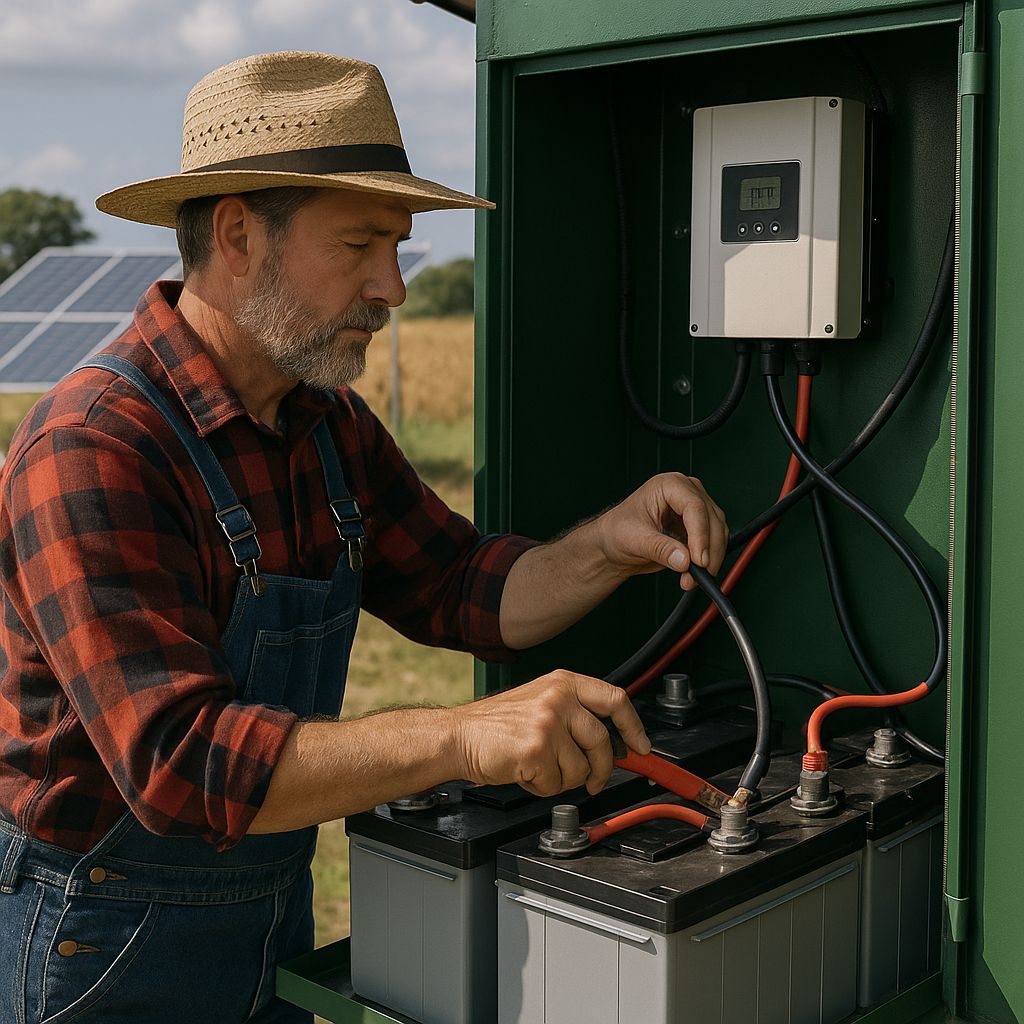
Proper maintenance dramatically extends battery life and ensures reliable performance when you need it most. Establishing regular maintenance protocols and keeping detailed records helps identify potential issues before they cause system failures. For agricultural operations where power outages can threaten livestock or crops, preventive maintenance becomes particularly critical.
Regular Testing Procedures
Implement monthly testing routines that include measuring individual battery voltages, checking specific gravity in flooded lead-acid cells, and verifying proper charging cycles. Modern battery monitoring systems can automate much of this process, providing continuous data logging and alert notifications when parameters drift outside optimal ranges. For critical farm operations, this technological investment provides valuable early warning of potential problems. To further enhance efficiency, consider integrating smart controllers and sensors that boost system performance.
Annual capacity testing helps track battery degradation over time, allowing for planned replacements before failures occur. This process typically involves a controlled discharge test measuring actual available capacity against rated specifications. Schedule these more involved tests during low-demand seasons when temporary system shutdown presents minimal operational risk.
Cleaning and Connection Checks
Battery terminals and connections represent common failure points in off-grid systems. Corrosion at these junctions increases resistance, reduces charging efficiency, and can eventually lead to complete connection failure. Establish quarterly inspection routines to clean terminals, check connection tightness, and apply appropriate terminal protectants to prevent future corrosion.
|
Maintenance Task |
Frequency |
Applied To |
Tools Required |
|---|---|---|---|
|
Visual Inspection |
Weekly |
All Battery Types |
None |
|
Terminal Cleaning |
Quarterly |
All Battery Types |
Wire brush, baking soda solution, petroleum jelly |
|
Electrolyte Level Check |
Monthly |
Flooded Lead-Acid Only |
Distilled water, protective gear, hydrometer |
|
Capacity Testing |
Annually |
All Battery Types |
Load tester, multimeter, monitoring equipment |
Keep battery compartments clean and free from dust, particularly in farm environments where airborne particles are common. Excessive dirt can create electrical pathways between terminals, potentially causing shorts or accelerated discharge. For ventilated battery areas, check that air intake filters remain unobstructed and replace them according to manufacturer recommendations.
When to Replace Components
Battery replacement becomes necessary when capacity falls below 80% of original ratings or when maintenance requirements increase significantly. Most lead-acid systems require replacement after 500-1,000 cycles or 5-7 years, while quality lithium systems might maintain performance for 3,000-5,000 cycles or 10-15 years. Rather than waiting for complete failure, plan replacements during farm downtime when power interruptions have minimal impact on operations.
Real Off-Grid Farm Success Stories
Examining real-world implementations provides valuable insights into both the challenges and benefits of off-grid solar systems for agricultural applications. These case studies highlight different approaches to system design based on specific farm needs, local conditions, and operational priorities.
While every farm presents unique energy requirements, these examples demonstrate how thoughtful planning and appropriate component selection create resilient power systems. Each success story includes lessons learned that can help other farmers avoid common pitfalls and optimize their own installations.
Small Livestock Operation in Colorado
The Jensen family operates a 40-acre goat farm in rural Colorado, where grid extension would have cost over $60,000 due to their remote location. They installed a 12kW solar array paired with a 30kWh lithium battery bank, providing reliable power for milking equipment, refrigeration, and basic farm operations. Their system includes a small propane generator for backup during extended cloudy periods in winter, though they report needing it less than 10 days annually.
Three years into operation, they’ve expanded their processing facilities without requiring additional power infrastructure, as their original system was deliberately oversized to accommodate growth. Their battery bank maintains over 90% of its original capacity, and the system has already offset more than $15,000 in would-be utility costs. Most importantly, they’ve experienced zero power-related production losses, maintaining consistent operations through regional outages that affected grid-connected neighbors.
200-Acre Crop Farm in Texas
Davidson Farms converted their irrigation systems to solar power using a 35kW array coupled with a 90kWh battery storage system. Their primary motivation was eliminating the fuel costs and maintenance requirements of diesel pumps previously used for irrigation. By incorporating variable frequency drives with their pumps, they created a system that automatically adjusts pumping rates based on available solar production and battery capacity, maximizing water delivery during peak solar hours.
The system’s sophisticated energy management capabilities allow for prioritizing water delivery to different fields based on crop needs and soil moisture levels. During their first full growing season with the solar system, they reduced irrigation costs by 64% compared to previous diesel operation while improving crop yields through more consistent moisture management. The elimination of fuel deliveries and engine maintenance has also freed up significant labor hours for other farm activities.
Off-Grid Orchard in Washington State
Cascade Orchards operates 150 acres of apple and pear trees in a valley where power lines were repeatedly damaged by winter storms. After experiencing three extended outages that threatened their cold storage facility, they invested in a comprehensive off-grid system featuring a 48kW solar array, 180kWh battery bank utilizing saltwater battery technology, and integrated thermal management systems. Their battery choice reflected concerns about fire safety in their wooden storage buildings and alignment with their organic growing practices.
Conclusion
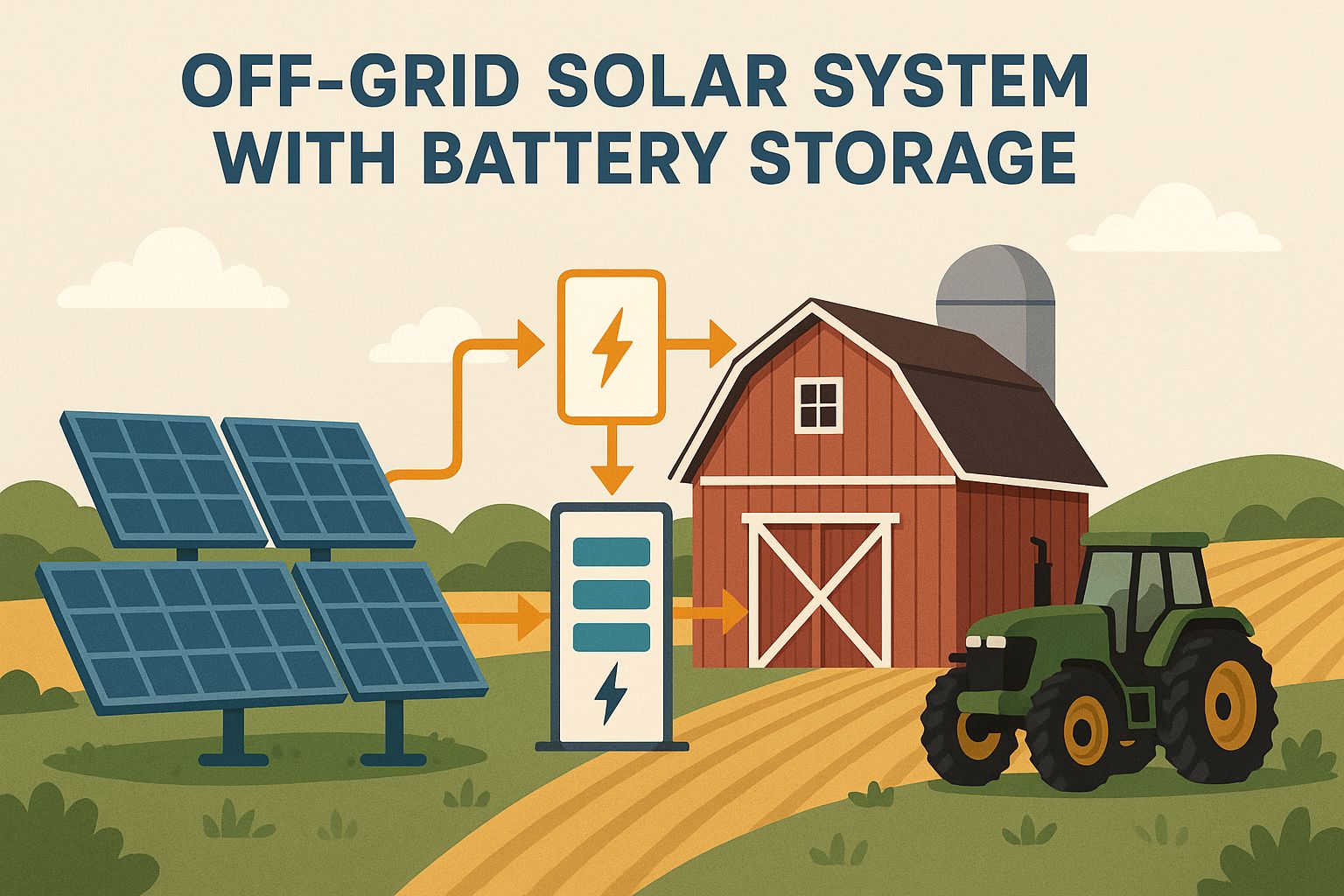
Off-grid solar systems with properly sized battery storage offer farms true energy independence, operational resilience, and long-term cost savings. While the initial investment is substantial, particularly for the battery component, the benefits extend far beyond simple economics to include improved reliability, environmental sustainability, and protection from utility rate increases. For remote agricultural operations or farms in areas with unreliable grid service, these systems transform energy from an ongoing vulnerability into a controlled, predictable resource.
Is Battery Storage a Must-Have to Use Solar Energy to Run an Off-Grid Farm
For truly off-grid farms, battery storage isn’t optional—it’s absolutely essential. Without batteries, solar power remains intermittent and unavailable during critical nighttime hours or cloudy periods when agricultural operations must continue uninterrupted. The question isn’t whether to include batteries, but rather which technology best matches your specific farm requirements and how to properly size the system for optimal performance. With careful planning, quality components, and appropriate maintenance, your off-grid solar system can provide decades of reliable, sustainable power for your agricultural enterprise.
Frequently Asked Questions
As you consider implementing an off-grid solar system for your farm, you likely have specific questions about practical aspects of these systems. The following answers address common concerns based on real-world agricultural implementations and current technology capabilities.
How long do solar batteries typically last on a farm?
Battery lifespan varies significantly based on technology, usage patterns, and maintenance. Lead-acid batteries typically last 5-7 years in farm applications, while premium lithium batteries often provide 10-15 years of service before requiring replacement. Flow batteries can potentially operate for 20+ years. Actual longevity depends greatly on cycling depth, temperature conditions, and maintenance quality. Farms with seasonal operations may experience longer battery life due to reduced cycling during off-seasons.
Can I run heavy farm equipment on solar power?
Yes, but with important considerations. Large motors and heavy equipment require substantial surge capacity during startup—often 3-5 times their running wattage. Your inverter system must be sized to handle these surges, not just continuous loads. For very large equipment like grain dryers or powerful irrigation pumps, consider solar pump inverters that reduce inrush current requirements.
Strategic scheduling of heavy equipment operation during peak solar production hours maximizes direct solar utilization and reduces battery cycling. Some farms implement load management systems that automatically start power-intensive equipment when solar production exceeds a certain threshold, optimizing energy utilization.
For extremely power-hungry equipment that operates seasonally, a hybrid approach using solar for daily operations and a generator for specific heavy equipment can be more cost-effective than massively oversizing your entire solar system.
What happens if my batteries run out of power?
Without battery power, your off-grid system cannot deliver electricity regardless of solar conditions. Well-designed systems include automated protection that disconnects loads before batteries reach damaging discharge levels. Most agricultural installations incorporate automatic generator startup systems that activate when battery capacity falls below predetermined thresholds, ensuring critical operations continue uninterrupted.
To prevent complete discharge situations, implement tiered load-shedding systems that progressively disconnect non-essential equipment as battery levels decline. Modern energy management systems can prioritize critical farm functions like livestock watering or refrigeration while temporarily disabling convenience loads until sufficient recharging occurs.
Do I need professional installation for an off-grid system?
Professional installation is strongly recommended for farm-scale off-grid systems due to their complexity, safety requirements, and the critical nature of agricultural power needs. Qualified installers ensure proper system sizing, component compatibility, and code compliance. They also typically provide commissioning services that verify all aspects of system performance before handover. For those interested in optimizing their solar systems, there are valuable solar panel efficiency maintenance tips available for farmers.
While skilled farm operators can certainly participate in installation and should understand system operation for maintenance purposes, professional design and oversight helps avoid costly mistakes. Look for installers with specific agricultural experience who understand farm-specific requirements like livestock safety, dust protection, and seasonal operational patterns. The additional investment in professional installation typically pays for itself through improved system performance and reduced operational problems.
How do extreme weather conditions affect battery performance?
Temperature extremes significantly impact battery performance and longevity. Cold temperatures reduce available capacity—batteries might deliver only 60-70% of rated capacity near freezing. High temperatures accelerate internal chemical reactions, potentially cutting battery lifespan in half for each 10°C (18°F) above optimal operating temperature (typically 25°C/77°F for most batteries). To explore further, learn how batteries enhance solar irrigation efficiency in agriculture.
For farm installations experiencing temperature extremes, battery room climate control represents a worthwhile investment. Insulated, temperature-regulated battery enclosures maintain optimal conditions year-round, significantly extending battery life and improving performance consistency. Some advanced battery technologies, particularly certain lithium chemistries, maintain better performance across temperature ranges compared to traditional lead-acid batteries.
Farm Battery Protection Strategy: Montana rancher Michael Keller installed his 45kWh lithium battery bank in a repurposed walk-in cooler with added heating elements, maintaining ideal temperatures between 60-75°F year-round despite external temperatures ranging from -30°F to 95°F. This strategic protection extended his projected battery lifespan by approximately 40% according to system monitoring data.
Understanding these performance variations allows for appropriate system sizing and management strategies tailored to your specific climate conditions. Farms in extreme environments should incorporate larger capacity margins to account for weather-related performance limitations, particularly for critical operations that cannot tolerate power interruptions.
When evaluating battery options, review temperature performance specifications carefully, as different technologies have varying sensitivities to thermal conditions. This consideration is particularly important for unheated outbuildings or installations where temperature control is impractical due to location or budget constraints.
For farms planning off-grid solar installations, partnering with experienced agricultural energy specialists ensures your system meets both current needs and future expansion possibilities. Growing Solar Mist specializes in designing custom solar solutions for farms of all sizes, helping you achieve energy independence while maximizing your return on investment.



Leave a Reply