
Key Takeaways
- Lithium-ion batteries offer the highest efficiency and longest lifespan for farm solar systems, while lead-acid options remain cost-effective for smaller operations.
- Modern solar irrigation systems can reduce water usage by up to 30% while cutting energy costs by 40-60% compared to traditional grid-powered systems.
- Monocrystalline solar panels deliver the best performance per square foot, making them ideal for limited farm spaces despite their higher initial cost.
- Drip irrigation paired with solar power provides the most water-efficient solution for most crops, delivering water directly to plant roots with minimal waste.
- Growing Solar Mist specializes in designing custom solar irrigation solutions that maximize both energy and water efficiency for farms of all sizes.
Transitioning to solar power on your farm isn’t just environmentally responsible—it’s becoming economically essential. With energy costs rising and water resources becoming increasingly precious, integrating the right combination of batteries, solar panels, and irrigation systems can transform your agricultural operation. Finding the perfect balance between these components is critical for creating a system that delivers reliable performance year-round.
Why Farm Batteries Are Essential for Agricultural Success
The heart of any farm solar system is its battery storage. Unlike residential solar setups, agricultural operations face unique power demands that fluctuate with seasonal needs, weather patterns, and crop cycles. Without proper battery storage, the inconsistent nature of solar generation can leave critical irrigation systems vulnerable during cloudy periods or overnight when water management is often most efficient.
24/7 Power Access During Outages and Low Sunlight
Grid outages can be devastating to agricultural operations, particularly during critical growing periods when irrigation timing makes all the difference. A properly sized battery bank ensures your pumps, monitors, and essential systems continue functioning regardless of grid conditions or sunlight availability. This becomes especially crucial during extended cloudy periods in spring planting seasons or during harvest when equipment demands peak. For farms in remote locations where grid connections are unreliable or nonexistent, a robust battery system isn’t a luxury—it’s the foundation of operational reliability.
Energy Storage Solutions for Peak Demand Periods
Modern farming operations experience significant energy demand fluctuations throughout the growing season. During peak irrigation periods, power requirements can increase dramatically, putting stress on both systems and budgets. Battery storage allows you to collect energy during low-demand periods and deploy it strategically when irrigation needs are highest. This load-shifting capability is particularly valuable when dealing with time-of-use utility rates, as you can avoid the highest electricity costs by running pumps on stored solar energy. Many Growing Solar Mist clients report savings of 30-50% on operational costs after implementing strategic battery storage solutions for irrigation.
Cost Savings Through Off-Grid Operation
The economic case for battery storage becomes particularly compelling when considering the costs of extending utility lines to remote fields or pastures. Traditional grid extension can cost $15,000-$50,000 per mile, making self-contained solar and battery systems the clear financial winner for distant agricultural operations. Even for grid-connected farms, the ability to operate irrigation systems off-grid during peak rate periods creates substantial savings over time. With properly sized battery systems, many operations achieve complete energy independence for their irrigation needs, eliminating monthly utility bills entirely and protecting against future rate increases.
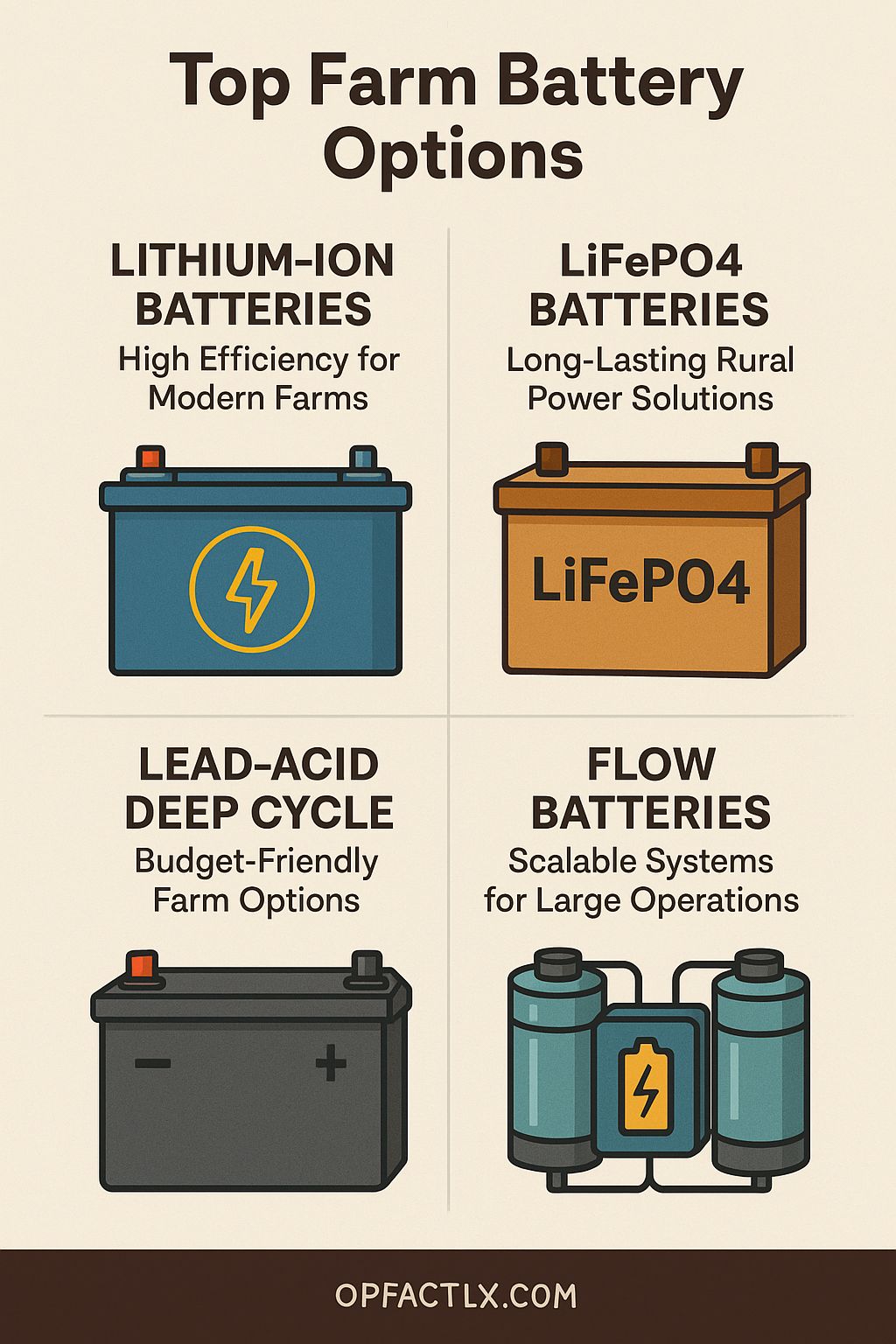
Top Farm Battery Options
The battery market has evolved rapidly in recent years, offering farmers more options than ever before. Selecting the right battery technology involves balancing initial cost against longevity, maintenance requirements, and performance characteristics. Your choice should align with your specific agricultural needs, climate conditions, and budget constraints.
Lithium-Ion Batteries: High Efficiency for Modern Farms
Standard lithium-ion batteries have revolutionized agricultural solar applications with their exceptional efficiency and compact footprint. These powerhouses deliver 95%+ round-trip efficiency, meaning almost all the energy stored can be successfully retrieved for use. This efficiency becomes particularly valuable in agricultural settings where every kilowatt-hour matters during extended irrigation cycles. Lithium-ion systems also perform remarkably well in extreme temperature conditions, maintaining consistent output even during summer heat waves when irrigation demands peak.
While the initial investment runs higher than traditional options, lithium-ion’s 3,000-5,000 cycle lifespan translates to 8-10 years of reliable service even with daily deep cycling. This extended performance makes them ideal for intensive agricultural operations where system reliability directly impacts crop yields and profitability. Many growers find the higher upfront cost is quickly offset by reduced maintenance and replacement requirements.
LiFePO4 Batteries: Long-Lasting Rural Power Solutions
Lithium iron phosphate (LiFePO4) batteries represent the gold standard for agricultural applications where safety and longevity are paramount. Their remarkable 5,000-7,000 cycle lifespan translates to 10+ years of reliable service even with daily deep discharging, making them particularly valuable for remote farming operations where replacement logistics are challenging. Unlike standard lithium-ion, LiFePO4 chemistry eliminates thermal runaway risks, providing peace of mind during hot summer months when irrigation demands are highest.
The thermal stability of LiFePO4 batteries makes them exceptionally well-suited for uncontrolled environments like pump houses, equipment sheds, and field-edge installations common in agricultural settings. Though carrying a 15-20% price premium over standard lithium-ion, their extended lifespan and reduced fire risk justify the investment for critical irrigation infrastructure. Many farmers report these batteries maintaining 80%+ of original capacity even after five years of continuous service in demanding field conditions.
Lead-Acid Deep Cycle: Budget-Friendly Farm Options
Despite newer technologies, traditional deep-cycle lead-acid batteries remain relevant for small to medium agricultural operations with modest budgets and basic power needs. Their significantly lower upfront cost (often 60-70% less than lithium alternatives) makes them accessible entry points for farmers beginning their solar journey. For seasonal operations or those with intermittent irrigation requirements, the financial equation often favors these tried-and-tested solutions despite their shorter lifespan of 500-1,200 cycles.
Flow Batteries: Scalable Systems for Large Operations
For extensive agricultural enterprises requiring massive energy storage, flow batteries present a compelling solution with unique advantages. These systems store energy in liquid electrolyte solutions pumped through electrochemical cells, allowing independent scaling of power and energy capacity. This flexibility enables custom-tailored solutions for operations with highly variable seasonal demands, such as rice cultivation or flood irrigation practices.
While relatively new to agricultural applications, flow batteries boast impressive 20+ year lifespans with minimal degradation, even after thousands of cycles. Their ability to discharge completely without damage makes them ideal for extended cloudy periods or seasonal operation. Though carrying higher initial costs, their exceptional longevity and scalability create compelling lifetime value for large-scale agricultural enterprises committed to decades of sustainable operation.
Comparing Cycle Life, Depth of Discharge, and Maintenance Requirements
“After switching from lead-acid to lithium iron phosphate batteries, our downtime during irrigation season dropped to zero, and we haven’t replaced a single battery in four years. The system paid for itself in the second season through reduced maintenance and improved crop yields from consistent irrigation timing.” — Carlos Mendez, 200-acre vegetable farm, California Central Valley
|
Battery Type |
Cycle Life |
Depth of Discharge |
Maintenance |
Best For |
|---|---|---|---|---|
|
Lithium-Ion |
3,000-5,000 |
80-90% |
Minimal |
Medium farms, hot climates |
|
LiFePO4 |
5,000-7,000 |
90-100% |
Minimal |
Remote locations, critical systems |
|
Lead-Acid |
500-1,200 |
50% |
Regular |
Small farms, budget systems |
|
Flow |
10,000+ |
100% |
Periodic |
Large operations, long-term investment |
Solar Panel Selection for Agricultural Applications
The solar panels you choose significantly impact both system performance and long-term reliability. Agricultural applications present unique challenges including dust accumulation, potential equipment impacts, and the need to maximize production in limited spaces. The right panel technology balances efficiency, durability, and cost considerations specific to your farming operation.
Monocrystalline: High Efficiency for Limited Space
Monocrystalline panels represent the premium choice for farms where space efficiency matters most. These panels convert 20-22% of available sunlight to electricity—the highest efficiency commercially available—making them ideal for installations on barn roofs, equipment sheds, or dedicated solar arrays where maximizing output per square foot is critical. Their superior performance in high-temperature conditions is particularly valuable for agricultural applications, as they maintain higher output during hot summer months when irrigation demands peak.
The sleek black appearance of monocrystalline panels also tends to blend more aesthetically with farm buildings and landscapes. Though carrying a 15-25% price premium over alternatives, their extended 25-30 year lifespan and higher energy density often make them the most cost-effective solution when evaluated on a lifetime production basis. For precision irrigation systems requiring consistent power delivery, the stable output characteristics of monocrystalline technology provide valuable performance predictability. To further enhance efficiency, consider exploring ways to increase solar panels’ efficiency for your farm irrigation system.
Polycrystalline: Budget-Friendly Options
Polycrystalline panels offer a practical middle ground for agricultural operations balancing performance and cost considerations. With efficiency ratings of 15-17%, they capture less energy per square foot than monocrystalline alternatives but typically cost 10-15% less initially. This makes them particularly suitable for farms with ample installation space but tighter capital budgets. Their distinctive blue color and performance characteristics have made them workhorses in agricultural solar applications for decades.
Thin-Film Options for Barn Roofs and Outbuildings
Thin-film solar technologies present unique advantages for certain agricultural applications, particularly where weight constraints or unusual mounting surfaces exist. Their flexible nature allows installation on curved barn roofs, equipment storage buildings, or even portable structures that wouldn’t support conventional panels. Though less efficient at 10-13% conversion rates, thin-film panels perform better in partial shading and high-temperature conditions common in agricultural settings.
Their superior performance in diffuse light conditions makes thin-film technology worth considering for regions with frequent morning fog or hazy conditions. The lightweight nature of these panels (up to 80% lighter than conventional options) enables installation on aging farm structures without costly structural reinforcement. For seasonal operations or portable irrigation systems, the flexible and lightweight characteristics of thin-film panels provide deployment advantages that can outweigh their lower efficiency.
Bifacial Panels: Capturing Reflected Light for Maximum Output
Bifacial solar panels represent cutting-edge technology particularly well-suited for agricultural installations. These innovative panels generate electricity from both sides, capturing direct sunlight on the front and reflected light on the back. In farm settings where panels are mounted above reflective surfaces like light-colored soil, gravel access roads, or limestone rocks, bifacial technology can boost energy production by 10-30% compared to traditional panels.
This dual-capture capability makes bifacial panels especially valuable for agrivoltaic systems where crops grow beneath solar arrays. The elevated mounting required for agricultural access creates ideal conditions for bifacial technology, maximizing energy harvest while maintaining productive farmland below. Though commanding a 10-15% price premium, the increased energy yield typically delivers faster return on investment, particularly in regions with high reflection potential.
Here is a table summarizing the main types of solar panels for agricultural applications, highlighting their key characteristics, benefits, and limitations:
|
Solar Panel Type |
Key Features |
Best Uses in Agriculture |
Advantages |
Limitations |
|---|---|---|---|---|
|
Monocrystalline |
Single-crystal silicon, high efficiency, dark appearance |
Limited roof/land space; high-demand farms |
Highest efficiency (up to 22%), longest lifespan (25–30 years), reliable in smaller spaces |
Highest upfront cost, slightly less efficient in extreme heat |
|
Polycrystalline |
Multiple silicon crystals, bluish tone, moderate efficiency |
Large farm roofs/land, budget-conscious projects |
Lower cost per watt, stable performance, good for large-scale installations |
Lower efficiency (13–17%), needs more space, drops in high heat |
|
Thin-Film |
Flexible modules, thin, low weight, lower efficiency |
Curved/irregular surfaces, barns, greenhouse roofs |
Flexible installation, lightweight, better in low light/cloudy regions |
Shorter lifespan, lowest efficiency (<14%), requires most area |
|
Bifacial |
Absorbs sunlight from both sides, transparent back |
Open fields, reflective surfaces, agrivoltaics |
Can boost power output by up to 30% with good reflectivity (albedo); efficient land use |
Higher initial investment, requires careful ground preparation and mounting |
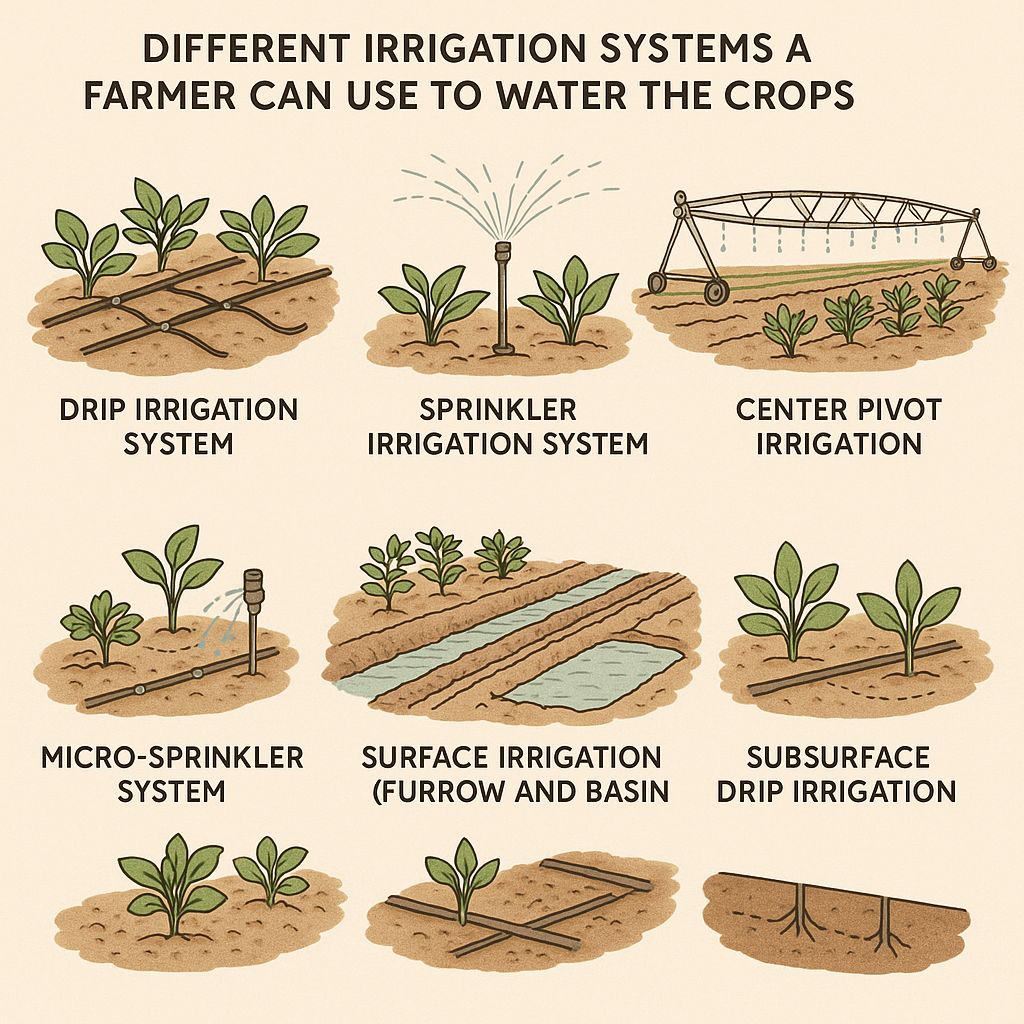
Different Irrigation Systems a Farmer can Use to Water the Crops
The irrigation system you pair with your solar array dramatically impacts both water and energy efficiency. Modern agricultural operations must balance water conservation, energy consumption, and crop-specific needs when selecting irrigation technology. The right system for your farm depends on crop types, soil conditions, terrain, and climate factors. For more insights, explore how smart controllers and sensors can boost your solar irrigation system’s efficiency.
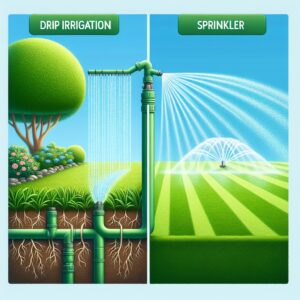
Drip Irrigation System
Drip irrigation represents the gold standard for water efficiency, delivering moisture directly to plant root zones through a network of tubes and emitters. By eliminating spray, evaporation, and runoff, drip systems reduce water usage by 30-70% compared to conventional methods while improving crop yields through consistent moisture levels. Their low pressure requirements (typically 10-15 PSI) make them ideal companions for solar-powered systems, requiring smaller pumps and less energy than high-pressure alternatives.
For specialty crops, orchards, and vineyards, the precision of drip irrigation justifies the higher initial investment through water savings, reduced weed pressure, and improved harvest quality. Modern drip systems paired with solar controllers can deliver water during optimal absorption windows, further enhancing efficiency. The modular nature of drip irrigation allows easy expansion as operations grow, making it adaptable to evolving farm needs.
Sprinkler Irrigation Systems
Sprinkler systems offer versatility for diverse farming operations, covering large areas efficiently while accommodating various field shapes and topographies. Modern impact and rotary sprinklers deliver relatively uniform water distribution while operating at pressures (30-50 PSI) manageable by mid-sized solar systems. For row crops, field crops, and pastures, sprinkler technology often provides the best balance between installation cost and operational efficiency.
Recent advances in pressure regulation and nozzle design have significantly improved the water efficiency of sprinkler systems, reducing misting and evaporation losses. When paired with solar-powered variable frequency drive (VFD) pumps, these systems can adjust pressure and flow rates based on real-time conditions, optimizing both water and energy usage. The adaptability of sprinkler systems makes them particularly suitable for farms transitioning to solar irrigation incrementally.
Center Pivot Irrigation
Center pivot systems have revolutionized irrigation for large-scale operations, efficiently watering circular fields ranging from 40 to 160 acres from a single installation. These systems distribute water through sprinklers mounted on wheeled towers that rotate around a central pivot point. Modern pivots feature precision application technologies including drop nozzles, pressure regulators, and variable rate irrigation capabilities that dramatically improve water use efficiency.
The controlled water delivery of center pivots makes them excellent candidates for solar power integration. Their predictable energy requirements allow precise sizing of solar arrays and battery systems. By incorporating solar tracking technology that moves panels to follow the sun throughout the day, farmers can generate 25-45% more energy to power these substantial irrigation systems. For farms with quarter-section fields or larger, the combination of center pivot irrigation with dedicated solar arrays often delivers the lowest cost per irrigated acre.
Micro-Sprinkler Systems
Micro-sprinkler systems bridge the gap between drip and conventional sprinkler irrigation, offering focused water delivery with broader coverage than drip emitters. These low-pressure systems spray water in small patterns near plant bases, making them ideal for orchards, vineyards, and high-value row crops where precise water placement matters. Operating at 15-30 PSI, micro-sprinklers require modest energy input while delivering excellent water efficiency, typically using 20-50% less water than conventional sprinklers.
The moderate pressure requirements of micro-sprinklers align perfectly with small to medium solar power systems, creating cost-effective irrigation solutions for specialty crop producers. Many growers appreciate their visibility—unlike subsurface drip systems, operators can easily observe micro-sprinklers functioning, simplifying maintenance and troubleshooting. Their adaptability to various soil types and ability to create beneficial microclimate effects make micro-sprinklers increasingly popular components in solar-powered farm systems.
Surface Irrigation (Furrow and Basin)
Traditional surface irrigation methods including furrow and basin systems remain relevant for specific agricultural contexts, particularly in areas with abundant water rights but limited electricity access. These gravity-based systems require minimal ongoing energy input but depend on careful field grading and water management to achieve reasonable efficiency. When powered by solar pumps for initial water delivery to field high points, these systems can operate effectively even in remote locations.
Modern laser-leveling technology has significantly improved surface irrigation efficiency, reducing water requirements while ensuring more uniform distribution. For farms with heavy soils, flat topography, and appropriate crop types, the simplicity and low maintenance requirements of surface irrigation paired with solar pumping can create sustainable, low-technology solutions. Though less water-efficient than pressurized alternatives, properly managed surface systems offer the lowest energy-per-acre requirement, minimizing both solar panel and battery needs.
Subsurface Drip Irrigation
Subsurface drip irrigation (SDI) represents the pinnacle of water and energy efficiency, delivering moisture directly to root zones through permanently buried emitter lines. By eliminating all surface water exposure, these systems virtually eliminate evaporation losses while dramatically reducing weed pressure. Their consistent moisture delivery typically improves yields 15-25% compared to surface irrigation while using 30-50% less water and operating at very low pressures (10-15 PSI).
The exceptional efficiency of SDI systems makes them ideal partners for solar power, as their modest energy requirements allow smaller solar arrays and battery systems. Though installation costs exceed surface options, SDI systems typically last 15-20 years with proper maintenance, creating excellent lifetime value. For high-value crops in water-restricted regions, the combination of subsurface drip and solar power often delivers the highest return on investment through water savings, yield improvements, and reduced labor costs. To further enhance efficiency, consider exploring ways to increase solar panel efficiency for your farm irrigation system.
Complete Farm Solar System Integration
Creating an effective farm solar solution requires thoughtful integration of panels, batteries, and irrigation components into a cohesive system. Beyond selecting quality individual components, proper sizing, configuration, and control systems determine whether your investment delivers optimal returns. A systems-thinking approach ensures all elements work together efficiently throughout the growing season.
Sizing Your System Based on Water Needs and Field Size
Proper system sizing begins with accurate assessment of your water requirements—the foundation of any irrigation design. Calculate your peak daily water needs in gallons based on crop types, soil conditions, and local evapotranspiration rates. This determines your pumping requirements, which in turn dictates both solar array and battery capacity needs. For most operations, designing for 120% of calculated peak demand provides valuable buffer capacity during extreme conditions while remaining cost-effective.
Field dimensions and irrigation system type significantly impact energy requirements. Pumping water through 1,000 feet of drip line requires substantially less pressure (and therefore less energy) than pushing water through a quarter-mile center pivot. Elevation changes across your farm dramatically affect system sizing—each additional foot of elevation lift requires approximately 0.43 PSI of pressure, directly increasing energy demands. Professional irrigation designers use hydraulic modeling software to accurately calculate the precise energy requirements for complex field layouts, ensuring your solar system meets actual operational needs.
Charge Controllers and Inverters for Agricultural Use
Agricultural solar systems demand robust charge controllers and inverters capable of withstanding harsh outdoor conditions while delivering consistent performance. MPPT (Maximum Power Point Tracking) charge controllers have become standard for farm applications, improving energy harvest by 15-30% compared to simpler PWM controllers. Their ability to optimize voltage conversion becomes particularly valuable during early morning and late afternoon hours when irrigation timing is often ideal but panel output varies.
For irrigation systems using AC pumps, industrial-grade pure sine wave inverters provide the clean power necessary for motor longevity. Agricultural-grade inverters feature enhanced surge capacity to handle the substantial startup current required by irrigation pumps—typically 3-7 times their running load. When selecting these critical components, prioritize models with conformal coated circuit boards, IP65+ weatherproof ratings, and operating temperature ranges that exceed your local extremes. The modest additional cost of agricultural-specific power conditioning equipment pays dividends through reduced failures during critical irrigation periods. For more information on enhancing efficiency, explore how a battery can add to the efficiency of a solar irrigation system.
Backup Power Options During Extended Cloudy Periods
Even the best-designed solar irrigation systems require backup power strategies for extended low-production periods. Hybrid systems that incorporate small generators provide cost-effective insurance against weather-related shortfalls. Modern automatic transfer switches seamlessly activate backup power sources when battery levels reach critical thresholds, ensuring irrigation continuity during extended cloudy periods or unexpected battery issues.
For critical applications, redundant battery banks segregated into primary and reserve systems provide added protection. This approach allows normal operation on the primary bank while maintaining a separate emergency reserve, creating valuable operational security during peak growing seasons when irrigation interruptions could damage crops. The emerging practice of designating certain solar panels to directly power daytime irrigation while others simultaneously charge batteries further enhances system resilience by maximizing real-time solar utilization while building battery reserves for nighttime operation.
Monitoring Systems to Track Energy Production and Usage
Advanced monitoring capabilities have transformed agricultural solar systems from “install and hope” investments to precisely managed assets. Today’s monitoring platforms provide real-time visibility into system performance, battery status, water delivery, and energy production through user-friendly smartphone interfaces. These systems alert farmers to potential issues before they cause irrigation interruptions, enabling proactive maintenance that prevents crop stress.
The data collected through monitoring systems enables continuous optimization of irrigation scheduling, battery cycling, and energy usage. Many farmers report 15-20% efficiency improvements simply by adjusting irrigation timing to align with peak solar production periods. For larger operations, enterprise-level monitoring platforms integrate solar irrigation data with broader farm management systems, creating holistic operational visibility that improves decision-making across all aspects of production.
Real Farm Success Stories: Solar-Powered Irrigation
Nothing illustrates the potential of farm solar solutions better than real-world success stories. Across diverse agricultural regions, farmers are discovering that properly implemented solar irrigation systems deliver both environmental and economic benefits that transform their operations. These case studies demonstrate the practical applications of the technologies and approaches discussed throughout this article.
Small-Scale Vegetable Farm Case Study: 50% Water Bill Reduction
Harmony Fields, a 15-acre diverse vegetable operation in the Pacific Northwest, implemented a 12kW solar array with 30kWh of lithium iron phosphate battery storage to power their drip irrigation system. The farm previously relied on grid electricity costing $450-600 monthly during peak growing season to power their well pump and pressure system. After installation, their monthly utility costs dropped by over 50%, with the system providing 100% of irrigation needs during summer months.
Beyond energy savings, owner Sarah Jenkins reports that the ability to program irrigation cycles during ideal early morning hours—regardless of utility peak rates—has improved crop quality while reducing water usage approximately 30%. The system included remote monitoring that allowed operation verification from anywhere via smartphone, reducing daily field checks and saving valuable labor. With USDA REAP grant funding covering 25% of system costs and tax incentives recovering another 30%, the farm projects complete payback within 4-5 years while gaining energy independence for their most critical farm system.
Large Cattle Ranch: Year-Round Water Access in Remote Pastures
Triple R Ranch in central Texas installed solar-powered pumping systems at five remote stock ponds located miles from grid connections. Each installation includes a 3.6kW solar array directly powering submersible pumps without batteries, moving water from wells to storage tanks that gravity-feed drinking troughs. This solar direct approach eliminated the estimated $45,000 per site cost of extending utility lines while providing reliable water even during prolonged drought conditions.
Ranch manager Carlos Vasquez notes that the solar systems have operated maintenance-free for over three years, requiring only occasional panel cleaning during extremely dusty periods. The improved water distribution has allowed more effective rotational grazing across formerly underutilized pastures, increasing carrying capacity by approximately 15% while reducing erosion from cattle congregating around limited water sources. The ranch’s return on investment came primarily through increased production capacity rather than direct energy savings, highlighting the diverse benefits possible through thoughtful solar implementation.
Organic Orchard: Precision Irrigation and Frost Protection
Sunridge Orchards, a 40-acre certified organic apple and pear operation, implemented an integrated solar solution addressing both irrigation and critical frost protection needs. Their 36kW ground-mounted array coupled with 80kWh of lithium battery storage powers a sophisticated micro-sprinkler system that provides precision irrigation during growing season and crucial overhead frost protection during spring bloom periods when temperatures drop to critical thresholds.
Orchard manager Elena Santos reports that system reliability during frost events has significantly improved fruit set, with production increasing approximately 22% compared to seasons before installation. The precision control allowed by their solar-powered variable frequency pump drive enables different irrigation zones to receive precisely calibrated water volumes based on tree age, variety needs, and soil moisture sensor readings. Combined with scheduled power for their cooler facilities during harvest, the comprehensive solar system reduced annual operating costs by $14,200 while qualifying for substantial sustainability premiums from their primary wholesale buyers.
ROI and Financing Options for Farm Solar Systems
The financial aspects of farm solar solutions extend far beyond simple energy savings calculations. Modern agricultural solar investments leverage specialized funding programs, tax structures, and incentives designed specifically for agricultural producers. Understanding these options helps convert what might seem like prohibitive upfront costs into manageable investments with attractive returns.
USDA REAP Grants and Loan Guarantees
The USDA Rural Energy for America Program (REAP) remains the gold standard for agricultural solar funding, offering both grants and loan guarantees specifically designed for farm energy projects. These competitive grants cover up to 25% of total project costs with maximum awards of $500,000, dramatically improving project economics. The program’s guaranteed loan component can cover up to 75% of project costs with terms up to 30 years, creating financing packages that generate positive cash flow from the first year of operation.
Tax Incentives Specific to Agricultural Solar Installations
Agricultural businesses enjoy exceptional tax advantages for solar investments that substantially reduce net system costs. The federal Investment Tax Credit currently returns 30% of system costs as a direct tax liability reduction—not merely a deduction, but a dollar-for-dollar tax bill reduction. For farmers with sufficient tax liability, this incentive alone can recover nearly one-third of project costs within the first year.
Beyond the ITC, accelerated depreciation options including bonus depreciation and Modified Accelerated Cost Recovery System (MACRS) allow writing off the entire system cost for tax purposes within the first five years. When combined with state-specific agricultural solar incentives available in many regions, these tax benefits can effectively reduce net system costs by 50-65%, dramatically improving return on investment calculations.
Typical Payback Periods for Different System Sizes
System scale significantly impacts economic return metrics for farm solar investments. Small-scale systems (5-15kW) typically designed for specific applications like livestock watering or small irrigation zones generally achieve payback in 5-8 years, representing 12-20% annual returns. These focused systems often serve as ideal entry points for farms beginning their solar journey, addressing critical needs while limiting initial investment.
Medium-scale systems (15-50kW) powering significant portions of farm irrigation infrastructure typically achieve faster 4-6 year paybacks due to economies of scale in both equipment and installation costs. These systems often represent the sweet spot for mid-sized operations, offering substantial energy independence without requiring major electrical infrastructure upgrades. Large systems exceeding 50kW designed for comprehensive farm power achieve the most favorable economics in suitable locations, with paybacks often compressed to 3-5 years when all available incentives are applied. Their ability to address multiple farm energy needs simultaneously—irrigation, cold storage, processing equipment—creates compound returns that accelerate economic benefits.
Power Purchase Agreements for Zero Upfront Costs
Power Purchase Agreements (PPAs) have emerged as attractive options for farms seeking solar benefits without capital expenditure. Under these arrangements, third-party investors install, own and maintain solar systems on farm property while selling the generated power to the farm at predetermined rates typically 10-30% below utility costs. These agreements require zero upfront investment from farmers while immediately reducing operating expenses and providing predictable energy costs for 15-25 years.
Future-Proofing Your Farm’s Energy System
Agricultural solar investments represent decade-spanning infrastructure that should accommodate evolving farm needs, technological advancements, and changing climate conditions. Forward-thinking design approaches create systems that appreciate in value through adaptability rather than becoming obsolete as farm operations evolve.
What is the Best Combination of Batteries, Solar Panels & Irrigation System to Get the Farmer the Most Efficiency
The optimal system configuration varies based on specific farm conditions, but certain combinations consistently deliver superior results across diverse operations. For most farms, monocrystalline panels paired with lithium iron phosphate batteries and variable frequency drive pumps create the core of highly efficient systems. This combination provides excellent energy harvest, reliable storage, and adaptive power delivery that maximizes both water and energy efficiency.
Irrigation technology should align with both crop needs and system scale. For small to medium operations growing high-value crops, pressurized drip irrigation powered by solar offers exceptional efficiency, often reducing water usage 30-60% compared to conventional methods. Larger operations typically benefit from center pivot systems with precision application technologies, particularly when integrated with soil moisture monitoring that prevents both under and over-irrigation. The key principle remains matching irrigation method to specific crop needs while ensuring system components are properly sized relative to each other—oversized pumps waste energy while undersized solar arrays create reliability issues.
Scalable Designs That Grow with Your Operation
Future-proof solar installations incorporate modular design principles that facilitate system expansion as farm needs evolve. Well-designed systems include appropriately sized electrical infrastructure—combiner boxes, conduit, and interconnection equipment—capable of handling additional capacity without complete retrofitting. This modest upfront investment in scalability typically adds just 5-8% to initial project costs while enabling seamless expansion that follows growing farm energy demands.
Emerging Battery Technologies Worth Watching
The energy storage landscape continues evolving rapidly, with several emerging technologies showing particular promise for agricultural applications. Sodium-ion batteries are approaching commercial viability, offering performance similar to lithium-ion chemistry but using abundant, low-cost materials that could reduce storage costs by 30-40% when manufactured at scale. These batteries show excellent tolerance for the temperature extremes common in agricultural settings while eliminating concerns about lithium supply constraints.
Solid-state battery technology represents another frontier with significant implications for farm energy systems. By replacing liquid electrolytes with solid components, these batteries promise substantial improvements in energy density, charging speed, cycle life, and safety. Though currently in limited production at premium prices, manufacturing advances are expected to make solid-state options increasingly competitive for agricultural applications within 3-5 years. Farms designing systems today should ensure battery enclosures and management systems can accommodate these emerging technologies as they become commercially viable.
Smart Farm Integration: Connecting Irrigation to Weather Data
Advanced farm solar systems increasingly incorporate weather-responsive automation that optimizes both energy and water usage. These intelligent systems integrate data from on-farm weather stations, soil moisture sensors, and weather forecast APIs to dynamically adjust irrigation scheduling. During approaching rainy periods, systems automatically reduce watering to prevent waste, while hot, windy conditions trigger adjusted irrigation timing to minimize evaporation losses.
Frequently Asked Questions
As farmers evaluate solar irrigation options, certain questions consistently arise during the planning process. Addressing these common concerns helps create realistic expectations and successful implementations.
How many batteries do I need to run a farm irrigation system?
Battery requirements depend primarily on pump size, runtime needs, and days of autonomy desired. As a general guideline, multiply your pump’s wattage by daily runtime hours, then multiply by desired days of autonomy (typically 1-3), then divide by battery depth of discharge (0.5 for lead-acid, 0.8 for lithium). For example, a 2HP pump (1,500W) running 6 hours daily with 2 days autonomy requires approximately 22.5kWh of lithium battery capacity. Most agricultural systems benefit from slight oversizing to accommodate seasonal variability and battery degradation over time.
Can solar panels power water pumps directly without batteries?
Direct solar pumping systems without batteries work well for specific applications, particularly livestock watering and irrigation systems that can operate only during daylight hours. These battery-free systems use specialized pump controllers that adjust pump speed based on available sunlight, automatically starting when sufficient power is available and ramping speed up or down with changing solar conditions. While eliminating substantial battery costs, these systems cannot operate at night or during heavy cloud cover without supplemental power.
For operations requiring consistent water delivery regardless of sunlight conditions, hybrid systems represent an effective middle ground. These setups connect pumps directly to solar during daylight while maintaining smaller battery banks sized for critical overnight operations. This approach maximizes real-time solar utilization while providing essential reliability during darkness or cloudy periods.
What maintenance do farm solar batteries require?
Maintenance requirements vary significantly by battery chemistry. Lead-acid batteries demand the most attention, requiring monthly water level checks in flooded models, terminal cleaning, and regular specific gravity testing to ensure proper function. Their 3-5 year typical lifespan means relatively frequent replacement in agricultural settings. In contrast, lithium iron phosphate batteries require virtually no routine maintenance beyond occasional terminal inspection and keeping them within their specified temperature range, while delivering 10+ year operational life with proper management.
How do I protect my solar irrigation system from lightning damage?
Lightning protection for agricultural solar systems requires a comprehensive approach beyond basic grounding. Essential protection includes surge protection devices (SPDs) installed on both DC and AC sides of the system, proper grounding with dedicated ground rods at the array, pump, and control equipment, and isolation transformers for sensitive electronics. For regions with frequent lightning, additional measures including lightning rods, equipotential bonding, and electronic filtering significantly improve system survivability during electrical storms.
Will solar-powered irrigation work in cloudy or northern climates?
Solar irrigation systems remain viable even in less-than-ideal solar conditions when properly designed with regional characteristics in mind. Northern locations typically require 20-40% larger solar arrays and battery systems compared to sunbelt regions to compensate for reduced solar intensity and shorter days. Incorporating seasonal usage patterns into system design—many northern farms only irrigate during summer months when solar availability peaks—often creates surprisingly favorable economics despite less ideal conditions.
Modern high-efficiency panels perform significantly better in cloudy conditions than older technology, typically producing 10-25% of rated capacity even during heavy overcast. This improved low-light performance, combined with strategic battery sizing, creates reliable systems even in regions not traditionally considered “sunny.” The economics remain compelling in many northern areas due to higher electricity rates that accelerate payback despite the need for larger systems.
Implementing the right combination of solar panels, batteries, and irrigation technology creates farm systems that deliver both environmental and economic benefits for decades. By carefully matching components to specific agricultural needs and leveraging available incentives, farmers across diverse regions are discovering that solar power isn’t just sustainable—it’s increasingly the most profitable energy choice for modern agriculture.
Farmers looking to enhance their sustainability efforts are increasingly turning to solar panels. These panels not only help reduce energy costs but also promote eco-friendly farming practices. For those interested in maximizing the efficiency of their solar panels, exploring solar tracking systems can be a great start. By aligning the panels with the sun’s movement, these systems ensure optimal energy capture throughout the day.

Leave a Reply