

Article-At-A-Glance
- Solar-powered traveling gun irrigation systems can reduce energy costs by up to 60% compared to conventional methods while providing reliable water distribution for crops
- These innovative systems combine solar energy with mobile irrigation technology, making them ideal for farms with limited access to electricity or irregular field shapes
- Farmers using solar irrigation systems report significant labor savings with automation reducing manual oversight by up to 70%
- Initial investment in solar irrigation technology typically achieves payback within 3-5 years through energy savings and increased crop yields
Water is the lifeblood of agriculture, but how you deliver it makes all the difference in today’s challenging farming environment. As fuel prices surge and climate patterns become increasingly unpredictable, traditional irrigation methods are leaving farmers high and dry—both financially and literally.
Modern agriculture requires modern solutions, and solar-powered traveling gun irrigation systems represent the cutting edge of sustainable farm technology. These systems harness free solar energy while delivering precise water application exactly where and when you need it. Growing Solar Mist has been pioneering these systems with farmers reporting transformative results across diverse agricultural settings.
Why Traditional Irrigation Methods Fail Modern Farmers
The irrigation techniques that served previous generations of farmers are increasingly becoming liabilities rather than assets. Between escalating costs, inefficient water usage, and labor challenges, conventional systems simply cannot keep pace with the demands of modern agriculture. These limitations create a perfect storm that threatens farm profitability and sustainability.
Rising Energy Costs Squeeze Farm Profits
Conventional irrigation systems rely heavily on grid electricity or diesel generators, exposing farmers to volatile energy markets. With electricity rates climbing an average of 3-5% annually in most agricultural regions, irrigation can quickly consume 20-30% of operational costs. Diesel-powered systems fare even worse, with fuel prices fluctuating dramatically and maintenance costs steadily increasing year after year. These unpredictable expenses make financial planning nearly impossible and steadily erode already-tight profit margins.
Water Waste in Conventional Systems
Traditional irrigation methods typically deliver water with shocking inefficiency. Flood irrigation wastes up to 50% of water through runoff and evaporation, while even standard sprinkler systems lose 30% of water before it reaches crop roots. This waste isn’t just environmentally problematic—it directly impacts your bottom line through higher water bills, increased pumping costs, and potential regulatory compliance issues.
Additionally, over-irrigation leads to nutrient leaching, soil erosion, and increased disease pressure, creating a cascade of problems that extends well beyond water waste. For farms in regions facing water restrictions or drought conditions, these inefficiencies can threaten operational viability.
Labor Shortages Make Manual Irrigation Unsustainable
The agricultural labor crisis has hit irrigation management particularly hard. Manual irrigation systems require constant monitoring, adjustment, and maintenance—tasks that demand skilled labor that’s increasingly scarce and expensive. Many farmers report spending 10-15 hours weekly just managing irrigation systems during growing seasons, time better spent on other high-value farm activities.
The aging farm workforce further compounds this problem, with fewer young people entering agriculture and experienced workers retiring. Without automation and more efficient systems, many farms simply cannot maintain proper irrigation schedules with available labor resources.
- Traditional systems require constant repositioning and monitoring
- Irrigation timing often requires middle-of-night adjustments
- Maintenance demands specialized skills increasingly difficult to find
- Labor costs for irrigation management have increased 35% in the past decade

Solar-Powered Gun Traveling Irrigation System: The Game-Changer You Need
Solar-powered traveling gun irrigation systems represent a revolutionary approach that addresses the fundamental limitations of traditional methods. By combining renewable energy with automated mobility, these systems deliver water exactly where needed with minimal oversight. The technology integrates several components into a cohesive system that can transform irrigation practices on farms of virtually any size.
- Solar panels generate clean, free energy from sunlight
- Battery systems store excess power for cloudy periods or night operation
- Efficient pumps convert electrical energy into water pressure
- Traveling mechanisms move the system across fields automatically
- Smart controls optimize water delivery based on crop needs and conditions
How does a Gun Traveling Irrigation System Work?
A traveling gun irrigation system consists of a large sprinkler mounted on a wheeled cart or platform that moves slowly across a field. The “gun” sprinkler shoots water in a wide arc (typically 80-360 feet in diameter) while gradually moving along a predetermined path. This movement is typically powered by the water pressure itself or by a separate motor, creating an extremely efficient coverage pattern. For more on this, explore solar-powered irrigation systems and their benefits.
The beauty of this system lies in its simplicity and effectiveness. A single traveling gun can irrigate 2-5 acres per setup, with minimal supervision required once initiated. The sprinkler travels at speeds typically ranging from 1-10 feet per minute, adjustable based on crop requirements and soil infiltration rates. This slow, methodical movement ensures even water distribution while minimizing runoff and soil compaction.
Solar Panels: How Do they Work in an Agricultural Setting
Solar panels for irrigation systems convert sunlight into electricity through the photovoltaic effect. When sunlight hits the silicon cells within the panels, it energizes electrons, creating direct current (DC) electricity. This energy can be used immediately to power pumps or stored in batteries for later use. Modern agricultural solar panels are designed specifically for farm applications, with durability features that withstand dust, moisture, and temperature fluctuations.
For irrigation applications, solar arrays are typically ground-mounted near the water source or on elevated structures to maximize sun exposure while minimizing the use of valuable farmland. Most systems utilize tracking mounts that follow the sun’s path throughout the day, increasing energy production by 25-40% compared to fixed installations. This maximizes power generation during peak irrigation hours when water demands are highest.
Combining the System: How Solar Gun Traveling Irrigation Systems Work in the Field
The integration of solar power with traveling gun technology creates a self-sufficient irrigation powerhouse. Solar panels generate electricity that’s either used directly or stored in batteries. This power runs the pump that creates water pressure, propels the traveling mechanism, and operates the control systems. The traveling gun moves systematically across fields, distributing water with precision that manual systems simply cannot match.
Most modern systems incorporate soil moisture sensors and weather monitoring equipment that communicate with the central controller. This allows for intelligent irrigation decisions – automatically increasing water volume during hot periods or pausing operation during rainfall events. The system’s mobility means a single unit can efficiently service multiple field sections, maximizing your investment return while minimizing equipment needs.
Types of Solar Traveling Gun Systems
Solar-powered traveling gun systems come in several configurations to accommodate different farm needs. Hard-hose systems use a large-diameter polyethylene hose that retracts onto a reel as the gun cart moves across the field. Soft-hose systems utilize flexible layflat hoses that follow behind the traveling unit. Cable-driven systems use a cable and winch arrangement to pull the sprinkler apparatus across the field at precisely controlled speeds.
Each system type offers specific advantages depending on field conditions, crop types, and water requirements. Hard-hose systems excel in larger, open fields while soft-hose configurations provide greater flexibility in irregularly shaped areas. Self-propelled units work well in situations where minimal oversight is available, automatically completing their irrigation cycle without operator intervention.
5 Major Benefits That Will Transform Your Farm
Solar-powered traveling gun irrigation systems deliver multiple advantages that collectively transform farm operations. From immediate cost savings to long-term sustainability improvements, these systems represent one of the most impactful investments available to modern farmers. When properly implemented, they address virtually every pain point associated with traditional irrigation methods.
1. Cut Energy Costs by 40-60%
The most immediate benefit of solar irrigation is dramatic energy savings. By harnessing free solar energy instead of expensive grid electricity or diesel fuel, farmers typically reduce irrigation energy costs by 40-60% in the first year alone. A 20-acre vegetable operation in California reported annual energy savings of $8,500 after converting from a diesel pump to a solar-powered traveling gun system. These savings accumulate year after year, providing predictable cost reduction regardless of energy market fluctuations.
Solar irrigation systems qualify for numerous financial incentives that further enhance their economic advantage. Federal tax credits currently cover 26% of installation costs, while USDA programs like REAP (Rural Energy for America Program) provide grants covering up to 25% of project expenses. Many states offer additional rebates and incentives, potentially reducing initial investment by 50-70% in optimal scenarios. For more information on the types of solar-powered irrigation systems, check out this comprehensive guide.
2. Water Conservation Through Precision Application
Solar traveling gun systems deliver water with remarkable precision, reducing consumption by 30-50% compared to flood irrigation and 15-25% versus conventional sprinkler systems. This efficiency comes from controlled application rates, reduced evaporation losses, and precise targeting that puts water exactly where crops need it. The slow movement of traveling systems allows for optimal soil infiltration, minimizing both runoff and deep percolation losses.
Water conservation translates directly to cost savings, particularly in regions with metered water usage or pumping from deep wells. Beyond financial benefits, efficient water use helps farms remain operational during drought restrictions and positions operations favorably with regulatory agencies and conservation programs. This water-efficient approach also reduces nutrient leaching and runoff, improving both environmental compliance and fertilizer efficiency.
3. Reduce Labor Requirements by 70%
Automation is perhaps the most transformative aspect of solar traveling gun systems. Once programmed and initiated, these systems operate with minimal human oversight, reducing labor requirements by up to 70% compared to manual methods. Farmers report reclaiming 10-15 hours weekly during irrigation seasons, time that can be redirected to other critical farm operations or simply improving work-life balance. The system handles positioning, water application, and movement between zones automatically, eliminating constant manual adjustments.
Advanced systems include remote monitoring capabilities via smartphone apps, allowing you to check status, adjust settings, or troubleshoot issues from anywhere with internet access. Real-time alerts notify you of completion cycles or potential problems, further reducing the need for physical presence. For farms struggling with labor shortages, this automation provides an immediate solution that improves irrigation consistency while reducing payroll expenses. Discover more about solar panels’ benefits for irrigation systems.
4. Independence from Grid Electricity
Solar irrigation systems free farmers from reliance on grid electricity, eliminating vulnerability to power outages and rate increases. This independence is particularly valuable in remote locations where grid connection is expensive or unreliable. Battery storage components ensure operation continues during cloudy periods or allows for strategic night irrigation when evaporation losses are minimized. This flexibility means irrigation continues regardless of utility service interruptions or peak-rate pricing periods.
The self-sufficient nature of these systems enables irrigation in previously inaccessible locations, potentially expanding productive acreage on your property. Farmers in areas with underdeveloped utility infrastructure report that solar irrigation made previously unusable land economically viable, creating new revenue streams without substantial infrastructure investment. Even in grid-connected areas, the ability to operate independently provides valuable insurance against service disruptions during critical growing periods.
5. Lower Carbon Footprint for Sustainable Farming
Solar irrigation dramatically reduces farm carbon emissions while supporting sustainability certifications increasingly valued in agricultural markets. A midsize diesel pump typically generates 30-40 tons of CO2 annually – emissions completely eliminated by switching to solar. This reduction supports carbon credit opportunities in emerging agricultural carbon markets, potentially creating additional revenue streams. More immediately, sustainability credentials often unlock premium pricing and preferred supplier status with environmentally conscious buyers and processors.
Beyond emissions reduction, solar systems eliminate risks associated with fuel storage and transportation, including soil contamination, fire hazards, and regulatory compliance issues. The clean operation also improves worker safety by removing exposure to exhaust fumes and reducing noise pollution that typically accompanies conventional pump operations. These environmental and safety improvements contribute to overall farm sustainability while potentially reducing insurance costs.
“Converting our irrigation to solar-powered traveling guns was the single most impactful decision we’ve made in a decade. Energy costs dropped 58% the first year, water usage decreased by 40%, and we’ve redirected two seasonal workers to more productive tasks. The system paid for itself in just over three years.” – James Harrington, Blue Creek Farm, Oregon
These benefits compound over time, creating cascading improvements across farm operations. The initial investment in solar irrigation technology typically achieves complete payback within 3-5 years, after which the system continues generating returns through reduced operational costs and improved crop performance for decades. With proper maintenance, solar panels maintain 80%+ efficiency for 25+ years, making them one of the most durable farm investments available.

Real Farm Results: Who’s Using Solar Gun Irrigation?
The true measure of any agricultural innovation lies in real-world performance. Solar-powered traveling gun irrigation systems have been implemented across diverse farming operations with compelling results. These case studies demonstrate the versatility and effectiveness of the technology in various agricultural settings.
California Vineyards Save $12,000 Annually
Sunridge Vineyards in Sonoma County implemented a solar traveling gun system across their 35-acre operation in 2019. The winery previously relied on diesel pumps and manual sprinkler movement, requiring significant labor and fuel costs. Their solar conversion included a 15kW panel array powering a traveling gun system with soil moisture monitoring. First-year results showed a 62% reduction in energy costs and 28% water savings, translating to approximately $12,000 in annual operational cost reductions.
Beyond the financial benefits, vineyard manager Elena Martinez reports significantly improved grape quality. “The consistent, precise irrigation has eliminated dry spots and overwatering issues we struggled with for years. Our Cabernet blocks showed a 15% increase in sugar content with more uniform ripening across the vineyard.” This quality improvement translates into premium pricing for their harvest, creating additional return on investment beyond operational savings.
Midwest Corn Growers Increase Yield by 22%
The Johnson Family Farm in central Iowa converted 120 acres of corn production to solar irrigation in 2020 after three consecutive seasons of drought stress and yield loss. Their system combines solar panels with three traveling gun units that can be deployed independently across different field sections. In the first season after implementation, they recorded a 22% yield increase compared to adjacent conventionally irrigated fields, representing an additional 31 bushels per acre.
Owner Robert Johnson emphasizes the labor savings as equally important: “Before, we had three people working irrigation shifts around the clock during dry periods. Now, one person manages the entire system with a smartphone app, freeing up family members for other critical tasks.” The system’s remote monitoring capabilities have proven particularly valuable during extreme weather events, allowing rapid adjustments to irrigation schedules when unexpected rainfall occurs or during heat waves.
Components That Power These Systems
Understanding the key components of solar-powered traveling gun irrigation systems helps farmers evaluate options and configure systems for their specific needs. Each element plays a crucial role in overall system efficiency and performance.
Solar Panel: What One to Use
Solar panel selection significantly impacts irrigation system performance and reliability. For agricultural applications, monocrystalline silicon panels typically offer the best efficiency-to-cost ratio, converting 20-22% of available sunlight into electricity. These higher-efficiency panels require less surface area to generate necessary power, reducing installation footprint. Polycrystalline panels provide a more economical option at slightly lower efficiency (13-17%), making them suitable for larger installations where space isn’t limited. Thin-film solar technology offers unique advantages for specialized agricultural applications despite lower efficiency rates (10-13%). These lightweight, flexible panels can integrate into structures like greenhouse roofing or shade cloth systems, providing dual functionality without requiring dedicated mounting space. Bifacial panels represent the newest mainstream solar technology, capturing light on both front and rear surfaces to increase energy production by 5-30% compared to traditional single-sided panels.
Panel durability features are particularly important in agricultural settings. Look for panels with tempered glass facing, aluminum frames with drainage holes, and IP67 or higher waterproof ratings. Advanced panels include anti-soiling coatings that minimize dust accumulation and self-cleaning features that improve performance in dusty farm environments. Most agricultural installations require 5-15kW systems, though specific sizing depends on water volume requirements and pump specifications.
Here is a comparison table of the four best solar panel types for agricultural use — focusing on features, efficiency, and suitability for farms.
|
Solar Panel Type |
Efficiency Range |
Cost per Watt (Approx.) |
Key Advantages for Agriculture |
Limitations |
Best Farm Applications |
|---|---|---|---|---|---|
|
Monocrystalline Panels |
17–22% 1 |
$0.90–$1.50 2 |
High efficiency, compact design, long lifespan, performs well in all climates |
Higher upfront cost |
Space-limited farms, rooftops, and irrigation systems 1 |
|
Polycrystalline Panels |
13–17% 3 |
$0.70–$1.00 3 |
Lower cost, durable, long lifespan, strong in direct sunlight |
Requires more space, less efficient in cloudy conditions | |
|
Thin-Film Panels |
10–13% 5 |
$0.50–$0.90 2 |
Lightweight, flexible, better low-light/shaded performance |
Lower efficiency, shorter lifespan |
Greenhouses, barns, shaded or irregular terrain 5 |
|
Bifacial Panels |
increase energy production by 5-30% compared to traditional single-sided panels. 6 |
$1.00–$1.60 6 |
Captures light from both sides, high energy yield, great for reflective surfaces like grass or soil |
Higher cost, more complex installation |
Agrivoltaics (dual-use with crops), open-field installations 6 |
Battery Storage Options
Battery systems store excess energy produced during peak sunlight hours for use during cloudy periods or night operation. Lithium iron phosphate (LiFePO4) batteries have emerged as the preferred option for agricultural applications due to their excellent cycle life (3,000+ cycles), tolerance for deep discharge, and safety profile. While lithium batteries represent a higher initial investment than lead-acid alternatives, their longer lifespan and superior performance typically deliver better long-term value.
System sizing depends on operational requirements, with most farm installations requiring 10-30kWh of storage capacity. Smart battery management systems protect against overcharging, optimize charging cycles, and provide remote monitoring capabilities. For farms with seasonal irrigation needs, modular battery systems allow for capacity adjustment throughout the year, optimizing investment while ensuring adequate power when needed most. Learn more about efficient farm operations with solar panels.
Pump and Motor Specifications
DC pumps designed specifically for solar applications provide maximum efficiency in direct-powered systems, eliminating conversion losses associated with traditional AC pumps. These specialized pumps start and operate at lower power thresholds, allowing irrigation to begin earlier in the morning and extend later into evening hours. Variable frequency drives (VFDs) automatically adjust pump speed based on available solar power, maximizing operational hours while protecting equipment from low-voltage damage.
For traveling gun applications, pumps typically need to deliver 50-100 gallons per minute at 60-100 PSI, requiring 3-10 horsepower depending on field elevation and distance. Submersible pumps work well for deep well applications, while centrifugal pumps are often preferred for surface water sources. Stainless steel components and quality seals significantly extend service life in agricultural settings, where water quality can vary considerably throughout the season.
Gun Sprinkler Technology Advancements
Modern gun sprinklers incorporate precision nozzle designs that dramatically improve water distribution uniformity while reducing drift and evaporation losses. Adjustable arc settings allow customization from 30° to 360° coverage patterns, adapting to field boundaries and avoiding irrigation of non-target areas. Trajectory adjustments (typically 15-45°) optimize performance in different wind conditions and for varying crop heights. Learn more about integrating solar panels with sprinkler irrigation systems for efficient farm operations.
Advanced models include pressure regulation that maintains consistent droplet size regardless of supply fluctuations, ensuring uniform water application across the entire coverage area. Flow rates typically range from 25-300 gallons per minute with coverage diameters from 80-360 feet per setup. Look for sprinkler guns with easily interchangeable nozzles that allow quick adaptation to different crops and growth stages throughout the season.
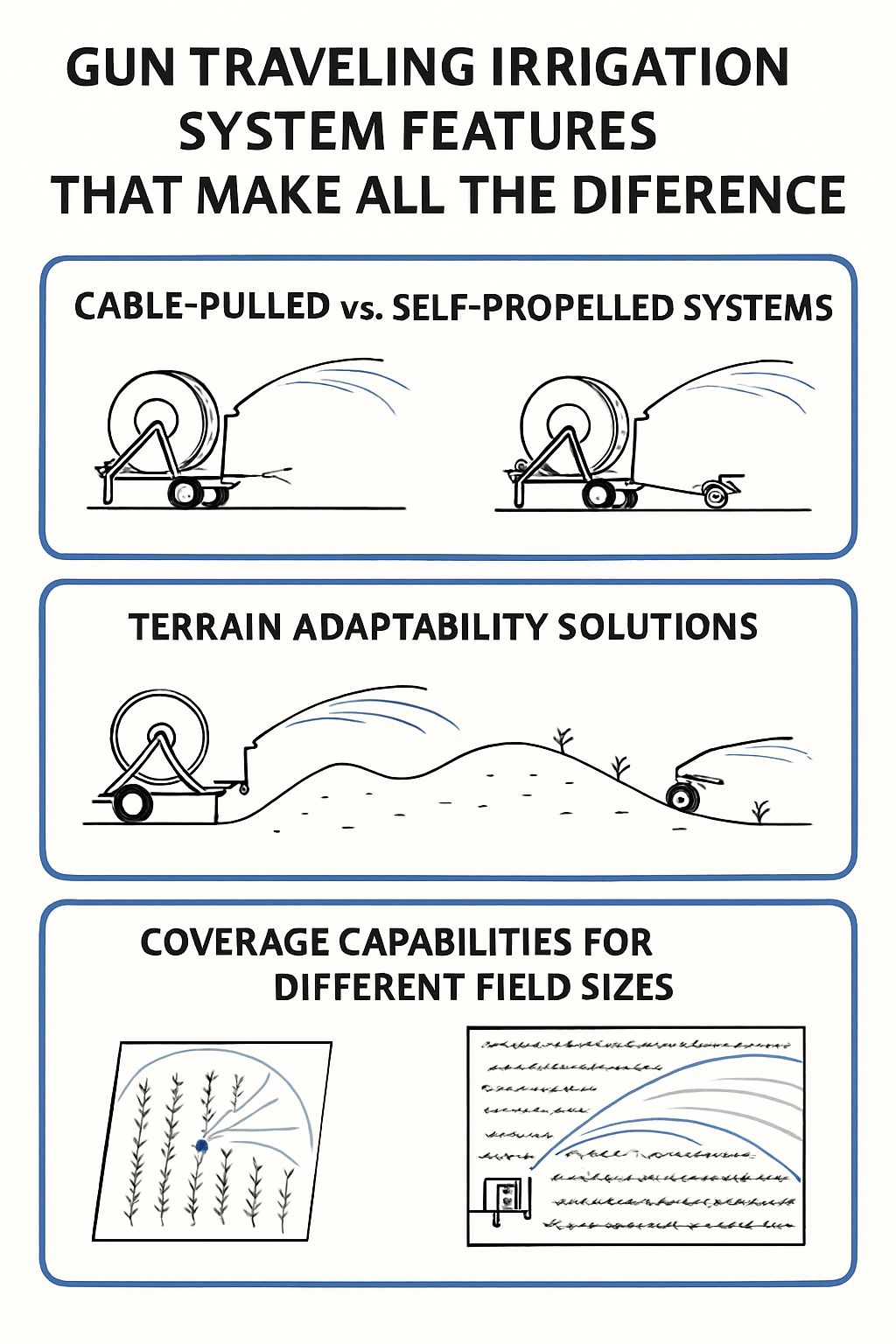
Traveling Features That Make All the Difference
The traveling mechanism is what truly distinguishes these irrigation systems from stationary alternatives. These components determine coverage patterns, operational efficiency, and labor requirements. Understanding the movement options helps match system capabilities to specific field requirements.
Cable-Pulled vs. Self-Propelled Systems
Cable-pulled systems use a stationary winch that gradually retracts a cable attached to the sprinkler cart, pulling it across the field. This design offers excellent speed control and uniform movement, particularly valuable for precision irrigation in specialty crops. Cable systems typically require less energy than self-propelled alternatives, extending operation time from limited solar power. However, they generally cover smaller areas per setup and require more frequent repositioning.
Self-propelled systems utilize a water turbine or electric motor that drives the wheels directly, moving the sprinkler cart without external pulling mechanisms. These units excel in larger fields where their autonomous operation minimizes repositioning requirements. Most self-propelled units include programmable speed controls that adjust travel rates based on soil type and infiltration capacity, ensuring optimal water absorption. The choice between these systems typically depends on field size, crop value, and available labor for system management.
Coverage Capabilities for Different Field Sizes
Coverage capability varies significantly between system designs and directly impacts irrigation efficiency and labor requirements. Small to medium traveling gun systems typically cover swaths 80-180 feet wide with run lengths of 400-800 feet per setup. This configuration efficiently handles 2-5 acre sections, making it ideal for specialty crop operations and smaller fields. Multiple setups can be completed daily to expand coverage area, though each repositioning requires operator intervention.
Larger systems extend coverage to 200-360 foot widths with run lengths up to 1,320 feet (quarter mile), covering 10-20 acres per setup. These larger units require more substantial solar arrays and pump capacity but minimize repositioning frequency. For irregularly shaped fields, traveling guns offer significant advantages over fixed systems, as their mobile design allows adaptation to field contours and boundaries that pivot systems cannot accommodate.
Terrain Adaptability Solutions
Modern traveling gun systems incorporate terrain adaptation features that maintain performance across variable field conditions. Oversized wheels with agricultural tread patterns provide traction in soft soils while minimizing compaction damage. Flexible wheel mounting systems automatically adjust to ground contours, maintaining stable operation even on rolling terrain with up to 15% grade variations.
Cost Analysis: Investment vs. Returns
Understanding the financial implications of solar irrigation requires examining both initial investment and long-term returns. While these systems represent a significant capital expenditure, their operational savings and productivity improvements typically deliver compelling return on investment. Careful analysis of costs and benefits helps determine financial viability for specific farm operations.
Initial Setup Expenses Breakdown
Complete solar traveling gun irrigation systems typically require investments ranging from $15,000-$65,000 depending on capacity, coverage area, and included features. Solar components (panels, mounting, batteries, and controllers) represent 40-50% of system cost, with irrigation components (pump, traveling gun, piping) comprising the remainder. Installation expenses vary considerably based on site conditions, water source development needs, and system complexity.
A midsized system serving approximately 20 acres breaks down as follows: solar panels and mounting ($8,000-12,000), batteries and electrical components ($5,000-9,000), pump and pressure system ($3,000-6,000), traveling gun apparatus ($5,000-12,000), and installation labor ($3,000-7,000). Additional expenses may include water source development, filtration systems for surface water, and remote monitoring capabilities.
Available Tax Incentives and Grants
Multiple financial incentives significantly reduce the effective cost of solar irrigation systems. The Federal Investment Tax Credit currently provides a 26% tax credit on total system cost, directly reducing tax liability. USDA’s Rural Energy for America Program (REAP) offers grants covering up to 25% of project costs and guaranteed loans for remaining expenses. Many states provide additional tax incentives, rebates, or low-interest financing for agricultural solar implementations.
Water conservation districts and environmental programs offer additional funding opportunities focused specifically on irrigation efficiency. These programs typically require documentation of water savings but can provide grants covering 30-50% of qualifying components. Combined incentives often reduce effective farmer investment by 50-70%, dramatically improving project economics and accelerating payback periods. For more information on improving irrigation systems, explore the integration of solar panels with sprinkler irrigation systems.
Payback Period Calculator
The payback period for solar irrigation systems depends on multiple factors including energy cost savings, labor reduction, yield improvements, and available incentives. Most properly designed systems achieve complete payback within 3-5 years, after which they generate positive cash flow for their 25+ year operational life. Calculating your specific payback requires analyzing current irrigation costs compared to projected savings while accounting for system maintenance.
A simplified calculation approach multiplies current annual irrigation energy costs by 0.6 (representing typical 60% savings) and adds labor savings (hours × wage rate) plus yield improvement value (increased yield × market price). Dividing total system cost (after incentives) by this annual savings figure provides an estimated payback period. More sophisticated analysis should include time value of money, system depreciation benefits, and potential carbon credit revenues.
Long-Term Maintenance Costs
Solar irrigation systems require minimal maintenance compared to conventional alternatives, typically averaging 2-4% of system cost annually. Solar components need little attention beyond occasional panel cleaning and battery system monitoring. Irrigation components require standard maintenance including nozzle inspection, lubrication of moving parts, and winterization in seasonal operations. Most systems include monitoring capabilities that identify maintenance needs before they impact performance.
Component longevity further enhances long-term economics. Quality solar panels maintain 80%+ efficiency for 25+ years, while batteries typically require replacement after 7-10 years. Pump systems generally need rebuilding or replacement after 8-12 years of regular use. These extended service intervals and declining replacement costs (particularly for solar components) continue improving system economics throughout its operational life. For more information on solar-powered systems, explore the benefits of solar-powered traveling gun irrigation systems.
Conclusion: When is it a Good Idea for a Farmer to Use a Solar-Powered Gun Irrigation Systems
Solar-powered traveling gun irrigation systems offer compelling advantages for many farming operations, but determining their suitability requires evaluating several key factors. These systems deliver maximum benefit for farms facing high energy costs, water limitations, labor challenges, or sustainability requirements. The technology proves particularly valuable in remote locations with limited grid access or for fields with irregular shapes that traditional pivot systems cannot efficiently serve. For most applications, the combination of operational savings, improved crop performance, and environmental benefits creates a compelling value proposition that justifies the initial investment. For more insights, explore the integration of solar panels with irrigation systems.
Frequently Asked Questions (FAQ)
How long do solar panels for irrigation systems typically last?
Quality solar panels used in agricultural applications maintain productive efficiency for 25-30 years, with manufacturers typically guaranteeing at least 80% of rated output after 25 years. This exceptional longevity dramatically improves lifetime economics compared to conventional power sources. Physical durability matches electrical performance, with modern panels withstanding severe weather including hail, high winds, and temperature extremes. For more insights on solar-powered irrigation, explore different types and examples of solar-powered irrigation systems.
The actual degradation rate averages only 0.5-0.7% annually, meaning a properly maintained system will still deliver 80-85% of its original power output after 25 years of continuous operation. This gradual decline rarely impacts irrigation performance, as most systems are initially oversized to ensure adequate power during less-than-optimal conditions.
Component longevity varies within the system. While panels maintain exceptional service life, batteries typically require replacement after 7-10 years depending on cycle frequency and depth of discharge. Charge controllers and inverters generally operate effectively for 10-15 years before replacement becomes necessary.
|
Component |
Expected Lifespan |
Maintenance Requirements |
|---|---|---|
|
Solar Panels |
25-30 years |
Occasional cleaning, annual connection check |
|
Batteries (Lithium) |
7-10 years |
Monitoring system health, terminal cleaning |
|
Batteries (Lead-Acid) |
3-5 years |
Regular fluid checks, terminal cleaning |
|
Charge Controllers |
10-15 years |
Annual inspection, cooling system cleaning |
|
Irrigation Pump |
8-12 years |
Seal replacement, bearing lubrication |
|
Traveling Gun |
15-20 years |
Nozzle inspection, gear lubrication |
This exceptional longevity creates significant advantages in lifecycle cost analysis compared to fossil fuel alternatives requiring frequent engine rebuilds or electrical systems vulnerable to grid rate increases. When calculating return on investment, this extended service life should be factored into financial projections.
Can solar-powered gun irrigation systems work at night?
Solar irrigation systems with battery storage can operate effectively at night, and in many situations, nighttime irrigation offers significant advantages. Battery systems store excess energy generated during daylight hours, powering pumps after sunset when evaporation losses are minimized and wind interference is typically reduced. Modern battery systems provide sufficient capacity for 4-8 hours of continuous nighttime operation, depending on system sizing and irrigation requirements. For many crops, nighttime irrigation improves water efficiency by 15-20% compared to daytime application, enhancing the overall system benefits.
What maintenance is required for these systems?
Maintenance requirements for solar traveling gun irrigation systems are substantially lower than conventional alternatives, contributing to their operational advantages. Solar components need minimal attention, with panel cleaning recommended 2-4 times annually depending on local dust conditions. Battery systems require regular monitoring of charge levels and connection integrity, particularly in seasonal operations where systems may sit idle for extended periods.
Irrigation components follow standard maintenance protocols similar to conventional systems, though typically with longer service intervals due to reduced operating hours and controlled start/stop cycles that minimize wear. For more insights on optimizing these systems, explore different types of solar-powered irrigation systems. Regular inspection points include:
- Nozzle condition and spray pattern uniformity
- Traveling mechanism lubrication and cable/drive condition
- Pump seals, bearings, and pressure performance
- Filter cleaning for surface water applications
- Control system calibration and sensor function
Most maintenance can be performed by farm personnel without specialized training, though annual professional inspection is recommended to ensure optimal system performance and identify potential issues before they impact operation. Many suppliers offer maintenance packages that include regular inspection, component replacement, and technical support throughout the growing season.
Are there minimum acreage requirements for solar gun systems?
Solar traveling gun systems can be economically viable for operations as small as 3-5 acres, particularly for high-value crops where precision irrigation significantly impacts quality and yield. Smaller systems (typically using 3-5kW solar arrays) provide adequate power for irrigation needs while maintaining reasonable equipment costs. These compact systems offer particular advantages for specialty crop producers, organic operations, and diversified farms where multiple crops with different irrigation requirements share limited acreage.
For broader-scale commodity production, systems serving 20+ acres typically provide optimal economics through equipment utilization efficiency. Multiple smaller fields can be served by a single traveling system that relocates between areas, maximizing investment return while maintaining irrigation precision. The modular nature of solar components allows system expansion as operations grow, protecting initial investments while accommodating changing farm needs. Learn more about different solar-powered irrigation systems and how they can benefit your farm.
How do these systems perform in winter or low-light regions?
Solar irrigation performance in low-light regions depends on system design and seasonal requirements. In northern climates where irrigation primarily occurs during summer months, longer daylight hours offset lower solar intensity, often providing adequate energy generation. Properly sized systems in regions like the Upper Midwest or Northeast typically generate 70-80% of the energy produced by identical systems in sunnier southern regions during peak growing seasons.
For year-round operations in low-light environments, increased solar capacity and battery storage compensate for reduced generation. Panel arrays 20-30% larger than those required in optimal solar regions ensure sufficient energy production, while expanded battery capacity bridges longer low-generation periods. Tracking mounts that follow the sun’s path provide significant advantages in these regions, increasing daily energy capture by 25-40% compared to fixed installations. For more insights, consider exploring the benefits of bifacial solar panels in farming.
Hybrid systems represent another effective solution for year-round operations in challenging climates. These configurations combine solar generation with backup power sources (typically grid connection where available or small generators where not) to ensure reliable operation during extended cloudy periods. Advanced control systems automatically manage power sourcing to prioritize solar generation while maintaining irrigation reliability regardless of weather conditions.

Leave a Reply